ICD-10 Code S42.444P: Medial epicondyle fracture, right humerus
ICD-10 Code S42.444P: full descriptor and code validity ICD-10 Code S42.444P car...

Last Updated: Oct 13, 2026
Billable Code Specific Code
M32.0 is the billable ICD-10-CM code for drug-induced systemic lupus erythematosus.
The code applies only to lupus triggered by a named medication, so idiopathic SLE is classified elsewhere in M32. A T36-T50 adverse-effect code identifying that drug must accompany M32.0 on the claim. Payers routinely reject claims that carry the code on its own.
Let Pabau's smart automation suggest the right codes, reduce claim denials, and keep your practice compliant—effortlessly.
Automate repetitive tasks and focus on what matters most—your patients.
Reduce coding errors and ensure compliance with the latest regulations.
Clean claims, fewer denials, and faster reimbursements.
Powerful insights and reporting to help your practice thrive.
HIPAA compliant SOC 2 certified GDPR-compliant Trusted by 4,000+ clinics worldwide

M32.0 covers drug-induced SLE only, so idiopathic lupus codes to M32.9 or an M32.1x subcategory.
A T36-T50 adverse-effect code with fifth or sixth character 5 must accompany M32.0 on the claim.
Sequence M32.0 first as the condition manifested, then the T-code that identifies the causative drug.
The physician has to state the diagnosis and name the drug, because a coder cannot infer either one.
Claims management software like Pabau flags an incomplete code pair before the claim is submitted.
ICD-10 code M32.0 is the billable ICD-10-CM code for drug-induced systemic lupus erythematosus, valid for fiscal year 2026. It applies only where the physician has named the medication that caused the lupus. Every claim carrying it also needs a T36-T50 adverse-effect code for that drug. The table below holds the reference data coders need before assigning it. The full ICD-10-CM code reference is the place to check a neighboring code.
M32.0 covers drug-induced systemic lupus erythematosus only. Idiopathic (primary) SLE belongs elsewhere in M32. The clinical distinction that matters to coders is the documented causative medication, and without one in the physician’s notes the code cannot be assigned. The WHO ICD-10 browser classifies lupus erythematosus within the systemic connective tissue disorders block, matching the ICD-10-CM placement in M30-M36.
Drug-induced lupus erythematosus (DILE) develops when a medication triggers an autoimmune response that mimics idiopathic SLE. It typically resolves or substantially improves after the causative drug is discontinued. Clinical markers often include ANA positivity, arthralgia, serositis, and rash. ANA positivity on its own does not justify M32.0, because the diagnosis has to be documented explicitly by the treating physician.
The drug classes most commonly associated with DILE, per rheumatology clinical consensus, include:
The specific drug has to appear in the medical record. That entry is a coding requirement for M32.0, and it determines which T-code accompanies the claim.
The tabular instructional note under M32.0 states: “Use additional code for adverse effect, if applicable, to identify drug (T36-T50 with fifth or sixth character 5).” The instruction is mandatory rather than advisory. Per the CDC/NCHS ICD-10-CM coding tool, the adverse effect T-code must identify the specific drug class responsible for the DILE presentation.
Claims submitted with M32.0 alone fail the edit check at the clearinghouse or payer level. Catching the incomplete pair before submission is the single biggest lever on this code’s denial rate.
Important: The T-code ranges above are illustrative. Always verify the exact 6th and 7th characters against the current ICD-10-CM tabular list for the specific drug documented by the physician. The 7th character encodes encounter type: A (initial), D (subsequent), S (sequela).
ICD-10-CM Official Guidelines Section I.C.19.e govern adverse effects. When a correctly prescribed medication causes an adverse reaction, code the condition manifested first, then the adverse effect T-code. For M32.0, this means:
M32.0 can function as the principal diagnosis when drug-induced lupus is the main reason for the encounter. It becomes a secondary code when the visit is primarily for the causative drug’s underlying indication. A cardiology visit for the arrhythmia that procainamide treats is one example, with DILE noted as a complication rather than the focus.
Following that code pair from the physician’s note through to adjudication shows where an M32.0 claim actually breaks down.
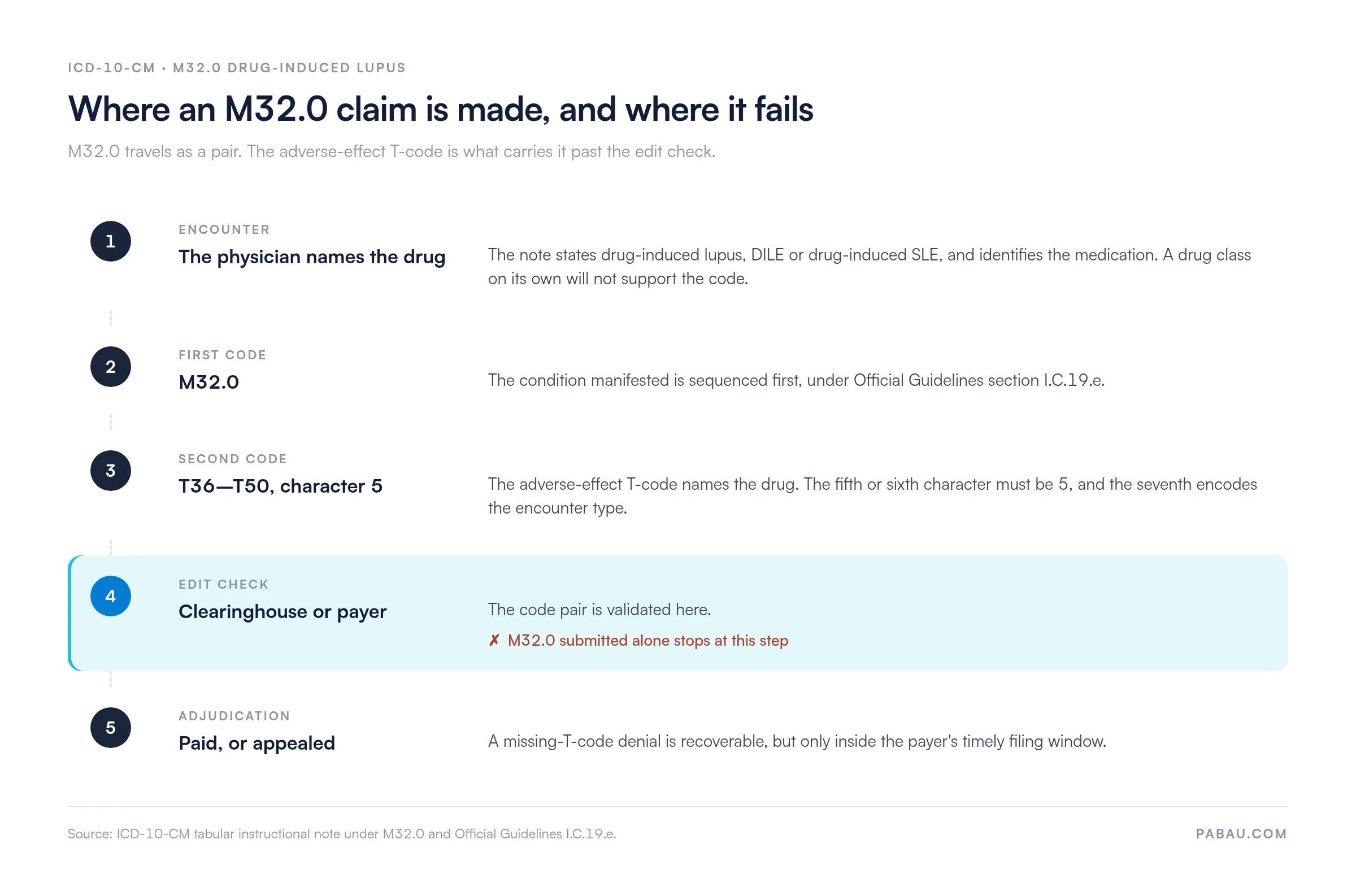
M32.0 and M32.9 are the two codes coders most frequently confuse. M32.9 is systemic lupus erythematosus, unspecified, and it covers idiopathic SLE where no organ involvement or drug cause is documented. Assigning M32.0 when the physician has not documented a causative drug is an upcoding error. Assigning M32.9 when a drug cause is clearly documented misses a specificity requirement. The AAPC ICD-10-CM code lookup provides descriptor detail for the full M32 subcategory set.
M32 carries a single Excludes1 note, and it restricts which codes can be reported together. Reading it before submission prevents the rejections that follow an invalid code pairing.
When documentation describes ‘lupus rash’ or ‘lupus-like syndrome’ without stating systemic involvement or naming the causative drug, query the treating physician before assigning M32.0. Coding to M32.9 pending clarification is safer than assigning M32.0 and risking an unsupported claim. That matters most on claims tied to biologic therapy authorization.
Documentation requirements for M32.0 are stricter than for M32.9, because the code carries a mandatory additional-code instruction. The medical record must contain specific elements before a coder can assign it. Causality inferred from drug timing alone does not meet the standard, and the treating physician has to draw the clinical conclusion.
Required documentation elements for M32.0:
Ambiguous documentation is a query, not a judgment call. Where a note states “possible drug-induced lupus” or “lupus, rule out drug cause,” the coder should query the physician rather than assign M32.0. ICD-10-CM guidelines allow coding of “possible” or “probable” diagnoses for inpatient settings but not for outpatient encounters.
M32.0 payer requirements vary by coverage type and by the treatment being authorized. The code itself does not trigger a universal prior authorization requirement. The treatments used to manage DILE often do, particularly biologics such as belimumab and corticosteroids for severe presentations. That holds across both Medicare Advantage and commercial plans.
Medicare coverage context:
M32.0 denials cluster around a small set of avoidable errors, and most of them originate at code-pair validation or documentation review. The table below maps the most common denial triggers to the action that prevents each one.
Practices with high rheumatology claim volumes should review their denial workflow for SLE codes specifically. M32.0 denials that go unappealed inside the payer’s timely filing window become write-offs. A structured appeal process recovers most missing-T-code denials, because the supporting documentation is usually already in the record and the error was a submission omission.
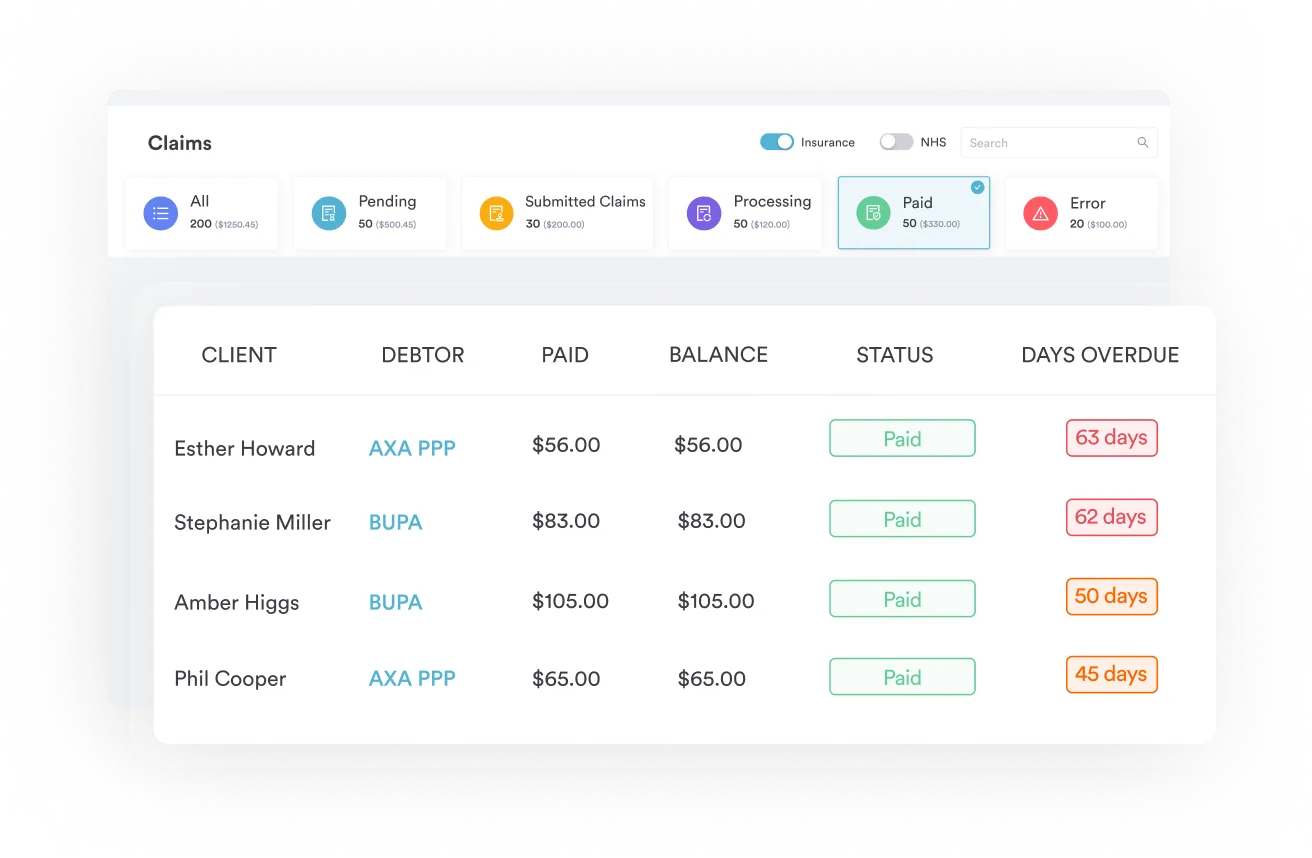
In a lot of rheumatology practices, a missing T-code surfaces only when the remittance comes back. The claim is reworked, resubmitted, and paid weeks later. The loop does not prevent the same omission on the next DILE encounter. The correction lives in one biller’s head rather than in the billing system.
Pabau, our practice management software, handles claims management for rheumatology practices from charge capture through to remittance. Code pairs are checked before the claim leaves the practice. An M32.0 without its accompanying T36-T50 code is flagged at the point of billing, not by the payer.
The clinical documentation sits in the same record. The physician’s statement naming the causative drug is captured in the note your coder reads, which shortens the query loop between billing and clinical staff. Denials and their appeal deadlines are tracked in one place, so a recoverable M32.0 rejection does not age quietly into a write-off.

Pabau’s claims management workflow flags incomplete ICD-10 code pairs at point of billing. Rheumatology teams submit cleaner claims and spend less time on denial follow-up.

Two requirements decide whether an M32.0 claim is paid. The physician has to document the drug that caused the lupus, and the claim has to carry the matching adverse-effect T-code. Build both into the billing workflow and this code stops generating denials.
The trade-off worth remembering is specificity against support. M32.9 is the safer assignment while the note is ambiguous. A physician query costs far less than an unsupported M32.0 claim on a biologic authorization. Book a demo to see how Pabau checks M32.0 code pairs before your claims reach the payer.

Need guidance on autoimmune disease billing compliance? Medical billing compliance guidance covers the documentation standards that prevent claim rejections across complex diagnoses.
Coding the skin-limited presentation instead? ICD-10 code L93.0 covers discoid lupus, the code the M32.0 Excludes1 note rules out.
Handling a high volume of denial codes? Denial codes in medical billing explains CARC codes and how to structure appeals for common rejection types.
Want to understand the clearinghouse submission process? Medical claims clearinghouse explains how claims flow from the practice to the payer and where ICD-10 code validation occurs.
ICD-10 code M32.0 is the billable ICD-10-CM diagnosis code for drug-induced systemic lupus erythematosus, a physician-documented autoimmune condition caused by a specific named medication. It sits within the M32 (Systemic lupus erythematosus) category of the M30-M36 systemic connective tissue disorders block and is valid for FY 2026. A mandatory adverse-effect T-code must accompany every M32.0 claim.
M32.0 is for drug-induced SLE only; a named causative drug must be documented and a T-code is required. M32.9 is for systemic lupus erythematosus, unspecified – used when idiopathic SLE is documented without a specific organ system involvement or drug cause. Assigning M32.0 when no drug cause is documented is an upcoding error.
Yes. The ICD-10-CM tabular instructional note under M32.0 mandates an additional code to identify the causative drug. That is a T36-T50 adverse-effect code with 5th or 6th character 5. Submitting M32.0 without this T-code is the single most common reason for claim denial on this diagnosis.
Lupus nephritis is captured in the M32.1x subcategory. M32.14 covers glomerular disease in SLE (lupus nephritis), while M32.10 covers organ or system involvement, unspecified. These are distinct from M32.0 and do not require an accompanying T-code unless the nephritis itself is documented as drug-induced.
Four causes account for most of them. The first is a missing T-code for the causative drug. The second is a T-code with the wrong 5th or 6th character, which must be 5 for an adverse effect. The third is M32.0 assigned without an explicit physician diagnosis of drug-induced lupus. The fourth is an invalid combination of M32.0 with L93.0, which violates the Excludes1 note. Most denials are recoverable through appeal when the clinical documentation supports the code.
Yes. M32.0 can be the principal diagnosis when drug-induced lupus erythematosus is the primary reason for the encounter. Per ICD-10-CM adverse effect sequencing rules, M32.0 is coded first, followed by the T-code identifying the causative drug. It becomes a secondary code only when the encounter is primarily for a different condition and DILE is documented as a complication.