ICD-10 Code S42.444P: Medial epicondyle fracture, right humerus
ICD-10 Code S42.444P: full descriptor and code validity ICD-10 Code S42.444P car...

Last Updated: Oct 13, 2026
Billable Code Specific Code
M06.1 is the billable ICD-10-CM code for adult-onset Still's disease.
A patient comes in with a spiking fever, a fading pink rash, and joints that will not calm down, and adult-onset Still's disease is what the physician writes on the chart. That diagnosis is easy to code wrong, because M06.1 sits right next to several more familiar rheumatoid arthritis codes in the M06 family, and reaching for the wrong neighbor is exactly what turns a clean claim into a denial.
ICD-10 code M06.1 is the specific, billable code for that diagnosis, and getting it right starts with knowing exactly what it covers and what the documentation needs to show to support it.
Let Pabau's smart automation suggest the right codes, reduce claim denials, and keep your practice compliant—effortlessly.
Automate repetitive tasks and focus on what matters most—your patients.
Reduce coding errors and ensure compliance with the latest regulations.
Clean claims, fewer denials, and faster reimbursements.
Powerful insights and reporting to help your practice thrive.
HIPAA compliant SOC 2 certified GDPR-compliant Trusted by 4,000+ clinics worldwide

ICD-10 code M06.1 is the billable ICD-10-CM code for Adult-onset Still’s disease (AOSD), a rare systemic autoinflammatory disorder.
M06.1 is valid for fiscal year 2026 HIPAA-covered transactions, with an effective date of October 1, 2025.
Accurate assignment requires documented clinical confirmation of AOSD including quotidian fever, evanescent rash, and arthritis, with other arthropathies excluded.
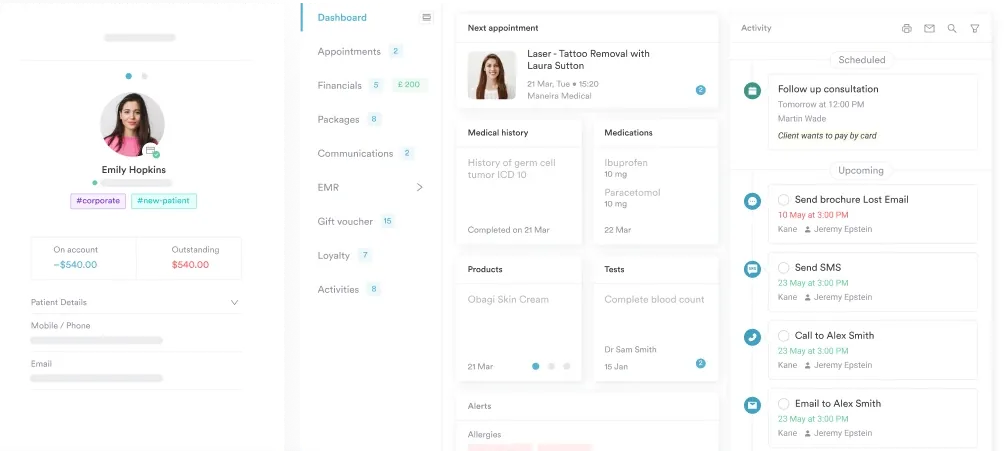
Pabau’s claims management software embeds ICD-10 code search directly within the clinical charting workflow, reducing manual re-entry errors.
The code is maintained jointly by the Centers for Medicare and Medicaid Services (CMS) and the National Center for Health Statistics (NCHS). For reference, the table below gives the essential facts for this code.
Adult-onset Still’s disease (AOSD) is a rare systemic autoinflammatory disorder that primarily affects adults, typically presenting between ages 16 and 35. Because it mimics several other conditions, it is frequently a diagnosis of exclusion, meaning coders need a confirmed physician diagnosis before assigning M06.1.
The condition is defined by a clinical triad. According to a Frontiers in Medicine review, the hallmark features are:
In addition to the triad, other systemic features may include lymphadenopathy, splenomegaly, serositis, and elevated ferritin levels. Ferritin is often dramatically elevated in active AOSD, a finding that supports the diagnosis when combined with the clinical triad. Because no single diagnostic test confirms AOSD, the Yamaguchi criteria are widely used by rheumatologists as a structured diagnostic framework. Checking insurance eligibility before the visit catches terminated coverage while the appointment can still be rescheduled. A billing workflow that separates coding from submission creates a handoff where claims stall.
For coding purposes, what matters is that the attending physician has documented a confirmed AOSD diagnosis. Coders should not infer AOSD from symptoms alone. Instead.
Understanding where M06.1 sits within the ICD-10-CM hierarchy helps coders navigate the broader rheumatology code family and select the correct code when AOSD is one of several diagnoses being documented.
The M05-M14 block covers inflammatory polyarthropathies, which sets these conditions apart from degenerative arthropathies. Within that block, M06 groups conditions that do not fit neatly into the seropositive rheumatoid arthritis category (M05). In turn, M06.1 is one of the more specific subcodes in the M06 family, marking a well-defined clinical entity rather than a catch-all.
Practices managing patients with complex inflammatory conditions can reference the CDC/NCHS ICD-10-CM web tool to confirm the current hierarchy and any annual updates. Ultimately, the official tabular list is the trusted source for hierarchy verification.
Chiropractors work with these codes constantly, and chiropractic software keeps adjustments, plans, and progress in one record.
M06.1 is a billable and specific ICD-10-CM code. That means it can be submitted directly on claims without requiring a more specific subcategory code. Consequently, payers accept it as a complete diagnosis indicator for AOSD in HIPAA-covered electronic transactions. Injury codes behave differently. A tibia fracture code such as S82.222E stays unbillable until its seventh character records encounter type, open fracture grade, and healing status.
A code’s HIPAA validity confirms it meets the standards set under the Administrative Simplification provisions of the Health Insurance Portability and Accountability Act (HIPAA) for use in standard electronic claim transactions. As a rule.

Code validity resets on October 1 each year with the annual ICD-10-CM update cycle. Because of this, coders should verify that any code used for dates of service after October 1 reflects the new edition. Ideally.
ICD-10-CM recognizes several alternate terms that map to M06.1. When the physician’s documentation uses any of the following terms, the correct code assignment is M06.1, provided the diagnosis meets the clinical criteria for adult-onset Still’s disease.
The apostrophe variant (“Still’s” versus “Stills”) is common in EHR search fields. Both forms map to the same code. However, coders should confirm they are not selecting a juvenile idiopathic arthritis code by mistake when the patient is an adult. Specifically, juvenile-onset Still’s disease maps to a separate code under the M08 category, not to M06.1.
For thorough synonym verification across the full rheumatology ICD-10 code set, the AAPC Codify ICD-10-CM lookup includes a clinical synonyms section for each code. As a result, cross-referencing that list during chart audits reduces the risk of miscoded encounters.

Pabau integrates ICD-10 code search directly within your clinical workflow, so coders and clinicians assign diagnosis codes during charting without switching to a separate lookup tool. Accurate documentation from the first encounter reduces claim rework.

M06.1 carries its own Excludes1 notation. The M06 category itself carries no Excludes1 or Excludes2 note of its own. Instead, the exclusion applies specifically at the M06.1 subcode level.
Excludes1 means the excluded condition cannot be coded at the same time as M06.1.
The most clinically important exclusion error in practice is coding juvenile-onset Still’s disease under M06.1. Whenever a patient’s record references childhood onset or pediatric diagnosis, verify with the physician whether M06.1 or a code from the M08 family is appropriate. In the end, the physician’s documented intent drives that determination.
M06.1 sits alongside several sibling codes within the M06 category. For quick reference, this table gives coders an overview of the full M06 family to support accurate selection when AOSD is suspected but not confirmed, or when another specific arthropathy is the diagnosis.
The most common coding error is defaulting to M06.9 (rheumatoid arthritis, unspecified) when the physician has documented a specific AOSD diagnosis. M06.9 is appropriate only when the rheumatoid arthritis cannot be further specified. When documentation confirms adult-onset Still’s disease, however, M06.1 is the correct and more accurate choice.
For broader context on rheumatology coding, the ResDAC Medicare data resource explains how ICD-10-CM codes function within Medicare claims and research datasets.
Because AOSD is a diagnosis of exclusion, the documentation burden is higher than for many other arthropathy codes. Accordingly, claim reviewers and auditors look for specific clinical elements before accepting M06.1 as a supported diagnosis code.
The following elements should appear in the medical record to support assignment of ICD-10 code M06.1:
For that reason, structured clinical documentation tools make this workflow more consistent. When rheumatologists and integrative medicine practitioners use a charting system that prompts for key diagnostic criteria, the documentation supporting M06.1 is captured at the point of care rather than reconstructed after the fact.
In turn, Pabau’s clinical record features support structured charting that captures these elements consistently, reducing the missing documentation that causes claim denials for complex systemic inflammatory diagnoses.
Run a quarterly audit on claims submitted with M06.1. Pull encounters where M06.9 was coded instead and review whether the physician documented AOSD. Catching those downcode patterns early reduces revenue leakage from unnecessarily unspecified diagnoses.
ICD-10-CM codes follow an annual update cycle managed by the ICD-10-CM Coordination and Maintenance Committee, with CMS and NCHS as co-chairs. Notably, new code editions take effect on October 1 of each year.
M06.1 has maintained stable billable status across recent fiscal years with no description changes or code changes. Nonetheless, coders working with retrospective claims should always match the code edition to the date of service, not the date of billing.
Submitting a code from the wrong fiscal year edition, even when the code number itself has not changed, can trigger edit errors in some payer systems.
Miscoding AOSD as M06.9 (unspecified) is the single most common revenue loss point for rheumatology and physical therapy practices billing this condition. When the physician has documented adult-onset Still’s disease, M06.1 is the correct, specific code, and the documentation to support it is well-defined.
Ultimately, Pabau’s digital forms and structured charting help rheumatology and integrative medicine practices capture the diagnostic criteria that support M06.1 assignment at the point of care, reducing denial rates for complex inflammatory diagnoses. To see how Pabau handles clinical documentation for systemic inflammatory conditions, book a demo with our team.

Coding a different musculoskeletal diagnosis? Our guide to M95.4 covers billable status and documentation requirements.
Need a refresher on a different ICD-10-CM code? Our guide to L26 covers billable status and recordkeeping requirements.
Billing a related procedure? Our guide to CPT 76801 covers billing and documentation requirements.
ICD-10 code M06.1 is the billable ICD-10-CM diagnosis code for adult-onset Still’s disease (AOSD), a rare systemic autoinflammatory disorder marked by high spiking fever, evanescent salmon-colored rash, and arthritis. In particular, it sits within the M06 category (Other rheumatoid arthritis) under the broader M05-M14 inflammatory polyarthropathies block.
Yes. M06.1 is a billable and specific ICD-10-CM code, meaning it can be submitted directly on claims for HIPAA-covered transactions without requiring a more detailed subcategory code. In addition, it is valid for fiscal year 2026, with the current edition effective from October 1, 2025.
M06.1 is specific to adult-onset Still’s disease, while M06.9 covers rheumatoid arthritis, unspecified. When a physician has confirmed an AOSD diagnosis, M06.1 is the correct code. As a result, using M06.9 in that situation is a downcode that may reduce specificity and can complicate payer reviews for a complex systemic inflammatory condition.
Juvenile-onset Still’s disease maps to codes within the M08 category (Juvenile arthritis), not to M06.1. In other words, M06.1 applies only to adult-onset Still’s disease. If a patient was diagnosed in childhood and continues treatment as an adult, the appropriate code depends on what the treating physician documents about onset classification.
The FY 2026 edition of ICD-10-CM code M06.1 became effective on October 1, 2025. Therefore, coders submitting claims for dates of service on or after that date should use the FY 2026 edition. For retrospective claims with earlier dates of service, match the code edition to the applicable fiscal year.
Accurate M06.1 assignment requires a physician-confirmed diagnosis of adult-onset Still’s disease with documented clinical criteria, typically the Yamaguchi criteria, plus exclusion of infection, malignancy, and other rheumatic conditions. Also, laboratory findings such as markedly elevated ferritin and leukocytosis should be referenced in the clinical note to support the diagnosis and code selection.