



ICD-10 Code S42.444P: Medial epicondyle fracture, right humerus
ICD-10 Code S42.444P: full descriptor and code validity ICD-10 Code S42.444P car...

Last Updated: Oct 13, 2026
ICD-10 code L00 is the billable diagnosis code for staphylococcal scalded skin syndrome. It covers an exfoliative skin disorder caused by toxin-producing Staphylococcus aureus, which predominantly affects neonates and young children.
Coders frequently confuse L00 with toxic epidermal necrolysis (L51.2), because both conditions cause widespread skin separation. The two are mutually exclusive under an Excludes1 note, so they can never be coded together. Missing the mandatory additional organism code, or assigning L51.2 instead of L00, are the two most common reasons claims for this condition are denied.

L00 covers staphylococcal scalded skin syndrome, with Ritter disease as its one included term.
Pemphigus neonatorum is excluded from L00 under an Excludes1 note and codes to L01.03, bullous impetigo.
An additional B95 code (B95.61 for MSSA or B95.62 for MRSA) is mandatory alongside L00 per the tabular instructional note.
Toxic epidermal necrolysis (L51.2) is excluded from L00 via an Excludes1 note and can never be coded together with it.
Pabau’s claims management software flags missing organism codes before submission, reducing L00-related claim denials.
ICD-10 code L00 is the official ICD-10-CM code for staphylococcal scalded skin syndrome. It sits within Chapter 12 (Diseases of the skin and subcutaneous tissue, L00-L99). Within that chapter it belongs to the L00-L08 block, which covers infections of the skin and subcutaneous tissue. According to the CDC/NCHS ICD-10-CM web tool, L00 carries full billable status and can be used on both inpatient and outpatient claims.
L00 has no subcategory codes. The code is complete as written, and no 4th or 5th character extension is required. For the most current lookup, coders should verify against the official CMS annual tabular release and any mid-year addenda.
Staphylococcal scalded skin syndrome is a toxin-mediated exfoliative skin disorder. It is caused by exfoliative toxins (ET-A and ET-B) produced by certain strains of Staphylococcus aureus. The toxins cleave desmoglein-1, the protein that holds the upper layers of the skin together. Sheets of superficial epidermis then separate without the deeper dermis being involved, which is the key clinical distinction from toxic epidermal necrolysis.
The condition predominantly affects neonates, infants, and children under five years of age. Adult presentations occur but are rare, almost exclusively in patients with renal impairment (which reduces toxin clearance) or immunosuppression. Knowing the patient population matters for coding accuracy. Documentation of age and immune status directly supports medical necessity for the assigned diagnosis.
For coding purposes, the critical clinical fact is that skin detachment in SSSS is superficial and spares the dermis. That is both the physiological basis of L00 and the key differentiator from L51.2 when reviewing the clinical note. Accurate documentation of this distinction by the treating physician is what allows the coder to assign L00 confidently.
Ritter disease is the same condition as staphylococcal scalded skin syndrome. The name refers to the neonatal presentation, first described by Gottfried Ritter von Rittershain. The ICD-10-CM Tabular List carries it as the one included term under L00, so no separate code exists for it.
Pemphigus neonatorum is handled differently, and this is where coders most often go wrong. It appears under the Excludes1 note at L00, not among the included terms. A note documenting pemphigus neonatorum codes to L01.03, bullous impetigo, and never to L00.
A coder who searches for “Ritter disease” in an encoder should be routed to L00. If the encoder returns no result or a different code, verify against the official WHO ICD-10 browser. The included-term relationship means a note documenting “Ritter disease of the newborn” is coded exactly like one documenting “staphylococcal scalded skin syndrome”. No query to the physician is needed for that wording alone.
The ICD-10-CM Tabular List places two sets of instructional notes at the L00 code entry that coders must apply before assigning the code. Missing either note is the root cause of most L00 claim denials.
L00 carries a “Use additional code” instruction to identify the infectious agent. This note is mandatory, not optional. The organism code is selected from the B95-B97 range. For the most common SSSS scenario:
Verify the exact B95 codes against the current CMS tabular before assigning. The MSSA and MRSA codes (B95.61, B95.62) are well established. Susceptibility status still has to be confirmed by culture results documented in the clinical note before you select between them.
Toxic epidermal necrolysis (L51.2) appears under an Excludes1 note at L00, alongside pemphigus neonatorum. An Excludes1 note means the excluded code can never be used at the same time as L00 on the same claim. If the clinical note documents TEN, code L51.2, not L00. Assigning both on the same encounter is a coding error regardless of payer.
When the clinical note says ‘scalded skin appearance’ without specifying the etiology, query the physician before coding. SSSS (L00) requires confirmed staphylococcal origin, while TEN (L51.2) is typically drug-induced. The distinction is clinical, not a coder judgment call.
Three conditions cause most of the confusion for coders working with exfoliative and blistering skin disorders. The panel below shows which findings in the note route to which code, and the full comparison follows it.
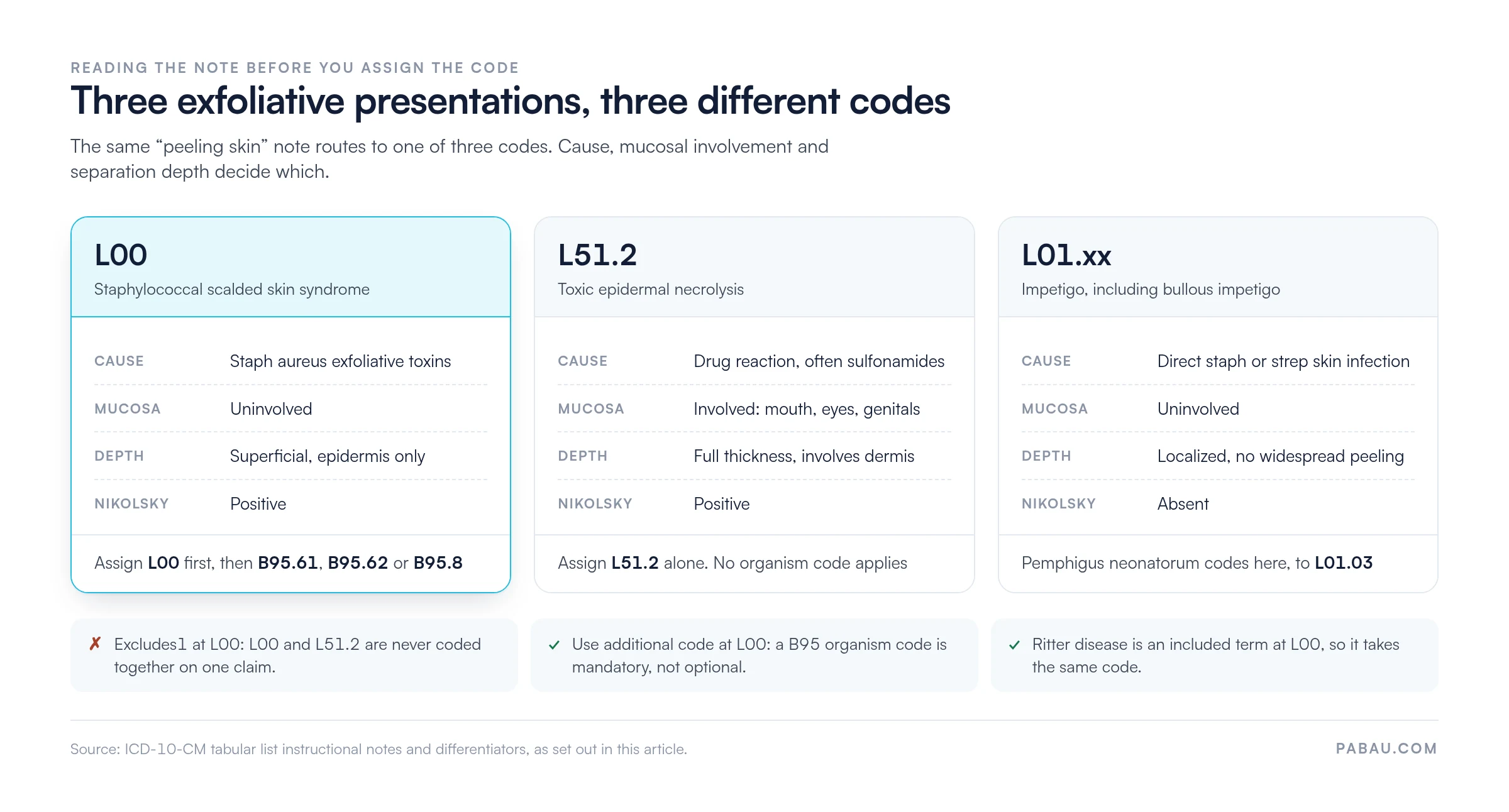
The practical differentiator between L00 and L51.2 during chart review is mucous membrane involvement and drug history. TEN involves the mouth, eyes, and genitals, while SSSS does not. If the physician’s note documents mucosal erosions, the code is L51.2. Cross-referencing guidance for these exclusion relationships is available through the AAPC Codify ICD-10-CM lookup.
The “Use additional code” instruction under L00 is a sequencing rule, not a reminder. Submitting L00 without the corresponding B95 organism code will cause the claim to fail medical necessity review at payers that audit ICD-10-CM instructional compliance.
The organism code matters beyond compliance. It affects clinical documentation completeness, infection control reporting, and, in inpatient settings, potential CC/MCC status for DRG assignment. A practice running software that validates claims can flag missing secondary codes on skin infection diagnoses before submission. That stops the denial at its source.
A clinical note that supports L00 must give the coder enough specificity to confirm both the diagnosis and the organism. Most L00 denials trace back to a note that stopped short of one of those two, rather than to the code selection itself.
Following medical billing compliance requirements, the documentation checklist for L00 includes:
If any of these elements are absent, the coder should query the physician before assigning L00. Assumptions about organism identity or diagnosis name are not permitted under ICD-10-CM official guidelines.
Denials on L00 claims fall into four consistent patterns. Each has a defined corrective action that can be built into the pre-submission workflow.
Building a claim edit that requires a B95 code whenever L00 is present removes the most common failure point. Tracking which preventable denial codes keep returning shows whether the fault sits in the code pair, the sequencing, or the clinical note. Practice management software like Pabau applies those edits while the note is written, so the pair is complete before the claim file is built.
SSSS requires inpatient admission in most pediatric presentations, because of the extent of skin involvement, fluid management needs, and IV antibiotic requirements. Inpatient claims with L00 as the principal diagnosis group to DRG 595 or 596 in the CMS MS-DRG grouper. Those are major skin disorders with and without MCC. Which of the two applies depends on whether documented complications or comorbidities meet CC/MCC criteria, so verify against the current IPPS final rule.
Electronic remittance advice carries the denial reason in coded form, which lets revenue cycle staff triage L00 rejections quickly. CARC codes on the remittance identify whether the rejection was a medical necessity issue, a coding edit failure, or a coverage exclusion. That narrows the correction without a call to the payer.
For adult SSSS presentations, document renal function status and immunosuppression explicitly in the admitting note. These comorbidities provide the clinical rationale for inpatient admission and support medical necessity review. Without them, commercial payers may flag the admission as not meeting criteria.
L00 is valid for FY2026 ICD-10-CM coding. The code descriptor, instructional notes, and included terms are unchanged in the most recent tabular release reviewed at publication. The code has remained stable across multiple fiscal years without revision. Coders should still verify currency against the official CMS release, as mid-year addenda occasionally affect adjacent L-chapter codes.
For ongoing FY2026 verification, bookmark the CMS ICD-10 codes page. It publishes both the annual tabular release and any addenda effective April 1 and October 1. Tabular changes often ripple across related codes in the L00-L08 block, so check the neighboring codes when L00 itself comes back unchanged.
Accurate L00 coding depends on three steps holding every time. The physician has to document the right diagnostic language. The coder then captures the mandatory B95 secondary code. Finally the claim clears without a code-edit rejection. Pabau’s practice management and EHR platform supports all three for dermatology and skin practice workflows.
Skin practices handle a mix of dermatology coding across the L00-L99 chapter. One workflow keeps the clinical note and the submitted claim in step. The coder works from the note the physician wrote, and the edits run before the claim file leaves the practice.

Pabau’s built-in ICD-10 and CPT code catalogs flag incomplete code pairs as the note is written. An L00 claim never ships without its required B95 secondary code.

L00 is a straightforward billable code that still generates repeat denials, and the cause is rarely the diagnosis. Three failures account for most of them. The mandatory B95 organism code is omitted. TEN (L51.2) is coded in its place. A note reading “pemphigus neonatorum” goes to L00 instead of L01.03.
Two changes fix all three. Build a claim edit that requires a B95 secondary code whenever L00 is assigned. Then train documentation staff on the SSSS versus TEN differentiators, so the physician note supports the correct code from the start. Practices that make those changes stop reworking the same claim twice.
Pabau’s claims management tools and Claim.MD integration give dermatology and pediatric practices a code-validation layer. It catches an incomplete pair before the claim is sent. Book a demo to see how Pabau handles skin infection coding from the clinical note through to the remittance.

Need a full claims management walkthrough? Claims management software explains how Pabau’s built-in code validation and Claim.MD integration reduce skin infection billing errors.
Managing denial patterns across your practice? Denial management in healthcare covers root-cause analysis frameworks for reducing repeat denials on ICD-10 code categories.
Want to understand the clearinghouse connection? Claim.MD clearinghouse overview details how electronic claim validation works before the 837P file transmits to payers.
ICD-10 code L00 is the billable diagnosis code for staphylococcal scalded skin syndrome, a toxin-mediated exfoliative skin disorder caused by Staphylococcus aureus. It predominantly affects neonates and young children. Ritter disease is its one included term, while pemphigus neonatorum is excluded from L00 and codes to L01.03.
Yes. Ritter disease is the neonatal eponym for staphylococcal scalded skin syndrome and is listed as an included term under L00 in the ICD-10-CM Tabular List. No separate code exists for it. A clinical note documenting “Ritter disease of the newborn” is coded L00 plus the appropriate B95 organism code.
No. Pemphigus neonatorum sits under the Excludes1 note at L00, so it is never coded there. It codes to L01.03, bullous impetigo. If the physician documents pemphigus neonatorum and the clinical picture looks like SSSS, query the physician rather than assigning L00 yourself.
Yes. The ICD-10-CM Tabular List carries a mandatory “Use additional code” instruction under L00. A B95 code must identify the organism: B95.61 for MSSA, B95.62 for MRSA, or B95.8 when the species or susceptibility is unconfirmed. Submitting L00 without a secondary B95 code is a claim edit failure at most payers.
L00 (SSSS) is caused by staphylococcal exfoliative toxins and involves only superficial skin separation, with no mucous membrane involvement. L51.2 (TEN) is drug-induced and causes full-thickness skin loss with mucosal involvement. An Excludes1 note at L00 means they can never be coded together on the same claim.
Three scenarios cause most L00 denials. The first is submitting L00 without a required B95 organism code. The second is assigning L51.2 (TEN) on presentation severity rather than documented etiology. The third is documentation that omits the confirmed diagnosis name or the organism.
L00 applies, with Ritter disease listed as an included neonatal term. For SSSS in a neonate, assign L00 as the principal diagnosis. Add B95.61 or B95.62 as the secondary organism code based on culture results, or B95.8 if susceptibility data is pending.




