ICD-10 Code S42.444P: Medial epicondyle fracture, right humerus
ICD-10 Code S42.444P: full descriptor and code validity ICD-10 Code S42.444P car...

Last Updated: Oct 13, 2026
Billable Code Specific Code
I15.1 is the billable ICD-10-CM code for hypertension secondary to other renal disorders.
Coders often default to I10 (essential hypertension) even when the record documents a renal cause, which is the most common source of missed reimbursement on these claims. I15.1 always requires a second code identifying the underlying renal condition, and it should not be confused with I15.0, which applies only when a renovascular mechanism such as renal artery stenosis is documented.
Let Pabau's smart automation suggest the right codes, reduce claim denials, and keep your practice compliant—effortlessly.
Automate repetitive tasks and focus on what matters most—your patients.
Reduce coding errors and ensure compliance with the latest regulations.
Clean claims, fewer denials, and faster reimbursements.
Powerful insights and reporting to help your practice thrive.
HIPAA compliant SOC 2 certified GDPR-compliant Trusted by 4,000+ clinics worldwide

ICD-10 Code I15.1 describes hypertension secondary to other renal disorders and is a billable, specific ICD-10-CM code effective October 1, 2025 (2026 edition).
I15.1 always requires a second code to identify the underlying renal condition, such as chronic kidney disease (N18.x), glomerulonephritis, or polycystic kidney disease.
I15.1 is not interchangeable with I15.0 (renovascular hypertension). I15.0 applies only when renal artery stenosis or another renovascular mechanism is documented, while I15.1 covers all other renal causes.
Pabau’s claims management software and AI-assisted clinical documentation help nephrology and primary care practices apply dual-coding rules correctly and reduce claim denials tied to missing secondary diagnosis codes.
ICD-10 Code I15.1 is a billable/specific ICD-10-CM code. It can be used to indicate a diagnosis for reimbursement purposes. The 2026 edition became effective on October 1, 2025, according to the Centers for Medicare and Medicaid Services (CMS) ICD-10 codes page. It has been a valid, non-revised code since ICD-10-CM replaced ICD-9-CM in fiscal year 2016.
The code sits inside ICD-10-CM category I15 (Secondary hypertension), which groups all forms of hypertension attributable to an identifiable underlying condition. I15.1 specifically covers renal causes that are not classified as renovascular, distinguishing it from its sibling code I15.0.
Secondary hypertension differs from essential (primary) hypertension in one critical way: a specific, identifiable underlying condition drives the elevated blood pressure. Primary hypertension defaults to I10 without requiring additional documentation of cause.
Secondary hypertension under I15.x is different. It requires the physician to document the causative condition and the coder to report it alongside the hypertension code.
I15.1 applies when the underlying cause is a renal disorder other than a renovascular abnormality. In practice, this means conditions that alter renal parenchymal function, fluid regulation, or the renin-angiotensin-aldosterone axis through non-vascular mechanisms.
Physicians treating these patients at GP clinic software-supported practices will recognize the clinical profile: a patient with known CKD, glomerulonephritis, or polycystic kidneys whose hypertension is attributed to the renal pathology.

The distinction from I10 matters for risk adjustment. Secondary hypertension codes carry different HCC (Hierarchical Condition Category) weights under Medicare Advantage, which affects capitation rates. Using I10 when I15.1 is clinically appropriate understates disease complexity and may reduce reimbursement. Medicare reimbursement follows the fee schedule, so the allowed amount is known before the claim is sent.
The single most common coding error in the I15 category is using I15.0 and I15.1 interchangeably. They are not interchangeable. The distinction turns on whether the renal mechanism is vascular or parenchymal/functional.
The key rule: if the physician documents renal artery stenosis or a clearly renovascular cause, use I15.0. If the documented cause is CKD, glomerulonephritis, polycystic kidney disease, nephrotic syndrome, or another non-vascular renal condition, use ICD-10 Code I15.1. When documentation is ambiguous, query the physician rather than defaulting to either code.
Cardiovascular patients carry long problem lists, and a good primary care EHR keeps those diagnoses current and coded.
The phrase “other renal disorders” in the I15.1 description covers a broad range of parenchymal and functional kidney conditions. The following conditions are among those commonly documented as the underlying renal cause when ICD-10 Code I15.1 is reported. Each requires its own additional code alongside I15.1.
Coders should verify each condition against the ICD-10-CM Alphabetic Index before assigning the secondary code. The CDC/NCHS ICD-10-CM web tool provides the official tabular list and index for confirming current code assignments and instructional notes.
ICD-10 Code I15.1 carries a mandatory “code also” instructional note in the official tabular list. This means you cannot report I15.1 as a standalone code. The underlying renal disorder must appear as a secondary diagnosis code on the same claim. Missing that second code is the most common denial trigger for I15.1 claims. The billing cycle for one claim can run weeks, and most of that time is spent waiting on a payer.
The sequencing rule follows the ICD-10-CM Official Guidelines for Coding and Reporting, Chapter 9 (Diseases of the Circulatory System). When the reason for the encounter is the hypertension itself, I15.1 sequences first.
When the encounter focuses on managing the underlying renal condition, the renal code may sequence first, with I15.1 as a secondary diagnosis. Physician documentation of the primary reason for the visit guides this decision. Using intake and assessment forms that capture the presenting problem can help practices sequence claims correctly.
Query the attending physician whenever the chart mentions both a renal condition and hypertension but does not explicitly state a causal relationship. ICD-10-CM guidelines prohibit coders from assuming the link, and an unanswered query that defaults to I10 can cost practices HCC risk-adjustment credit worth hundreds of dollars per member per year.
CKD is the most commonly paired condition with ICD-10 Code I15.1. Getting the combination right requires understanding both the staging system and a nuance in ICD-10-CM that distinguishes hypertensive CKD from secondary hypertension due to CKD.
When a physician documents hypertension and CKD together, ICD-10-CM Chapter 9 guidelines instruct coders to first determine whether the relationship is coded as hypertensive CKD (using the I12.x combination codes) or as secondary hypertension due to CKD (using I15.1 plus N18.x).
The distinction rests on physician documentation. If the notes describe the CKD as a consequence of longstanding essential hypertension, the I12.x codes apply. If the notes describe the hypertension as a result of the renal disease, ICD-10 Code I15.1 plus N18.x is correct.
Incorrect CKD staging when paired with I15.1 is a compliance risk. Assigning N18.6 (ESRD) on a patient who has not reached end-stage renal disease can trigger improper dialysis billing flags and payer audits.
Verify the stage against laboratory values and physician-documented eGFR before assigning the N18.x companion code. Tracking these clinical measurements over time using measurement tracking software helps practices support the documented CKD stage at audit.
Understanding where ICD-10 Code I15.1 sits within the broader I15 category helps coders select the right code when the clinical picture involves secondary hypertension from a non-renal cause. The full I15 hierarchy also carries excludes notes that affect code selection.
The I15 category carries an Excludes1 note for postprocedural hypertension (I97.3). That code must be reported instead of I15.1 when the hypertension follows a medical or surgical procedure, and the two codes should never be reported together on the same encounter.
I15 also carries an Excludes2 note covering secondary hypertension involving vessels of the brain (I60-I69) and secondary hypertension involving vessels of the eye (H35.0-). Unlike an Excludes1 conflict, these Excludes2 codes can be reported alongside I15.1 on the same claim when both conditions are documented.
The AAPC Codify ICD-10-CM lookup displays current excludes notes alongside each code, making it a practical first check before claim submission.
Three documentation elements are required to support ICD-10 Code I15.1 without a physician query. Missing any one of them forces the coder to either query the physician or default to a less specific code.
Practices that maintain structured clinical documentation workflows for chronic disease management reduce the frequency of physician queries on these encounters.
When hypertension and a renal disorder appear on the same problem list, a documentation prompt asking “Is this hypertension secondary to the renal condition?” takes seconds to answer at the point of care and saves a coder-to-physician query cycle that can delay billing by days.
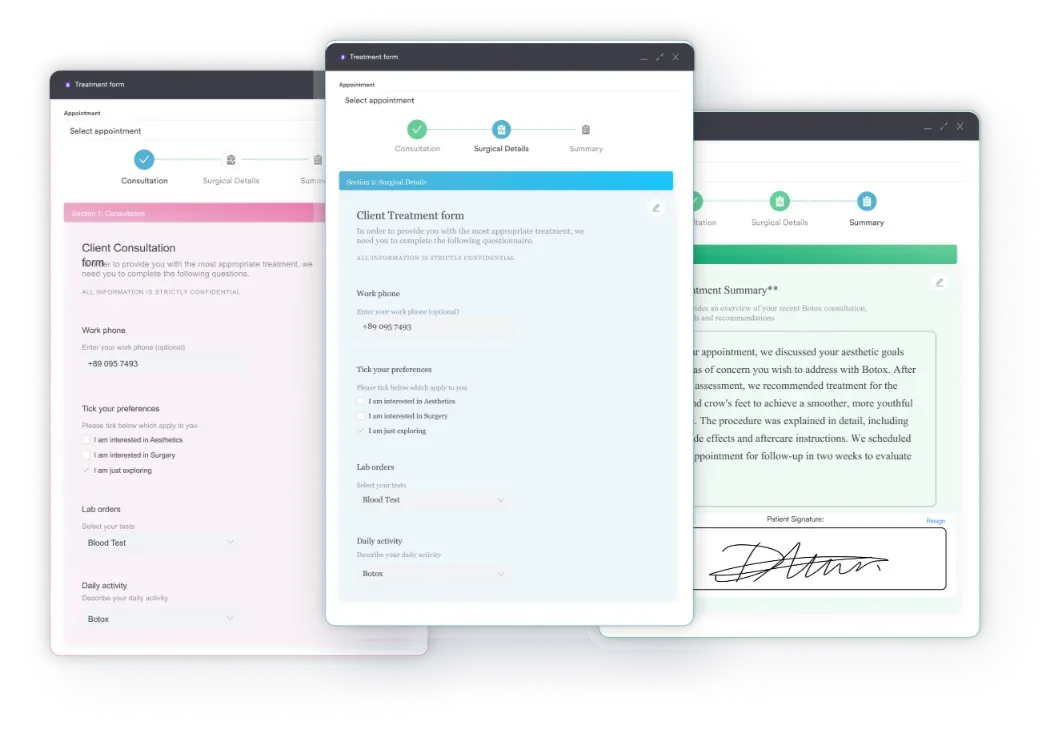
Keeping structured medical forms that include a causality checkbox for known comorbidities streamlines this process further.
For practices subject to HIPAA.

Pabau’s clinical documentation tools help nephrology and primary care practices apply dual-coding rules correctly, reduce claim denials from missing secondary diagnosis codes, and keep audit-ready patient records.

Several recurring errors account for the majority of I15.1 claim denials and audit flags. Recognizing them before submission prevents rework.
Practices can reduce these errors by building a documentation checklist into the encounter workflow for known hypertensive-renal patients.
ICD-10 Code I15.1 has remained stable since ICD-10-CM replaced ICD-9-CM on October 1, 2015. The code description has not changed across fiscal year editions, and no revisions or additions to the instructional notes under I15.1 have been issued through the 2026 edition.
This kind of long-term stability isn’t unique to I15.1. Codes like F05 and D34 have also kept the same description across multiple fiscal years, with updates confined to instructional notes rather than the code itself.
The WHO ICD-10 browser provides the international classification context, though the U.S. ICD-10-CM version, maintained by the NCHS, includes additional code specificity not present in the WHO base.
Coders should verify code status at the start of each fiscal year using the official CMS ICD-10-CM files or the CDC/NCHS lookup tool. ICD-10-CM updates take effect October 1 annually, and codes that appear stable.
Practices managing patients with complex comorbidities like secondary renal hypertension need documentation workflows that surface coding requirements at the point of care, not during a retrospective chart review.
Pabau’s claims management software helps practices track which diagnoses require companion codes and flags encounters where secondary codes may be missing before a CMS-1500 claim form is submitted.

Pabau’s AI-assisted clinical documentation captures consultation notes and structures them into chart entries, reducing the friction between a physician’s spoken attribution (“BP elevated secondary to his CKD”) and the documented causality statement that supports ICD-10 Code I15.1.
For nephrology and primary care practices handling high volumes of CKD and hypertension patients, this reduces the documentation mismatch that most often leads to I10 being used instead of I15.1.
For practices running multi-provider workflows, Pabau’s practice management software centralizes patient records so coders reviewing charts can see the full problem list context, including prior encounters where the causal relationship was documented, even if the treating physician for the current encounter did not restate it.
ICD-10 Code I15.1 is the correct code when hypertension is documented as secondary to a non-renovascular renal disorder. Using it correctly means confirming the physician’s causality statement, pairing it with the appropriate secondary renal code (typically from the N18.x family for CKD), and understanding where it differs from I15.0 and I10.
The coding pitfalls are predictable:
Practices that embed these checks into their documentation and claims workflows before submission will find I15.1 claims straightforward to defend at audit. To see how Pabau’s clinical documentation and claims tools handle these workflows, book a demo.

Coding a diagnosis that only has an unspecified option? M24.9 walks through when an unspecified code is appropriate and when payers expect more specificity, a judgment call that comes up far beyond joint conditions.
Want to improve how your practice captures clinical documentation? Capture Forms software lets practices build structured intake and assessment forms that prompt for causality documentation before a patient leaves the room.
Coding Dressler’s syndrome after a heart attack? Dressler’s syndrome coding guide covers the sequencing rules coders face in the weeks following an acute myocardial infarction.
ICD-10 Code I15.1 is a billable ICD-10-CM diagnosis code that describes hypertension secondary to other renal disorders, meaning high blood pressure that is caused by a renal condition other than a renovascular mechanism. It is distinct from I10 (essential hypertension) because the hypertension has an identified kidney-related cause, and from I15.0 because that code is reserved for renovascular hypertension specifically.
I15.0 (renovascular hypertension) applies when a vascular mechanism, typically renal artery stenosis or fibromuscular dysplasia, is the documented cause of elevated blood pressure. I15.1 applies when the cause is a parenchymal or functional renal disorder, such as CKD, glomerulonephritis, or polycystic kidney disease, rather than a vascular one. If vascular imaging has not confirmed a renovascular cause, I15.1 is the appropriate code.
Yes, ICD-10 Code I15.1 is a billable and specific ICD-10-CM code valid for use in the 2026 edition (effective October 1, 2025). It can be reported as a diagnosis for reimbursement purposes, but it requires a companion code identifying the underlying renal condition, per the mandatory “code also” instruction in the tabular list.
I15.1 requires an additional code to identify the specific underlying renal disorder. For CKD, this means the appropriate N18.x staging code (N18.1 through N18.6). For glomerulonephritis, an N00-N03 code applies. For polycystic kidney disease, Q61.x codes are used. The specific companion code depends on the renal diagnosis documented by the physician.
Use ICD-10 Code I15.1 instead of I10 when the physician’s documentation explicitly states that the hypertension is caused by or secondary to a renal disorder. If the chart lists hypertension and a kidney condition as separate problems without stating a causal link, I10 may be appropriate until a physician query confirms the relationship. Never assign I15.1 based on inference alone.
ICD-10-CM Chapter 9 guidelines distinguish between hypertensive CKD (coded with I12.x combination codes, where hypertension caused the CKD) and secondary hypertension due to CKD (coded I15.1 plus N18.x, where CKD caused the hypertension). The physician’s documentation of which condition caused the other determines which code set applies. When the note is ambiguous, a query is required before assigning either code set.