ICD-10 Code S42.444P: Medial epicondyle fracture, right humerus
ICD-10 Code S42.444P: full descriptor and code validity ICD-10 Code S42.444P car...

Last Updated: Oct 13, 2026
Billable Code Specific Code
M24.9 is the billable ICD-10-CM code for joint derangement, unspecified.
Most unspecified joint complaints end up coded as ICD-10 Code M24.9 by default, but that habit costs practices.
Payers scrutinise unspecified codes closely. As a result, a routine audit can flip a clean claim into a denial when documentation doesn't justify the "NOS" designation. ICD-10 Code M24.9 is a legitimate, billable code when documentation genuinely cannot identify a more specific derangement. However, clinicians often reach for it when a more precise code exists and would survive payer review.
Let Pabau's smart automation suggest the right codes, reduce claim denials, and keep your practice compliant—effortlessly.
Automate repetitive tasks and focus on what matters most—your patients.
Reduce coding errors and ensure compliance with the latest regulations.
Clean claims, fewer denials, and faster reimbursements.
Powerful insights and reporting to help your practice thrive.
HIPAA compliant SOC 2 certified GDPR-compliant Trusted by 4,000+ clinics worldwide

ICD-10 Code M24.9 (Joint derangement, unspecified) is a billable ICD-10-CM diagnosis code valid for HIPAA-covered transactions in the 2026 edition (effective October 1, 2025).
M24.9 sits under parent code M24 (Other specific joint derangements) within the musculoskeletal chapter M00-M99; use it only when no more specific joint derangement code applies.
Key excludes notes: current joint injuries route to injury-by-body-region codes, and recurrent dislocation maps to M24.4, not M24.9.
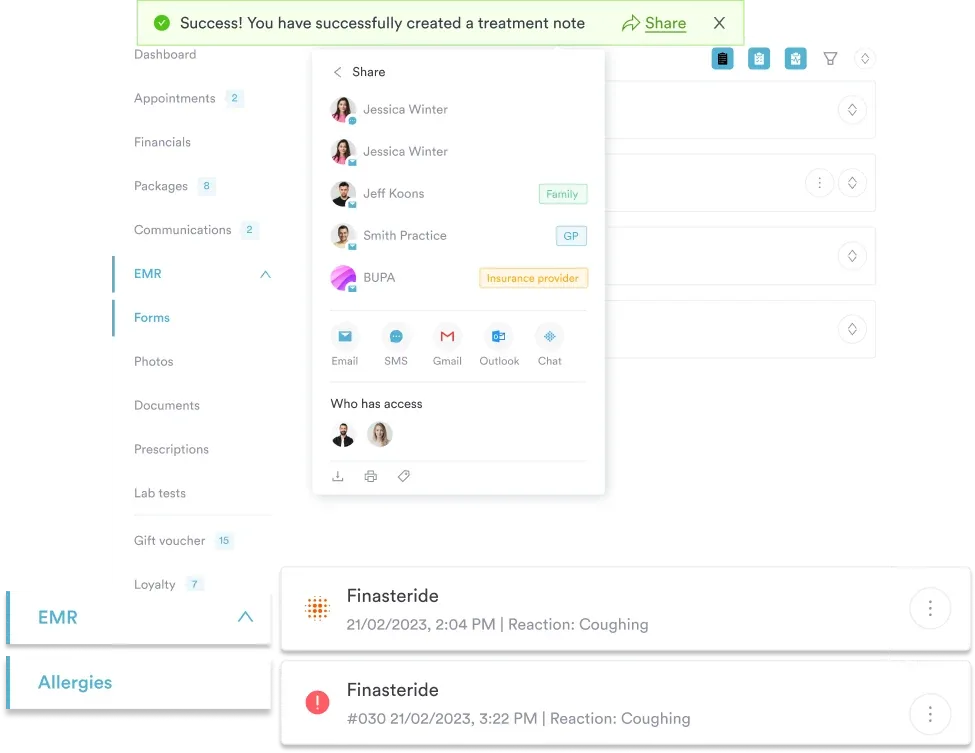
Pabau’s claims management software lets physical therapy, sports medicine, and chiropractic practices attach ICD-10 codes like M24.9 directly at the point of documentation, reducing manual re-entry and transcription errors.
The CDC/NCHS ICD-10-CM web tool classifies M24.9 as a billable, specific code within the ICD-10-CM system. It became effective October 1, 2025 as part of the 2026 edition of ICD-10-CM. As a result, it carries no current expiry or deletion flag for the current fiscal year. Coders can submit it on HIPAA-covered transactions without a modifier requirement at the code level itself, though payer policies vary.
Understanding the hierarchy helps coders confirm that M24.9 is the terminal, billable node rather than a category header. The full path from the ICD-10-CM chapter to M24.9 runs through three levels. More specifically, each level narrows the clinical territory until the code becomes specific enough to bill.
Practices running high volumes of physical therapy or sports medicine encounter M24 codes frequently. The M24 category itself is a non-billable header; only its specific child codes carry reimbursement weight. In practice, M24.9 is the catch-all child code when no other M24 subcategory fits the documented condition.
Joint derangement, unspecified describes a structural or functional disruption of a joint. In practice, the clinical evidence does not allow the coder to identify the specific type of derangement. It is often documented as “joint derangement NOS” (not otherwise specified). That’s why this phrase is the clinical equivalent of M24.9 in medical record terminology.
The unspecified designation applies when all of the following are true for the presenting episode:
In practice, this code appears most often in initial presentations where the clinician is still working up the diagnosis. It also appears in situations where the patient’s documentation history does not contain enough specificity for a more granular code.
Musculoskeletal caseloads demand solid charting, and several Jane App competitors handle it with billing built in.
The official includes and excludes notes for M24.9 come directly from the ICD-10-CM tabular list. Getting these right is where many unspecified joint claims go wrong. Specifically, both the Includes note and the two Excludes categories narrow the code’s legitimate scope.
M24.9 carries two categories of exclusion. In practice, understanding the difference between Excludes1 and Excludes2 is critical to correct sequencing.
The Excludes1 rule for current injuries is the most frequently violated. When a patient presents with an acute joint injury, coders must route to the injury chapter rather than M24.9. This holds true regardless of how the attending clinician phrases the diagnosis. Similarly, M24.4 handles recurrent dislocation; it is not a companion code to M24.9. Attempting to bill both on the same encounter will trigger an edit. For comprehensive compliance requirements in physiotherapy clinics, understanding these exclusions is foundational. Medicare coverage for a service can depend on frequency limits rather than medical necessity alone.
These are the clinical phrases most commonly mapped to M24.9 in encoder databases and EHR search fields. When documentation uses one of these terms, coders should first check for a more specific joint derangement type. If they can’t identify one, M24.9 is the correct assignment.
Clinical notes that include phrases like “joint instability NOS” or “joint dysfunction, unspecified” may map to M24.9 in some encoder systems. However, coders should verify against the official synonyms list in the AAPC ICD-10-CM code reference before assigning. The official includes note limits M24.9 to “derangement of joint NOS” as its primary alternate descriptor.
M24.9 is a residual code. Before assigning it, coders should systematically check the following sibling codes under M24 or the adjacent M25 category. Specifically, they should confirm whether one better describes the documented condition. In addition, submitting a specific code reduces audit risk and improves clinical data quality across the practice.
The M25.50 distinction deserves particular attention. Sometimes a patient’s primary complaint and documentation focus on pain rather than structural disruption. Instead, the M25 pain codes are more accurate than M24.9. Mixing these up is a common audit finding in chiropractic practices that handle high volumes of musculoskeletal claims. Practices using integrated claims management can flag these code selection patterns at the point of documentation. So, they catch the problem before it reaches clearinghouse edit, not after.
Most reference sites skip a content gap here: they simply list related codes. Instead, this section gives coders decision criteria for when M24.9 is genuinely appropriate versus when it reflects incomplete documentation.
The CMS ICD-10-CM coding guidelines consistently instruct coders to assign the code that reflects the highest level of specificity. Specifically, the documentation itself must support that specificity. Using M24.9 when a specific M24 subcategory code is clearly documented is a specificity failure, not a conservative coding choice. The same principle applies for practices working to build accurate ICD-10 coding habits across multiple diagnosis types. In practice, the unspecified code is a valid last resort, not a default.
Before submitting M24.9, run a documentation check against the M24 subcategory list. If the note contains any structural descriptor (loose body, ligament instability, contracture, cartilage finding), a more specific code applies. Defaulting to M24.9 when the note already contains the specificity needed for a subcategory code is the fastest route to a targeted audit on your joint-related claims.
Practices migrating older records or resolving legacy claims need the General Equivalence Mapping (GEM) for M24.9. So do practices working with payers that cross-reference ICD-9 history. For example, the ResDAC guidance on ICD codes in Medicare files documents how GEMs work for claims research and historical coding audits.
First, ICD-9-CM code 718.90 is the primary legacy equivalent.
The mapping is approximate in both the forward (ICD-9 to ICD-10) and backward directions. This is the standard designation for unspecified residual codes, because the ICD-9 era offered limited clinical granularity for these conditions. Practices running historical utilisation analyses should use this crosswalk as a starting point. The same applies to practices responding to payer record requests referencing pre-2015 claims. Next, they should verify against the ICD List crosswalk database for any additional legacy mappings.

Pabau lets physical therapy, sports medicine, and chiropractic teams select and attach ICD-10 diagnosis codes directly within clinical notes, so codes flow into invoices and claims without a separate lookup step.

Beyond the code definition itself, several practical coding considerations affect how M24.9 performs during claims processing. In addition, these points reflect standard ICD-10-CM Official Guidelines for Coding and Reporting requirements.
M24.9 requires documentation of a joint derangement that coders cannot classify more specifically. The note must identify the affected joint, even though the code itself does not require a site-specific qualifier. If the note says only “knee derangement” without specifying the type, M24.9 remains valid. If the note later describes a loose body in the knee, the coder should update the code. Specifically, M24.0 (Loose body in joint) applies, with the appropriate site qualifier.
Coders can assign M24.9 as either a principal or secondary diagnosis, depending on the reason for the encounter. When the joint derangement is the primary reason for the visit, it sequences first. When it is a complicating comorbidity alongside another principal musculoskeletal diagnosis, it instead sequences as a secondary code.
According to the CMS ICD-10-CM Official Guidelines, the principal diagnosis is always the condition established after study. Specifically, it must be chiefly responsible for the encounter.
For example, some payers apply medical necessity edits that flag unspecified musculoskeletal codes for additional documentation requests.
Medicare Advantage plans and certain commercial carriers use M24.9’s unspecified status as a trigger for clinical documentation improvement (CDI) queries. Practices with high volumes of M24.9 claims should monitor denial patterns by payer. In addition, they should establish a documentation protocol for when the unspecified code is the only defensible option.
Practices that use structured clinical record-keeping can build note templates. These templates prompt clinicians to document the specific joint and structural findings at the time of examination. As a result, unspecified code reliance drops over time.
M24.9 is often appropriate at an initial encounter but becomes inappropriate once imaging or specialist results return.
The ICD-10-CM guideline on “uncertain diagnoses” applies. Once clinicians establish a definitive diagnosis, coders should update the code to reflect the more specific condition. Continuing to bill M24.9 after the record documents a specific diagnosis is a coding error, not a conservative practice.
If you work across multiple coding areas and need a broader framework, this series can help. Specifically.
M24.9 is a valid, billable code when documentation genuinely cannot support a more specific joint derangement diagnosis. The coding risk is not the code itself. Instead, it is reaching for it before checking whether a sibling M24 code already covers the documented condition.
Practices that build ICD-10 code selection into their clinical workflow see fewer unspecified code denials. That’s because they treat it as a core step, not an afterthought.
Pabau lets physical therapy, sports medicine, and chiropractic teams attach diagnosis codes directly within clinical notes. As a result, codes flow automatically into invoices and billing records. That workflow closes the gap between clinical documentation and accurate coding at the point of care. To see how it works in practice, book a demo with the Pabau team.

Coding an antenatal screening result? abnormal cytological finding code reports an abnormal antenatal screening result on the mother’s record, separate from the screening encounter code.
Coding a different maternal care diagnosis? maternal care for pelvic inlet contraction is billable for disproportion from pelvic inlet contraction, and an Excludes1 note keeps it off O65 claims.
Billing for a failed induction attempt? failed instrumental induction of labor code applies when a mechanical or surgical attempt to start labor does not produce active labor.
ICD-10 Code M24.9 (Joint derangement, unspecified) is used to diagnose a structural or functional disruption of a joint when no more specific type of derangement can be identified from the available clinical documentation. It applies when the joint is documented but the mechanism, such as cartilage disorder, ligament laxity, or dislocation, is not specified. It is valid for HIPAA-covered transactions in the 2026 ICD-10-CM edition.
Yes, M24.9 is a billable, specific ICD-10-CM code valid for use on claims as of the 2026 edition (effective October 1, 2025). It can be submitted on HIPAA-covered transactions. Note that some payers apply medical necessity edits to unspecified musculoskeletal codes and may request additional clinical documentation before approving payment.
M24.9 describes a structural or functional joint derangement of unspecified type, while M25.50 describes pain in an unspecified joint. The key distinction is clinical focus: if the primary documented complaint is pain without evidence of structural disruption, M25.50x is the correct code. If the note documents a structural joint derangement that cannot be classified more specifically, M24.9 applies.
M24.9 includes: derangement of joint NOS. It carries two Excludes1 notes, meaning these conditions cannot be coded alongside M24.9: current injuries to a joint (route to injury-by-body-region codes instead) and recurrent dislocation of a joint (use M24.4 instead). These are hard exclusions, not optional guidance.
The primary ICD-9-CM equivalent of M24.9 is code 718.90 (Unspecified derangement of joint, site unspecified). The General Equivalence Mapping (GEM) lists this as an approximate forward and backward mapping. Practices resolving legacy claims or historical audits should use this crosswalk as a starting point and verify against official GEM files from CMS.
Yes. M24.9 is valid for 2026 billing. It became effective October 1, 2025 as part of the 2026 ICD-10-CM edition and carries no deletion or revision flag for the current fiscal year. Coders can submit it on claims for encounters occurring on or after October 1, 2025.
Use M24.9 only when documentation records a joint derangement but does not specify the structural type (loose body, cartilage disorder, ligament problem, contracture, dislocation, or ankylosis). If imaging or specialist findings identify the specific derangement type, assign the more precise M24 subcategory code. M24.9 is a legitimate last resort after reviewing the M24 subcategories, not a default.
M24.9 (joint derangement, unspecified) applies when the type of joint derangement is not documented. M24.89 (other specific joint derangement of other specified joint, not elsewhere classified) applies when the derangement is specified but does not match a named M24 subcategory. Put simply, M24.89 is the other-specified option and M24.9 is the unspecified one — assign whichever the clinical documentation supports.