ICD-10 code S61.201A: Open wound of left index finger without nail damage
ICD-10 code S61.201A covers a left index finger wound of unstated type ICD-10 co...

Last Updated: Oct 16, 2026
Billable Code Specific Code
H67.2 is the billable ICD-10-CM code for otitis media in diseases classified elsewhere, left ear.
Unlike primary otitis media codes, H67.2 is a manifestation code. The middle-ear infection is a complication of a systemic disease coded elsewhere, and that underlying disease code must be sequenced first on every claim. The code-first note names plasminogen deficiency (E88.02) and viral disease NEC (B00-B34). Add a code from H72.- when a perforated tympanic membrane is documented. Submitting H67.2 as the principal diagnosis is a sequencing error and a common denial trigger.
Let Pabau's smart automation suggest the right codes, reduce claim denials, and keep your practice compliant—effortlessly.
Automate repetitive tasks and focus on what matters most—your patients.
Reduce coding errors and ensure compliance with the latest regulations.
Clean claims, fewer denials, and faster reimbursements.
Powerful insights and reporting to help your practice thrive.
HIPAA compliant SOC 2 certified GDPR-compliant Trusted by 4,000+ clinics worldwide

H67.2 covers left-ear otitis media that arises as a manifestation of a disease classified in another ICD-10-CM chapter, such as plasminogen deficiency. Influenza, measles, scarlet fever, and tuberculosis are Excludes1 conditions, not code-first partners.
H67’s code-first note names plasminogen deficiency (E88.02) and viral disease NEC (B00-B34), and that underlying code is sequenced before H67.2.
H67 carries a use-additional-code note for an associated perforated tympanic membrane (H72.-). Add that code when the chart documents a perforation.
Pabau’s claims management software flags incomplete code sequences before submission, reducing H67.2-related denials caused by missing etiology codes.
ICD-10 code H67.2 is a billable, claim-submittable ICD-10-CM code with a full official descriptor of “Otitis media in diseases classified elsewhere, left ear.” Its FY2026 effective date is October 1, 2025, and it remains valid through September 30, 2026, per the CMS ICD-10 codes release.
The phrase “diseases classified elsewhere” is the operative clinical signal. The otitis media is a manifestation of a systemic disease that belongs to a different ICD-10-CM chapter. Coding H67.2 as a standalone principal diagnosis is a sequencing error and a common denial trigger.
H67.2 sits within the H65-H75 block, which covers diseases of the middle ear and mastoid. That block context matters when comparing H67.2 with the suppurative otitis media codes in the adjacent H66 category.
H67.2 follows the etiology/manifestation convention. The underlying systemic disease is always sequenced first, and H67.2 appears second or later in the diagnosis list. A manifestation code records a condition that expresses an underlying disease, so it cannot stand as the primary diagnosis.
The ICD-10-CM tabular notes for H67 explicitly state: “Code first underlying disease, such as: plasminogen deficiency (E88.02); viral disease NEC (B00-B34).” These are instructional notes, not suggestions. Submitting H67.2 first violates the sequencing rule and signals to the payer that the middle-ear infection is the presenting condition.
A correct sequence for a patient with a documented viral infection and left-ear otitis media looks like this:
Whether H67.2 belongs on the claim at all turns on one question about the underlying disease.
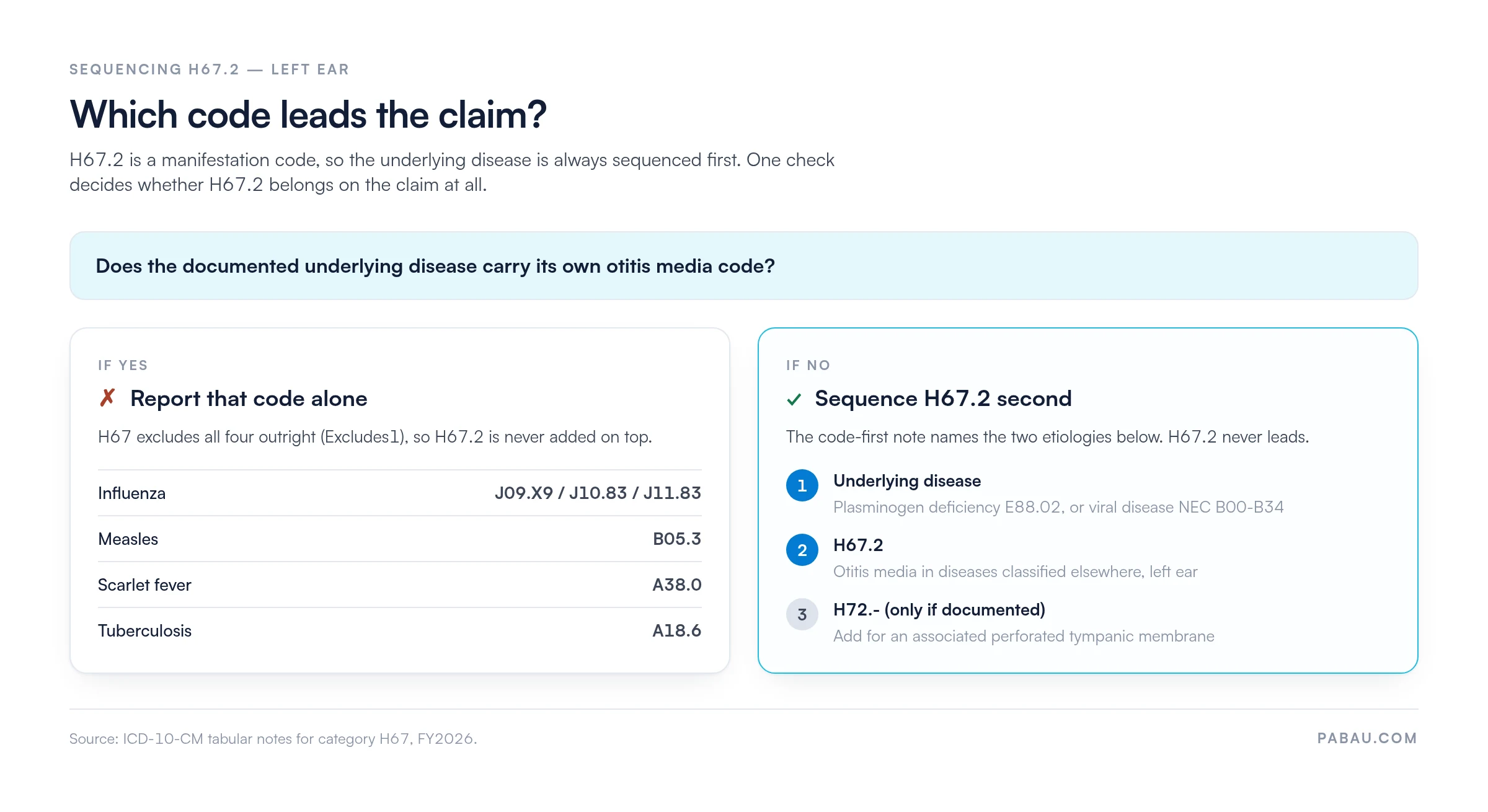
The CMS ICD-10-CM Official Guidelines for Coding and Reporting, Section I.C, govern the etiology/manifestation convention in full. Influenza, measles, scarlet fever, and tuberculosis are not code-first partners for H67. Each of those diseases carries its own otitis media code, and H67 excludes all four outright.
A code from category H72 (Perforation of tympanic membrane) is added when the documentation records a perforation alongside the otitis media episode. The instruction is explicit. The tabular notes for H67 direct coders to “use additional code for any associated perforated tympanic membrane (H72.-).” H72 codes carry their own site and laterality detail, so the otoscopic finding has to support the specific code chosen.
The H67 category carries Excludes1 notes that prohibit dual coding with certain other otitis media conditions. Submitting a code listed under Excludes1 on the same claim as H67.2 is a hard coding violation, not a billing choice.
When the chart names influenza, measles, scarlet fever, or tuberculosis as the cause, the combination code for that disease is the whole answer. H67.2 is not added on top of it. H67.2 applies where the underlying disease has no combination code of its own. That is why the code-first note points to plasminogen deficiency and viral disease NEC.
H67.2 sits four levels deep in the ICD-10-CM hierarchy. Coders who search by chapter or block rather than by code directly need the full taxonomy to land in the right place.
H67 itself is a non-billable parent category. It cannot be submitted for reimbursement, and it must always be extended to a laterality-specific child code. Submitting plain H67, without the .1, .2, .3, or .9 extension, will be rejected by payer edits as insufficiently specific.
Pabau’s ICD-10-CM code directory indexes these reference pages by chapter and category, so the parent-versus-child check takes one lookup.
The four child codes under H67 differ only by laterality. Selecting the wrong sibling is the most straightforward documentation error in this family. Payer audits catch it through laterality consistency checks against procedure codes.
H67.9 (unspecified ear) is frequently overused. ICD-10-CM specificity guidelines require the most specific code the documentation supports. If the clinician’s note documents the otoscopic finding or treatment in the left ear, H67.2 is the correct code, and H67.9 should not be used.
When documentation is genuinely silent on laterality, coders should query the provider before defaulting to H67.9. Most ENT and primary-care EHR templates have laterality checkboxes precisely because ICD-10-CM requires it. Defaulting to H67.9 across a practice’s H67 claims suppresses the specificity of the coded data. It may also flag the practice in payer data analytics as a documentation-quality outlier.
H67.3 (bilateral) requires documented evidence of involvement in both ears during the same encounter. A chart that notes “left ear consistent with otitis media, right ear clear” supports H67.2 only, not H67.3. Coding bilateral when only unilateral involvement is documented inflates specificity. It also creates a consistency risk when the associated procedure codes, such as myringotomy CPT codes, are unilateral.
The ICD-10-CM tabular notes for H67 name two example underlying diseases. They are illustrative rather than exhaustive. Any disease classified in another chapter can serve as the “code first” etiology code. It has to be documented as causing the otitis media, and it must have no combination code of its own.
The B00-B34 range is broad, so select the most specific viral code the documentation supports rather than defaulting to B34.9. Verify the pairing with the CDC/NCHS ICD-10-CM web tool before submission. Diseases that carry their own otitis media combination code, including measles, scarlet fever, influenza, and tuberculosis, never pair with H67.2.
H67.2 appears in audiology encounters when a patient presents with conductive hearing loss or middle-ear effusion during an active systemic illness. Audiologists do not diagnose otitis media, but they document middle-ear status through tympanometry and audiogram findings.
When a physician has already coded an underlying disease, and the audiologist’s findings show middle-ear involvement, H67.2 may be reported as a secondary diagnosis. It supports the clinical picture the encounter documents.
In ENT practice, H67.2 turns up most often during follow-up visits for systemic illness with ear complications. The ASHA audiology reference guide includes H67.1 through H67.9 in its ICD-10-CM audiology code set, grouping them under the “Otitis media codes” section.
The most common CPT pairings with H67.2 include 92550 (tympanometry and acoustic reflex testing) and 92552 (pure tone audiometry). Both apply when assessing conductive hearing loss related to the middle-ear condition.
The American Speech-Language-Hearing Association (ASHA) publishes annually updated ICD-10-CM reference guides for audiologists. Those guides list H67 category codes alongside the hearing loss codes (H90-H91) commonly co-documented in these encounters.
Legacy data analysis, payer audits, and multi-year trend reporting sometimes require mapping H67.2 back to its ICD-9-CM predecessor. These crosswalks are approximate equivalences rather than exact matches, because ICD-10-CM introduced laterality specificity that ICD-9-CM lacked.
For rigorous crosswalk lookups, the ResDAC ICD codes in Medicare files guide explains how ICD-9 to ICD-10 transition files are structured. That includes the General Equivalence Mappings (GEMs) used by CMS for research and payer auditing.
Most H67.2 claim problems are preventable at the documentation and pre-submission stage. The four errors below account for the majority of denials on this code family.
Run a quarterly audit on your H67 claims: Filter for any claim where H67.1, H67.2, H67.3, or H67.9 appears in position 1. Any H67 code as the principal diagnosis is a sequencing error. Cross-check those claims for the presence of an underlying disease code in position 2 or later, then correct and resubmit.
Most H67 sequencing errors are caught by the payer rather than the practice. The coder submits the claim, the remittance comes back weeks later, and someone reworks it by hand. By then the denial has already cost a billing cycle.
Practice management software like Pabau validates the diagnosis sequence while the claim is still a draft. If H67.2 sits in position 1, or the etiology code is missing altogether, the claim gets flagged before it leaves the practice.
Our Claim.MD integration routes electronic claims through 4,000+ US payers and checks ICD-10-CM combinations against payer-specific edit sets. So the coder fixes the sequence once, at the desk, instead of chasing it through an appeal. For more on getting this right from the start, see what goes into submitting a clean claim.

Pabau’s claims management software validates ICD-10-CM code sequences before submission, flags missing etiology codes, and connects to 4,000+ US payers through our Claim.MD integration. See how practices eliminate coding errors at the source.

H67.2 is simple to look up and easy to submit wrongly. The code itself is rarely the problem. What gets the claim denied is its position in the diagnosis list, so the habit worth building is checking position 1 before anything else.
Two checks cover almost every H67.2 denial. Confirm the documented underlying disease has no otitis media code of its own, then confirm it sits ahead of H67.2. A coder who does both will rarely meet the appeals process for this code family.
Pabau’s claims management software runs those checks against payer edits before submission, so manifestation codes stop eating review time. Book a demo to see how the sequencing validation handles your own H67 claims.

Need to understand how denials on ICD-10 manifestation codes are managed? Denial management in healthcare covers the workflows practices use to identify, appeal, and prevent recurring claim denials.
Working on broader ICD-10 coding compliance across your practice? Medical billing compliance explains the documentation standards that support accurate ICD-10-CM code selection and audit readiness.
Want to understand how electronic remittance advice ties back to ICD-10 denial reasons? Electronic remittance advice explains ERA/835 file structures and how CARC denial codes link back to specific coding errors.
ICD-10 code H67.2 is the billable ICD-10-CM code for otitis media in diseases classified elsewhere affecting the left ear. It is valid for FY2026, from October 1, 2025 through September 30, 2026. It is a manifestation code: the middle-ear infection is a complication of an underlying systemic disease coded in another ICD-10-CM chapter. That underlying disease code must be sequenced before H67.2 on any claim.
Yes, H67.2 is a billable ICD-10-CM code valid for claim submission in FY2026. It is a specific, fully extended code within the H67 category. The parent code H67, without the decimal extension, is not billable and will be rejected by payer edits as insufficiently specific.
The “code first” instruction requires coders to sequence the underlying disease before H67.2 on every claim. The ICD-10-CM tabular notes name two examples: plasminogen deficiency (E88.02) and viral disease NEC (B00-B34). H67.2 must never appear as the principal diagnosis. Submitting it in position 1 violates the etiology/manifestation convention and causes claim denial.
H67.9 (unspecified ear) should be used only when the clinical documentation genuinely does not specify which ear is affected. It also requires a provider query that came back without a laterality answer. If the chart, otoscopic note, or procedure documentation identifies the left ear, H67.2 is required. Defaulting to H67.9 when laterality is actually documented is a specificity error.
The approximate ICD-9-CM crosswalk for H67.2 is 382.02, acute suppurative otitis media in diseases classified elsewhere. It is an approximate equivalence only. ICD-9-CM carried no laterality detail, so 382.02 does not distinguish the left ear from the right. Use the CMS GEM crosswalk files for research or audit purposes rather than direct billing equivalence.
H67 carries a use-additional-code note for an associated perforated tympanic membrane, so a code from H72.- is added when the documentation records a perforation. The H72 code follows H67.2 in the diagnosis sequence and is never the principal diagnosis. The H67 tabular notes carry no other use-additional-code instruction.