ICD-10 code S61.201A: Open wound of left index finger without nail damage
ICD-10 code S61.201A covers a left index finger wound of unstated type ICD-10 co...

Last Updated: Oct 16, 2026
Billable Code Specific Code
H21.9 is the billable ICD-10-CM code for unspecified disorder of iris and ciliary body. It applies when a note documents iris or ciliary body pathology without naming a condition from the H21 block.
Use H21.9 only after the H21.0x to H21.8x sibling codes have been ruled out. Record in the chart why greater specificity was unavailable, because payers audit unspecified codes routinely.
Let Pabau's smart automation suggest the right codes, reduce claim denials, and keep your practice compliant—effortlessly.
Automate repetitive tasks and focus on what matters most—your patients.
Reduce coding errors and ensure compliance with the latest regulations.
Clean claims, fewer denials, and faster reimbursements.
Powerful insights and reporting to help your practice thrive.
HIPAA compliant SOC 2 certified GDPR-compliant Trusted by 4,000+ clinics worldwide

H21.9 is a billable ICD-10-CM code covering disorders of the iris and ciliary body when documentation lacks enough specificity for a more precise H21.x code
Use H21.9 only after confirming no sibling code (H21.0-H21.8x) better fits the documented clinical findings
Excludes1 notes bar H21.9 from being coded alongside certain H20 iridocyclitis codes for the same eye at the same encounter
Pabau’s claims management software flags unspecified codes and prompts coders to verify documentation before submission
ICD-10 code H21.9 is the billable diagnosis code for an unspecified disorder of the iris and ciliary body. The table below captures its core billing attributes, as confirmed in the CMS ICD-10-CM FY2026 tabular list. Use it as a first checkpoint before submitting a claim.
Yes. H21.9 is a billable ICD-10-CM diagnosis code that payers accept on submitted claims. It has been valid for Medicare, Medicaid, and commercial payers since October 1, 2015. Being billable means the code is specific enough to appear on a claim form on its own, with no more granular child code beneath it. A header code such as H21 works differently, because it needs a fourth or fifth character before it can be billed.
Billable status still does not guarantee payment. Payers routinely audit unspecified codes and may request medical records to confirm no more specific diagnosis was documented.
A clean H21.9 claim depends on the underlying chart note explaining why a more specific code was unavailable. Denial reason codes on the remittance advice reveal whether a payer flagged H21.9 for specificity.
An unspecified disorder of the iris and ciliary body is a pathological condition affecting either or both anterior uveal structures. It is assigned when the documentation does not support a more precise named diagnosis.
The iris is the pigmented, contractile diaphragm that controls pupil size. The ciliary body produces aqueous humor and drives lens accommodation through the zonular fibers. Both structures sit in the anterior segment of the eye and share a vascular supply, so disease in one often affects the other.
In ICD-10-CM, “unspecified” means the clinical picture was documented in too little detail to assign a named condition. Coders also see it written as NOS, for not otherwise specified. Common scenarios where H21.9 legitimately applies:
None of these scenarios is a coding error on its own, as long as the chart note says which one applies.
ICD-10 H21 is the parent category for all disorders of the iris and ciliary body, sitting within Chapter 7 (H00-H59) of ICD-10-CM. H21.9 is its terminal, “catch-all” code.
Reading the full H21 block prevents the most common coding error, which is defaulting to H21.9 when a named sibling code fits.
H21.00 covers hyphema of an unspecified eye, and H21.331 covers a parasitic cyst of the iris or ciliary body in the right eye. Either one beats H21.9 when the documentation supports it.
The CDC/NCHS ICD-10-CM index maps several clinical terms and lay descriptors to H21.9 when no laterality or named condition is specified. Coders who search by clinical term rather than code number will reach H21.9 through these routes:
One term coders frequently misroute is “anterior uveitis, unspecified.” That maps to H20.9, not H21.9. Uveitis carries its own H20 code block because it designates active inflammation. H21.9 is reserved for structural or functional disorders where inflammation is not the documented feature.
The H21 category carries Excludes1 and Excludes2 annotations that are binding on every code within the block, including H21.9. Misreading these is among the most common reasons claims return with a coding error remark.
The two Excludes rules and the sibling-code check run in a fixed order, and the chart below shows where each one sends the claim.
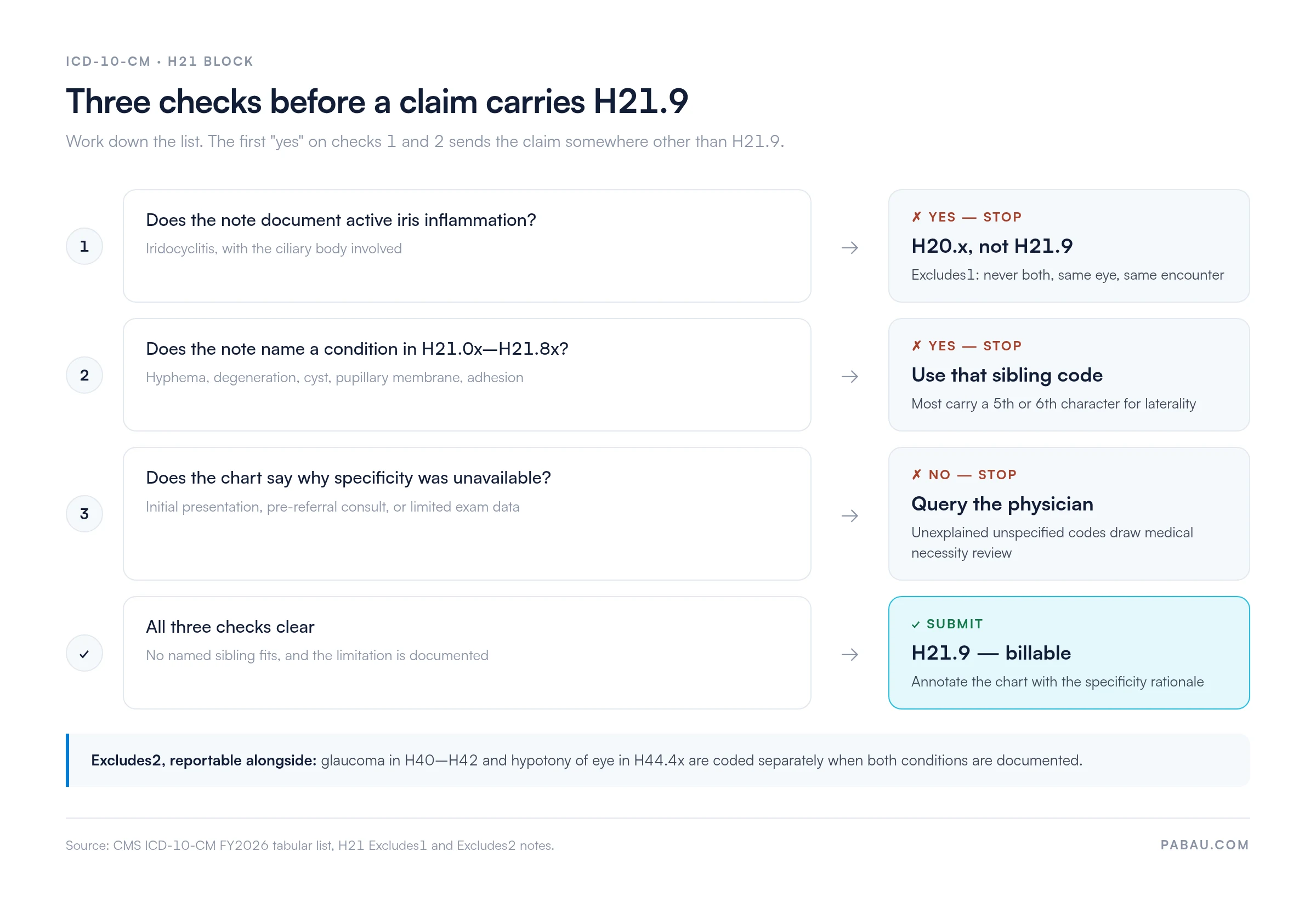
Before using H21.9, run the documentation against the H21 sibling codes first. If a 5- or 6-character code fits the chart note, use it. H21.9 is appropriate only when no named condition in H21.0x through H21.8x is supported by the note. It is not a shortcut for notes nobody has reviewed.
Query the physician when the documented finding points toward one of the conditions below without clearly establishing it. Defaulting to H21.9 in that situation is what draws an audit. The AAPC Codify ICD-10-CM lookup allows a rapid comparison of sibling codes. Pabau’s ICD-10-CM code directory covers the same block from the billing side.
A valid code and a defensible code are judged differently once a payer opens the chart. Per AAPC coding best practices, a coder who assigns any unspecified code should be able to state one of three chart-based justifications.
Submitting H21.9 without one of these documented justifications increases the risk of a medical necessity denial. Robust denial management strategies include pre-submission screening of unspecified codes against the chart note.
Specificity norms also tighten with each fiscal year, so a code that passed audit in FY2023 may attract closer scrutiny in FY2026.
H21.9 has been part of ICD-10-CM since the system’s US implementation on October 1, 2015, and has remained structurally unchanged through FY2026.
No revisions, resequencing events, or validity changes affect it in the CMS/NCHS FY2026 release files. Coders should still verify the code annually using the Check ICD-10 database, which mirrors official CMS/NCHS data.
The broader H21 block has also been stable. Adjacent categories within Chapter 7 have seen selective additions in recent years, particularly among glaucoma and retinal disorder codes.
H21 itself has not been restructured since ICD-10-CM’s US rollout. Practices that previously used ICD-9-CM code 364.9 (disorder of iris and ciliary body, unspecified) will recognize H21.9 as its direct structural equivalent.
Verify H21.9 annually in the CMS ICD-10-CM tabular list each October. Even stable codes can acquire new Excludes notes or cross-references as adjacent categories expand. A five-minute check at fiscal year start prevents mid-year claim surprises.
Ophthalmology practices with high anterior segment volumes encounter H21.9 constantly. Its “unspecified” status also puts it on most payer watch lists for routine audit. The harder problem sits between the systems. A chart note may record why specificity was unavailable, and the biller building the claim never sees it.
Practice management software like Pabau puts ICD-10 coding support inside the documentation workflow, so the coder and the biller read the same note. Pabau’s claims management software routes coded claims through built-in ICD-10 and CPT catalogs before submission, flagging unspecified codes that may warrant a physician query.
Claims submitted through Pabau’s integration with Claim.MD, our US clearinghouse partner, get real-time eligibility checks and ERA processing. Practices learn of any payer-side coding concerns within the same billing cycle rather than 30 days later.

In a well-configured practice, an H21.9 claim follows four steps:
That sequence separates practices with H21.9 clean-claim rates above 90% from those chasing denials. Code-level alerts surface during charting, so no separate billing review step is needed.

Pabau’s claims management tools flag unspecified ICD-10 codes at the point of coding, prompt staff to verify documentation, and route clean claims through your clearinghouse. See how it works for ophthalmology practices.

H21.9 is a legitimate, billable ICD-10-CM code, and it is also a documentation test. Every claim carrying it tells a payer that the physician could not, or did not, document a more specific iris or ciliary body diagnosis.
The practices that stay ahead of it build a physician query step into coding and annotate every unspecified code with its rationale. Cleaner claims and fewer post-submission audits follow from that habit, not from the code choice itself.
If your ophthalmology practice wants to reduce unspecified-code denials without adding billing headcount, Pabau handles this workflow end to end. Book a demo to see how H21.9 claims move from coding to remittance in one system.

Need a framework for clean-claim submission? Clean claim requirements walks through the data elements every ICD-10 claim needs to pass payer edits on the first pass.
Want to understand how clearinghouse submissions work? 837 file format overview explains the EDI transaction set that carries your ICD-10 diagnosis codes to the payer.
Looking to benchmark your denial rate? Medical billing compliance guidance covers audit triggers and documentation standards that apply to unspecified diagnosis codes.
ICD-10 code H21.9 is the billable ICD-10-CM diagnosis code for an unspecified disorder of the iris and ciliary body. It applies when documentation identifies pathology in these structures but names no specific condition from the H21 code block.
Yes, H21.9 is a valid, billable ICD-10-CM diagnosis code that may be submitted on insurance claims. Payers may request supporting documentation to confirm that no more specific H21.x code was available based on the clinical record.
Use H21.9 only after reviewing H21.0x through H21.8x and confirming that none of those codes fits the documented clinical finding. It is appropriate when the chart note describes iris or ciliary body pathology without naming a specific condition. The documentation should also explain why greater specificity was unavailable.
The ICD-10-CM code for iridocyclitis is H20.x, with H20.9 covering unspecified iridocyclitis. Iridocyclitis is excluded from H21.9 under an Excludes1 note. The two codes cannot be billed together for the same eye at the same encounter.
Yes. While H21.9 is billable, the supporting chart note should explain why a more specific code was not assigned. An incomplete diagnostic workup, a pending specialist referral, or limited examination data all qualify. Claims submitted without that context are more likely to trigger a medical necessity review.
The parent category is H21, Other disorders of iris and ciliary body. It sits within Chapter 7 of ICD-10-CM, Diseases of the eye and adnexa (H00-H59). H21 itself is a non-billable header code, and H21.9 is its terminal billable child.