

ICD-10 Code S42.444P: Medial epicondyle fracture, right humerus
ICD-10 Code S42.444P: full descriptor and code validity ICD-10 Code S42.444P car...

Last Updated: Oct 13, 2026
Billable Code Specific Code
E60 is the billable ICD-10-CM code for dietary zinc deficiency. It covers zinc deficiency caused by inadequate intake through food, not deficiency caused by malabsorption or increased physiologic demand. The code is leaf-level, so no fifth character exists and none may be added.
E60 sits in Chapter 4 of ICD-10-CM, inside the E50-E64 block for other nutritional deficiencies. Assignment turns on the chart, where the physician has to document zinc deficiency and tie it to a dietary cause.
Let Pabau's smart automation suggest the right codes, reduce claim denials, and keep your practice compliant—effortlessly.
Automate repetitive tasks and focus on what matters most—your patients.
Reduce coding errors and ensure compliance with the latest regulations.
Clean claims, fewer denials, and faster reimbursements.
Powerful insights and reporting to help your practice thrive.
HIPAA compliant SOC 2 certified GDPR-compliant Trusted by 4,000+ clinics worldwide

ICD-10 Code E60 is the billable ICD-10-CM diagnosis code for dietary zinc deficiency, separate from the nutrient element deficiencies in E61.
E60 is valid for the FY2026 code set, so claims with a service date from October 1, 2025 may carry it.
Documentation must name a dietary cause. Without that qualifier, the claim risks denial or downcoding to an unspecified nutritional deficiency.
Practice management software like Pabau handles eligibility checks, electronic claim submission through Claim.MD, and ERA tracking.
ICD-10 Code E60 is a billable, specific ICD-10-CM diagnosis code that represents dietary zinc deficiency. It is valid for use on HIPAA-covered transactions in fiscal year 2026. Claims with a service date on or after October 1, 2025 may carry it. The CDC/NCHS ICD-10-CM web tool confirms E60 as a leaf-level code, so no additional digits are required or available. Coders who add a fifth character will generate an invalid code.
The code has been part of ICD-10-CM without structural change across multiple fiscal years, which makes it a stable reference in nutrition-focused practices. Any practice submitting claims for nutritional deficiency diagnoses should still confirm fiscal year validity annually. The CMS ICD-10 codes page publishes the updated tabular list each October.
E60 sits within Chapter 4 of ICD-10-CM, which covers endocrine, nutritional, and metabolic diseases. Its full classification path runs from chapter to block to category to the code itself. Understanding this path helps coders who are cross-referencing related nutritional deficiency codes or confirming that E60 is the most specific available option.
Practices working in integrative medicine or functional health often meet the E50-E64 block, with several nutritional deficiency codes on one encounter note. Reviewing the full block helps coders separate E60 from E61 (deficiency of other nutrient elements) and E63.9 (nutritional deficiency, unspecified). You can browse the hierarchy through the WHO ICD-10 browser, which mirrors the international classification behind ICD-10-CM.
The ICD-10-CM tabular list recognizes several approximate synonyms for E60. Coders searching by condition name rather than code number may meet any of these terms. All map correctly to E60 when the deficiency is dietary in origin.
A note that reads “zinc deficiency disorder” or simply “zinc deficiency” still maps to E60. The chart has to establish the dietary cause as well. If no dietary cause is documented, coders face a specificity problem. The AAPC Codify ICD-10-CM lookup lists these approximate synonyms alongside the official tabular entry, making it a useful reference for index verification.
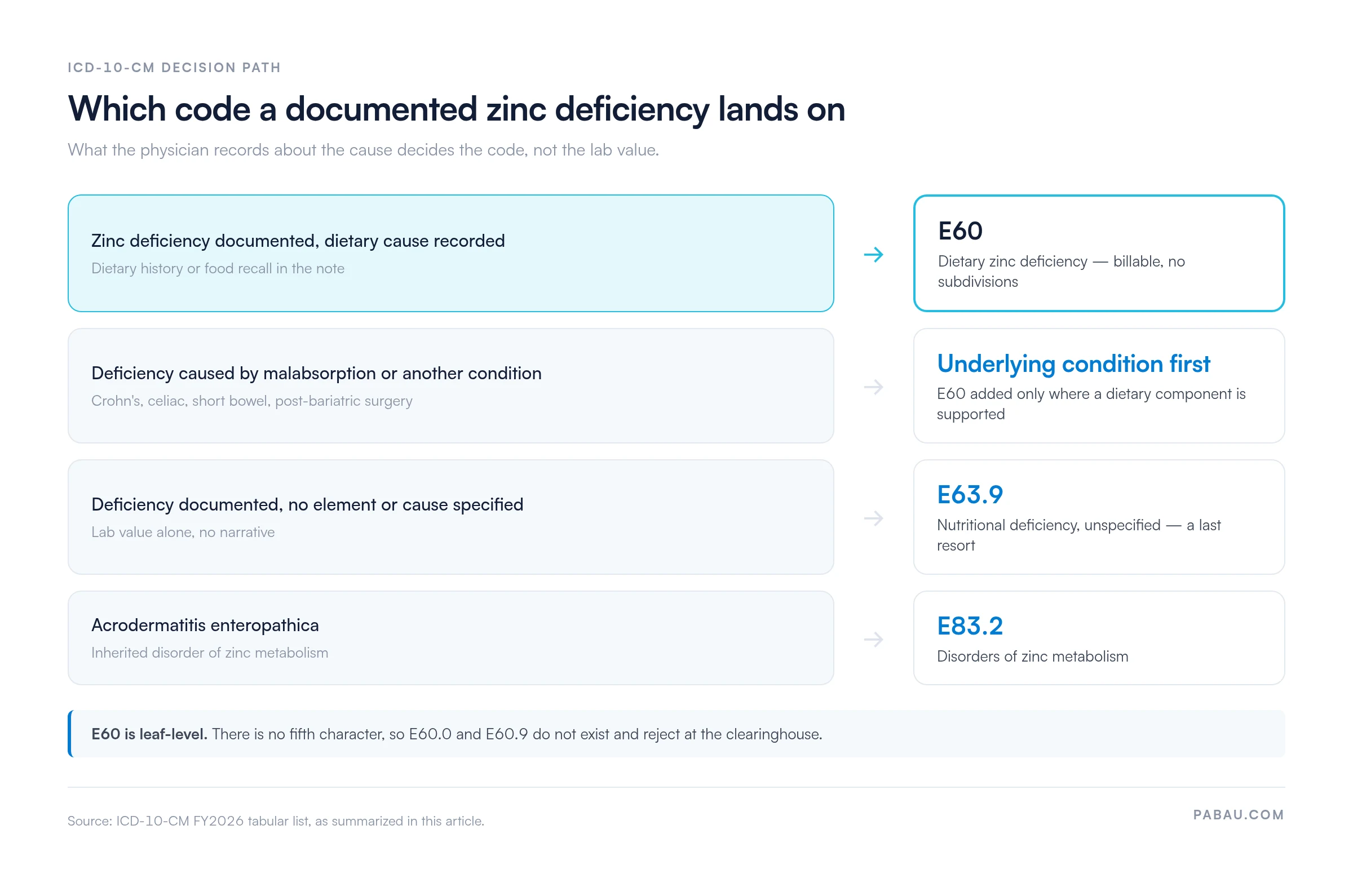
Dietary zinc deficiency is a nutritional condition caused by insufficient zinc intake through food. It differs from zinc deficiency caused by malabsorption, as in Crohn’s disease or after bariatric surgery. It also differs from deficiency driven by increased physiologic demand in pregnancy.
The ICD-10-CM code E60 is specific to the dietary cause. Where the deficiency arises from another underlying condition, coding guidelines may require that condition as the principal diagnosis. E60 then sits as a secondary code, or gives way to a more specific manifestation code.
Zinc deficiency produces a recognizable clinical picture that practitioners should document explicitly. Vague notes like “patient appears zinc deficient” without objective findings are a common audit trigger. The following signs and symptoms are clinically recognized as supporting zinc deficiency documentation:
Documenting the findings present, and not only the lab result, strengthens the clinical record. It also lowers the risk of a medical necessity challenge from a payer. A serum zinc result on its own, with no clinical correlation, may not satisfy payer documentation requirements for nutritional intervention coverage.
Laboratory confirmation is the backbone of E60 documentation. Clinicians typically rely on the tests below. Reference ranges vary by laboratory and patient population, so always record the range supplied by the performing lab.
Proper documentation is where E60 claims succeed or fail. The physician or qualified clinician must record the diagnosis of zinc deficiency and tie it to a dietary cause. ICD-10-CM coding guidance keeps returning to the same principle. Code what the physician documents, and document what was clinically assessed.
A clean E60 documentation set includes these elements:
Digital intake forms standardize how dietary history and supplement use get captured at the point of care. That makes the dietary-cause qualifier much harder to miss.
A structured note template helps practices running a high volume of nutritional assessments. Prompting for each of the five elements above measurably reduces incomplete documentation. Build those checkpoints into the clinical workflow, so the biller is never the first person to notice a missing qualifier.
Flag E60 claims for pre-submission review when the chart note does not explicitly state ‘dietary’ as the cause. A note that reads ‘zinc deficiency’ without a qualifying etiology is ambiguous, and some payers will default to unspecified nutritional deficiency. Run a documentation checklist before billing to confirm all five elements are present.
E60 is a straightforward code with a narrow description, which means coding errors tend to cluster around a few predictable failure points. The following are the most frequent mistakes coders and billers encounter:
Catching these errors before submission costs far less than working the denials afterward. Electronic denial management in healthcare workflows show the pattern across many claims at once. A practice can then correct the documentation habit behind the denials, instead of reworking claims one by one.
Coders working with E60 often cross-reference codes from the same block or an adjacent category. The table below covers the companion codes referenced most often, each checked against the ICD-10-CM tabular list.
Which of these codes applies turns on what the chart records about the cause, not on how low the serum zinc result is.
E60 is a valid, billable ICD-10-CM code accepted for HIPAA-covered claim submissions. Billable status and insurance coverage are still separate questions. Reimbursement for the services associated with E60 depends on the CPT codes billed alongside it, the payer’s medical policy, and the patient’s plan design.
Two coverage contexts where E60 appears most often:
A clean E60 claim starts before the appointment, with an eligibility check. From there, match the diagnosis to the CPT code’s medical necessity requirements and confirm the claim data is complete. Pabau’s Claim.MD integration covers real-time eligibility checks, electronic claim submission to thousands of US payers, and ERA (835) remittance retrieval.
For practices handling a high volume of nutritional deficiency claims, the remittance data is the feedback loop. Reading the electronic remittance advice (ERA) for E60 claims shows whether denials trace back to diagnosis specificity, missing documentation, or payer policy. Each of those causes has a different fix.
Practices that regularly assign E60 and related nutritional deficiency codes face a documentation burden that compounds quickly at volume. A single missed dietary-cause qualifier across dozens of weekly encounters translates to claim denials, rework, and delayed reimbursement.
Pabau’s claims management software keeps the ICD-10 and CPT code catalogs inside the practice management workflow. Coders pick codes in the same system that holds the schedule, the clinical notes, and the patient record.
Claims then go out through the Claim.MD clearinghouse integration, which handles submission, eligibility responses, and ERA retrieval in one place. The coding decision still belongs to the coder, so what reaches the payer is only as good as what the physician documented.
For nutrition-focused programs, the revenue cycle starts at intake. Capture the dietary history and the lab order at the point of care. Link both to the clinical note, then let that documentation flow into the claim. E60 denials usually trace back to a claim that carried less detail than the physician wrote down.
Review your ERA data for E60 claims each quarter. If denials cluster around ‘diagnosis code not supported by documentation,’ fix it upstream. Add a dietary etiology checkbox and a serum zinc result field to the clinical note template, both required before the note can be signed.

Pabau submits ICD-10 claims electronically through Claim.MD, with real-time eligibility checks and ERA tracking in the same system as the patient record. See how it fits your billing workflow.

Dietary zinc deficiency claims hinge on one documentation detail. The dietary cause has to be written into the note, rather than left for the coder to infer. ICD-10 Code E60 is specific, billable, and stable for FY2026, but it asks the physician for more than a low lab result.
Pabau’s claims management tools and the Claim.MD connection give nutrition-focused practices one place to document, submit, and track E60 claims. To see how much shorter the path from signed note to payment gets, book a demo with the Pabau team.

Need to understand how clearinghouse claim validation works? Clean claim submission requirements covers what makes a claim error-free before it reaches a payer.
Managing multiple nutritional deficiency codes in one encounter? Superbill documentation best practices explains how to structure multi-diagnosis encounters for cleaner billing.
Want to reduce denial rates across your whole practice? Denial codes in medical billing breaks down the most common denial reason codes and how to address each one.
ICD-10 Code E60 is the billable ICD-10-CM diagnosis code for dietary zinc deficiency, a nutritional condition caused by insufficient zinc intake through diet. It is a leaf-level code with no further subdivisions, valid for HIPAA-covered claim submissions in fiscal year 2026. The code sits within block E50-E64 (other nutritional deficiencies) of Chapter 4 (endocrine, nutritional, and metabolic diseases).
Yes, E60 is a billable, specific ICD-10-CM code effective October 1, 2025 for all FY2026 HIPAA-covered claim submissions. No additional digits are needed or available. Codes like “E60.0” or “E60.9” do not exist and will reject at the clearinghouse.
The physician must document zinc deficiency with an explicit dietary cause in the assessment. Support it with lab results (typically serum zinc), a dietary history, and the associated clinical findings. Without the dietary qualifier, the code may default to an unspecified nutritional deficiency (E63.9), which can affect reimbursement and benchmarking.
E60 is a valid billable code accepted for submission, but coverage depends on the payer and the services billed alongside it. Medicare’s medical nutrition therapy (MNT) benefit covers dietary counseling for a defined set of conditions. A nutritional deficiency diagnosis does not create coverage by itself. Confirm medical policy with the relevant Medicare Administrative Contractor or commercial payer before submitting MNT claims.




