Anemia nursing care plan
An anemia nursing care plan is a structured document that guides a nurse from as...

1
Last Updated: Oct 9, 2026
A TCA drug test is a urine or blood screening panel that detects tricyclic antidepressants (TCAs) and their metabolites.
Practices order it in emergency toxicology, in medication compliance monitoring, and inside extended workplace panels.
According to MedlinePlus (National Library of Medicine), TCA screens are most often ordered when overdose is suspected. The other common reason is verifying that a patient is taking a prescribed medication. The screen returns a positive or negative result against a standard immunoassay cutoff of 300 ng/mL.
A positive screen is preliminary, and confirmatory testing has to follow before any clinical or legal action does. This guide covers which drugs the panel detects, how cutoff levels work, and what causes false positives. It also shows how to document a result so it holds up later.

TCA stands for tricyclic antidepressant, a medication class used for depression, anxiety, and chronic pain. The panel detects these compounds in urine or blood.
The standard immunoassay screening cutoff is 300 ng/mL, and a result at or above it triggers confirmatory GC-MS or LC-MS/MS testing.
Several non-TCA medications, including carbamazepine, quetiapine, cyclobenzaprine, and diphenhydramine, can cause false positive results on immunoassay screens.
Detection windows run roughly 2 to 7 days after therapeutic use, and up to about 10 days with chronic high-dose use.
Pabau’s lab order tracking helps practices record the screening order, file the confirmatory result, and flag positives for clinician review.
TCA stands for tricyclic antidepressant, a class of medications that act on serotonin and norepinephrine reuptake pathways in the brain. On a drug test, a TCA panel is a urine or blood immunoassay that detects these compounds above a defined concentration threshold. The screen does not separate legitimate prescription use from misuse, which is why every positive result needs confirmation.
TCAs were developed in the 1950s and 1960s and remain in clinical use today. Psychiatrists, primary care physicians, and pain specialists prescribe them for depression, anxiety disorders, neuropathic pain, migraines, and insomnia. A screen becomes clinically relevant when a patient’s prescription history meets a multi-panel workplace or probationary drug test.
Standard 5-panel DOT tests do not include TCAs, but 10-panel and 12-panel screens often do. Practices that manage patients on long-term antidepressants need one clear process for recording the test order and the result interpretation. That process belongs in the same system as the patient record, which is what therapy practice management software is built to hold.
A TCA panel screens for the tricyclic antidepressants below, along with their active metabolites. The Quest Diagnostics TCA quantitative urine panel (test #39411) lists seven compounds as the standard analytes for therapeutic monitoring.
The panel also detects active metabolites. Amitriptyline breaks down into nortriptyline, so both the parent compound and the metabolite show up in urine after amitriptyline use. That cross-detection helps verify compliance, but it complicates interpretation when a patient is prescribed nortriptyline on its own.
Record the patient’s full medication list before you read a TCA result. A structured psychiatric evaluation template keeps that list beside the rest of the assessment, so the person interpreting the screen is not working from memory.
The standard immunoassay screening cutoff is 300 ng/mL. A urine sample at or above that level returns a positive preliminary result. Below it, the test reports negative even when trace amounts are present. That 300 ng/mL threshold comes from commercial reference laboratory standards rather than a federal mandate, and the major reference labs apply it consistently.
Screening cutoffs are not the same as confirmation cutoffs. When a sample clears 300 ng/mL on immunoassay, the lab sends it for GC-MS or LC-MS/MS confirmation. Confirmation labs work to cutoffs set per compound rather than one universal threshold. Desipramine and nortriptyline have different pharmacokinetic profiles from amitriptyline, and those differences shape the compound-specific limits.
Quantitative TCA monitoring is a different ordering context from immunoassay screening. A practice ordering a quantitative test wants more than a presence or absence answer. It needs to know whether the serum or urine concentration sits inside the therapeutic range for the prescribed dose. This is standard work in therapeutic drug monitoring (TDM) programs.
TCA screening turns up across several clinical and occupational settings. The reason for ordering decides which test fits: a qualitative immunoassay for presence or absence, or quantitative monitoring for therapeutic optimization.
Clinicians ordering a TCA screen should record the clinical indication clearly. An emergency screen, a compliance check, and a workplace panel carry different chain-of-custody and reporting requirements. Mixing up the documentation for those use cases creates clinical and legal exposure for the practice. A mental health EMR that stores the indication alongside the order keeps the three apart.
False positives on TCA immunoassay screens happen because the antibody reagents cross-react with structurally similar molecules. This is the most clinically significant limitation of the immunoassay method, and it is well documented in peer-reviewed literature. The AnnClinLabSci validation study reported quetiapine, cyclobenzaprine, and antihistamines among the interfering substances it tested.
Substances documented to cause false positive TCA results include:
Confirmatory GC-MS or LC-MS/MS testing settles a false positive. Mass spectrometry identifies the specific molecular structure in the sample, which separates a TCA from a cross-reactive substance. No clinical or employment decision should rest on an unconfirmed immunoassay positive.
A positive screen means the urine sample contains one or more compounds that reacted with the immunoassay antibody above the 300 ng/mL threshold. It does not name the compound, and it does not establish misuse. The University of Rochester Medical Center notes that results are reported as positive or negative against cutoff thresholds, with confirmation required before clinical action.
Three scenarios produce a positive immunoassay screen:
Confirmation is what separates those three, and the route from a positive screen to a result you can act on looks the same each time.
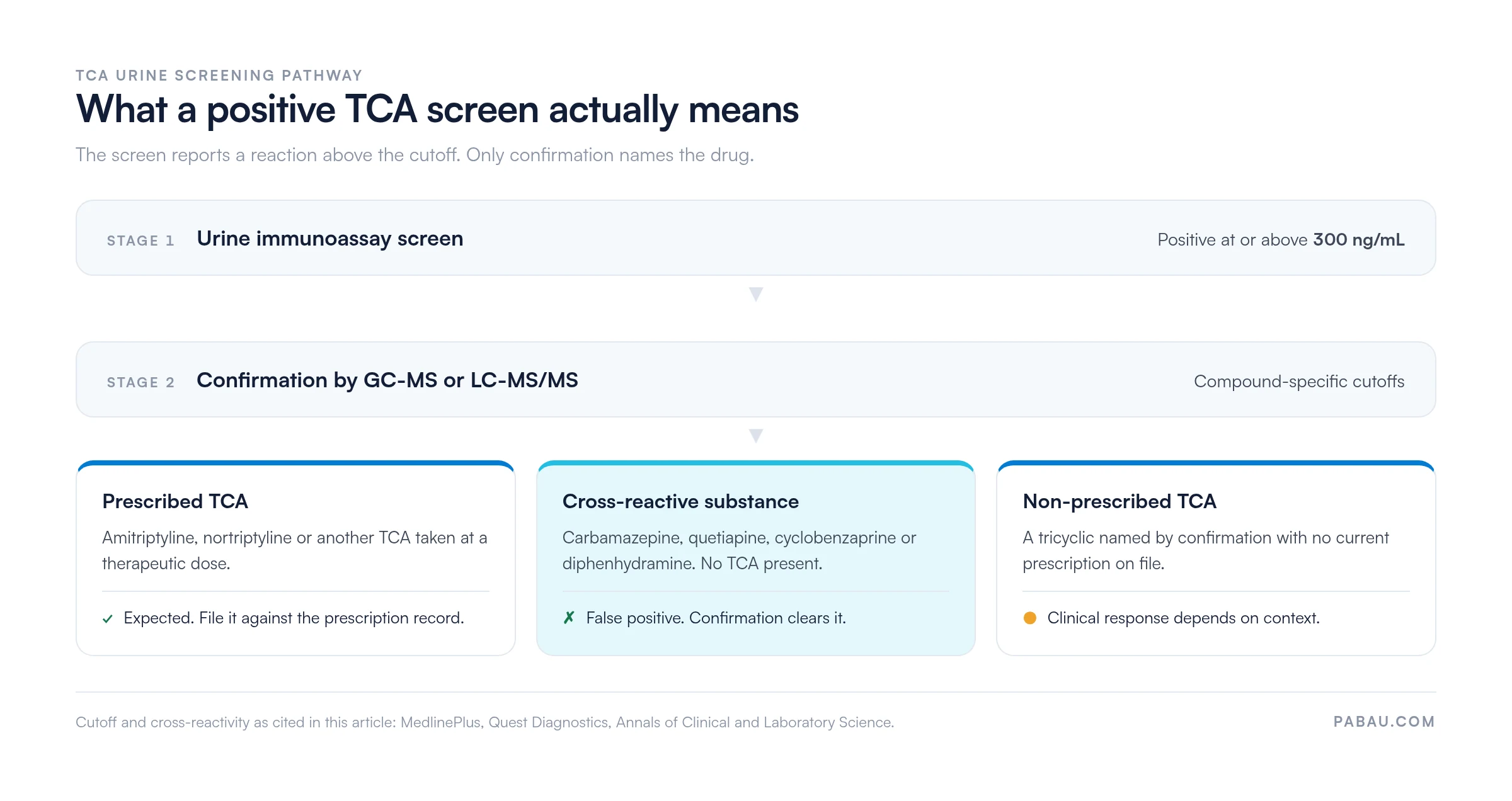
Treat every positive immunoassay as preliminary. Document it, order confirmation, and read the confirmed result against the patient’s current medication list before you draw conclusions.
TCA detection windows in urine usually run 2 to 7 days after standard therapeutic use, though individual factors move that considerably. Chronic use at higher doses can stretch detection to roughly 10 days. These are general ranges drawn from multiple laboratory sources. No single window applies to everyone, because tricyclic antidepressants have long and variable elimination half-lives.
Do not read a published range as a precise pharmacokinetic guarantee. A patient who stopped amitriptyline five days ago may still test positive, or may already be negative, depending on their clearance profile. When the timing of the last dose matters clinically, a quantitative TCA test tells you more than a qualitative screen.
Ordering the test is the small part of the workflow. What holds up later is the record around it. That record needs the indication for testing, the result received, the confirmatory outcome, and the clinical decision that followed. Outpatient psychiatry and pain management run TCA screens routinely, and the record often stops at the result.
A documented chain from indication to order to screening result to confirmatory result to clinical response is the standard a well-run practice should meet. It matters most when a positive screen has to be explained to an employer, an insurer, or a regulator.
Three points in the workflow are where the record most often stops short:
Lab order tracking inside a practice management platform holds that chain in one place. Results return to the patient record and get flagged for clinician review, so the follow-up step does not depend on someone remembering to chase it.
Patient communication belongs in the workflow too. A patient taking a prescribed TCA who faces employment drug testing should know in advance that the immunoassay stage may read positive. Tell them that this is not a failure, and that confirmation testing will identify their medication accurately. Saying it up front reduces distress and makes patients less likely to avoid testing altogether.
Document the clinical indication at the time of ordering a TCA screen, not after the result arrives. An indication note written in retrospect is harder to defend in employment or legal contexts than one created contemporaneously. A structured field in your lab order workflow settles this consistently across the whole patient panel.
Most practices run TCA screening across three disconnected systems. The order goes out through a lab portal, and the result arrives back by fax or email. The clinician’s interpretation is then typed into a note that links to neither. Reconstructing that chain months later takes an afternoon.
Practice management software like Pabau keeps the order, the result, and the interpretation on one patient record. The indication is captured as a structured field when the order is raised, so the reason for testing is recorded before anyone knows the outcome. Returned results are flagged for clinician review instead of sitting in a shared inbox.
Psychiatry EMR software earns its place in a high-volume medication practice for the same reason. When medication lists, screening orders, and confirmatory results sit together, reading a positive screen against a current prescription takes seconds rather than a phone call. Every Pabau subscription includes the full feature set, so none of this sits behind a higher tier.

Pabau helps psychiatric and primary care practices record TCA screening orders, track results, and flag positive screens for clinician review, all inside a HIPAA-compliant workflow. No disconnected paper trails.

The value of a TCA screen depends on what the practice does after it. On its own, the screen reports that something reacted with an antibody above 300 ng/mL. Confirmation turns that into a clinical fact, and the patient’s medication list turns the fact into a decision.
So build the confirmation step into the protocol rather than leaving it to whoever happens to read the result. Tell patients on prescribed TCAs what to expect before an employer tests them. Both steps cost a few minutes and head off the situations that take weeks to unwind.
Pabau keeps the indication, the screening result, and the confirmatory result on one patient record. Book a demo to see how that works in a psychiatry or pain management practice.

Choosing a system for a psychiatry practice? Psychiatry EHR walks through what medication-heavy practices should look for before they commit.
Need a structured framework for mental health assessments? Psychiatric evaluation template gives you a step-by-step structure that captures the full medication list.
Tracking how a patient responds to a prescription? ADHD medication side effects monitoring sheet shows how a simple monitoring record is laid out.
Assessing a patient with a substance use history? Drug and alcohol evaluation covers the questions a screening result rarely answers on its own.
TCA in a drug test stands for tricyclic antidepressant, a class of medications that includes amitriptyline, nortriptyline, imipramine, desipramine, clomipramine, doxepin, and trimipramine. The test is a urine or blood immunoassay. It detects whether these compounds are present above a standard concentration threshold of 300 ng/mL.
TCA on a drug test result means the sample was screened for tricyclic antidepressants. A positive result indicates that one or more compounds reacted with the immunoassay antibody above the 300 ng/mL cutoff. It does not identify the specific drug, and it does not confirm misuse without confirmatory GC-MS or LC-MS/MS testing.
False positive TCA results are caused by medications that cross-react with the immunoassay antibody. The most common are carbamazepine (Tegretol), quetiapine (Seroquel), cyclobenzaprine (Flexeril), and diphenhydramine (Benadryl). Confirmatory mass spectrometry testing resolves false positives by identifying the compound actually present.
TCAs are typically detectable in urine for 2 to 7 days after standard therapeutic use, and up to roughly 10 days with chronic high-dose use. Detection windows vary with the specific TCA compound, individual metabolic rate, renal function, and urine pH. Treat these ranges as general estimates, not precise pharmacokinetic guarantees.
No, TCA is not included in the standard 5-panel DOT drug test used for most federal workplace programs. It appears on extended panels, typically 10-panel or 12-panel screens. Those are ordered by employers requiring broader psychoactive substance detection, by probation programs, and in clinical therapeutic monitoring.
Yes, a TCA immunoassay screen will return positive if you are taking a prescribed tricyclic antidepressant at therapeutic doses. A positive screen in an employment or legal context should always proceed to confirmatory testing, which identifies the specific medication. Giving the medical review officer documentation of your prescription protects you from adverse action.