Nitrates medication list
A nitrates medication list is a point-of-care reference that sets out the main c...

1
Last Updated: Oct 6, 2026
The supination lift test is a wrist provocation test used to assess the triangular fibrocartilage complex (TFCC) in patients with ulnar-sided wrist pain. Reference sources credit its description to Buterbaugh and colleagues in 1998 and to Magee’s Orthopedic Physical Assessment.
The maneuver loads the TFCC in supination and extension, which is why it is taught as a screen for peripheral, dorsal tears. Ulnar-sided wrist pain is hard to pin down clinically. Knowing what this test can and cannot tell you matters as much as the technique itself.
One caveat shapes how much weight the result carries. No published study reports a sensitivity or specificity for the classic supination lift test. A 2025 study did validate a scored variant, the TFCC table lift (TTL) test, against wrist arthroscopy.

The supination lift test loads the TFCC in supination and extension, which stresses the peripheral, dorsal portion of the complex
A positive result is the patient’s familiar ulnar-sided wrist pain, reproduced when they try to lift a table with supinated forearms
No published study reports a sensitivity or specificity for the classic supination lift test as it is usually taught
A 2025 study of a scored variant, the TFCC table lift (TTL) test, reported 100% sensitivity and 97% specificity against arthroscopy
Practice management software like Pabau keeps test findings, referral rationale, and follow-up bookings in one patient record
The supination lift test asks the seated patient to lift a table from underneath with the forearms fully supinated and the wrists extended. That position drives an axial load through the ulnar carpus and into the TFCC.
Physiopedia and OrthoFixar both catalog the test. They describe it as a provocation test for peripheral, dorsal TFCC tears rather than for the complex as a whole.
Its clinical value lies in the loading direction. Most TFCC provocation tests compress the ulnocarpal space in pronation or neutral rotation. This one loads it in supination, so it stresses structures that a compression test in pronation can underload. Used alongside the TFCC load test and the fovea sign, it helps narrow the differential before imaging is ordered.
The triangular fibrocartilage complex is a load-bearing structure on the ulnar side of the wrist. It stabilizes the distal radioulnar joint (DRUJ) and cushions ulnocarpal loading. Its components are the articular disc, the dorsal and palmar radioulnar ligaments, and the ulnocarpal meniscus homologue. The ulnolunate and ulnotriquetral ligaments and the ECU tendon sheath complete it.
The DRUJ has minimal bony congruency, so it depends almost entirely on these soft-tissue restraints. That is why a peripheral TFCC tear produces instability rather than simple pain. Patients often describe a painful click or a sense of give-way in everyday tasks. Carrying a tray palm-up, opening a jar, and turning a stiff door handle are common triggers.
Tear location drives both symptoms and management. Central perforations of the disc are avascular and heal poorly, while peripheral tears at the ulnar attachment carry a blood supply and can be repaired.
The Palmer classification calls the peripheral ulnar-side tear a 1B lesion, and the Atzei system then grades how far the foveal attachment is involved. Supination with extension and axial load reproduces symptoms in many of these peripheral presentations. That is the mechanical rationale behind the test.
Use the supination lift test when a patient reports ulnar-sided wrist pain that worsens under load in supination. Presentations that should prompt its inclusion in the wrist screen include:
The test earns its place in sports medicine settings and hand therapy caseloads with a high volume of wrist trauma. For a physiotherapy team with a broad MSK caseload, it belongs in the wrist screen beside the TFCC load test.
It is not a standalone screening tool. In primary care, a patient often presents with no prior wrist injury. Pre-test probability is low enough there that even a positive result warrants imaging before any conclusion is drawn.
The test needs no specialist equipment. Precise positioning and consistent execution are what matter. Small deviations in elbow angle or forearm rotation change the mechanical load on the TFCC and can produce a misleading result.
The whole sequence takes under two minutes. Check that the patient is not gripping the table edge. Contact must run through the flat hand with the wrist in neutral radial and ulnar deviation. Grip substitution recruits the wrist flexors and unloads the TFCC, which can mask a positive result.
A positive supination lift test is reproduction of pain at the ulnar side of the wrist during the lift. The operative word is reproduction. The pain elicited should match the patient’s presenting complaint, not simply be new discomfort from an unfamiliar position.
A negative result does not rule out a TFCC tear. Because no validated sensitivity figure exists for this test, you cannot put a number on how often it misses one. Treat a negative finding as informative only alongside the rest of the examination. Where suspicion stays high, MRI arthrography is the practical next step.
Some clinicians grade the pain response on a 0 to 10 scale at the moment of provocation and compare it with the unaffected side. That scoring approach is what the TTL test formalizes, and it gives you a reproducible baseline for reassessment after treatment. Recording the score beats recording a bare positive or negative.
Document the exact patient position, elbow angle, and pain score at the moment of provocation, plus the score on the unaffected side. When you reassess after conservative management, identical positioning lets you compare findings reliably rather than relying on patient recall.
No published study reports a sensitivity, specificity, or likelihood ratio for the classic supination lift test as it is usually taught. Reference sites that catalog wrist special tests, including Physiopedia and OrthoFixar, describe the technique and the positive sign but list no accuracy data.
Any figure quoted for this test should be traced back to its source before you rely on it.
What the literature does offer is a validated, scored variant of the same lifting maneuver. In 2025, Marcovici and colleagues published the TFCC table lift test in the Journal of Hand and Microsurgery. The authors introduce the TTL test as a new examination, and they do not present it as the classic supination lift test under another name.
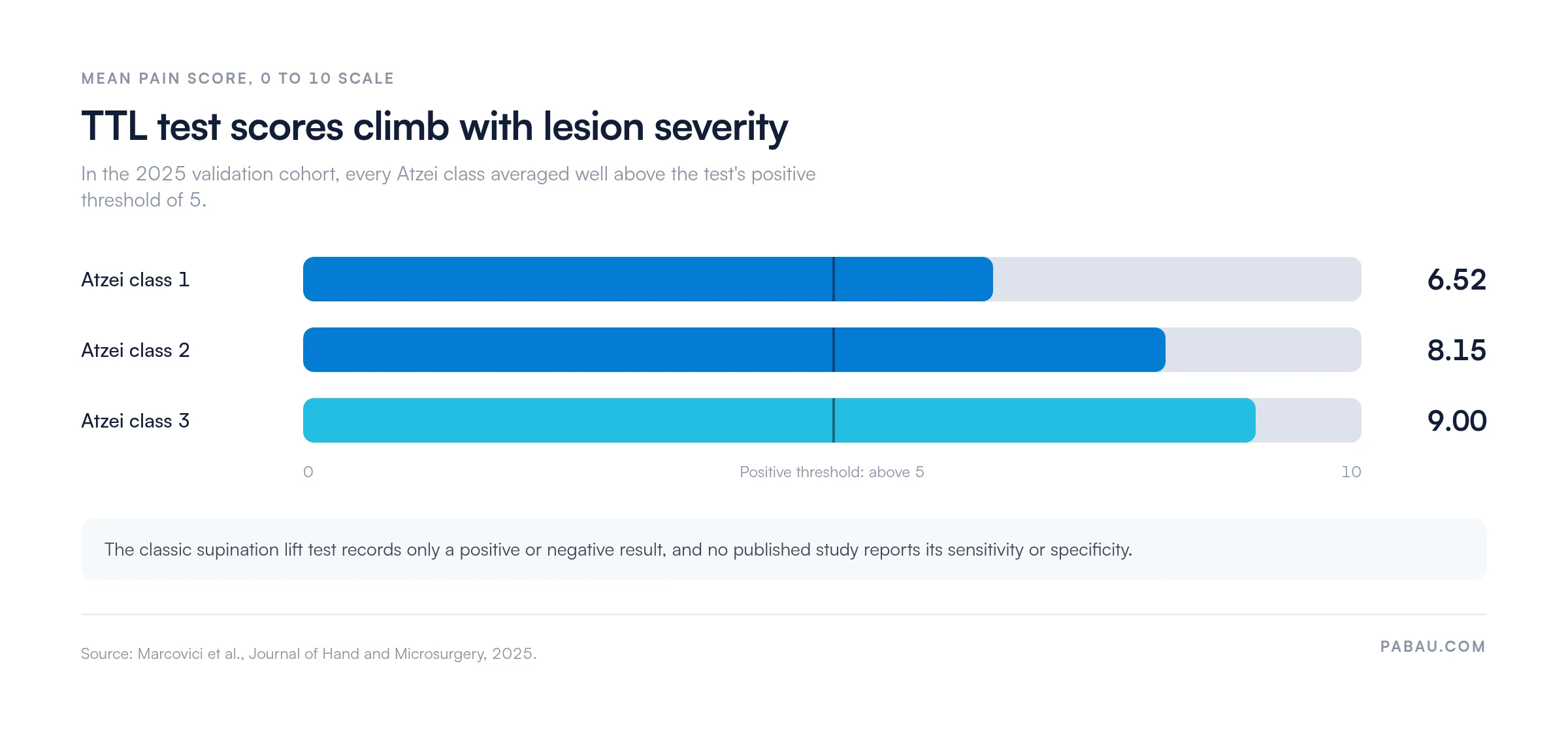
The two differ in what gets recorded. The classic test asks whether ulnar-sided pain is reproduced. The TTL test scores pain intensity on a 0 to 10 visual analogue scale and compares it with the unaffected side. The threshold for a positive result is a score above 5.
The validation study was a retrospective case-control review of 314 patients with chronic unilateral ulnar-sided wrist pain. All of them went on to wrist arthroscopy between 2016 and 2023. Arthroscopy confirmed a Palmer 1B lesion in 213 of them.
The figures below belong to the TTL test in that cohort. They are not accuracy data for the classic supination lift test.
Read those numbers with the study design in mind. Every patient in the cohort was already a surgical candidate, so the prevalence of Palmer 1B lesions was roughly 68%. Predictive values fall as prevalence falls, which means a physiotherapy or primary care caseload will not reproduce them.
The study is also retrospective and from a single center, so prospective replication is still needed.
Within that cohort, the score also tracked how severe the lesion was. Mean scores climbed across the three Atzei classes, and each class average sat clear of the positive threshold.
For updated clinical recommendations on TFCC assessment, the American Society for Surgery of the Hand (ASSH) remains a useful reference point. Clinicians can log provocation scores before and after treatment alongside validated wrist outcome measures such as the PRWE and DASH.
Five limitations shape how much weight a result should carry:
No single TFCC special test is sufficient on its own. Experienced clinicians run the supination lift test alongside a short battery of complementary tests, including the TFCC compression test and the ulnar fovea sign. Comparing the findings helps triangulate the likely site of pathology. The table below sets out the tests most often used in physiotherapy and manual therapy assessment.
The differential for a positive supination lift test includes ECU tendinopathy, lunotriquetral ligament tear, ulnocarpal impaction syndrome, and DRUJ arthritis. Clinical testing alone does not reliably separate them.
MRI arthrography or diagnostic arthroscopy is required once conservative management fails or surgical planning begins. The Physiopedia entry on the supination lift test gives a referenced summary alongside these related tests.
A positive finding is only as useful as the pathway that follows it. Where no structured documentation and referral workflow exists, results get recorded inconsistently, review appointments slip, and patients arrive at imaging with no documented clinical rationale. Reference pages describe the maneuver and stop there, which leaves each practice to design the follow-up itself.
A practical post-test workflow for a physical therapy practice looks like this:
Build a wrist assessment template in your clinical notes system that pre-populates the supination lift test, the TFCC load test, and the fovea sign. Therapists tick and score during the session rather than free-texting from recall afterward, which cuts documentation time and stops a test result being omitted.
In most MSK practices the supination lift test is recorded as a line of free text, worded differently by each therapist. That makes reassessment awkward, audit slow, and referral letters inconsistent. Practice management software like Pabau removes the retyping so the finding is captured once and reused everywhere it is needed.
Build the wrist screen once as a digital assessment form, and every therapist captures the same fields in the same order. Results land in structured client records with a timestamp against the clinician who recorded them. That audit trail matters if a case ever reaches medico-legal review.
Appointment scheduling links the review booking straight to that record, so the treating therapist opens the original findings rather than working from a referral letter. Automated workflows then send loading-progression instructions at set intervals after immobilization, which lifts the manual burden off reception.
For a multi-practitioner physiotherapy team, standardizing the workflow this way means every clinician documents the test identically. Audit and outcome reporting get much simpler as a result.
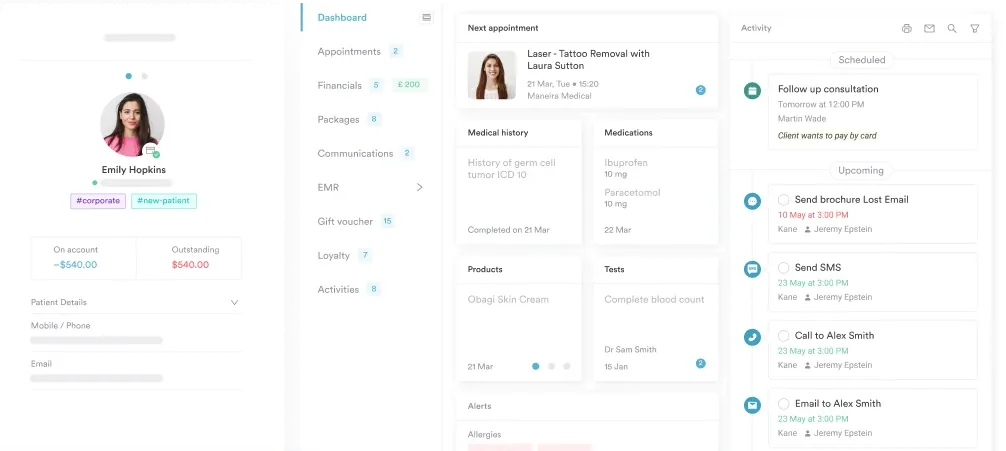

Pabau lets physiotherapy and sports medicine teams build digital assessment templates and capture test results in structured client records. Follow-up scheduling is automated, so no positive supination lift test is lost before referral.

The supination lift test gives physiotherapists and sports medicine clinicians an equipment-free way to load the ulnar side of the wrist in supination. Used within a battery alongside the TFCC load test and the fovea sign, it adds clinical information before imaging is ordered.
Used alone, it carries no validated accuracy figures, so it cannot rule a TFCC tear in or out.
The 2025 TTL test is worth watching for anyone assessing ulnar-sided wrist pain. Scoring the same maneuver, rather than calling it positive or negative, produced near-perfect results against arthroscopy in a surgical cohort. Independent prospective work in general caseloads is the next step to watch for.
The pathway after the test decides whether a positive finding changes the patient’s care. Structured documentation and a clear referral route keep positive results actionable instead of buried in free-text notes.
Pabau’s digital assessment forms, structured client records, and automated scheduling give physiotherapy and sports medicine teams one joined-up system for capturing findings and managing follow-up. To see how it works in a practice like yours, book a demo.

Screening the whole hand and wrist? Hand nerve tests walks through the sensory and motor screens that sit alongside a structural wrist examination.
Ruling in carpal tunnel syndrome? The hand elevation test is a quick provocation test for median nerve compression, with its own reported accuracy data.
Managing a high-volume MSK caseload? Physiotherapy clinic management software covers scheduling, documentation, and recall automation for multi-practitioner teams.
The supination lift test is used to assess the triangular fibrocartilage complex (TFCC) in patients with ulnar-sided wrist pain. Reference sources describe it as a provocation test for peripheral, dorsal TFCC tears. Clinicians include it in the wrist assessment battery, particularly after trauma or repetitive forearm rotation.
The patient sits with elbows flexed to 90 degrees and forearms fully supinated, placing their hands flat against the underside of a table. They then attempt to lift the table by pushing upward. The examiner watches for pain at the ulnar side of the wrist on the symptomatic side, comparing bilaterally where needed.
A positive supination lift test suggests TFCC involvement on the ulnar side of the wrist. The positive sign is reproduction of the patient’s familiar ulnar-sided pain during the lift. It does not confirm a diagnosis on its own, and MRI arthrography or wrist arthroscopy is required for definitive confirmation.
No. The TFCC table lift test, or TTL test, was introduced by Marcovici and colleagues in 2025 as a new examination. It uses the same lifting maneuver but scores pain from 0 to 10, compares it with the unaffected side, and applies a threshold above 5. The authors do not present it as the classic supination lift test renamed.
The supination lift test loads the TFCC in full supination with the wrist extended. The TFCC load test, also called the ulnocarpal stress test, applies ulnar deviation with axial compression and forearm rotation. That stresses the disc and ulnocarpal space more broadly. The two are complementary rather than alternatives.
No published study reports a sensitivity or specificity for the classic supination lift test, so its accuracy is not established. The 2025 validation of the scored TTL test reported 100% sensitivity and 97.03% specificity against arthroscopy. That was a different, newer test, studied in a surgical cohort where lesion prevalence was around 68%.
MRI arthrography should be considered when the test is positive alongside clinical DRUJ instability. It is also indicated when six weeks of conservative management has not helped, or when surgical planning is required. Plain MRI without arthrographic enhancement has limited sensitivity for partial TFCC tears, and wrist arthroscopy remains the reference standard.