Nitrates medication list
A nitrates medication list is a point-of-care reference that sets out the main c...

Last Updated: Oct 6, 2026

SAD is not a standalone DSM-5 diagnosis. It is major depressive disorder carrying a seasonal pattern specifier.
The specifier needs at least two consecutive years of seasonal episodes, with full remission between the seasons.
Seasonal episodes must substantially outnumber non-seasonal ones across a patient’s lifetime, which rules out a coincidental pattern.
Winter-pattern SAD brings hypersomnia and hyperphagia. Summer-pattern SAD runs the other way, with insomnia, poor appetite and agitation.
ICD-10-CM carries no SAD code, so clinicians bill an F33 code and document the seasonal pattern in the notes.
The seasonal affective disorder DSM-5 criteria define a seasonal pattern specifier that attaches to major depressive disorder (MDD) or bipolar disorder.
The DSM-5 lists no standalone SAD diagnosis. A clinician confirms a full depressive episode first, then adds the specifier on top of it. According to the American Psychiatric Association, roughly 5% of US adults experience SAD each year, with episodes lasting about 40% of the year.
For mental health practices, the documentation burden is the hard part. The specifier requires evidence of a temporal pattern across at least two consecutive seasons, not just the symptoms in front of you today.
This guide sets out the specifier criteria in full, plus the clinical differences between winter- and summer-pattern SAD. It then moves on to pathophysiology, ICD-10 coding, validated assessment tools, and evidence-based treatment options.
The seasonal affective disorder DSM-5 criteria sit as a specifier on top of a confirmed diagnosis. That base diagnosis is major depressive disorder, recurrent, or bipolar I or II disorder with recurrent depressive episodes. The DSM-5 lists no distinct diagnostic category for SAD. Clinicians satisfy the full criteria for a major depressive episode first, then meet all five requirements below.
Before applying the seasonal pattern specifier, confirm that the patient meets criteria for at least one major depressive episode. The DSM-5 requires five or more of the nine symptoms below in the same two-week period. At least one of them must be depressed mood or loss of interest or pleasure.
These symptoms must cause clinically significant distress or impairment in social, occupational, or other important areas. They must also not be attributable to a substance or to another medical condition.
Winter-pattern SAD is considerably more common, accounting for the majority of SAD cases according to StatPearls (NCBI). Summer-pattern SAD affects a smaller group and runs the opposite way on sleep, appetite and energy. The table below summarizes the clinical differences.
A patient who turns agitated and sleepless every June, then recovers by September, belongs in the summer-pattern differential. That holds with more force once the pattern has repeated across consecutive years.
Four biological hypotheses explain most of what drives SAD, and the mechanisms are not mutually exclusive. Each one points toward a different treatment lever, so they are worth keeping straight.
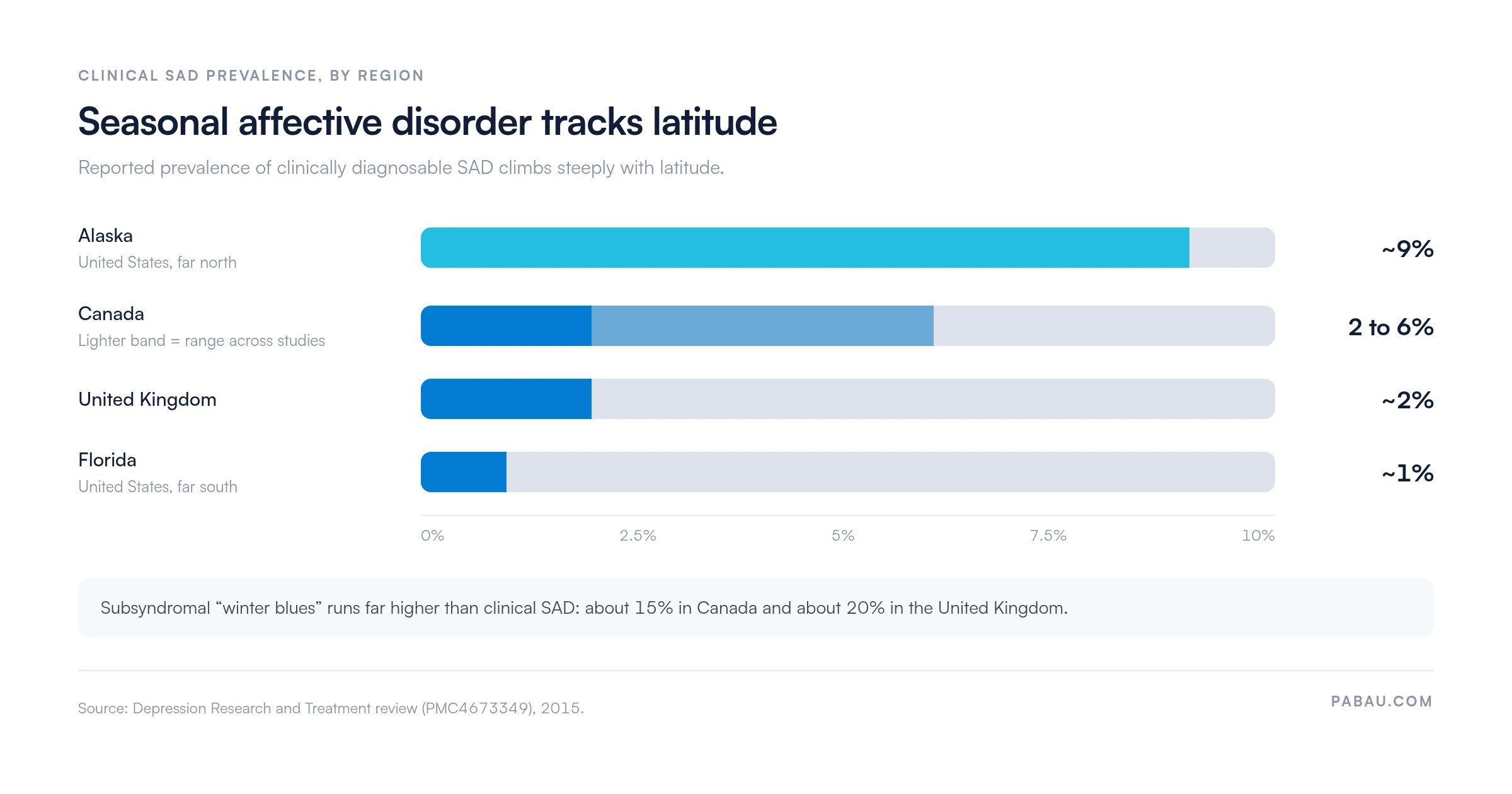
A 2015 review in Depression Research and Treatment (PMC4673349) reports clinical SAD prevalence of roughly 9% in Alaska and about 1% in Florida. Canadian estimates run from 2% to 6%, and UK estimates sit around 2%. Subsyndromal SAD, the “winter blues”, is far more common: about 15% in Canada and about 20% in the UK. Prevalence climbs steeply with latitude, and the chart below shows how steeply.
Four demographic patterns are worth carrying into the assessment:
Practices in northern states therefore carry a heavier winter caseload than their patient list alone predicts. Planning fall and winter staffing around that peak keeps appointment availability from collapsing when demand rises.
Confirming SAD requires systematically ruling out conditions that can mimic a seasonal depressive pattern. Seasonal timing alone is not diagnostic, because psychosocial stressors, medical conditions, and other mood disorders can all follow a seasonal course.
ICD-10-CM includes no specific code for SAD as a named entity. Clinicians apply the major depressive disorder code that matches episode severity and recurrence, then document the seasonal pattern in the clinical record. The table below summarizes the applicable codes.
The seasonal pattern specifier itself is documented in the clinical notes and treatment plan rather than through a separate code. Payers may request supporting documentation showing the two-year pattern, so longitudinal records matter for billing accuracy.
Where anxiety symptoms are comorbid, code them alongside the F33 code and evidence both in the same record.
Validated instruments improve diagnostic consistency and support documentation when applying the seasonal affective disorder DSM-5 criteria. Three tools are most commonly used in clinical settings.
Using the SPAQ at first fall contact, paired with PHQ-9 scores tracked monthly, builds the longitudinal record the two-year criterion needs. A psychiatric evaluation template that incorporates seasonal symptom tracking makes that record easier to keep. Pairing it with a PHQ-9 and GAD-7 template covers comorbid anxiety in the same review.
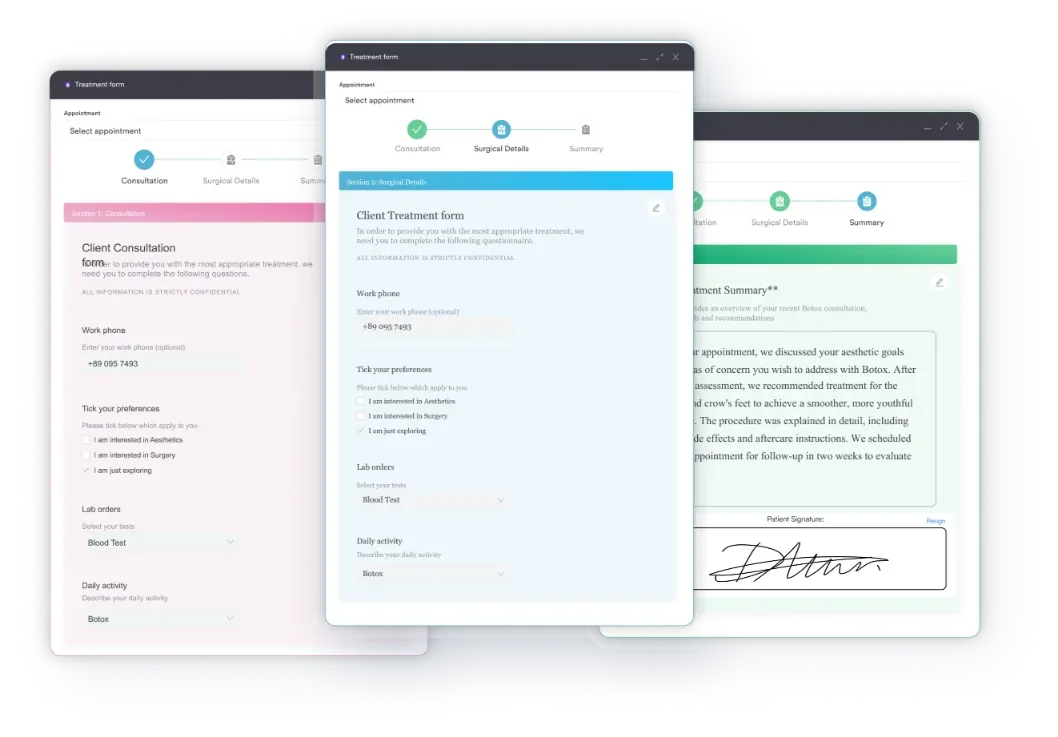
Practices that use digital intake forms can send the SPAQ and PHQ-9 automatically at intake and at each seasonal transition. Collection then happens on schedule rather than from staff memory.
Three treatment modalities have the strongest evidence base for SAD, and combining them shows additive benefit according to Mayo Clinic’s clinical review. Selection should account for episode severity, patient preference, and comorbidities.
Schedule patients with a known seasonal pattern for a proactive fall appointment, before symptoms start. Waiting until they present in distress starts treatment weeks late. That narrows the window for light therapy and raises the risk of a full depressive episode.
Longitudinal seasonal tracking is hard to systematize in a mental health practice. The seasonal affective disorder DSM-5 criteria demand evidence of a temporal pattern across at least two years. Paper notes and clinician recall rarely hold that history in a form a payer will accept.
Practice management software like Pabau keeps the whole history on one timeline instead. Our therapy practice management software is built around recurring care, which is the shape a seasonal caseload already has.
Pabau’s mental health EMR software gives practices three tools that address the tracking problem directly:
For practices carrying comorbid anxiety or other mood disorders alongside SAD, that same timeline supports measurement-based care rather than reactive appointments. The seasonal episode gets caught on the way in, while there is still time to act on it.

Pabau gives psychiatry and therapy practices structured records, digital intake forms, and automated recall workflows. Together they track longitudinal symptom patterns and keep seasonal caseloads under control.

Reading the seasonal affective disorder DSM-5 criteria takes a minute. Evidencing them takes two winters, because the proof lives in records that span both of them.
So the practical work here is a records problem. Decide now which patients get a fall recall, which instrument goes out at each seasonal transition, and where those scores land. Practices that settle those three questions once stop reconstructing a patient’s seasonal history from memory every fall.
The trade-off worth remembering is that a seasonal pattern only becomes visible in hindsight. Start recording it before you are sure the patient has it. Book a demo to see how Pabau handles seasonal recall and structured documentation for psychiatry and therapy practices.

Need a structured psychiatric intake? Psychiatric evaluation template gives you a step-by-step assessment framework with room for seasonal symptom history.
Watching burnout risk across your clinical team? Therapist burnout: signs, causes and prevention covers what drives it and what practice leaders can do about it.
Looking for between-session tools for depressed patients? Coping skills for depression sets out techniques you can hand a patient during a winter episode.
Need to track mood between appointments? Daily mood chart is a printable log that builds the season-by-season record the specifier needs.
Seasonal affective disorder is a recurrent major depressive disorder carrying a seasonal pattern specifier under the DSM-5. It is not a standalone diagnosis. The specifier requires at least two consecutive years of seasonal depressive episodes with full remission between seasons. Seasonal episodes must also substantially outnumber non-seasonal ones across the patient’s lifetime.
Yes, SAD is recognized in the DSM-5. It is classified as a specifier of major depressive disorder or bipolar disorder rather than as an independent diagnostic category. The official DSM-5 label is “major depressive disorder with seasonal pattern specifier.”
ICD-10-CM has no dedicated code for SAD. Clinicians use F33.0 for mild, F33.1 for moderate, F33.2 for severe without psychosis, or F33.9 for unspecified, based on current episode severity. The seasonal pattern is documented in the clinical notes rather than through a separate billing code.
The DSM-5 requires at least two consecutive years of seasonal depressive episodes. No non-seasonal major depressive episodes may occur in that same two-year window. The lifetime pattern must also show that seasonal episodes substantially outnumber non-seasonal ones.
SAD is a clinically validated diagnosis, supported by serotonin transporter studies and circadian rhythm disruption models. The term “winter blues” refers to subsyndromal SAD, which does not meet the full MDD threshold. Subsyndromal SAD is far more common and much less severe than clinical SAD.
Winter-pattern SAD presents with hypersomnia, hyperphagia, carbohydrate craving, leaden fatigue, and social withdrawal, and it remits in spring. Summer-pattern SAD presents with insomnia, decreased appetite, agitation, and irritability, and it remits in fall. Winter-pattern accounts for roughly 90% of SAD cases, which is why summer-pattern is missed so often.