GLP-1 diet plan
A GLP-1 diet plan is a structured eating framework for patients taking semagluti...

2
Last Updated: Oct 13, 2026

The rent test, also called transdeltoid palpation, screens for a full-thickness rotator cuff tear by feeling through the deltoid for a tendon defect.
A positive result means your fingertip drops into a defect at Codman’s point as you extend and rotate the arm.
Wolf et al. reported roughly 96% sensitivity and 97% specificity, which puts the positive likelihood ratio near 30.
The test only finds complete tears, so a negative result never rules out a partial-thickness tear.
Practice management software like Pabau keeps exam findings, laterality, and imaging referrals in one patient record.
Shoulder pain rarely tells you what is wrong underneath it. Weakness, night pain, and a painful arc turn up whether the cuff is torn or only irritated.
The rent test narrows that decision at the bedside. You palpate through the deltoid and feel for a defect in the supraspinatus or infraspinatus tendon. If your fingertip drops into a gap where firm tendon should be, a full-thickness tear is very likely.
Among shoulder tests, that approach is unusual. Most of them load or compress the cuff and read the patient’s pain response, which is easy to confuse with tendinopathy. The rent test asks a structural question instead, so technique is what decides whether the answer is worth anything.
The rent test is a shoulder special test that detects full-thickness rotator cuff tears by direct palpation. Its other name, transdeltoid palpation, describes the mechanics well. You reach through the overlying deltoid to feel the tendon footprint on the humerus.
Wolf and colleagues described the test formally in 2001 (PubMed PMID 11641706). They used surgical findings as the reference standard. A palpable defect, the “rent,” tracked closely with complete tears of the supraspinatus or infraspinatus.
Four terms circulate for the same idea, which makes reading the literature harder than it needs to be:
The test-versus-sign split matters more than it sounds. A sign is what you feel, and a test is the procedure you run to feel it. Keep them apart and study results become easier to compare, especially when a paper reports on the sign alone.
A full-thickness tear breaks the tendon from top surface to bottom surface. The torn fibers then retract away from the greater tuberosity, leaving a physical gap at the footprint. Your finger is hunting for exactly that gap.
Two things make the gap reachable. First, the deltoid is thin enough over the anterior shoulder that firm pressure gets you close to the tendon. Second, moving the arm rotates the tuberosity forward and out from under the acromion, into a position your fingertip can reach.
Two tendons account for nearly everything you will feel:
Partial-thickness tears are the obvious exception. Because part of the tendon still spans the footprint, there is nothing hollow to drop into. So a smooth, continuous ridge tells you the cuff is probably intact through its full depth, and nothing more than that.
Palpation tests live and die on consistency, so the sequence below is worth learning as a fixed routine. It follows the original description, and the rotation step is the one clinicians most often get wrong.
Rotating in one direction only is the classic shortcut, and it costs you findings. External rotation alone presents part of the footprint, so a defect sitting slightly medial or posterior can pass under your finger unnoticed. Sweep through both directions and you cover the whole attachment.
Four conditions have to hold before the result means anything. Work down the list while your hand is still on the shoulder:
Any condition you cannot tick makes the test inconclusive rather than negative. Recording that distinction matters, and safer clinical notes keep the difference visible to whoever sees the patient next.
A positive rent test means you have palpated a discrete defect in the cuff tendon through the deltoid. Instead of rolling over a firm continuous ridge, your finger sinks into the space the retracted tendon left behind.
Three features separate a convincing positive from something ambiguous:
Bone can fool you here, so keep it in mind. A healed greater tuberosity fracture, coded S42.256P when malunion follows, can leave a ridge or step that feels like a tendon edge. Radiographs sort that out quickly.
A negative test lowers the odds of a complete tear without closing the question. Large deltoid bulk, extra subcutaneous tissue, and guarding all shrink what your finger can detect. Judge the result against how the examination went, not against how it should have gone.
The published figures are the reason this test earns a place in your examination. Wolf and colleagues compared their findings against surgery and reported the following performance against full-thickness tears.
You can check that likelihood ratio yourself in a few seconds. Divide sensitivity by one minus specificity, so 0.957 divided by 0.032 lands close to 30. Cleland’s clinical examination reference reports 32.0, and Physiopedia’s rent test page carries the same source data.
Anything above 10 counts as a strong rule-in test, which puts the rent test in rare company for the shoulder. Structured decision rules such as the Ottawa Ankle Rules earn their reputation the same way. They shift probability far enough to change what you do next.
One caveat travels with these numbers. They come from a single surgical validation cohort, and independent replication has been thin since. Examiner experience and the patients walking through your door both move the figures, so treat them as a ceiling rather than a promise.
Strong numbers do not make a test universal, and this one has clear boundaries. Five of them decide whether you should lean on the result at all:
Referral hygiene follows from that last point. A positive test moves the patient toward an MRI or a musculoskeletal ultrasound, and the note should say why. Surgical planning depends on it, whether the eventual procedure is a cuff repair or an arthroplasty billed under CPT code 23472.
A rent test note needs four details. Record the side examined, the defect size in fingertip widths, whether you compared the other shoulder, and how well the patient relaxed. Without those, a follow-up examiner cannot tell whether the shoulder changed or the technique did.
Most shoulder special tests are not competing with the rent test, they are answering a different question. The table below sorts the common ones by what each one measures.
Notice the pattern in the right-hand column. Neer and Hawkins-Kennedy reproduce pain by squeezing the cuff, which tells you the space is irritated and nothing about tendon continuity. The Whipple test and the full can test read strength, and pain inhibition can weaken a shoulder with an intact tendon.
Only the rent test puts a finger on the structure in question, which is why it behaves so differently in the numbers. That advantage comes with the usual palpation trade-off. Any touch-based test rewards technique and repetition, exactly as the fibular translation test does at the ankle.
No single test carries a rotator cuff assessment, and this one is no exception. It works hardest inside a sequence that starts with history and builds pre-test probability before you touch the shoulder.
A workable order for a suspected complete tear looks like this:
Sequencing is the practical point most descriptions skip. Provocative tests leave the shoulder sore and the patient braced, and a braced arm will not extend or rotate for you. Palpate first, provoke second, and you protect the most informative test in the set.
When the rent test and the drop arm test both come back positive, a complete tear becomes the leading diagnosis. Refer for imaging at that point even if the pain seems mild, because long-standing tears often present with surprisingly modest symptoms.
Why did the defect disappear when I moved the arm further? You probably pushed past the useful range. Beyond about 20 degrees of extension the deltoid tightens over your fingertip and masks what sits underneath.
Why does everything feel like a gap on this patient? Pressing too lightly is the usual cause. Skimming the deltoid surface reads muscle texture, and muscle texture is full of soft spots that mean nothing.
Why do my findings disagree with my colleague’s? Compare notes on positioning before you doubt the test. Different amounts of extension, different rotation, or a missing side-to-side comparison will produce two honest but incompatible results.
Once imaging confirms the diagnosis, the finding keeps working for you. It anchors the baseline your rehab plan is measured against, in the same way a return-to-running protocol anchors a phased lower-limb progression.
Special tests usually land in the notes as free text, and that is where the detail leaks away. One clinician writes “rent test positive,” another writes a paragraph, and a third forgets to name the side. Six weeks later nobody can tell whether the shoulder improved or the examiner changed.
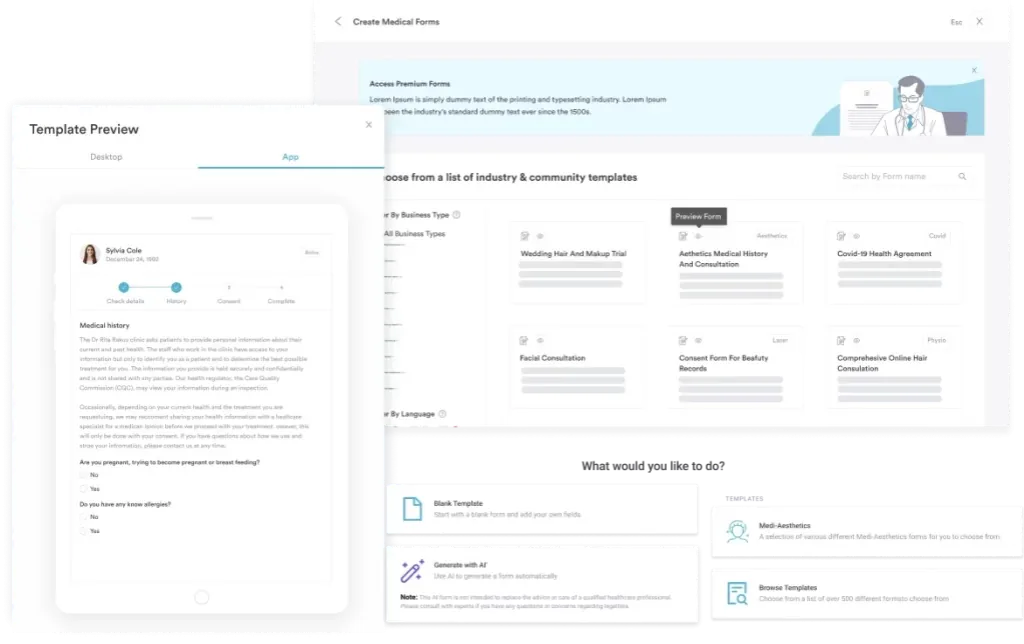
Pabau, an all-in-one practice management system, closes that loop with structured forms. You build one shoulder examination template for the whole team, with fields for laterality, defect size, relaxation quality, and the imaging decision. Every clinician then answers the same questions in the same order.
Because the form sits inside the record, the finding travels with the patient. Pabau’s digital clinical forms feed straight into the chart, referral letters pull from what you entered, and follow-up reminders fire without anyone chasing a spreadsheet. Teams running physical therapy EMR workflows at volume feel that difference fastest.
That consistency pays off across a whole caseload. Multi-clinician sports medicine software setups get audit-ready records without anyone writing longer notes, and physical therapy practice software handles the scheduling and follow-up around them.

Pabau lets physical therapy and sports medicine teams build one shoulder examination form for the whole practice. Every rent test result, laterality note, and imaging referral lands in the patient record automatically.

Learn the rotation sweep properly and the rent test becomes one of the most useful things your hands can do at a shoulder. Skip it, palpate too lightly, or work on a guarded arm, and the same test tells you almost nothing. The technique is the whole difference.
So use it early, use it on a relaxed shoulder, and let a clean positive push the patient toward imaging rather than a wait-and-see plan. Keep the trade-off in view too. This test rules complete tears in beautifully and rules nothing out, least of all a partial tear.
What decides whether that finding still helps in six weeks is how you wrote it down. Pabau’s patient record keeps the side, the defect size, and the referral together in one place. Book a demo to see how Pabau structures clinical examination notes for physical therapy and sports medicine teams.

Want another supraspinatus test to pair with this one? Whipple test walks through the technique, the accuracy data, and how to read a weak result.
Clearing a client for exercise? PAR-Q template is a seven-question screening tool that identifies clients needing medical clearance before starting exercise.
Deciding whether a knee needs imaging? Pittsburgh Knee Rules is a point-of-care card covering the mechanism screen, age and walk test qualifiers, and how to record your reasoning.
Standardizing how you record pain? PQRST pain assessment form covers Provocation, Quality, Region, Severity, and Timing for a structured, systematic pain assessment.
Clearing an athlete before the season? Preparticipation physical evaluation form is a 10-page form covering history, medications, vitals, and a joint-by-joint musculoskeletal check with provider sign-off.
No. A confirmed full-thickness tear is managed on symptoms, function, tear size, age, and activity demands, and many patients do well without an operation. The test tells you to get imaging, not to schedule surgery.
It can be. Firm pressure through the deltoid over an irritated cuff often stings, so warn the patient first and stop if they tense up. Remember that pain on palpation is not the finding, only a defect is.
No. Special tests are part of the physical examination, so they fall inside a physical therapy evaluation or a physician visit. No individual code exists for one shoulder test, which is why the finding belongs in your evaluation note.
Any clinician who examines shoulders within their scope, including physical therapists, athletic trainers, physicians, physician assistants, and nurse practitioners. Reliability tracks tactile experience more than job title, so newer examiners should compare findings with a colleague.
Yes, as a triage step. Ultrasound answers the question definitively, but scanning time is limited. A positive rent test tells you which shoulder to scan first.