Patient financing: How to offer it and stay compliant
Patient financing lets patients spread the cost of treatment over weeks or month...

Last Updated: Oct 7, 2026

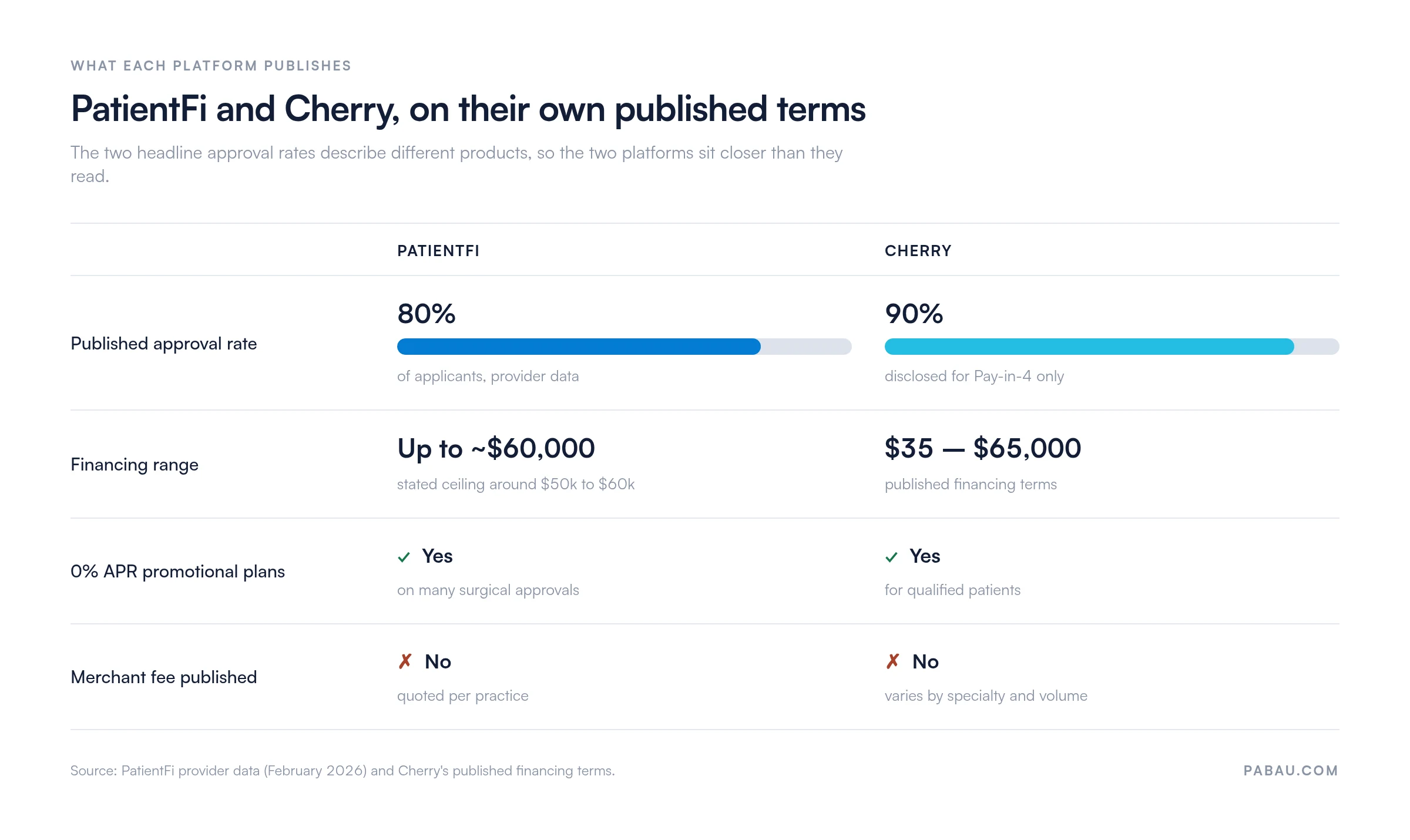
Cherry’s headline approval rate of about 90% is disclosed for its Pay-in-4 short-term plan, not for every financing tier.
PatientFi publishes an approval rate of roughly 80%, so the two platforms sit closer together than most comparisons suggest.
Both fund large cases: Cherry lists $35 to $65,000, and PatientFi’s stated ceiling sits around $50,000 to $60,000.
Both run 0% APR promotional plans, so promotional financing is not a reason to pick one over the other.
Practice management software like Pabau tracks deposits, balances, and card payments alongside either financing partner.
PatientFi and Cherry both finance elective treatment, and both publish an approval rate you have probably seen quoted in a sales deck. The two numbers do not measure the same thing. Cherry’s roughly 90% figure is disclosed for Pay-in-4, its short-term plan. PatientFi reports approving about 80% of applicants overall.
Line the published terms up and the two platforms look much closer than the usual comparison suggests. Both fund cases into the tens of thousands. Both run 0% APR promotional plans. What differs is where the financing decision happens and which specialties each one serves. Merchant cost is the third variable, and it is the one neither platform publishes.
The table below sets the published terms side by side. The sections after it break each line down and say what it means at the front desk.
PatientFi is a US-based patient financing platform built for elective healthcare. Its core audience is plastic surgery, aesthetics, and vision care, where procedures carry higher price tags and patients plan ahead. According to PatientFi’s own documentation, approved patients get fixed monthly plans with a set rate and term.
PatientFi publishes an approval rate of around 80%, based on provider data from February 2026. Approved patients can borrow up to roughly $50,000 to $60,000. Many surgical approvals also come with a zero-interest or deferred-interest promotional offer, which PatientFi states in its own materials.
The platform still leans toward borrowers with an established credit file. Patients with thin or damaged credit are the ones most likely to fall outside that 80%. For a lower-volume practice running five-figure cases, that trade rarely costs a booking. For a med spa seeing a wide credit mix every week, it shows up in the conversion rate.
Cherry is a patient financing platform built around approving as many patients as it can. Cherry states an approval rate of approximately 90%, and its own site ties that figure to Pay-in-4, its short-term plan. The longer interest-bearing tiers are not covered by the same number.
Cherry publishes a financing range of $35 to $65,000, which stretches from a single injectable appointment to a full surgical case. Qualified patients can take a 0% APR promotional period. Everyone else moves to a standard interest-bearing plan.
The platform is built to return a decision at the point of care, which shortens the distance between a patient’s interest and a booked treatment. That speed is what aesthetic practice owners most often name as the reason they keep Cherry at the front desk.
Four things decide this for most practices.
The table below sets both platforms against each of them.
Merchant fee structures are not published by either platform and vary by contract, specialty, and volume. Always request a fee schedule directly before you commit. The FTC’s guidance on credit and finance is a useful reference for your own disclosure duties when you present financing to patients.
Cherry publishes the higher number, but the two figures describe different products. Cherry’s approximately 90% is disclosed for Pay-in-4, its short-term plan. PatientFi’s roughly 80% covers its applicants overall, per provider data from February 2026. The chart below puts both on the same page.
That distinction matters at the front desk. A patient who qualifies for Cherry’s Pay-in-4 has not necessarily qualified for a 36-month plan on a $9,000 surgical case. Both numbers are marketing disclosures about a specific product. Neither one predicts what the patient in front of you will be offered.
So for a med spa running 60 consultations a month, the useful question is not which headline is bigger. It is how many of your patients need a short-term plan, and how many need a multi-year one. Cherry covers the short-term end explicitly. PatientFi’s published rate covers its whole applicant pool, which is a broader claim about a different product set.
Both lenders operate under the Equal Credit Opportunity Act, so both must assess every applicant without discrimination. What separates them is risk appetite and product mix, not their compliance posture.
PatientFi offers fixed monthly plans with a set rate for the life of the loan, so a patient knows the payment before they book. Many surgical approvals also carry a zero-interest or deferred-interest promotional offer. That gives your consultant a monthly figure and a promotional option in the same conversation.
Cherry runs a similar two-tier shape. Qualified patients get a 0% APR promotional period, and everyone else moves to a standard interest-bearing plan. Cherry adds Pay-in-4 on top for smaller balances, and that short-term plan is where its 90% approval disclosure sits.
So promotional financing is not the tiebreaker it is often presented as. Both platforms have it, and both reserve it for patients who qualify. What differs is term length. Cherry leans short and PatientFi leans long.
Under the Truth in Lending Act, both platforms must disclose APR, fees, and repayment terms clearly before a patient signs. Your practice does not carry the financing agreement itself. You should still be able to explain the broad structure when someone asks at the desk.
Merchant fees are the cost your practice absorbs for offering financing. Neither PatientFi nor Cherry publishes its merchant discount rates, and both say the rate varies by specialty, volume, and contract. The consistent theme across practitioner feedback is that PatientFi costs the practice more per financed case.
How much that matters depends on your procedure mix. A plastic surgery practice doing a handful of rhinoplasty cases a month can absorb a higher per-case fee, because the revenue per case is large. A med spa running 200 laser or injectable appointments feels the same rate far more acutely across that volume.
Ask both platforms for a written fee schedule before you sign. Merchant rates are negotiable in some cases, particularly for practices putting high monthly volume through the program.
The financing experience decides whether a patient books or leaves to think about it. Cherry’s instant decision model is built for that moment. A patient applies during the consultation, gets an answer in seconds, and leaves with a plan in place. Fewer patients need a follow-up call to convert.
PatientFi’s experience suits the pre-appointment phase instead. Patients pre-qualify before they arrive, so the money conversation is settled by the time they sit down with your practitioner. For a long surgical planning consult, that removes friction at a different point in the journey.
PatientFi fits practices whose cases run past $5,000 and whose patients tend to have an established credit file. Higher loan capacity, a fixed rate, and promotional offers on many surgical approvals make it easy to quote a monthly figure in a consultation. Pre-qualification also moves the money conversation out of the treatment room.
Roughly one applicant in five is declined, and those declines cluster among thin or damaged credit files. That hurts most in a mixed-demographic med spa. Provider feedback also points to higher merchant fees, which bite harder the smaller each case is.
The approval disclosure is the headline, but the operational benefit is the decision speed behind it. A patient applies at the desk and gets an answer while they are still in the room. Your team presents the option, the patient applies, and the plan is confirmed before they leave.
In a med spa, that checkout moment is where financing either lands or lapses. Practices already running dedicated medical spa software take payment at that same moment. An instant financing decision then drops into a flow the team already follows.
Patients who miss the promotional tier can face a meaningful APR on a standard plan. The 90% figure also covers Pay-in-4 only, so a practice quoting it for surgical financing is quoting the wrong number. Merchant rates vary by specialty, so ask for a written schedule before you sign.
Both platforms serve the aesthetic market, and the honest deciding factors are your case mix and where financing happens in your patient journey.
Choose Cherry if: your treatments run from a single appointment up to a full surgical case. It also fits when you want a short-term interest-free option at the desk and convert at the checkout moment. Med spas, injectable-led practices, and dental practices sit here most often.
Choose PatientFi if: your practice is built on plastic surgery or other high-cost elective work, and your patients tend to pre-qualify before the visit. Fixed monthly payments over 12 to 36 months suit someone planning a significant investment, and promotional terms are available on many surgical approvals.
Some practices run both. Plastic surgery groups with a med spa attached often keep PatientFi on the surgical side and Cherry at the aesthetic desk. Two programs add admin, which stays manageable when your practice software shows both revenue streams in one dashboard. Our roundup of the best medical spa software covers the platforms that handle it.
Before you commit to either platform, run the numbers on your last three months of consultations. Count how many patients paid out of pocket, how many asked about financing, and how many left without booking. That ratio tells you whether you need a short-term plan at the desk or longer terms on bigger cases. Both platforms will walk a practice representative through their fee structure before you sign.
Neither platform removes the admin around a financed treatment. The appointment still needs confirming, the consent still needs signing, and the payment still needs matching to the service delivered. That work sits in your practice management system, not in the financing portal.
Practice management software like Pabau keeps that side in one place. Pabau’s payment processing tools sit alongside whatever financing a patient has arranged. You can take a deposit at booking, track the balance owed, and reconcile takings across card, cash, and financed treatments from one screen.
Pabau Pay, our card terminals, covers the in-person side. A deposit taken on a clinic POS terminal lands against the same client record as the booking. For a practice running PatientFi and Cherry side by side, that is the difference between one revenue report and three.

Pabau brings scheduling, deposits, digital consents, and payment tracking together, so your team spends less time reconciling admin and more time with patients. Book a demo to see how it handles a practice running third-party financing.

The headline numbers should not decide this for you. Cherry publishes the broader short-term approval rate and PatientFi publishes a whole-pool rate. Both fund cases into the tens of thousands, and both offer promotional terms to patients who qualify.
Ask each platform for a written fee schedule, then hold it against your own case mix. If most of your revenue is decided at the chair, the faster decision is worth more than a bigger ceiling. If patients plan weeks ahead, pre-qualification matters more than speed.
Whichever partner you pick, the payment record belongs in your practice system rather than a third-party portal. Book a demo to see how Pabau tracks deposits, balances, and card payments alongside patient financing.

Comparing payment tools for your practice? Best integrated payment processing tools weighs the platforms that keep takings and client records in step.
Taking payment at the treatment room door? Medical spa POS software covers what a point-of-sale setup needs to handle deposits, packages, and retail.
Financing surgical cases as well as aesthetics? Best plastic surgery software reviews the platforms surgical practices use to manage payments and records.
Both are US-based patient financing platforms for elective healthcare, and their published terms overlap more than most comparisons suggest. Cherry discloses an approval rate of about 90% for its Pay-in-4 short-term plan and returns decisions at checkout. PatientFi publishes an approval rate of around 80% overall and leans on pre-qualification before the visit. Both fund large cases and both offer promotional 0% APR plans, so the practical differences are merchant fees, decision timing, and specialty focus.
Cherry publishes a financing range of $35 to $65,000, which covers a single treatment and a full surgical case alike. PatientFi’s stated ceiling sits at roughly $50,000 to $60,000 for approved patients. Neither platform is limited to small balances, so loan size is rarely the deciding factor between them. The amount an individual patient is offered still depends on their own credit assessment.
Yes, and some practices do. Plastic surgery groups that also run a med spa commonly use PatientFi for surgical cases and Cherry for the aesthetic side. Managing two programs adds some administrative overhead, but it lets you match the term length to the treatment. Using a practice management platform that centralizes payment tracking across both programs makes it far easier to reconcile.
Yes. PatientFi is a legitimate US-based lender operating under federal consumer lending regulations, including Truth in Lending Act disclosure requirements. Patients receive clear disclosure of APR, fees, and repayment terms before signing any agreement. Established plastic surgery and aesthetic practices across the United States use the platform. As with any consumer loan, patients should read the agreement carefully and confirm terms directly with PatientFi.