Professional development record
A professional development record is a structured log of a healthcare practition...

8
Last Updated: Oct 8, 2026

Patient complaints cluster into five categories: communication failures, wait times, billing confusion, staff conduct, and missing follow-up.
Acknowledge every complaint within 24 to 48 hours, investigate it, answer in writing, and log the outcome.
A grievance is a written complaint asking for a formal answer, and it carries regulatory deadlines a complaint does not.
Complaint records hold protected health information, so HIPAA privacy rules apply to the log just as they do to the chart.
Tag each complaint by category at intake, then read the log quarterly to find the process behind the pattern.
Handling a patient complaint well comes down to four moves: acknowledge it fast, investigate it fairly, answer it in writing, and log what happened. The order matters, and so does the paper trail.
Complaints that reach a regulator or a public review page almost always started as something small that was answered badly. A slow reply turns a billing question into a formal grievance.
A BMJ Quality & Safety systematic review found that complaints are one of the least used sources of quality improvement data in healthcare. This guide covers the five complaint categories and the five-step response. It also covers the documentation each step owes the log, and where the grievance line sits.
Research across healthcare systems keeps finding the same five categories. The BMJ review mapped them across multiple systems, which suggests they are structural rather than local. Here is the taxonomy, with the operational cause sitting behind each one.
Communication failures top the list in every major study. The BMJ review put communication and information problems first across healthcare systems. A patient who does not know what is happening feels unsafe, and that becomes a complaint even when the clinical care was sound.
The response decides whether the situation settles or spreads. The framework below applies to any complaint type, from a disputed invoice to a clinical concern.
Speed signals seriousness. A patient who hears nothing for a week assumes they are being ignored, and escalates. The acknowledgment does not have to settle the complaint. It has to confirm that the complaint arrived and is being taken seriously.
Effective language: “Thank you for letting us know. We take your experience seriously and are reviewing what happened. We will be back in touch within [timeframe].” This shows accountability without admitting liability. Avoid wording that assigns blame, minimizes the experience, or promises an outcome before the investigation is done.
Review the clinical record, the appointment notes, and any communication log tied to the visit. Speak with the staff member involved, separately from the patient conversation. The aim is to establish what happened, not to defend a position.
Note whether the complaint reveals a one-off failure or a pattern. A single billing error is a process correction. The third billing complaint in a month is a workflow problem. Your client records should surface the full appointment and message history in under two minutes.
The written response should name what happened, acknowledge the effect on the patient, and describe what changes next. Patients rarely want compensation first. They want to know they were heard, and that the same experience will not land on the next person.
Resolution means the patient has a substantive answer, not only an acknowledgment. If the outcome involves a refund, a follow-up appointment, or a policy change, write down what was agreed and by when. Verbal resolutions that nobody confirms in writing tend to re-escalate.
Log every complaint, whatever its severity. That log is both a legal protection and a quality improvement tool. Six months of tagged complaints will tell you more about a practice’s weak points than any staff survey.
Each of those five steps owes the log a specific entry, and the mapping below is what makes a complaint file defensible later.
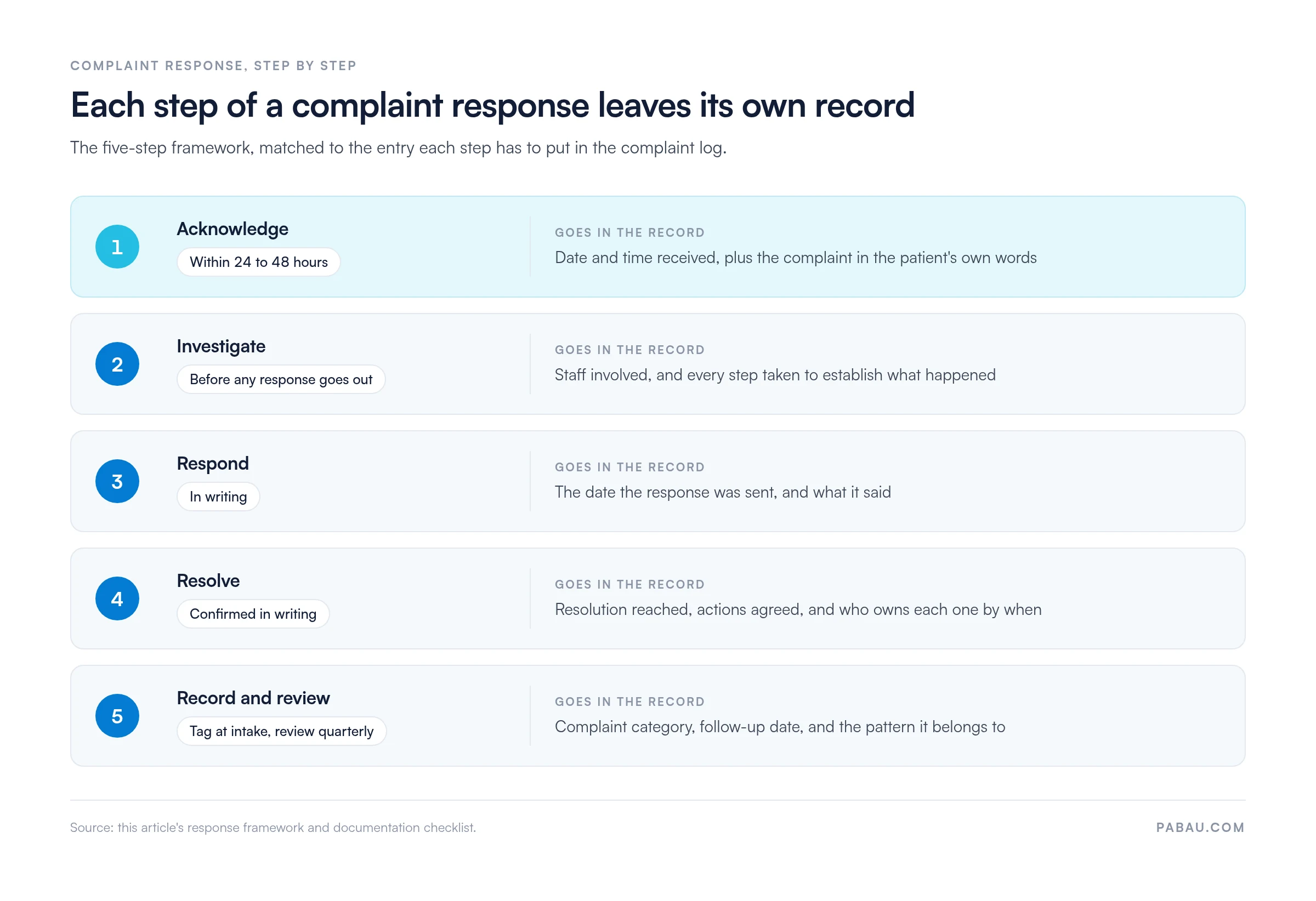
Complaint documentation does two jobs: legal protection and quality data. A complaint handled well but never written down offers no protection if the patient escalates later. A 2008 BMJ article on dealing with complaints makes the same point. Written records are the foundation of a defensible response.
Every complaint record should capture the following. A standard form, or a dedicated field in the client record, keeps the list from getting shortened on a busy day.
Complaint records often contain protected health information, known as PHI. Under HIPAA, complaint documentation needs the same privacy protection as the clinical record. Do not keep complaint logs in open email threads or shared spreadsheets.
Audit your complaint log quarterly. If more than 20% of complaints share one category, treat it as a systemic issue rather than a run of isolated incidents. Tag complaints by category at intake, so the quarterly review is a filter rather than a manual read-through.
The two words get used interchangeably, but they carry different regulatory weight in the US under CMS guidelines. Getting it wrong means answering casually where a formal process was required.
A complaint becomes a grievance in three situations:
A practice that answers a written grievance verbally is out of step with the CMS Conditions of Participation. Response deadlines vary by state and accreditation body, so check with your compliance advisor rather than assuming one universal rule.
A complaint that reaches the Joint Commission, a state health department, or a medical licensing board runs on someone else’s process. External investigations are not handled the way internal ones are, and an unprepared practice usually makes the situation worse by answering defensively or inconsistently.
The Agency for Healthcare Research and Quality publishes guidance on patient safety event reporting that shapes how regulators read a complaint. Five points matter for a practice.
Any discussion of clinical negligence belongs with legal counsel. A practice’s own view of whether an incident was negligent is not the test regulators apply, and a premature admission can be used later.
Complaint data only pays off when someone reads it. A practice that logs complaints without reviewing them has done the paperwork and skipped the improvement. The BMJ review names complaint data as one of the least used quality improvement resources in healthcare.
A quality improvement cycle built on complaint data looks like this. Start by measuring patient satisfaction alongside the complaint log, so you can line up dissatisfaction signals with complaint spikes.
That is the same feedback loop the BMJ article recommends for continuous improvement.
Prevention beats management. Four of the five top categories are addressable upstream, with better systems and better communication. These are the moves with the highest return for the effort.
No prevention program gets complaint volume to zero. The goal is to shrink the avoidable share, while building the response system that handles the rest well.
Most complaint processes break at the same point. The information needed to investigate sits in four places. The clinical note is in the EMR and the appointment is in the scheduler. The follow-up sits in someone’s sent mail, and the complaint itself in a Word document.
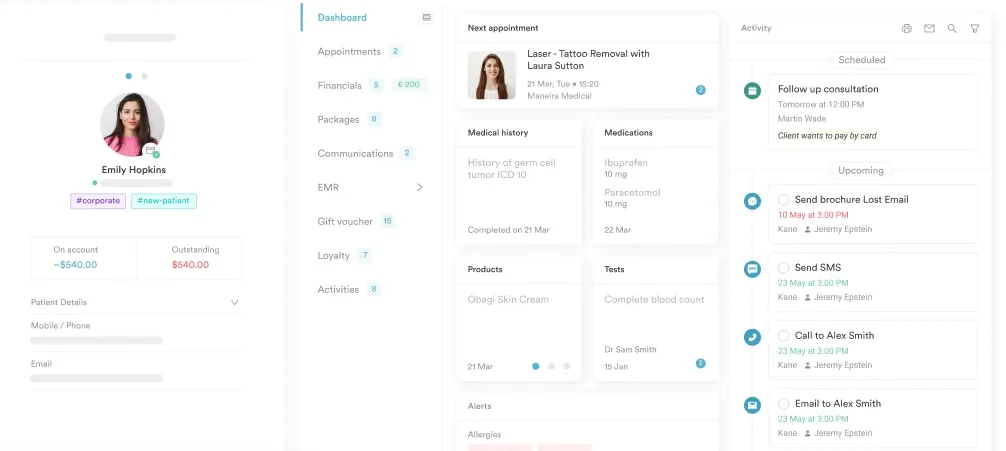
Pabau keeps them together. Appointment history, clinical notes, messages sent, and follow-up all hang off one client record, so a complaint can be investigated from a single screen. The investigation gets faster and the write-up gets more complete, because nobody has to reconstruct the timeline from memory.
Four capabilities in particular take the pressure off the categories that generate the most complaints.

Pabau keeps appointments, notes, messages, and follow-up in one client record, so any complaint can be investigated from one history instead of four systems. Automated follow-up then removes the most common reason patients complain at all.

Patient complaints measure the distance between what a patient expected and what they got. That distance closes fastest in practices that treat complaints as operational data, rather than as isolated incidents to survive.
So the work is unglamorous. Tag at intake, answer inside 48 hours, put the resolution in writing, and read the log every quarter. A complaint log only earns its keep once someone reads it. Put the quarterly review in the calendar before you build the form.
If your practice is rebuilding its complaint process, the fastest win is getting the record into one place. Book a demo to see how the whole complaint trail sits inside one client record.

Worried what a complaint does to your search results? Healthcare reputation management covers how practices monitor and answer public reviews without making the problem bigger.
Want the workflow that sits underneath all of this? Patient care management shows how appointment history, notes, and follow-up connect inside one client record.
The five categories are communication failures, long wait times, billing and insurance confusion, staff conduct, and missing post-visit follow-up. Communication comes first in every major study, including the BMJ Quality and Safety review of complaint data across several healthcare systems.
A complaint is an informal expression of dissatisfaction, verbal or written, that the practice can resolve through its standard process. A grievance is a formal written complaint that triggers regulatory obligations under the CMS Conditions of Participation, including a written response and a documented investigation. The distinction matters because treating a grievance as an informal complaint puts the practice out of compliance.
Acknowledge within 24 to 48 hours, then investigate by reviewing the records and speaking with the staff involved. Respond in writing with your findings and any corrective action, and document the resolution. Wording that shows empathy without admitting liability works better than a defensive reply.
Record the date received, the patient’s description in their own words, staff involved, investigation steps taken, the written response sent, and the resolution reached. Complaint records that contain protected health information must be handled under HIPAA privacy standards, not kept in open spreadsheets or email threads. Log every complaint regardless of severity, since six months of records reveals systemic issues that individual complaints obscure.
The practice follows its formal grievance procedure, answers in writing within the required timeframe, and retains the documentation. If the patient escalates to the Joint Commission, a state health department, or a licensing board, external investigators get involved. They will ask for the original complaint, the investigation, and the response. Practices without a documented process are far more exposed here.
Four moves do most of the work. Send pre-appointment information that sets accurate expectations. Tell patients about delays at the point of care rather than afterwards. Automate post-appointment follow-up so nobody is left in silence. Then capture feedback right after the visit, so an unhappy patient has a channel to you before they have one to Google.