CRM for chiropractors: how to manage patients, bookings and marketing
A CRM for chiropractors is a patient relationship management system built around...

Last Updated: Oct 13, 2026

The passive compression test is a shoulder assessment developed by Kim et al. in 2007 to detect SLAP lesions of the glenohumeral joint.
A positive result is pain or an audible click in the glenohumeral joint when axial compression is applied with the arm abducted 30 degrees.
Sensitivity is about 82% and specificity about 86%, which makes it one of the stronger single tests for superior labral pathology.
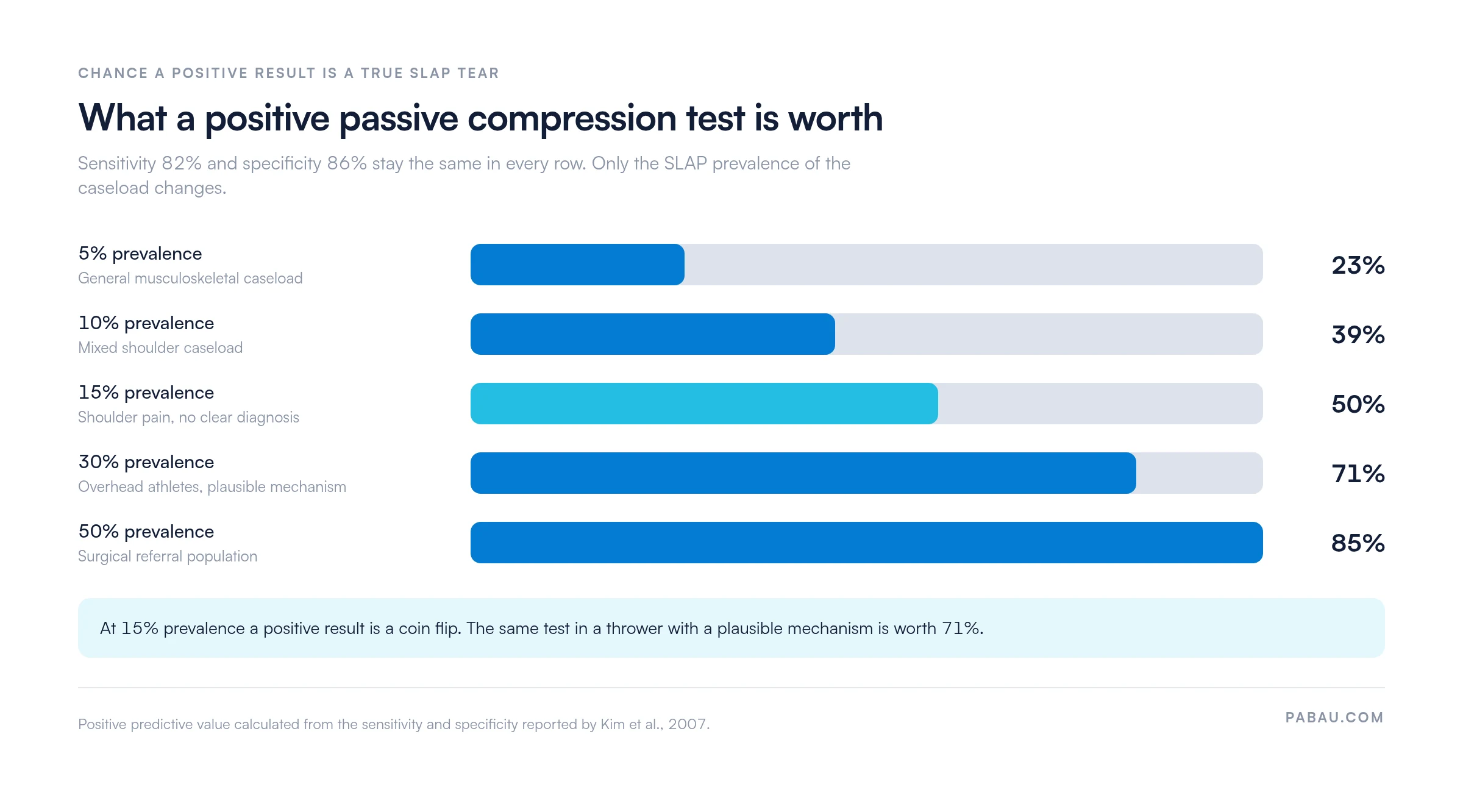
A positive result is only worth about 50% at 15% SLAP prevalence, so your caseload mix decides how much the test tells you.
Pabau’s digital forms let physical therapy and sports medicine practices record special test findings in structured, searchable SOAP notes.
SLAP tears are hard to confirm on clinical examination alone. Most shoulder special tests were described before diagnostic accuracy studies were routine, so clinicians inherited a crowded toolkit with thin evidence behind it. The passive compression test is better documented than most of them. It came out of a peer-reviewed study, it carries published sensitivity and specificity figures, and its technique is defined tightly enough to reproduce.
This guide covers the anatomy rationale, the step-by-step procedure, the interpretation criteria, and the diagnostic accuracy figures. It also covers what those figures are worth in a general caseload. Then it compares the test with the O’Brien test, crank test, and biceps load test.
The passive compression test is a clinical orthopedic examination used to detect superior labral (SLAP) lesions of the glenohumeral joint. Kim et al. first described it in their 2007 study in the American Journal of Sports Medicine. The test loads the superior labrum with an axial compressive force through the humerus. The shoulder sits in a position of vulnerability for labral tissue while you apply it.
The Kim test for posteroinferior labral lesions comes from a separate, earlier paper by the same group. The two are often cited together in error, so treat them as different tests with different evidence behind them.
Earlier SLAP tests relied on active muscle contraction, joint rotation, or both. The passive approach removes active muscle force, which isolates the compressive load on the labrum. That mechanical rationale is why the passive compression test adds information even when used alongside the O’Brien active compression test.
Understanding what the passive compression test loads takes a working knowledge of the superior labrum. The glenoid labrum is a fibrocartilaginous ring that deepens the shallow glenoid socket, raising glenohumeral stability by roughly 50% in translation resistance.
The superior portion is anatomically distinct. It is the origin of the long head of the biceps tendon, known as the biceps anchor. That leaves it open to traction, compression, and shear during overhead or throwing activity.
Snyder et al. originally classified SLAP lesions into four types. Type I is degenerative fraying without detachment. Type II is the most common and the most clinically significant. It is a detachment of the biceps anchor from the superior glenoid tubercle.
Type III involves a bucket-handle tear of the superior labrum with an intact biceps anchor. Type IV extends that bucket-handle tear into the biceps tendon. The passive compression test is most sensitive for Type II lesions. The biceps anchor is destabilized there, so axial loading provokes the characteristic pain or click.
That distinction matters clinically. A positive test in an overhead athlete after a fall on an outstretched arm means one thing. The same result in a 55-year-old with insidious pain and rotator cuff degeneration means something else. The test detects labral loading. The clinical picture decides what happens next.
Practices working in sports medicine see Type II SLAP tears most often in throwers, swimmers, and gymnasts.
The passive compression test needs consistent patient and examiner positioning. Variation in abduction angle or force direction is the single biggest source of false negatives.
The patient lies supine on the examination table. The shoulder being tested is abducted to 30 degrees in the scapular plane, with the elbow in full extension. The forearm can sit in neutral rotation or slight external rotation. Kim’s 2007 protocol used a neutral forearm, so that is the default unless clinical reasoning suggests otherwise.
The examiner stands at the side of the table, level with the patient’s shoulder. One hand cups the posterior aspect of the elbow. The other stabilizes the shoulder girdle at the acromion, which prevents scapular compensation.
A steady axial compressive force is then applied along the long axis of the humerus, toward the glenohumeral joint. The force should be firm rather than impulsive. A gradual ramp over two to three seconds gives the patient time to separate pressure from pain.
One contraindication note applies here. Skip the passive compression test where you suspect an acute proximal humeral fracture. Skip it too with acute instability, significant soft-tissue disruption, or uncontrolled pain at rest. Axial loading in those cases adds no diagnostic value and risks harm.
A positive passive compression test is reproduction of the patient’s concordant pain during axial compression. A click or clunk felt or heard in the glenohumeral joint is also a positive. Either finding stands on its own, and neither requires the other.
Three interpretation points separate clinically meaningful positives from incidental findings:
The Kim et al. 2007 study is still the primary source for diagnostic accuracy data. It compared passive compression test findings against arthroscopic confirmation as the reference standard. Those figures are cited widely across physical therapy teaching resources. They also come from a single-center study population, which limits generalizability.
An LR+ of 5.7 puts this test in the moderate-to-large shift category for Bayesian reasoning about post-test probability. In a population with 30% pre-test probability, a positive result pushes post-test probability to roughly 71%. The LR- of 0.21 cuts probability substantially without ruling a SLAP lesion out.
Those likelihood ratios are fixed. What a positive result is actually worth is not, because it moves with the SLAP prevalence of the caseload you are testing in.
Knowing where a test fails is what tells you when to trust a result. Four things limit the passive compression test in day-to-day practice.
Combine the passive compression test with the O’Brien active compression test and a biceps load test rather than using any single test in isolation. A cluster of two or more positive SLAP-specific tests raises post-test probability substantially more than one positive result alone.
Several shoulder special tests target superior labral pathology. Knowing how it differs from the O’Brien test, the crank test, and the biceps load test helps you build a rational examination battery.
The O’Brien test is performed with the arm at 90 degrees of flexion, 10 to 15 degrees of horizontal adduction, and the elbow extended. The examiner applies a downward force while the patient resists, first with the forearm fully pronated, then supinated. A positive SLAP result is pain in pronation that eases or disappears in supination.
The key difference from the passive compression test is the active muscle component. O’Brien’s original 1998 paper describes a test that loads the superior labrum through biceps tension rather than pure joint compression. It also screens AC joint pathology, because AC pain persists in both forearm positions.
The crank test loads the glenohumeral joint with the arm at 160 degrees of elevation in the scapular plane. The examiner applies axial compression along the humerus and rotates the joint internally and externally at the same time. A positive test reproduces pain or a click.
Adding rotation to the axial load gives the crank test a shear component across the labrum that the passive compression test does not have. That may explain why some lesions show up on one test and not the other. Both target the same structure by complementary mechanical routes.
The biceps load test places the shoulder in 90 degrees of abduction and 90 degrees of external rotation, the position of maximum instability. The patient then tries to flex the elbow against the examiner’s resistance. A positive test is pain or increased apprehension during that contraction.
This test recruits the long head of the biceps directly. It puts a tensile load on the biceps anchor rather than a compressive one. Our biceps load test template sets out the full protocol and a recording sheet you can hand to a colleague. Pairing its 97% specificity with passive compression test sensitivity gives you two readings of the same lesion type.
Use it when the presentation already creates a plausible pre-test probability of a SLAP lesion. Three scenarios raise that probability enough to justify the test.
Should the test ever be used in isolation? No. A single positive result is grounds for further investigation, not a diagnosis. MRI arthrography remains the imaging gold standard for SLAP tears, with reported sensitivity of 82% to 94% depending on technique and reader experience. A positive test in a clinically appropriate patient warrants orthopedic or imaging referral.
Accurate documentation of special test findings protects patients, supports medicolegal defensibility, and lets you compare a reassessment against the original. A free-text entry that reads “shoulder tests done” does none of that.
A purpose-built physical therapy EMR lets you embed orthopedic special test fields directly into an assessment template. The same fields then get completed on every patient, by every clinician.
A complete passive compression test entry should record the following:
Record shoulder range of motion in the same entry, because a SLAP lesion rarely presents without a movement restriction worth tracking. Our shoulder range of motion chart gives those numbers a consistent format across the team.
Most practices log a special test result as a line of free text in whatever note-taking tool they have. The wording changes between clinicians, the fields drift, and a reassessment six weeks later has nothing consistent to compare against.
Practice management software like Pabau handles this with digital forms you build once. You can create a shoulder assessment template with fixed fields for laterality, result type, pain concordance, and clinical impression. Every clinician on the team then completes the same fields, in the same order.

Each entry links to the appointment date, the clinician, and the treatment plan. That gives you a traceable line from first assessment through to discharge. Because the fields are structured rather than free text, you can search across them and pull every positive result in a caseload.

Pabau gives physical therapy and sports medicine practices structured digital forms for recording special test findings, SOAP notes, and laterality. No paper, no transcription errors, and every assessment searchable in the patient record.

The passive compression test earns its place in a shoulder examination. It carries published accuracy figures and a positive likelihood ratio that genuinely moves clinical probability. Neither of those makes one positive finding a diagnosis.
The judgment worth carrying away is that the same result means different things in different caseloads. Pair the test with the O’Brien and biceps load tests, and weigh the mechanism against the history. Then treat a positive as a reason to investigate further.
Consistent records are what let you compare today’s result against the last one. Book a demo to see how Pabau structures shoulder assessment notes for physical therapy and sports medicine teams.

Need the O’Brien test protocol in full? O’Brien’s test: how to perform and interpret the result walks through the pronation and supination sequence, and what separates labral pain from AC joint pain.
Assessing a possible labral tear from another angle? Clunk test: procedure, accuracy and free template covers the compression-plus-rotation technique and gives you a recording sheet.
Ruling the supraspinatus in or out first? Whipple test: technique, accuracy, and interpretation covers the overhead reaching presentation that most often mimics labral pain.
Need a rotator cuff test to sit alongside this one? Full can test: procedure, interpretation, and accuracy reports its 77% sensitivity and what to record in the note.
Managing a physical therapy practice? Physiotherapy clinic management workflows covers how practice management software fits around clinical documentation.
The passive compression test is a clinical orthopedic assessment used to detect SLAP (Superior Labrum Anterior to Posterior) lesions of the glenohumeral joint. Kim et al. described it in 2007. The examiner applies axial compression along the humerus to provoke pain or a click from the superior labrum.
A positive passive compression test is reproduction of the patient’s concordant shoulder pain, an audible or palpable click in the glenohumeral joint, or both. The compression is applied along the long axis of the humerus. Pain that does not match the presenting complaint is less clinically meaningful.
Kim et al. (2007) reported sensitivity of about 82% and specificity of about 86%. The positive likelihood ratio was 5.7 and the negative likelihood ratio 0.21. Those figures come from a surgical referral population, so performance may be lower in a general physical therapy caseload.
The passive compression test applies a pure axial compressive load with no active muscle contraction. The O’Brien active compression test asks the patient to resist a downward force with the arm at 90 degrees of flexion. The O’Brien test also screens AC joint pathology by comparing pronated and supinated forearm positions.
No. A positive passive compression test means further investigation is warranted, not that a SLAP tear is confirmed. MRI arthrography is the imaging gold standard for SLAP diagnosis. Use the test alongside clinical history, mechanism of injury, and other special tests. O’Brien, biceps load, and crank tests all add information before you refer.
A superior labral tear test is any clinical examination that provokes symptoms from the superior glenoid labrum. Alternatives include the O’Brien active compression test, the crank test, the biceps load test, and the Kim test. Each loads the labrum through a different mechanical route. Using two or three as a cluster beats any single test on accuracy.