Bear hug test: Procedure, interpretation and free template
The bear hug test is a quick shoulder special test that screens for subscapulari...

2
Last Updated: Oct 23, 2026

The full can test loads the supraspinatus with the arm at 90 degrees of scapular abduction, thumb up.
Pain, weakness, or both counts as a positive result, pointing to a supraspinatus tear, tendinopathy, or impingement.
Weakness is the criterion worth trusting, at 77% sensitivity and 74% specificity for full-thickness tears.
The full can position provokes less impingement than the empty can test, so painful shoulders tolerate it better.
Record which criterion turned positive, because pain alone and weakness alone lead to different next steps.
A patient raises their arm to shoulder height, you press down, and the arm gives way. That moment tells you more about the supraspinatus than anything in the history.
The full can test provokes that response on purpose. Thumb up, arm at 90 degrees in the scapular plane, then a steady downward push.
Most clinicians get the position right. Reading the response is harder. Pain and weakness carry different weight, and only one of them tracks a torn tendon well. That difference decides whether your patient starts rehab or heads for imaging.
The full can test is a resisted abduction test that screens the supraspinatus tendon for a tear, tendinopathy, or subacromial impingement. It takes a couple of minutes and needs nothing beyond your hands.
The only other name it carries in the literature is the supraspinatus test. Some texts hang that label on the empty can test too. So name the arm position in your note rather than the test alone.
The “full can” label describes the hand. Your patient holds the arm as if carrying a full can of soda, thumb pointing up instead of down. Turn that thumb over and you are running a different test.
Physical therapists, orthopedic surgeons, and sports medicine clinicians all use it inside a wider shoulder screen. It rarely decides anything alone. The result mostly sets up the next step, which means loaded rehab for some patients and imaging for others. Practices built around musculoskeletal assessment, including those running sports medicine software, tend to bake it into a standing protocol.
The supraspinatus is the rotator cuff muscle that starts abduction. It runs from the supraspinous fossa of the scapula to the greater tuberosity of the humerus. That short lever leaves it working hard from the first degree of movement.
It carries the load through roughly the first 15 degrees of elevation. After that, the deltoid becomes the principal abductor. Anatomy references describe both muscles sharing the movement through the rest of the range.
On its way to the humerus, the tendon passes under the coracoacromial arch. Internal rotation narrows that space, which is why a thumb-down position pinches. The full can position holds the arm in the scapular plane with external rotation, and that keeps the subacromial space open.
So the test asks a sore tendon to produce force without squeezing it at the same time. When the tendon cannot manage that, you get the pain or weakness that makes the test positive. Structured charting in a physical therapy EMR keeps that reasoning attached to the result, which matters when a colleague reads the note next.
Positioning decides the result, so keep it identical every time. Six steps, under two minutes, no equipment.
Standardizing that sequence across a team is what makes two visits comparable. Teams using digital intake forms can build a shoulder screen that prompts each step in the same order.
A positive test means pain, weakness, or both during resisted abduction. Each of the three responses points somewhere slightly different.
The test cannot diagnose a rotator cuff tear by itself. A positive result raises the odds of supraspinatus pathology, and MRI or diagnostic ultrasound confirms it. Where imaging shows a complete tear on the right side, M75.121 is usually the code that follows.
Write down which criterion turned positive. Pain alone and weakness alone lead to different loading, different conversations, and different referral urgency. Tools that track measurements over time then show whether strength is returning or slipping at the next visit.
Weakness in a painful shoulder is not always structural. If the pain score sits above 6, re-test after analgesia or at the next visit before you record weakness. Pain inhibition mimics a tear, and a note that carries the pain score beside the result stops the next clinician over-reading it.
Weakness is the criterion to trust. Itoi et al. (1999) tested 143 shoulders against high-resolution MRI and found weakness the most accurate positive finding. On that criterion the full can test reached 75% accuracy, with 77% sensitivity and 74% specificity for full-thickness tears.
Those figures come from Itoi and colleagues in the American Journal of Sports Medicine, and they apply to full-thickness tears only. Accuracy drops for partial tears and tendinopathy across every shoulder special test. So treat any positive result as a reason to keep looking rather than a verdict.
Reach for the full can test first. Both tests read the same tendon, and Itoi’s data puts sensitivity at 77% for each. The full can position is the more specific of the two, and it hurts less on the way.
The advantage is comfort rather than raw accuracy. A patient guarding against pain gives you a weaker, less honest strength reading, and the whole examination suffers for it. Starting thumb up keeps the shoulder cooperative for the tests that follow.
Run the test when the history points at the rotator cuff. That covers most of these presentations:
Hold off when the shoulder cannot be positioned safely. Acute dislocation, suspected fracture, and severe unmanaged pain all rule it out for the moment. Come back to it once the acute problem settles.
Check the neck before you blame the cuff. Cervical referral copies a rotator cuff pattern closely, and neck-driven pain belongs under M54.2 rather than a cuff code. Treating the wrong structure costs weeks of rehab.
No single test carries a decision on its own. The American Physical Therapy Association points clinicians toward guideline-based batteries instead of single-test reasoning.
The full can test earns its keep inside a battery. These are its usual companions:
Repeat the same battery at each milestone rather than picking a different test every visit. Clinicians running structured rehabilitation protocols use that repetition to justify progression, or to hold someone back.
When two clinicians disagree about the same shoulder, the cause is usually on this list.
Every one of those is a documentation problem as much as a technique problem. Which brings us to the note.
A result recorded as “full can +ve” loses most of its value within a week. Five fields keep it useful:
That set drops neatly into the objective section of a SOAP note. A shoulder range of motion template can hold the same fields beside movement data, which keeps the whole shoulder picture in one place. Visual documentation works the same way in other settings — a full body mole mapping template applies identical fixed-field logic to skin checks.
Broader documentation standards apply here too. Guidance on safer clinical notes covers the habits that keep a record defensible, from timing through to specificity.
In many practices the shoulder screen lives in someone’s head. One clinician records “full can positive”, the second writes a paragraph, and the third notes a pain score but not the criterion. Six weeks later, nobody can say whether the shoulder improved.
Practice management software like Pabau replaces that with a fixed form. You build the shoulder screen once, with a field for each criterion, the side tested, and the pain score. Every clinician then fills the same fields, so results line up visit to visit.
From there, automated workflows can prompt the reassessment or start a referral checklist as soon as a positive result is saved. And because findings sit in the client record instead of a paper form, whoever sees the patient next reads exactly what you wrote.
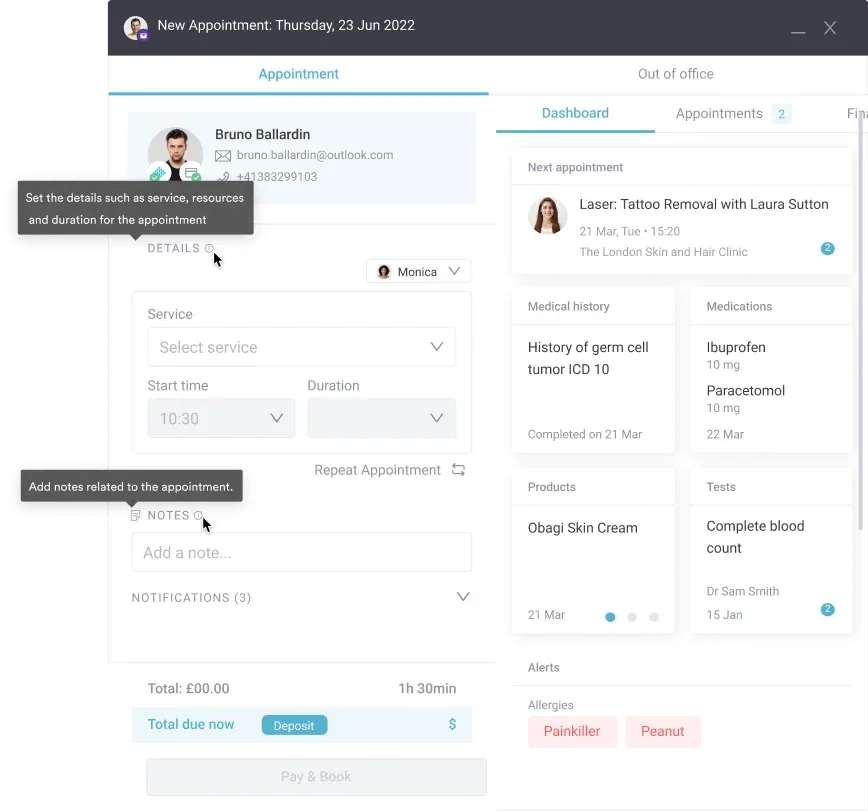

Pabau lets physical therapy and sports medicine practices build one shoulder screening template. Follow-ups trigger automatically, and every result stays in the client record.

Trust weakness over pain. That single habit lifts your accuracy more than swapping tests will, because weakness tracks a torn tendon and pain follows almost anything.
The trade-off worth remembering is comfort. Starting thumb up costs you nothing in sensitivity and buys a calmer shoulder for the rest of the examination. The payoff is a strength reading you can still compare next month.
Whatever you find, the note is what carries it forward. Book a demo to see how Pabau turns a shoulder screen into a template your whole team fills the same way.

Need a faster way to capture shoulder history at intake? Physical therapy intake form gives you a ready-made structure for history, consent, and baseline function.
Assessing the pelvis as well? Supine to long sit test covers the technique, interpretation table, and evidence for posterior iliosacral rotation.
Testing for a meniscus tear too? Thessaly test shows the 5 and 20 degree technique and how to avoid false positives.
Comparing systems for a musculoskeletal practice? Physiotherapy clinic management software sets out what to look for before you commit to a platform.
Losing patients partway through a rehab plan? Physical therapy patient retention covers the usual drop-off points and what brings people back.
Yes, the supraspinatus test is the same maneuver under a different name. Some texts apply that label to the empty can test as well. Note the thumb position in your record so nobody has to guess which version you ran.
No. A negative result lowers the odds, but small partial tears often pass the test. Where pain and loss of function persist, arrange imaging regardless of what the examination showed.
Often not. Adhesive capsulitis limits elevation, so the arm may never reach the test position. When passive range is the limiting factor, a resisted strength test cannot be interpreted.
Yes, and it turns a judgment call into a number. A dynamometer held at the wrist records force in the same position, which makes side-to-side and visit-to-visit comparison much cleaner.
Agreement improves when the arm angle, plane, and hand placement are fixed in advance. Weakness is recorded more consistently than pain, since pain reporting shifts with the patient’s day.