HD Brows consultation form: Free template and guide
HD Brows is a seven-step brow treatment that combines consultation, tinting, wax...

2
Last Updated: Oct 13, 2026

Ohio cosmetology license requirements start at 1,500 hours of board-approved training, plus a written and practical exam through the Ohio State Cosmetology and Barber Board.
Regulatory fees run about $100 total. School tuition is separate, and the Board doesn’t set or cap it.
Renewal is biennial, due January 31 of odd-numbered years, with 4 hours of continuing education every cycle.
Ohio abolished the corporate practice of medicine doctrine in 2012, but a cosmetology license still can’t authorize Botox, fillers, or laser treatments.
Those treatments need a physician or an advanced practice registered nurse (APRN) working under the Ohio Board of Nursing, not the cosmetology board.
Ohio cosmetology license requirements start with 1,500 hours of board-approved training, a written and practical exam, and about $100 in state fees before tuition. The Ohio State Cosmetology and Barber Board runs the whole process through its eLicense Ohio portal, from application to renewal.
That part is straightforward. Harder to pin down is where a cosmetology license stops and a medical one begins. Ohio abolished the corporate practice of medicine doctrine in 2012, so a cosmetologist or esthetician can co-own a med spa’s business. Performing Botox, fillers, or laser treatments there still needs a different license the cosmetology board has no say over.
This guide covers both halves. The first is the hours, fees, and exams for every Ohio cosmetology license type. The second is the medical-aesthetics boundary that decides who is licensed to perform what.
Ohio licenses cosmetology by branch, and each branch sets its own training hours. Age and education requirements are the same across every entry-level branch. Applicants must be at least 16 years old with the equivalent of a 10th-grade education, under Ohio Revised Code (ORC) 4713.28.
| License type | Training hours | Governing statute |
|---|---|---|
| Cosmetologist | 1,500 | ORC 4713.28 |
| Hair design | 1,200 | ORC 4713.28 |
| Esthetician | 600 | ORC 4713.28 |
| Natural hair stylist | 450 | ORC 4713.28 |
| Manicurist (nail technician) | 200 | ORC 4713.28 |
Every branch also requires passing both a written and a practical exam. The Ohio State Cosmetology and Barber Board administers every license through the eLicense Ohio portal.
Getting a cosmetology license in Ohio takes four steps: Meet the eligibility requirements, complete your training hours, pass both exams, and apply through eLicense Ohio.
You need to be at least 16 years old with a 10th-grade education or its equivalent, per ORC 4713.28. Ohio doesn’t require a full high school diploma for an entry-level license.
The hours depend on the branch you’re licensing into, from 200 for manicuring up to 1,500 for full cosmetology. Schools can schedule these as clock hours, credit hours, or competency-based credit hours, as long as the total matches the state minimum.
Unlike Texas, which outsources testing to PSI, or California, which manages renewals through its BreEZe portal, Ohio’s board administers the exam directly. The written portion runs 110 multiple-choice questions in 90 minutes, covering infection control, anatomy, and hair, skin, or nail care depending on your branch. The practical portion is a hands-on skills demonstration. Both require a passing score of 75%.
The hour counts and fees differ too, as our guides to Texas cosmetology license requirements and California cosmetology license requirements set out.
Once you’ve passed both exams, your school submits a certificate of hours. That can take up to three weeks to process before it’s uploaded to eLicense. You’ll then receive your license and can begin practicing.
Getting licensed costs about $100 in state fees alone, not counting school tuition, which the Board doesn’t set or regulate.
| Fee | Amount |
|---|---|
| Exam application | $40 |
| Pre-exam work permit | $15 |
| License issuance | $45 |
| Total regulatory cost | About $100 |
| Re-examination (if you fail) | $35 |
| Exam no-show fee | $50 |
| Duplicate license | $30 |
Those three fees are the full regulatory cost of getting licensed. School tuition sits on top of them and varies widely by program length and school, so budget for tuition separately when you’re comparing programs.
A full cosmetology license takes about 10 to 12 months for most students, based on Ohio’s 1,500-hour training requirement at a typical program pace.
Programs that run full-time, around 30 hours a week, clear 1,500 hours in about 50 weeks. Part-time students attending 20 hours a week take closer to 75 weeks, or about 18 months. Add exam scheduling and the up-to-three-week hours-verification window, and most full-time students are licensed within a year of finishing school.
Lighter branches move faster. A 200-hour manicurist program at a full-time pace clears in under seven weeks. A 600-hour esthetics program takes about four to five months.
An Ohio esthetician license requires 600 hours of board-approved training, on top of the same 16-years-old, 10th-grade eligibility as the general cosmetology license.
Estheticians in Ohio are limited to skin care: Facials, waxing, and non-medical exfoliation treatments. The license doesn’t extend to injectables, laser treatments, or anything that pierces or medically alters the skin. That boundary matters most for estheticians working inside a med spa, covered further down.
An Ohio nail technician license, officially called a manicurist license under ORC 4713.28, requires 200 hours of board-approved training. It’s the shortest path to licensure of any Ohio cosmetology branch, and it authorizes manicures, pedicures, and related nail services only.
Ohio also issues advanced-level licenses for practitioners who want to supervise a salon or expand their scope beyond entry-level work. Under ORC 4713.30, these are:
A salon itself needs a separate establishment license from the Board, on top of every practitioner’s individual license. State law requires a licensed cosmetologist or boutique-services registrant to supervise the salon on-site whenever it’s open. The salon can only practice the specific branch of cosmetology it’s licensed for.
Ohio cosmetology license renewal happens every two years, due by January 31 of odd-numbered years, and costs $65.
Every renewal requires 4 hours of continuing education under Ohio Administrative Code 4713-21-03. Three of those hours cover infection control and safety, and the fourth covers Ohio cosmetology laws and rules.
Licensees who turned 65 before October 2, 2024, are exempt from the CE requirement, though they still pay the renewal fee. You can renew online through the eLicense Ohio portal, the same system used for the original application.
You can look up an Ohio cosmetology license through the eLicense Ohio portal at elicense.ohio.gov, searching by the licensee’s name or license number.
A license lookup confirms three things: That the license is active, which branch it covers, and whether it’s carrying any disciplinary flags. Salon owners run this check before hiring, and med spa managers run it before adding a new esthetician to the schedule. Clients occasionally run it too, before booking with an unfamiliar practitioner.
You can transfer an out-of-state cosmetology license to Ohio through reciprocity. Your original state must have required at least 80% of Ohio’s training hours, or a minimum of 1,200. It must also have required both a written and a practical exam. Check the exam condition early. The Illinois cosmetology license requirements, for example, set one exam and no practical, while a Missouri cosmetology license requires both.
Ohio Administrative Code 4713-7-09 governs this process. Your current state’s board sends certified proof of your license and hours directly to the Ohio board. If the 80% threshold and exam requirements are met, Ohio can waive its own exams entirely. A year of licensed work experience can offset up to 100 hours of training, capped at 500 hours total.
One condition catches people off guard. After Ohio issues your license through reciprocity, the board won’t verify it back to another state for a full year. That year can stall a second move. A transfer under the Maryland cosmetology license requirements needs verification sent straight from the issuing state, never from the applicant.
Ohio also joined the Cosmetology Licensure Compact under ORC 4713.33, activated in June 2024. Once fully implemented, a multistate license under the compact will let Ohio-licensed cosmetologists practice in every member state without applying separately in each one. There are 10 member states: Alabama, Arizona, Colorado, Kansas, Kentucky, Maryland, Ohio, Tennessee, Virginia, and Washington.
An Ohio cosmetology license covers non-medical services only: Haircare, skin care, waxing, makeup application, and manicures. It doesn’t authorize Botox, dermal fillers, laser hair removal, laser skin resurfacing, or any treatment that requires a prescription. The diagram below maps each service to the board that authorizes it.
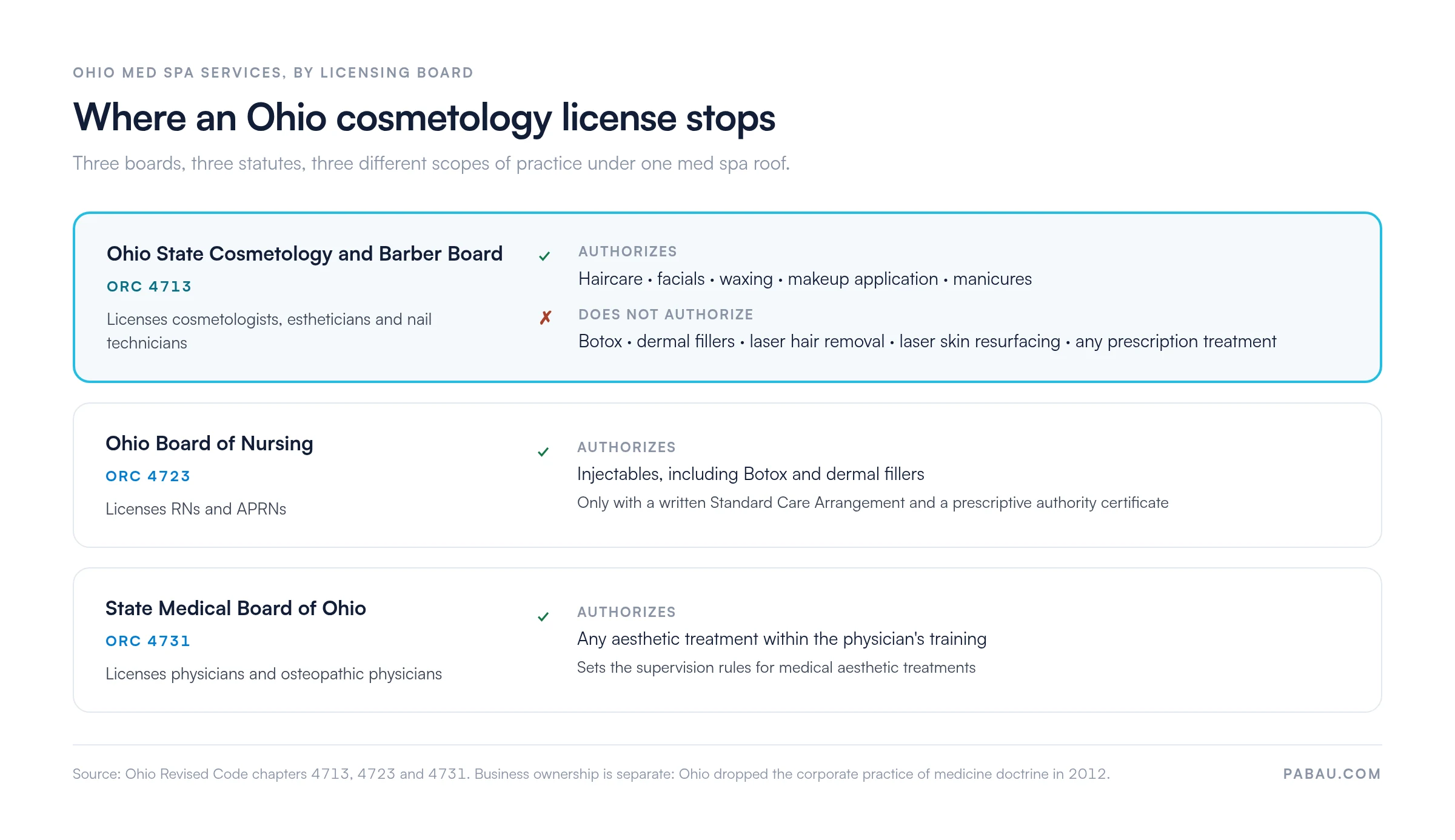
That boundary matters because Ohio makes it unusually easy to open the business around those treatments. On March 15, 2012, the State Medical Board of Ohio published a position statement on the doctrine. It declared that “the corporate practice of medicine doctrine no longer exists in Ohio.”
In practice, that means a non-physician, including a licensed cosmetologist, can legally own a med spa’s business entity under Ohio Revised Code Chapter 4731. Pain management clinics are the one carve-out that must stay physician-owned. Which licenses that structure requires is a separate question, and our guide to what you need to open a medical spa answers it.
Owning the business isn’t the same as performing the treatment. A physician or osteopathic physician, licensed under ORC Chapter 4731, can perform any aesthetic treatment within their training. An APRN can perform injectables like Botox and dermal fillers, but only under a written Standard Care Arrangement with a collaborating physician.
ORC 4723.431 requires that arrangement to be reviewed at least every two years, and the APRN also needs a prescriptive authority certificate. The Ohio Board of Nursing publishes an interpretive guideline on nurses caring for cosmetic and aesthetic patients receiving injected medications. It spells out where that line sits for RNs working under delegation.
Three different licenses, three different chapters of the Revised Code, three different boards:
A cosmetology license from the first board never substitutes for authorization from the other two.
A med spa built around Ohio’s no-CPOM rule usually staffs across all three of those boards at once. Cosmetology-licensed estheticians run the facials, an APRN handles injectables under a Standard Care Arrangement, and a physician signs off as medical director.
Keeping that straight is a records problem before it is a compliance problem, and it is what medical spa software is for. Practice management software like Pabau keeps each provider’s credentials, consent forms, and treatment notes tied to their own record.
When a client books an esthetics service and an injectable on the same visit, the record shows which license authorized each one. A medical director reviewing charts isn’t cross-referencing eLicense lookups by hand. Practices weighing up platforms for that job can start with our roundup of the best medical spa software.

Pabau ties each provider’s credentials, consent forms, and treatment notes to their own record. A medical director reviewing charts can see which license authorized which treatment.

The hours, fees, and exams are the easy part of an Ohio cosmetology license. The harder part is knowing where that license stops. Ohio’s no-CPOM rule makes it simple to co-own a med spa. The treatments most med spas are built around still need a physician or an APRN under Ohio Board of Nursing oversight.
Get the license type right, then get the board right before you assume one covers the other. Book a demo to see how Pabau keeps every provider’s credentials straight.

Licensing in a different state? Texas cosmetology license requirements breaks down how the hours, fees, and boards differ just across the state line.
Comparing another state’s rules? California cosmetology license requirements covers a very different regulatory model, including SB 803’s recent changes.
Structuring a med spa’s ownership? What license do you need to open a medical spa? maps the ownership question this guide only touches on.
Need a medical director on file? How to hire a medical director for your med spa covers what that role actually has to do.
Auditing compliance across the board? Medical spa compliance checklist is the wider list this article’s licensing section fits into.
Ohio requires cosmetology applicants to be at least 16 years old with a 10th-grade education or its equivalent, under ORC 4713.28. There’s no requirement for a full high school diploma.
Ohio’s state fees for a cosmetology license total about $100, covering the exam application, work permit, and license issuance. School tuition is separate and varies by program.
No, Ohio requires board-approved training hours at a licensed school for every branch, from 200 hours for manicuring up to 1,500 hours for full cosmetology.
Most full-time cosmetology students finish Ohio’s 1,500-hour requirement in about 10 to 12 months, plus a few weeks for exams and processing.
No, practicing any branch of cosmetology in Ohio without a license is prohibited outside narrow exemptions for incidental services at limited events under ORC 4713.
You can transfer a license through reciprocity if your original state required at least 1,200 training hours and both exams, under Ohio Administrative Code 4713-7-09.