HD Brows consultation form: Free template and guide
HD Brows is a seven-step brow treatment that combines consultation, tinting, wax...

2
Last Updated: Oct 13, 2026

Illinois licenses cosmetologists at 16 or older, with 1,500 clock hours from an IDFPR-approved school.
IDFPR’s own fee table puts the cosmetology exam at $200, not the $107 several guides still list.
Licenses expire September 30 of every odd-numbered year, and each renewal needs 14 continuing education hours.
IDFPR does not reciprocate another state’s license, so out-of-state cosmetologists file for endorsement at $45.
A lapsed license comes back through restoration, and the relicensing decision rule below shows which route applies.
Illinois cosmetology license requirements start with four boxes to tick. You need to be 16, with a high school diploma or the equivalent. Then come 1,500 clock hours at an approved school and one passing exam. The Illinois Department of Financial and Professional Regulation, known as IDFPR, sets all four and issues your license.
Two pages ranking for this query still put the exam fee at $107, while IDFPR’s own table says $200. Budget from the wrong figure and you arrive short.
Every number below traces to IDFPR’s documents or to the Illinois rules at Title 68, Part 1175. That covers training, the exam, renewal, and out-of-state transfers.
Two documents hold the answer. The Act is 225 ILCS 410, and the rules that attach numbers to it are Title 68, Part 1175. Every row below names where its figure comes from, so you can check it yourself.
| Requirement | Detail | Source |
|---|---|---|
| Minimum age | 16 | 68 Ill. Adm. Code 1175.400 |
| Education | High school graduate or equivalent, or beyond compulsory school age | 68 Ill. Adm. Code 1175.400 |
| Training | 1,500 clock hours at a Department-approved cosmetology school | IDFPR, Qualifications for Licensure (011) |
| Examination | One cosmetology exam, passing grade 75 | 68 Ill. Adm. Code 1175.410 |
| Exam fee | $200 | IDFPR exam fee table |
| Application fee | $30 | 68 Ill. Adm. Code 1175.100 |
| License term | Two years, expiring September 30 of odd-numbered years | 68 Ill. Adm. Code 1175.425 |
| Renewal fee | $50 per cycle, set at $25 a year | 68 Ill. Adm. Code 1175.100 |
| Continuing education | 14 hours per cycle, first renewal exempt | 68 Ill. Adm. Code 1175.425 |
| Out-of-state route | Endorsement at $45, with no reciprocity | IDFPR, Qualifications for Licensure (011) |
| Restoration fee | $50 plus lapsed renewal fees, capped at $200 | 68 Ill. Adm. Code 1175.100 |
| Governing law | 225 ILCS 410, with rules at Title 68, Part 1175 | Illinois Compiled Statutes |
One point to clear up before you read further. There is no separate Illinois state board of cosmetology that issues licenses. The Act names an advisory board, and IDFPR itself issues your license. Inside IDFPR that board is the Barber, Cosmetology, Esthetics, Hair Braiding and Nail Technology Board.
Illinois licenses cosmetologists who are at least 16 and hold a high school diploma. On top of that, you finish 1,500 clock hours at an IDFPR-approved school.
The education test has a second door, though. Section 1175.400 accepts a high school graduate or the equivalent. It also accepts an applicant who is beyond the age of compulsory school attendance. Guides that name a diploma as the only route leave that out.
An approved school holds an IDFPR license and Department approval for the cosmetology curriculum. IDFPR asks for an official transcript showing graduation from a 1,500-clock-hour program. That same transcript also has to show a passing grade on the school’s final exam.
Three groups get a shorter path, and IDFPR names each one:
Training from another state or country has to substantially comply with the Illinois requirements. IDFPR decides that from your transcript, not from the other state’s license.
You also do not have to finish all 1,500 hours before testing. Under 225 ILCS 410/3-6, an applicant who has completed 1,200 hours of study may sit the exam.
IDFPR’s qualifications document lists four ways into an Illinois cosmetology license, and apprenticeship is not one. The four are examination, acceptance of an examination passed elsewhere, endorsement, and foreign endorsement. Section 1175.400 sets out no apprenticeship pathway either.
So where does the 3,000-hour apprenticeship figure come from? Several pages ranking for this query describe one, and none of them cites a source. It appears in neither IDFPR’s qualifications document nor the rule. Call IDFPR on 1-800-560-6420 before you plan a career around it.
If school is the obstacle, the credit routes above are the shortcut IDFPR actually publishes. A licensed barber reaches a cosmetology license on 500 supplemental hours.
Illinois requires one cosmetology examination, with a passing grade of 75 and a $200 fee. IDFPR’s designated testing service administers it.
Some guides list the fee as $107. IDFPR’s own fee schedule says $200, and the $107 figure appears on two ranking pages without a source. For context, the neighboring licenses cost less:
On format, the requirement documents describe one exam rather than two. Section 1175.410 refers to the examination and sets a single passing grade of 75. IDFPR routes candidates to a product called the Cosmetologist Online Examination, run by Continental Testing Service, Inc.
Neither the rule nor IDFPR’s page sets out a separate hands-on practical exam. Two ranking pages say Illinois requires one. Until IDFPR says otherwise, read the state board exam as a single test.
Failing does not cap you out. After a third failure, Section 1175.410 requires a refresher course before a fourth attempt. That course runs 100 or 250 hours at a licensed school. The Division can waive the training if you show competence.
A retake request goes in writing at least 45 days ahead, with the fee. Passing has a shelf life too. Apply for the license within 12 months of passing, or you take the exam again.
One change is coming. From October 1, 2026, IDFPR will offer the barber, cosmetology, esthetician and nail technician exams in five languages. English, Spanish, Chinese, Korean and Vietnamese are all included. The testing vendor already sells a Chinese-language cosmetology exam as a separate product.
New Illinois cosmetology license applications go through CORE, IDFPR’s online licensing system.
CORE replaced the previous portal on October 30, 2024, and stands for Comprehensive Online Regulatory Environment. The application fee is $30 under Section 1175.100, separate from the $200 exam fee.
Have these ready before you start:
IDFPR approves the Skinny on Skin program from Impact Melanoma, Inc. for the skin growth requirement. The course runs online and issues a certificate you attach to the application.
Form F2523 replaced the older Third Party Authorization forms. IDFPR stopped accepting the earlier versions on May 1, 2024.
After you file, two rules matter. An application stays active for three years from the date IDFPR receives it, and fees are non-refundable. IDFPR then uses your email address of record for all correspondence, so keep it current.
Most delays trace back to paperwork, not eligibility. Run this list before you submit:
Your school’s schedule decides it, because IDFPR publishes no processing time. Illinois asks for 1,500 clock hours and lets you test at 1,200.
Two timing figures IDFPR does publish are worth noting. An online renewal takes two to four business days to post in IDFPR’s systems. Separately, an application stays active for three years from receipt.
So a full-time program moves faster than an evening one, and the school sets that pace. Treat any 12-to-18-month figure you read as a school estimate, because IDFPR publishes no such number.
Illinois does not reciprocate cosmetology licenses from other states. Out-of-state cosmetologists apply by endorsement instead, for a $45 fee.
IDFPR states the position plainly. Its qualifications document says Illinois does not reciprocate licenses of another state, another United States jurisdiction, or a foreign jurisdiction. That single line answers most reciprocity questions about the state.
There is a sharper edge to it. A license you obtained elsewhere through reciprocity may not qualify you for an Illinois license by endorsement. IDFPR warns that such a license is not the same or substantially similar to an Illinois one.
Endorsement wants certification from more than one board:
IDFPR provides an affidavit form for the work-experience evidence, coded VE-COB. Fall short on any requirement, and the Department may ask for extra coursework or the examination.
Watch one figure here. Some guides publish a formula crediting up to 300 hours of work experience a year, capped at 900. IDFPR’s qualifications document sets out no such formula, so do not budget your hours against it.
Applicants licensed abroad file under foreign endorsement. That route wants the original licensing document, an official transcript, and evidence of at least three years of practice.
The practice has to fall within the five years before the application. Affidavits from three clients, coworkers or business owners can prove it.
One more route helps someone who trained elsewhere but never got licensed. Acceptance of examination costs $30 and covers an applicant who holds no cosmetology license anywhere. It requires substantially similar training and a passed licensing exam from another jurisdiction, within 12 months of applying.
Moving the other way works differently. Our guide to Texas cosmetology license requirements covers that state’s hours, fees and exam route.
Illinois cosmetology licenses expire on September 30 of every odd-numbered year. Each renewal needs 14 continuing education hours and a $50 fee.
The renewal window is the month before that date. Renewal runs online through IDFPR, and a renewed license takes two to four business days to post.
The fee is where two guides split. One set says $50, another says $25. Section 1175.100 settles it by charging $25 a year, which makes $50 for a two-year cycle. Both numbers came from the same rule, read at different lengths.
Continuing education is 14 hours, earned within the two years before expiration. The sponsor has to be registered with the Division. Your first renewal after original licensure is exempt, and every renewal after that carries the full 14 hours.
The requirements are the same for every licensee, whatever their age or years in the chair. An older exemption came out of the 1985 Act by amendment, and the 2017 cycle was the first without it.
Three of the 14 hours are fixed subjects rather than open topics:
That skin growth requirement already applies. IDFPR’s statement on Public Act 103-0851 is dated August 21, 2025, and the January 1, 2026 trigger has passed.
Self-study has a limit worth checking. Subpart F caps how many of the 14 hours can be self-study. CE sponsors report a Department variance dated May 30, 2025 that allows all 14 online. Confirm the split with your sponsor first, because the rule text and the variance point different ways.
No attendance roster is required for Illinois CE courses, so the sponsor’s certificate is your proof. IDFPR no longer mails paper licenses either. You print your own from the getmylicense page once the renewal posts.
In the practices we onboard, the renewal date catches more people out than the hour count. Every cosmetologist on a team shares September 30, so a five-chair salon renews five licenses in one month.
Two exceptions round this out. Cosmetology teacher and clinic teacher licenses expire September 30 of each even-numbered year, and teachers need 24 hours. Placing a license on inactive status at renewal time also works, and reactivating later skips the lapsed renewal fees.
A lapsed Illinois cosmetology license comes back through restoration. The requirements change once the license has been expired for five years.
Two names describe one process. IDFPR’s renewal page tells anyone who misses the window to request a Reinstatement application. The rules call the same route restoration, at Section 1175.430. Guides that present reinstatement and restoration as two separate processes are describing one.
We call the whole route the relicensing decision rule, because one question decides the rest. How long has the license been expired, and which state issued it? The diagram below runs the four answers side by side.
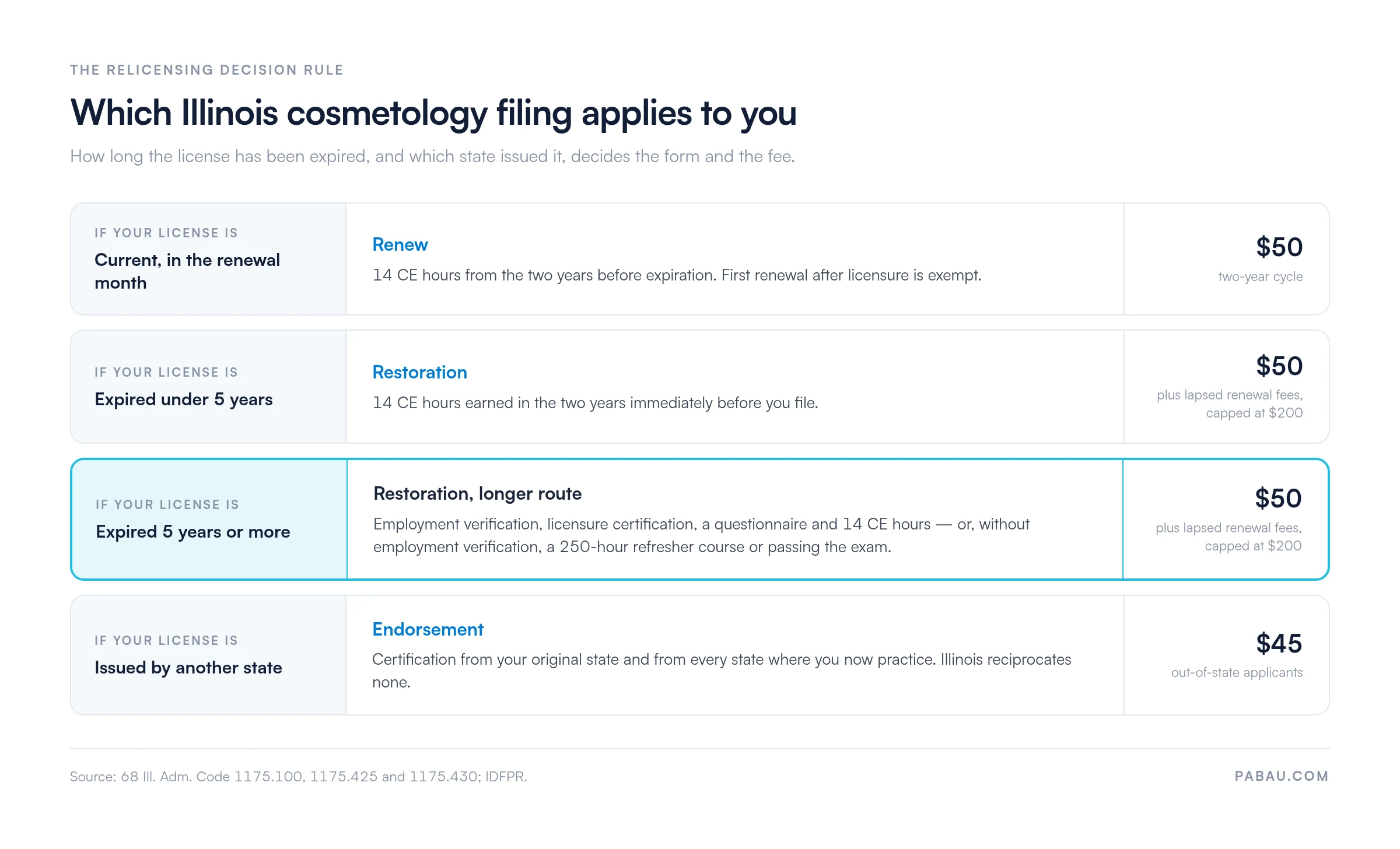
Restoration under five years asks for the application and the fee. The 14 continuing education hours have to be earned in the two years immediately before you file.
At five years or more, the list grows. Section 1175.430 wants verification of employment, a certification of licensure, a questionnaire, the 14 CE hours, and the fee.
There is an alternative for anyone who cannot verify the employment. Official transcripts showing a 250-hour refresher course will do instead. So will passing the examination within two years before or after the restoration application.
Military applicants have a shorter route at either length of lapse. A copy of the DD-214 and the current renewal fee is enough.
The fee itself is $50, plus all lapsed renewal fees. Section 1175.100 caps those lapsed fees at $200. Several guides publish a flat $150 reinstatement fee, which does not appear in the rule.
Where the license came from another state, none of this applies. An out-of-state license goes through the endorsement application at $45, covered above.
IDFPR’s License Lookup returns a license number, type, status, effective and expiration dates, and any disciplinary action. The tool lives at ilesonline.idfpr.illinois.gov and takes either a name or a license number. Single lookups update daily and bulk lookups weekly.
The lookup carries more weight than a printout. Three national accreditors treat IDFPR’s License Lookup as a primary source for verification. They are The Joint Commission, the National Committee for Quality Assurance, and the American Osteopathic Association’s accreditation program.
What people call an Illinois state board of cosmetology license verification is this lookup. A candidate’s printed license is a self-served PDF, so the lookup is the stronger check before a hire. It also surfaces disciplinary history, which a resume will not.
Running that check before a new hire touches a client is part of a wider picture. Our guide to med spa compliance covers what else an inspector asks to see.
A license lets you work on clients. It does not book them, chart them, or take their deposit. Most newly licensed cosmetologists start with a paper diary and a phone camera for before-and-after photos. The card reader sits apart from both.
Practice management software like Pabau replaces that patchwork with one client record. Bookings, consent forms, treatment notes, before-and-after photos and payments all file against the same client. Pabau’s online booking lets clients book and reschedule themselves, so the phone stops being the front desk.
The records side matters in a state that spells out melanoma training in its licensing rules. Photos taken in Pabau attach to the client’s record instead of sitting in a camera roll.
Consent forms get signed before the appointment rather than chased afterwards. Pabau is medical spa software built for aesthetics practices, so those workflows arrive set up.
Still choosing a system? Our roundup of the best aesthetic clinic software compares the options on the axes that decide it.

Pabau keeps bookings, consent forms, treatment notes, before-and-after photos and payments in a single client file. Newly licensed cosmetologists take online bookings and deposits without stitching four tools together.

Illinois asks less of you than the internet suggests. The route in is short, and the paperwork around it is where candidates lose weeks.
Second-hand numbers cause most of that loss. A $107 exam fee, a $150 reinstatement fee and a 3,000-hour apprenticeship all circulate widely. None of the three appears in IDFPR’s documents or the Illinois rules. So check the fee table and Part 1175 before you budget, not after.
Settle one more question early. Which door are you walking through? The relicensing decision rule sorts renewal, restoration and endorsement in one question. Your form, your evidence and your fee all turn on the answer.
Once the license is on the wall, the work is bookings, records and consent. Book a demo to see how Pabau keeps a new Illinois practice’s client records, photos and payments in one place.

Licensed in the Pacific Northwest? Washington cosmetology license requirements: hours, fees and scope sets out that state’s hour counts and what each license covers.
Comparing a Southern state’s rules? Georgia cosmetology license requirements: costs, hours, and how to apply breaks down four practitioner licenses and their fees.
Moving a license from the West Coast? Understanding California cosmetology laws covers the hours, the exam and the scope California allows.
Hiring licensed staff into a med spa? Med spa compliance for owners walks through the records and credential checks an inspector asks about.
Still picking a system for the new practice? 7 best aesthetic clinic software solutions compares platforms on booking, records and payments.
Yes. IDFPR registers the business as a salon or shop, separately from your own cosmetology license. The owner does not have to be a licensed cosmetologist. Anyone who actually performs cosmetology services in that salon does.
Illinois sets the hair braiding license at 300 hours of classroom and practical training. Braiders once needed the full 1,500-hour cosmetology program instead. IDFPR licenses them under the same 1985 Act.
No. Paid cosmetology work in Illinois needs a license. The Barber, Cosmetology, Esthetics, Hair Braiding and Nail Technology Act of 1985 sets that rule. IDFPR takes complaints about unlicensed practice.
IDFPR emails updates to the address on your CORE account, so keep it current. License Lookup shows a license only once it issues, not while an application is pending. For a direct answer, call IDFPR on 1-800-560-6420.