Sample treatment plan
A sample treatment plan is a structured clinical document that sets out a patien...

3
Last Updated: Oct 12, 2026

Michigan requires 1,500 hours at a licensed cosmetology school, or a two-year apprenticeship, before the licensing exam.
PSI runs both exam parts, and passing means 70 points of 100 on theory and 95 of 127 on the practical.
LARA charges $63 to apply and $48 to renew, with licenses expiring August 31 every two years.
No continuing education is required in Michigan, but the grace period after August 31 runs only 60 days.
Opening a salon or spa needs its own cosmetology establishment license under MCL 339.1204.
Public Act 78 of 2024 raised esthetician, manicurist and instructor training hours, and left cosmetologist hours at 1,500.
Michigan cosmetology license requirements come down to 1,500 school hours or a two-year apprenticeship, a two-part PSI exam, and a $63 application through LARA. Before adding a newly licensed cosmetologist to an aesthetic practice’s booking calendar, compare scheduling tools in our guide to med spa software.
The complication is that the hour figures published online no longer agree with each other. Public Act 78 of 2024 raised training minimums for estheticians, manicurists and instructors, and left cosmetologists at 1,500.
Plan a program, a hire or an apprenticeship around the wrong number and you lose months. So every figure below is tied to the LARA guide, PSI bulletin or statute it came from.
Michigan licenses cosmetologists who are at least 17 and hold an education equivalent to the ninth grade. You then finish either 1,500 school hours or a two-year apprenticeship. Both routes end at the same two exams.
LARA’s wording repays a close read. The licensing guide asks for an applicant who is “not less than 17 years of age”. It also wants “an education equivalent to the completion of the ninth grade”.
No high school diploma is required. Every applicant also answers a good moral character question and supplies a Social Security number.
The apprenticeship clause carries a condition almost nobody repeats. Those two years have to be served in a licensed cosmetology establishment that offers hair care, skin care and manicuring services.
A nails-only salon cannot host a cosmetology apprentice, because a cosmetologist trains across all three service categories.
Article 12 of the Occupational Code holds the full cosmetology license requirements in Michigan. LARA turns them into a licensing guide and FAQ for each role it licenses. That pair is the document to trust when a school website says something different.
LARA treats the two routes as equivalent, and the exam at the end is identical either way. The costs are not equivalent at all.
Cosmetology school runs 1,500 hours and charges tuition. A Michigan cosmetology apprenticeship runs at least two years and charges none. It trades money for time, and for a good deal more paperwork. Not every state offers that trade. The Illinois cosmetology license requirements include no apprenticeship route at all.
At about 80 training hours a month, two years works out near 1,920 hours. That total comes from licensing-prep sources doing the monthly arithmetic, not from a figure LARA publishes. LARA publishes a minimum of two years, so the calendar binds you rather than the hour count.
The apprenticeship rules also put limits on both sides of the arrangement:
That last pair matters more than it looks. An apprenticeship that ends without either form filed leaves the hours in limbo. A salon owner who took on the apprentice owns that filing, not the trainee.
You pass Michigan’s theory exam with 70 points out of 100, and the practical with 95 points out of 127. PSI Services delivers both under the National Barber Cosmetology Program.
Those two thresholds come from PSI’s Michigan cosmetology test taker guide. The practical mark works out at just under 75%, which is where the widely repeated “75% on both parts” figure comes from. Theory is the more forgiving half.
Michigan’s Board of Cosmetology adopted the PSI-run exam effective November 4, 2022, retiring the old state exam.
LARA’s exam FAQ also confirms that both parts can be taken with an online proctor or at a PSI testing center. Michigan’s rules separately allow distance education for theory hours, which is why classroom theory often runs online now.
The two halves work very differently. Theory gives you 120 minutes for 100 scored questions, plus 10 experimental ones that carry no weight. Safety and infection control is the heaviest topic at 30%, ahead of client consultation and analysis at 19%.
The practical is a different day out. It runs about 235 minutes across 11 topic areas, in a set order, and you bring your own tools and supplies.
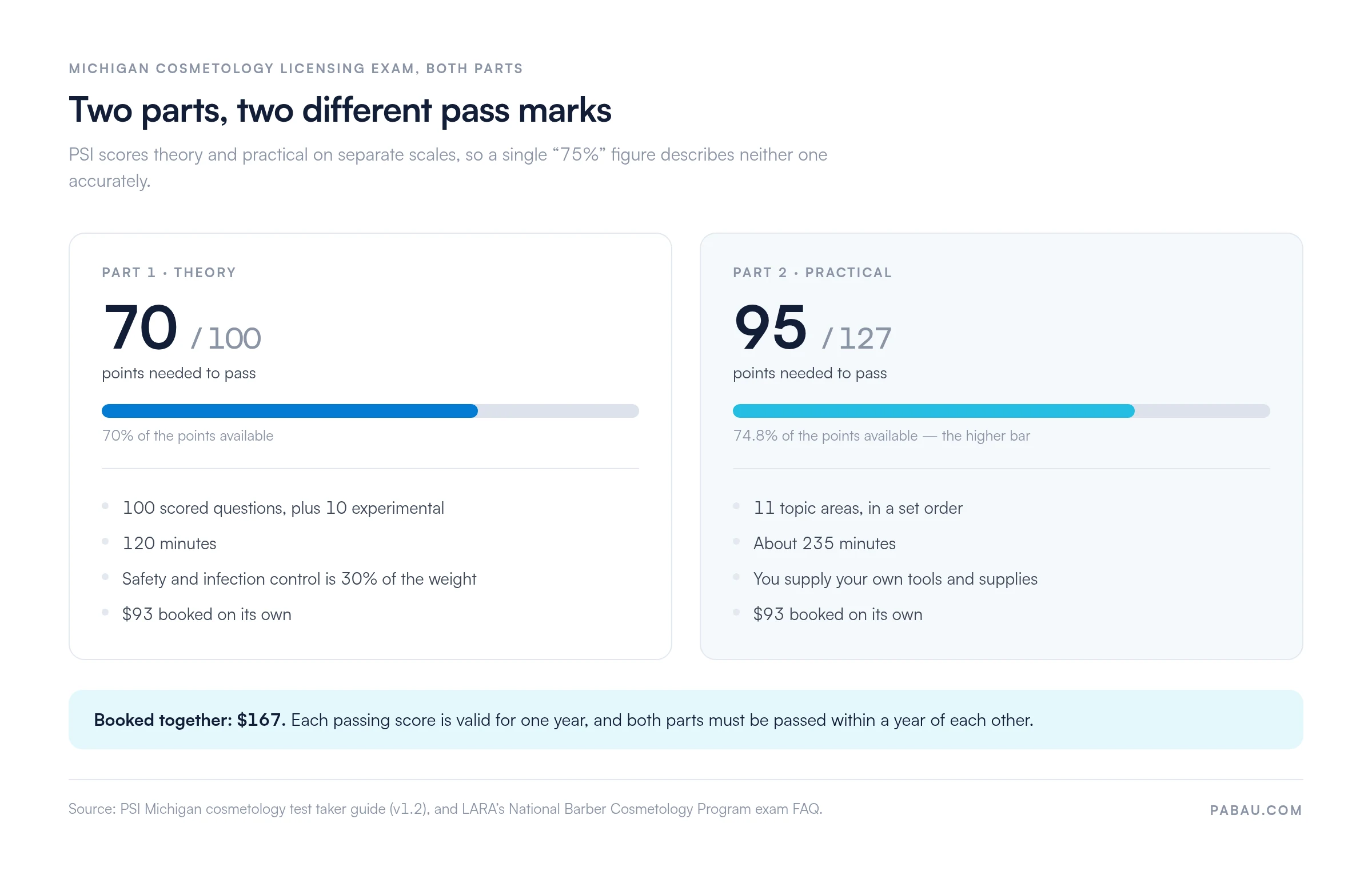
The scoring rules are where candidates get caught. Each passing score stays valid for one year from the day it was earned.
Both parts also have to be passed within a year of each other. Pass theory in March, stall on the practical until the following April, and the theory result is gone.
A second clock runs quietly alongside it. PSI forfeits a test fee that goes unused for a year after it arrives. LARA holds your application and fee for one year too.
State and exam fees come to roughly $230. That is $63 to LARA for the application and first two-year license, plus $167 to PSI for both exam parts.
Here is where each dollar goes, and who collects it:
Tuition is the number that decides the budget, and no LARA guide sets or publishes it. Schools price their own programs. Treat the $230 as the floor for state and exam costs, then price tuition with two or three schools before committing.
Most delays are paperwork rather than eligibility. Work through this list before you open the MiPLUS application:
The costliest mistake sits in that last item. Candidates pass theory, go back to work, then let the year run out before they sit the practical. Book both parts in the same stretch and that risk disappears.
Holding a personal license is one job, and opening a location is another. Operating a salon or spa in Michigan requires a separate cosmetology establishment license, under section 339.1204 of the Occupational Code.
The Michigan cosmetology establishment license requirements attach to the premises, not to the person.
A licensed cosmetologist who signs a lease still needs the establishment license before opening the doors. LARA publishes a separate establishment licensing guide and its own set of shop inspection requirements.
Practicing cosmetology outside a licensed establishment falls under MCL 339.1217 instead. That section is the one that governs mobile work, rented chairs and home visits.
The definitions here moved recently. Public Act 160 of 2024, effective April 2, 2025, redefined “cosmetology establishment”, “mobile salon” and “cosmetology suite” in the Occupational Code.
That report comes from a single licensing-prep source, so check the current establishment guide before you build a suite-rental model around it.
Adding injectables or laser treatments takes the business outside cosmetology altogether. The rules on who may open a medical spa sit with different boards, and a cosmetology establishment license does not reach them.
Public Act 78 of 2024 raised training hours for esthetician, manicurist and instructor licenses, for anyone starting a program on or after July 1, 2024.
The bill was Senate Bill 702 of 2024, signed by Governor Whitmer. Anyone who began training before July 1, 2024 keeps the old, lower requirement. That split is why two pages can both be right about the same license.
The chart below shows how far each license moved.
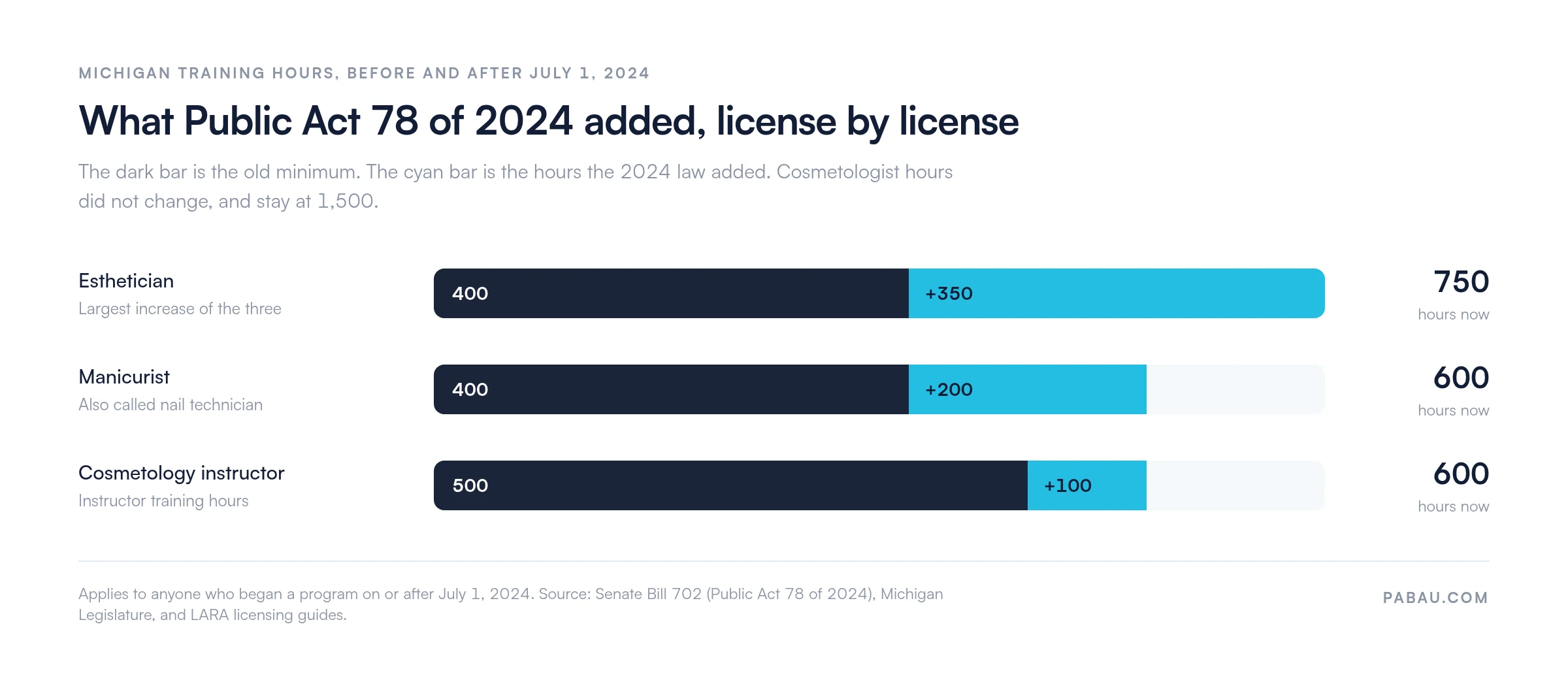
The reason the new figures cluster at 600 is federal, not cosmetic. Gainful Employment rules effective July 1, 2024 set 600 hours as the floor for a program to keep student financial aid eligibility.
Michigan raised its minimums to protect that access, which is why the manicurist and instructor totals both landed on exactly 600.
LARA’s esthetician guide now states both figures in one line. It reads 400 hours of training, or 750 for a program starting on or after July 1, 2024.
Meanwhile one widely read licensing-prep page still lists 300 hours for cosmetology instructor training. That number matches neither the old 500 nor the new 600.
Two consequences follow for a practice owner. Esthetician, manicurist, natural hair culturist and instructor licenses are legally separate from a cosmetologist license, even though one Board oversees them all. And an esthetician who trained in 2023 will show fewer hours than one who trained in 2025, without either record being wrong.
Michigan cosmetology licenses renew every two years, expire August 31, and cost $48 through LARA’s MiPLUS portal. No continuing education is required.
The renewal window opens 90 days before expiration and not a day earlier. LARA sends a notice to the mailing address and email on record. A notice that never arrives does not excuse a late renewal, though, so the date belongs in your own calendar too.
Miss the date and the cost climbs in two steps. A 60-day grace period lets you renew without relicensure, for the $48 fee plus a $20 late fee. Past those 60 days the license has lapsed, and relicensure costs $83.
A lapse then forks on three years, and LARA’s guide is explicit about it. Under three years, the relicensure application and fee are all you file. At three years or more, you also have to pass the licensure exams again. The alternative is showing a license held in good standing in another state during one of the previous three years.
A Michigan cosmetology license lookup runs through LARA’s online licensing system, which returns a licensee’s status and expiration date. Run it before a new hire touches a client.
In practices we onboard, the license expiration date is the field most often missing from a staff record. Nobody forgets to check the license at interview. The problem is the second August 31, two years later, when the hire is no longer new and nobody owns the reminder.
LARA runs verification the other way around too. Separate forms cover school or barber college hours, NACCAS verification, and work experience. Those are the documents a licensee needs when another state asks Michigan to confirm their training.
Two bodies share the work. LARA, the Michigan Department of Licensing and Regulatory Affairs, issues and renews the licenses. The Michigan Board of Cosmetology writes the rules underneath, through Article 12 of the Occupational Code, Public Act 299 of 1980.
The Board publishes its administrative rules through LARA’s Administrative Rules System, and posts its meeting schedule in advance. Schedules currently run through 2027, so a rule change is visible on the calendar before it lands.
Scope is worth knowing. LARA’s cosmetology licensing guides cover 13 distinct roles under this Board, including cosmetologist, esthetician, manicurist, electrologist, natural hair culturist, instructor, establishment and school.
Barbers are the exception. They sit under the Michigan Board of Barber Examiners, with their own hours and their own renewal cycle.
Michigan credits 100 training hours for every six months of active licensed practice in another state, applied against its own hour requirement.
Run that ratio out and the arithmetic gets sobering. Covering the full 1,500 hours from experience alone would take seven and a half years of licensed practice. For most people arriving from another state, the credit closes a shortfall rather than replacing training outright.
The same $63 fee covers licensure by examination and licensure by reciprocity, so the transfer route costs no more to file. Verification has to come straight from the other state’s licensing agency, never from the applicant. If you already hold a Minnesota cosmetology license, that proof is a Certification of Licensure from the Board of Cosmetologist Examiners, at $30 per certificate.
Hour totals vary a lot between states. Texas cosmetology license requirements sit with a different agency and a different hour figure, so the credit gets calculated rather than transferred one for one.
Two more routes are worth naming:
A Michigan practice with six licensed staff is tracking six renewal dates, and all six land on the same August 31. Most owners keep those dates in a spreadsheet, or in their head.
Practice management software like Pabau holds the staff record, the schedule and the paperwork in one system. The renewal date then sits where a manager will actually look.
Pabau is purpose-built med spa software, so the licensing detail a salon or spa carries has somewhere to live.
The calendar also assigns each service to the practitioners who can perform it. A manicurist license does not cover hair services, so online booking should never offer a cut on a nail technician’s column.
Set those service permissions once and the booking page holds the line, rather than the front desk catching it.
Pabau’s digital forms and client records tie consent forms, treatment notes and before-and-after photos to the appointment they belong to. Michigan publishes its own shop inspection requirements, and an inspector asking who performed a service gets a straight answer from the record.
The daily win is smaller than the compliance one, and more useful. Front desk staff stop hunting for a signed consent between clients, and an expired license stops being something a practice discovers in its busiest week.
Owners comparing systems can weigh the trade-offs in our roundup of med spa scheduling software.

Pabau ties each practitioner’s schedule, service permissions and consent records to one staff profile. A manager checking cover for August can see who is licensed for what, without opening a spreadsheet.

Budget about $230 in state and exam fees, then treat tuition as the number that decides your timeline. School buys a fixed end date. The apprenticeship buys a lower cash cost, and hands you two years of monthly filings in exchange.
Put August 31 in the calendar the day the license arrives, not the summer it expires. Renewal in Michigan asks so little that it is easy to forget entirely. The $20 late fee is the cheap version of that mistake, and a lapse past 60 days is the expensive one.
If a location is the plan rather than a chair, start the establishment license early. It covers the premises rather than the person, so a fully licensed cosmetologist can still be locked out of opening on time.
Book a demo to see how Pabau keeps staff licenses, renewal dates and consent records in one place.

Hiring across the state line? Texas cosmetology license requirements sets out the hours, fees and agency a Texas licensee is coming from.
Comparing a very different model? California cosmetology laws covers a state that regulates the same trade on a different structure entirely.
Thinking past a salon license? Who can open a medical spa? maps the boards a cosmetology establishment license never reaches.
Auditing the whole picture? The medical spa requirements checklist is the wider list this article’s licensing section sits inside.
That depends on the route. At 35 hours a week, 1,500 school hours takes roughly 43 weeks of study. An apprenticeship runs a minimum of two years whatever the pace, because LARA sets a calendar minimum rather than an hour target. Add a few weeks for PSI scheduling.
PSI gives you 120 minutes for 100 scored questions, plus 10 experimental ones that do not count. Safety and infection control carries the most weight at 30%, followed by client consultation and analysis at 19%. The practical is separate, running about 235 minutes across 11 topic areas.
Yes. LARA’s exam FAQ confirms that both the theory and practical parts can be completed with an online proctor, or at a PSI testing center. Apply through MiPLUS first, because PSI cannot schedule you until the state has found you eligible to test.
You can re-register with PSI as a retake test taker. Each attempt costs another test fee, which is $93 for a single part. Watch the calendar as well. A test fee that sits unused expires one year after PSI receives it.
Michigan licenses natural hair cultivation separately. A natural hair culturist license takes 400 hours of training over at least three months, or a six-month apprenticeship where natural hair cultivation is practiced. The application fee is the same $63, and PSI runs the exams.