Physician credentialing checklist
A physician credentialing checklist lists every license, certificate, verificati...

Last Updated: Oct 23, 2026
A master patient index (MPI) is a database that gives each patient one unique identifier.
Every clinical encounter, in every department and system, links back to that single verified identity record. A Ministry of Health poster in PubMed notes that up to 20% of registered patients are duplicated in most systems. It recommends search algorithms to reduce this. Without an MPI, one person can exist as several separate records in systems that never share data.
This guide covers how patient matching works, how an MPI differs from an enterprise master patient index (EMPI), and what HIPAA requires. It also sets out the habits that keep patient identity data clean in a small practice.

A master patient index assigns each patient a unique medical record number (MRN) and links all encounters to one verified identity.
Duplicate patient records cause medication errors, misdiagnosis, and billing fraud exposure, and the MPI is the main defense against them.
An EMPI extends MPI logic across multiple facilities, while most small practices need a well-maintained single-facility MPI.
HIPAA treats MPI data as protected health information (PHI), so a third party that manages it needs a business associate agreement (BAA).
Pabau, the practice management system we build, keeps each patient on one client card, which helps you avoid duplicate profiles.
A master patient index is a register that holds one record per patient, each keyed to a unique medical record number (MRN). It maps every clinical encounter to that single identity. Hospitals and practices create an MPI entry when a patient first registers. Later visits, procedures, and billing events attach to the same MRN.
The MPI does not store clinical notes or lab results. It holds identity data, so every system in the organization knows that last Tuesday’s consultation and last month’s follow-up call belong to the same person.
Think of it as the spine of a health record system. EHRs, billing platforms, scheduling tools, and lab portals all need a consistent patient identity before they can exchange data safely. The MPI supplies that identity layer, while the clinical content sits in your wider medical records management setup.
When a patient registers, the system checks whether a matching identity already exists in the MPI. If it finds one, it returns the existing MRN and links the new encounter to it. If it finds none, it creates a new MRN. This check runs at every point of entry, from the reception desk and online booking to referral intake and emergency admission. The diagram below maps it.
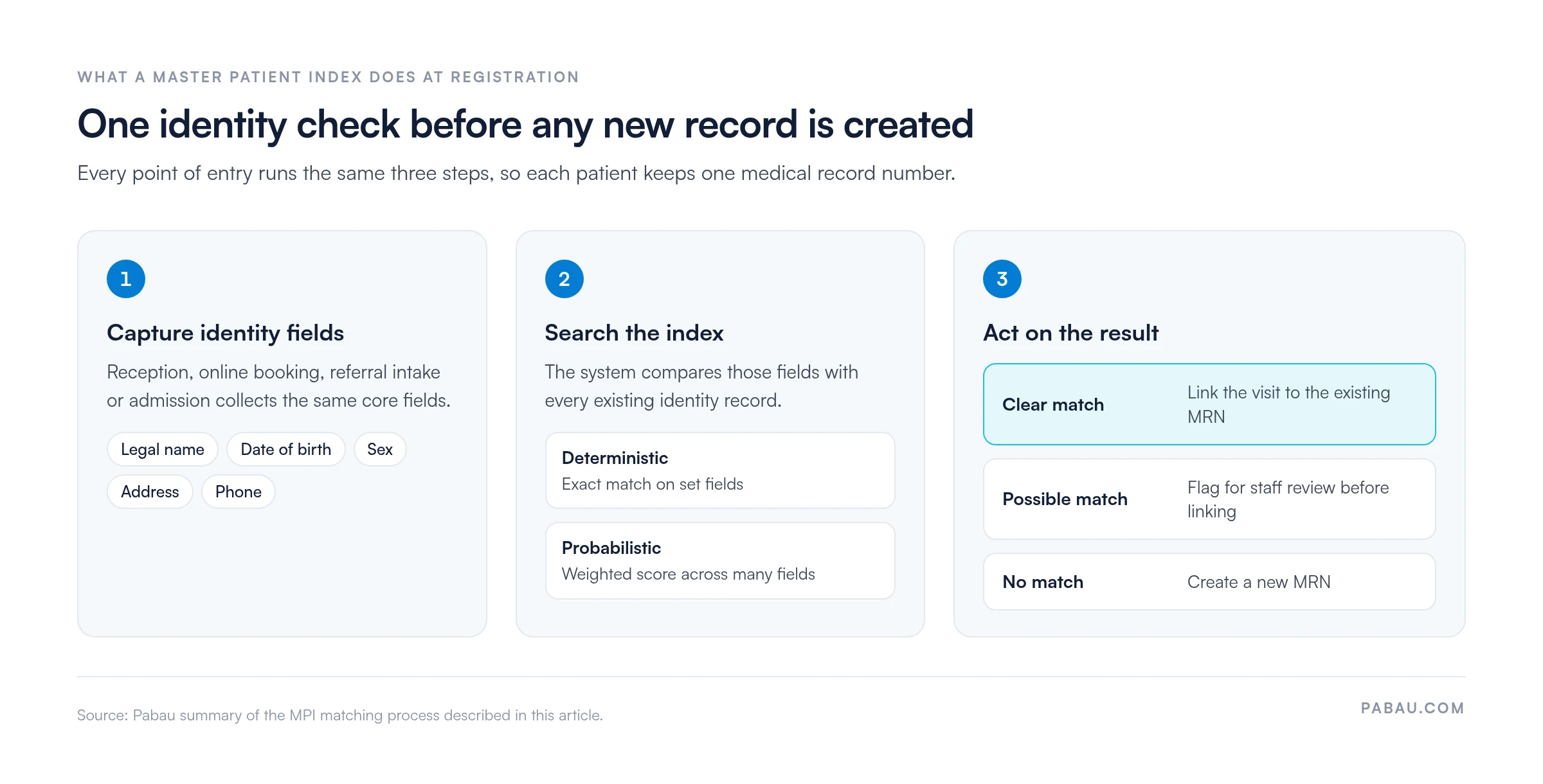
The matching step is where the complexity lives. Two approaches handle it, and most modern systems combine them. Getting it right keeps appointments, notes, and invoices attached to one person, and good patient management software is built around that link.
Deterministic matching requires an exact match on one or more defined fields before linking records. Probabilistic matching assigns a weighted score across multiple fields and links records when the combined score crosses a confidence threshold. Scores that land just below that threshold usually go to a staff member for review instead of linking automatically.
The MPI holds the identity data needed to match a person across systems, not their clinical record. Standard fields include:
Some MPI implementations also hold a pointer to the patient’s primary care record, known allergies, and flags for sensitive record access. The depth varies by system. The purpose stays the same: give every connected application enough information to confirm it has the right person.
A master patient index operates within a single facility or organization. An enterprise master patient index (EMPI) spans multiple facilities, health systems, or care settings, and resolves patient identity across all of them.
Most independent practices and small groups do not need an EMPI. A well-maintained single-facility MPI, built into their practice management or EHR system, does the job. The EMPI question comes up when organizations merge or a practice joins a hospital network. It also arises when a regional health information exchange links records across covered entities.
Duplicate patient records put patients at clinical risk. When two records exist for the same person, a clinician may act on an incomplete or outdated record without knowing the other one exists.
Here is what that looks like in practice:
Estimates run from about 8% to as high as 20% of records in most systems (PubMed), depending on how consistently data entry standards are enforced. A working master patient index is the main structural control for keeping that rate close to zero.
Health information exchanges (HIEs) are regional or national networks that let different healthcare organizations share patient data. Every participating organization has to agree on who a patient is before it can exchange their records. That agreement runs through an EMPI.
The US Department of Health and Human Services (HHS) has confirmed that a health information organization (HIO) may run one MPI for several covered entities. It has to act as a business associate under HIPAA to do so. In practice, the HIO needs a signed business associate agreement (BAA) with each covered entity whose patient data it indexes.
This is how statewide and regional patient identity networks operate. A regional HIO maintains the EMPI. Hospitals, practices, labs, and pharmacies contribute their local MPI data to it. When a patient presents at any participating facility, the HIO can resolve their identity and pull relevant records from across the network.
Data held in a master patient index is protected health information (PHI) under HIPAA. Name, date of birth, address, contact details, and identifiers like the MRN all count as PHI once they are linked to a healthcare context. Standard HIPAA safeguards therefore apply: access controls, audit logging, minimum-necessary disclosure, and breach notification.
Practices comparing HIPAA compliance tools should check the MPI against the Security Rule’s technical safeguards. That means encryption at rest and in transit, role-based access, and audit trails that log who accessed or changed a patient record, and when.
Three specific obligations are worth flagging:
Most MPI problems trace back to three causes. Data entry at registration is inconsistent, deduplication is weak, and staff were never told why identity accuracy matters. The American Health Information Management Association (AHIMA) publishes guidance on patient identity integrity, and the practices below reflect it.
Five practices make a measurable difference, and keeping patient records current runs through all of them:
Run a monthly report that flags patient profiles created in the same 30-day period with an identical date of birth and last name. This query surfaces potential duplicates for a single review session.
For most practices, the master patient index comes built into the EHR or practice management system rather than as a standalone product. When you evaluate how a platform handles patient identity, these features separate adequate from reliable:
Pabau is an all-in-one practice management system built for aesthetic, medical, and wellness practices. Its medical records software keeps each patient on one client card. The whole clinical team sees treatment history, forms, and follow-up messages in one place. Role-based access controls and encryption limit that record to authorized staff.
The MPI principle carries straight over to a single practice: search existing patients before creating a new profile, so every encounter attaches to one record. Ask to see that registration step during your demo, including how the team handles a suspected duplicate.
Pabau’s digital intake forms capture patient demographics in the same structured fields at every touchpoint, including self-serve online booking. Your front desk no longer types identity data free-form on different days, which is where many duplicates start.
If you run several locations, ask how patient records are shared across sites in your setup before you migrate. That answer decides whether a patient who visits two of your sites stays one record.

Pabau’s client records help you avoid duplicate profiles and give your whole team a single trusted view of every patient.

Treat duplicate records as a patient safety problem, and treat the master patient index as the control that stops them. In a single practice, that control is mostly discipline: standard fields at registration, a search before every new profile, and a monthly duplicate review.
The trade-off is a few seconds at the desk against hours of clean-up later. Merging two records after a missed allergy is far harder than checking a date of birth at check-in.
Want registration, intake, and patient records in one system? Book a demo to see how Pabau keeps each patient’s history on a single record.

Comparing systems that hold patient identity? Best patient management software reviews nine systems on records, intake, and scheduling.
Storing patient details in a CRM? HIPAA compliant CRM explains what a CRM needs before it can hold PHI.
Training the front desk on privacy? Patient confidentiality covers what it means in day-to-day practice and how to protect it.
Planning how records are stored and organized? Medical records management walks through how practices store, organize, and protect patient records.
Cleaning up the records you already have? Keeping patient records accurate shows how to keep records accurate, safe, and audit-ready.
A master patient index is a database that assigns each patient a unique medical record number. It links every clinical encounter, across departments and systems, to a single verified identity. It prevents duplicate records, supports accurate billing, and gives clinicians confidence that the record they are viewing is complete.
A master patient index operates within a single facility. An enterprise master patient index (EMPI) spans multiple facilities or an entire health system. Small and independent practices typically need a single-facility MPI, while hospital networks and health information exchanges use an EMPI to resolve identity across organizations.
Yes, provided it acts as a business associate under HIPAA. The US Department of Health and Human Services has confirmed that a health information organization (HIO) may run an MPI for several covered entities. A signed business associate agreement (BAA) is required with each one before any protected health information is processed.
Many organizations keep the identity record indefinitely, and state law sets the minimum. Keeping it lets the MPI match a returning patient years later, even after older clinical records are destroyed under a retention policy.
No, HIPAA does not mandate a master patient index by name. Its requirements for access controls, audit logging, and patients’ rights to access and correct their records are hard to meet without one. An MPI is the standard way healthcare organizations meet those obligations in practice.
Small practices rarely need standalone MPI software. The MPI function should be built into their EHR or practice management platform. Look for duplicate detection at the point of registration, probabilistic matching support, full audit trails, and a documented merge workflow for resolving duplicates once identified.