Dental vacuum form: Free template for appliance records
A dental vacuum form is a production record for each vacuum-formed appliance you...

Last Updated: Oct 6, 2026
This how to start a medical practice checklist covers 12 steps, from the business plan to opening day. Most physicians need 9 to 12 months to finish them. Credentialing sets the pace, because commercial payers typically take 60 to 120 days to approve a new provider.
Budget $70,000 to $250,000 or more, depending on specialty and location, and start credentialing before you sign a lease. The steps below give you the order, the timing, and the traps that push an opening date back.

The 12 steps cover planning, legal setup, financing, licensing, credentialing, premises, staffing, software, HIPAA, billing, insurance, and marketing.
Payer credentialing typically takes 60 to 120 days, so start it before you sign a lease.
Budget $70,000 to $250,000 or more, plus three to six months of operating expenses held in reserve.
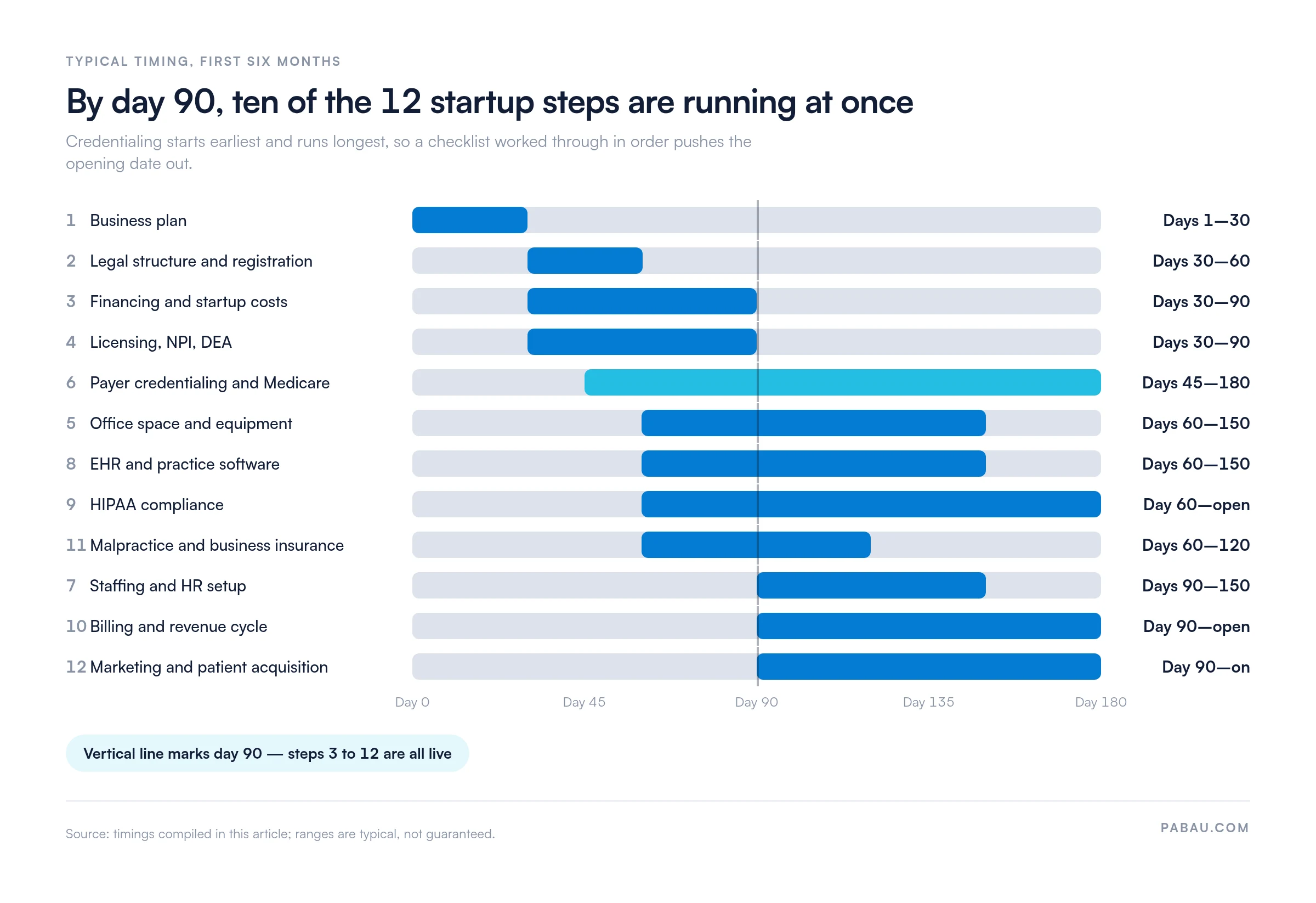
Run the phases in parallel. By day 90, ten of the 12 steps should already be under way.
Practice management software like Pabau covers scheduling, intake forms, billing, and patient messaging in one system.
The checklist below covers every major decision point, roughly in the order you’ll meet them. Some phases overlap. EHR selection happens alongside credentialing, and staffing runs parallel to office setup.
Plot those day ranges on a calendar and the numbering stops looking like a queue. By day 90, ten of the 12 steps are already running.
Before you contact a bank or sign a lease, you need a medical practice business plan that holds up to scrutiny. Lenders require it. More practically, it forces you to stress-test your assumptions before they cost you.
Your plan should cover specialty focus, operating expenses, and expected payer mix. Add projected patient volume at months 3, 6, and 12, plus a 12-month cash flow forecast. The American Medical Association publishes a getting-started series for physicians entering private practice that follows the same planning sequence.
Most physicians choose between a Professional Corporation (PC), a Professional Limited Liability Company (PLLC), and a sole proprietorship. Each carries different liability protection and tax treatment. Consult a healthcare attorney, because state law varies on which structures physicians may use, and some states require a PC.
Once your structure is chosen, register with your state and obtain an Employer Identification Number (EIN) from the IRS. Then open a dedicated business bank account and keep personal and practice finances separate from day one.
Startup costs for a medical practice typically run from $70,000 to $250,000 or more. The range depends on specialty, location, and whether you lease or buy your space. These figures are estimates, and a healthcare accountant can model your specific scenario.
Financing options include SBA 7(a) loans, conventional bank loans, and practice acquisition financing for physicians buying an existing practice. Lenders will ask for the cash flow forecast from your business plan, so finish that first.
This phase runs longer than most physicians expect. Start credentialing as early as you can, ideally before you sign your lease.
Commercial payer credentialing typically takes 60 to 120 days, and it varies by payer and by specialty. Plan your cash flow around that wait, because you cannot bill a plan you are not yet contracted with.
Office setup and EHR selection happen in parallel. Don’t choose your EHR after you’ve committed to a space. The software drives workflow decisions that affect your floor plan, exam room count, and front desk layout.
Your EHR is the operational spine of your practice. Judge it on specialty fit, billing integration, patient portal capability, and total cost of ownership. Implementation typically takes 1 to 3 months, so plan it alongside staff training.
Solo and small practices have a narrower shortlist than a hospital-owned group, since the cost of a consultant-led rollout rarely fits the budget. Our comparison of the EHR for solo practice market covers the systems that install without one.
HIPAA compliance is not a one-time checkbox. It takes policies, training, signed agreements, and ongoing documentation. The HHS Office for Civil Rights enforces the HIPAA Security Rule, which requires a written security risk assessment before you open.
The HHS summary of the HIPAA Security Rule requirements sets out the administrative, physical, and technical safeguards your policies have to cover. Work through it before opening day, not after a payer or a patient asks for it.
Revenue cycle management decides whether your practice survives the first year. Claims submitted with errors get denied. Denials that aren’t worked within 30 to 60 days become write-offs.

Insurance coverage checklist: malpractice (claims-made or occurrence policy), general liability, workers’ compensation, property insurance, and cyber liability. Coverage minimums vary by state, specialty, and hospital affiliation, so consult a healthcare-focused insurance broker.
A clean setup still fails if nobody knows you exist. Patient acquisition for a new practice needs both a digital presence and referral relationships.
The tactics that fill a schedule in year one are not the ones that keep it full in year three. Our guide on how to grow a medical practice covers what comes after the launch push.
Most physicians need 9 to 12 months from decision to first patient. Six months is possible for a cash-pay specialty practice. An insurance-based primary care practice realistically needs 12 months or more once credentialing is factored in.
Practice failures trace back to the same handful of mistakes. Knowing them in advance doesn’t guarantee you avoid them, but it gives you a fighting chance.
Run credentialing and licensing as two parallel tracks from day one. File your CAQH ProView application as soon as you have your NPI and state license. Then contact each payer individually to start their credentialing process. Every week of delay is a week without insurance revenue after you open.
A new practice usually buys scheduling, intake forms, charting, billing, and patient messaging from four or five separate vendors. Each one needs its own contract, its own BAA, and its own training session before opening day.
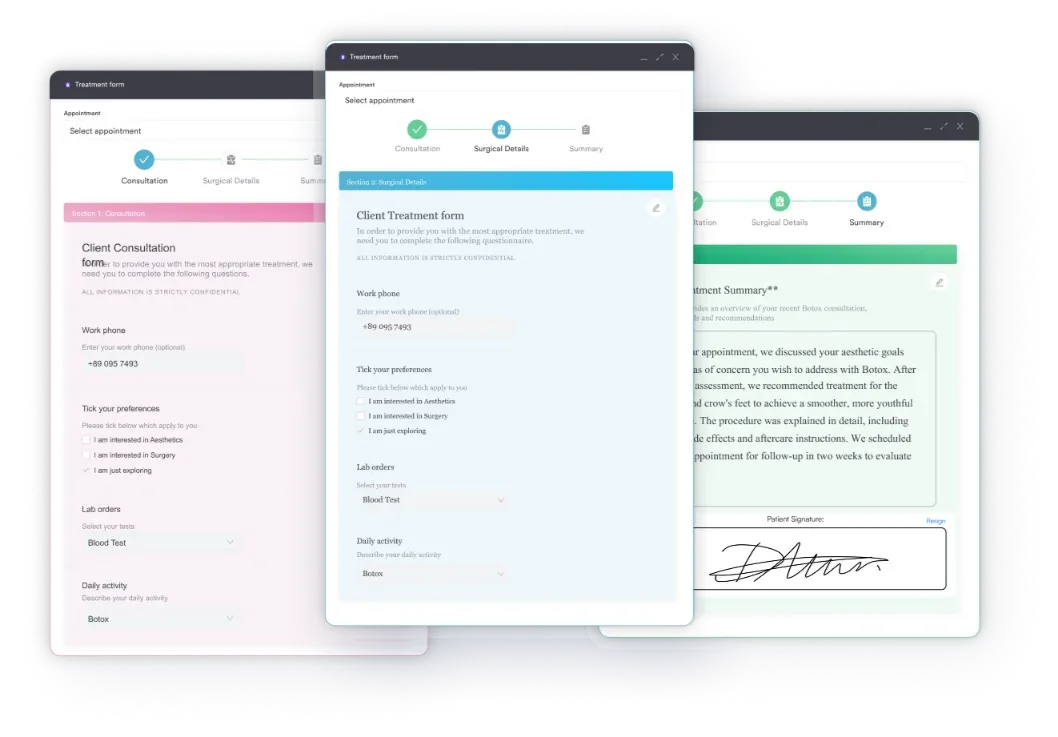
Practice management software like Pabau runs those jobs in one system, built for specialty and wellness practices. Appointments, digital forms, clinical records, invoices, and reminders share a single patient record, so nothing is rekeyed between tools.
Consolidating into one practice management app also means one vendor BAA to sign and one workflow to train staff on. Every subscription includes every feature, so a solo practice starts on the same system a three-site group runs.
Onboarding is structured rather than self-serve. Your team is configured and trained while credentialing is still pending. That is the one stretch of the launch when nobody is seeing insurance patients anyway.

Pabau gives a new practice scheduling, digital forms, billing, and patient communications in a single platform. Fewer vendors to contract with, and one workflow to train your team on.

Opening a practice rewards planning in parallel. Put credentialing, licensing, and financing on the calendar together in month two. The remaining nine steps then have room to move without pushing your opening date.
Two decisions are expensive to reverse: your payer mix and your software. Both lock in workflows you will live with for years, so give them more deliberation than the lease.
Choosing practice management software before opening day saves a painful migration in year two. Book a demo to see how Pabau handles scheduling, intake, and billing for a practice that hasn’t seen its first patient yet.

Still shortlisting systems? Best medical practice management software compares the platforms a new practice is most likely to evaluate.
Worried about the rollout itself? EHR implementation sets out the data migration, configuration, and training steps in order.
Opening with two or three staff? Best EMR for small practice weighs the options that suit a very small team.
Need cash coming in before payers pay? Patient collections covers point-of-service payment policies that protect early cash flow.
A medical practice startup checklist is a structured list of every task, decision, and compliance requirement a physician must complete before opening a private practice. It covers business planning, legal structure, licensing, credentialing, EHR selection, HIPAA compliance, billing setup, staffing, and marketing. Most physicians work through it across 6 to 12 months.
Yes. You need both a Type 1 NPI (individual provider) and a Type 2 NPI (organization) before you can submit insurance claims or enroll with payers. Registration is free through the NPPES portal at nppes.cms.hhs.gov and typically takes 1 to 2 weeks to process.
Start by completing your CAQH ProView profile, which most commercial payers accept. Then contact each payer individually to open their credentialing application using your CAQH ID. Enroll in Medicare and Medicaid through CMS PECOS at the same time. Expect 60 to 120 days per payer, and apply to every plan in your target mix together.
CLIA (Clinical Laboratory Improvement Amendments) certification is required if your practice performs any lab testing beyond CLIA-waived tests. Practices running point-of-care tests such as urinalysis, strep tests, or glucose monitoring typically need at least a Certificate of Waiver. Contact CMS to work out which certificate applies to your testing menu.