Head to toe assessment cheat sheet: Printable nursing guide
A head to toe assessment cheat sheet gives you one fixed order at the bedside, s...

2
Last Updated: Oct 23, 2026

The Hospital del Mar criteria scores 10 hypermobility items at one point each, for a maximum of 10. Bulbena and colleagues developed it in Barcelona.
The published cut-off is sex-specific. Men meet it at 4 or more positive items, and women at 5 or more.
Unlike the Beighton score, it includes no trunk-flexion maneuver and covers more peripheral joints. That is why it reports higher prevalence.
Practice management software like Pabau stores each score as a structured field per visit, so trends and referral thresholds stay visible at follow-up.
Clinicians managing hypermobility-related conditions face a persistent documentation problem. The Beighton score has dominated joint hypermobility screening for decades. Its 9-point scale misses several peripheral joints that frequently cause symptoms.
The Hospital del Mar criteria takes a wider view. It scores 10 items across the hand, the limbs, and the skin, one point each. This guide covers how the tool works, how to score it, and how to read the result. It also sets the two instruments side by side, so you can see which one fits the patient in front of you.
The Hospital del Mar criteria is a structured clinical assessment tool for generalized joint hypermobility (GJH). Bulbena and colleagues developed it at Hospital del Mar in Barcelona as an alternative to the Beighton score. The aim was to capture hypermobility across a wider range of peripheral joints.
You will also see it cited as the Bulbena score, or simply the Bulbena criteria, after its lead author. All three names describe the same assessment.
The tool is used primarily by physical therapists, rheumatologists, and other musculoskeletal clinicians. It is not a standalone diagnostic instrument for any condition. That includes hypermobile Ehlers-Danlos syndrome (hEDS) and hypermobility spectrum disorder (HSD).
Nine of the 10 items are joint maneuvers, spanning the thumb, fifth finger, elbow, shoulder, hip, patella, knee, ankle and foot. The tenth records a skin sign, bruising after minimal trauma. There is no trunk-flexion maneuver, which is the clearest structural difference from the Beighton score.
You will meet the tool in two places. The first is routine musculoskeletal assessment in a physical therapy practice. The second is a rheumatology workup where the Beighton score came back low despite obvious peripheral laxity.
Each item tests one joint or, in the case of bruising, one clinical sign. A positive finding scores one point and a negative finding scores nothing. The table below sets out all 10 items, the maneuver used, and the threshold that counts as positive.
Each joint maneuver is tested passively on both sides. An item still contributes only one point, whether the finding is one-sided or bilateral. That is what keeps the maximum at 10 rather than 20, and it is the detail clinicians most often get wrong.
Assessment requires physical examination by a trained clinician, so it cannot be self-administered. The thumb and fifth-finger maneuvers are the two patients already know. What people call the double-jointed fingers test is exactly this pair, and patients often demonstrate it before you ask.
Clinicians using digital assessment forms can standardize how hypermobility findings are captured and linked to each patient record. That removes most of the incomplete documentation you get across a busy caseload.

Scoring is straightforward. Each positive finding adds one point, and the maximum possible score is 10. A higher score indicates greater generalized hypermobility.
Interpretation is where the tool differs most from the Beighton score. Bulbena and colleagues published a sex-specific threshold. Men reach it at 4 or more positive items out of 10, and women at 5 or more.
Women tend to score higher than men on hypermobility testing, which is why the female threshold sits one point above the male one. The consequence is easy to miss in a busy clinic. A man scoring 4 out of 10 meets the threshold, while a woman with the identical score does not.
So a raw total on its own is not a result. Record the score, the sex-specific threshold you applied, and the version of the tool you used. Anything less leaves the next clinician guessing.
Write the threshold into the note next to the raw score, not just the number. A line reading 5 out of 10, female, threshold 5, is unambiguous six months later. A bare 5 out of 10 is not, and it cannot be compared with anything.
Interpretation starts with the published cut-off, then widens to the clinical context. The table below sets out how each band is usually read, and what it tends to prompt next.
A positive screen does not confer a diagnosis of hEDS or hypermobility spectrum disorder. Both need broader diagnostic criteria than any single assessment score can supply.
The 2017 hEDS criteria from the Ehlers-Danlos Society ask for a good deal more. They require evidence of systemic connective tissue involvement, musculoskeletal complications, and family history alongside the hypermobility finding.
Spinal involvement is a separate question this tool does not answer. Where a patient’s symptoms point at the lumbar spine, an inflammatory cause such as M45.6 needs ruling in or out on its own evidence. Thoracic symptoms call for a hands-on exam instead, since costovertebral joint mobility is graded rib by rib.
Three differences separate the two tools. The Hospital del Mar criteria scores 10 peripheral items and includes no trunk-flexion maneuver. The Beighton score scores 9 points across five maneuvers, one of which is trunk forward flexion. And their thresholds work differently, because only one of them is sex-specific.
Naming causes confusion as well. The Beighton score turns up in the literature and in patient conversations as Beightons score, and as the Beighton hypermobility scale. The Hospital del Mar test carries the Bulbena name just as often as the hospital name.
Hips are the clearest example of what the two tools see differently. The Beighton test has no hip item at all, so a patient with marked hip laxity can still score low. The Hospital del Mar criteria scores hip abduction to 85 degrees or more. That single item is often why the same patient’s result moves.
The table below sets the two instruments side by side on the axes that decide which one you reach for. That includes origin, alternative names, thresholds, and typical clinical use.
The size of that prevalence difference is worth knowing before you switch tools. A study of school children applied both instruments to the same cohort. The Beighton score flagged 12 percent as hypermobile, while the Hospital del Mar criteria flagged 34 percent.
That is close to a threefold difference in the same children. It reflects broader item coverage rather than a sharper ability to detect hypermobility that actually matters clinically. Read a high Hospital del Mar score in that light.
The Hospital del Mar criteria has a smaller validation evidence base than the Beighton score. Factor that in before you build it into a standard assessment protocol.
Both tools sit inside a wider workup for Ehlers-Danlos syndrome (EDS). The 2017 hEDS framework uses the Beighton score as its first criterion, which makes Beighton the standard opening move. Rheumatology referrals therefore tend to ask for a Beighton score by name.
Part of the reason is the Beighton cut-off of 4/9, which gives two clinicians a figure they can compare directly. No score, from either tool, confirms a diagnosis alone.
Single-maneuver tests behave the same way, which is why they are graded on the same axes. The full can test is a useful comparison, since its value also rests on sensitivity and examiner technique rather than the finding alone.
The Ottawa ankle rules show the pattern in a different joint, where a short rule set decides who needs imaging. The Physiopedia entry on the Hospital del Mar criteria is the quickest reference for the maneuvers themselves.
Each limitation below changes either what the score can be used for, or how much weight it should carry in a decision.
Complex presentations need more than one data point. An association between joint hypermobility and ADHD has been proposed in emerging research, alongside autism, and that evidence remains preliminary.
No hypermobility instrument screens for either condition. If a patient raises the connection, document the joint findings and refer separately. A dedicated tool such as an impulsivity test fits that pathway better.
Reach for the Hospital del Mar criteria when the clinical question concerns peripheral joint hypermobility. It earns its extra minutes when the Beighton score’s narrower coverage would understate how widespread the laxity is. Hypermobility syndromes also travel with anxiety and other psychiatric comorbidities, so understanding how thought blocking is diagnosed is useful when interview answers stall.
Athletes are a common reason to choose it, since laxity in the shoulders, hips, and ankles drives their presentation. Practices running sports medicine software tend to score these joints as a matter of routine.
A structured score should feed the rehab plan instead of sitting in the notes. For patient-facing explanations of Beighton ranges, Medical News Today is a useful plain-language companion.
Written into a free-text note, a score of 5 out of 10 is just a number inside a sentence. Three visits later, nobody can tell whether it was an improvement, a decline, or a second clinician reading the same joints differently.
Practice management software like Pabau handles this differently. You build the Hospital del Mar criteria once as a digital assessment form. Each item gets its own structured field, plus a field for the total and one for the threshold applied.
Each completed form attaches to the patient’s clinical record. Every visit then adds a dated score rather than another paragraph of prose that someone has to read to the end.
Because those totals are structured fields, measurements tracking can trend them across visits. For a patient with chronic hypermobility, isolated numbers become a line you can show them in the room.
That also makes your referral threshold usable. A result that crosses it is visible at the next appointment, not buried in a note from six months ago.
Structured client records link the assessment to appointment history, treatment notes, and follow-up scheduling. The whole clinical team then reads the same information without a manual filing system. That matters most in hypermobility care, where up-to-date records are the only way to see change over time.
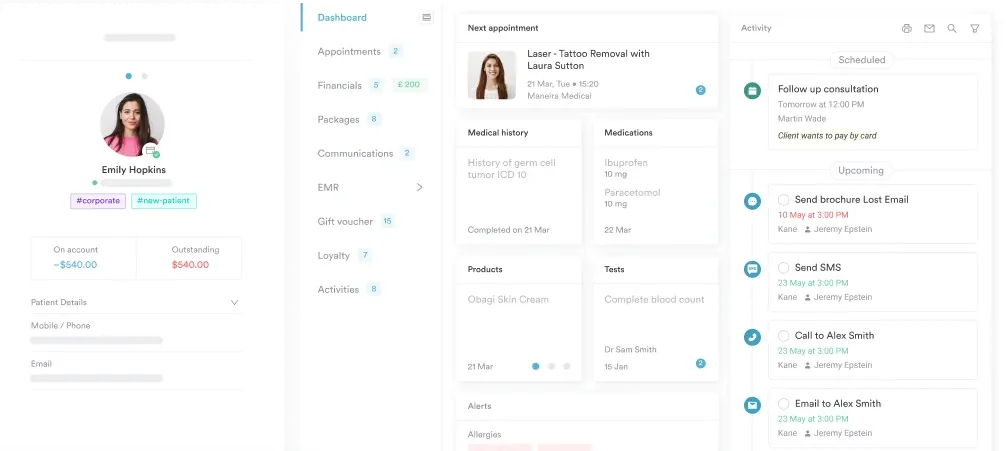
Physical therapy practice management software keeps assessment documentation, scheduling, and patient communication in one system instead of three. Each result then stays attached to the patient context it belongs to.

Pabau lets physical therapists and rheumatologists build the 10 items as a structured form. Each total attaches to the patient record, and follow-up care is scheduled in the same place. See how it works for your practice.

The Hospital del Mar criteria earns its place when the peripheral joints carry the symptoms. Its 10 items reach the hip, patella, and forefoot, which the Beighton score’s five maneuvers never touch. The trade is a longer exam and a thinner validation literature.
For routine screening, the Beighton score remains better validated and more widely referenced. Use the Hospital del Mar criteria when the presentation looks broader than Beighton captures. Then write down the threshold you scored against, because the male and female cut-offs are not the same.
Whichever tool you choose, a score only changes care if the next clinician can find it and compare it. Book a demo to see how Pabau keeps hypermobility scores and follow-up care in one patient record.

Need another shoulder test with a clear interpretation path? Full can test sets out the procedure, the positive finding, and what the accuracy data supports.
Want guidance on interpreting another scored assessment? Beery VMI scoring and interpretation shows how structured scoring frameworks work across different instruments.
Starting or scaling a physical therapy practice? Opening a physiotherapy clinic walks through the operational and compliance requirements for private practice.
Need a structured approach to clinical documentation? Physiotherapy clinic management software covers how one platform can hold assessment, scheduling, and records together.
Need to assess daily living independence too? Katz Index of Independence worksheet standardizes how you score a patient’s activities of daily living.
The Hospital del Mar criteria is a clinical assessment tool for generalized joint hypermobility across peripheral joints. Physical therapists, rheumatologists, and other musculoskeletal clinicians use it to screen for widespread joint laxity. It is most often applied where hypermobility spectrum disorder or hypermobile Ehlers-Danlos syndrome is suspected. It is not a standalone diagnostic instrument for any condition.
The Hospital del Mar criteria scores 10 items at one point each and includes no trunk-flexion maneuver. The Beighton score uses a 9-point scale across five maneuvers, one of which is trunk forward flexion. Its cut-off is also the same for both sexes, where the Hospital del Mar threshold is not. The Hospital del Mar criteria tends to report higher prevalence, because its item coverage is broader.
Yes. The Hospital del Mar criteria is sometimes called the Bulbena score or the Bulbena criteria, after its lead author. Bulbena and colleagues developed the tool at Hospital del Mar in Barcelona. All three names refer to the same 10-item joint hypermobility assessment.
The published cut-off is sex-specific. Bulbena and colleagues set it at 4 or more positive items out of 10 in men, and 5 or more in women. So a man scoring 4 meets the threshold while a woman with the same score does not. Record the raw score and the threshold you applied, so the result stays unambiguous in the notes.
It covers 10 items in total. Nine are joint maneuvers, testing the thumb, fifth finger, elbow, shoulder, hip, patella, knee, ankle and foot, and the first metatarsophalangeal joint. The tenth item records bruising after minimal trauma. Each item scores one point, whether the finding is one-sided or bilateral.
No. It includes no trunk-flexion maneuver of the kind the Beighton score uses. Its items focus on peripheral joints, plus one skin sign for bruising. Where spinal mobility is clinically relevant, the Beighton score’s trunk forward flexion offers a complementary assessment point.
No, not on its own. A positive screening result contributes to a hypermobile EDS workup, but cannot confirm the diagnosis independently. The 2017 hEDS criteria require evidence of systemic connective tissue involvement, musculoskeletal complications, and other features beyond a single hypermobility score.
There is no single standardized Beighton score calculator of the kind that exists for some clinical scores. Clinicians tally the five maneuvers by hand during the physical exam. Informal online versions exist. The total still depends on the examiner’s own measurements, so the exam itself is the instrument.
Research has reported an association between joint hypermobility and ADHD, alongside other neurodivergent conditions such as autism. It remains an area of active clinical interest rather than settled evidence, and no hypermobility assessment screens for ADHD. If a patient raises the connection, document the joint findings and refer for neurodevelopmental assessment separately.