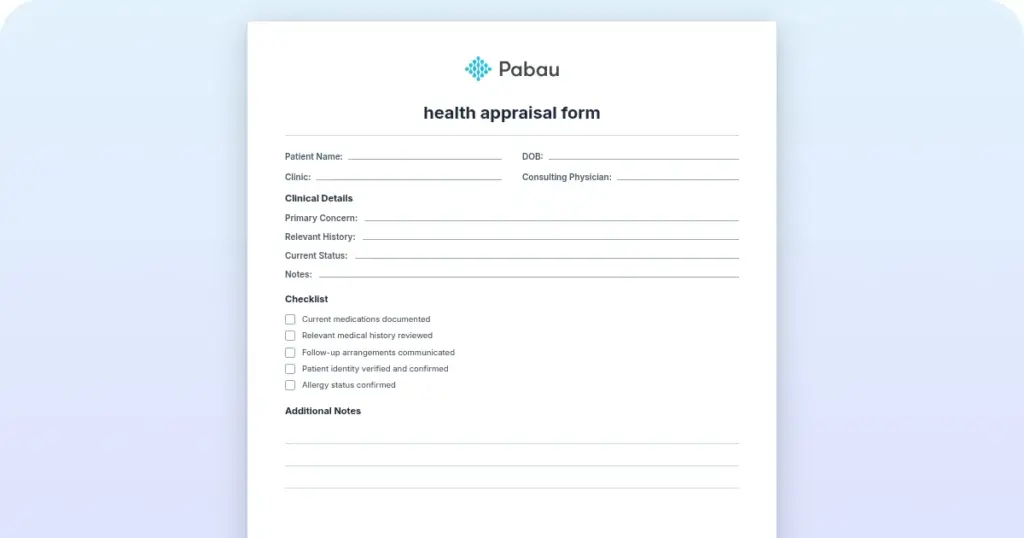
Health appraisal form
A health appraisal form is a record a licensed provider signs to document someon...

2
Last Updated: Oct 13, 2026

Software covered: 1. Pabau, 2. SimplePractice, 3. Tebra, 4. AdvancedMD, 5. athenahealth, 6. DrChrono (for context)
DrChrono suits iPad-native physician workflows but scores 3.6/5 on G2, with support delays and limited Android access cited as top reasons practices switch
EverCommerce acquired DrChrono in November 2021 for roughly $182 million, and many switch-worthy support complaints date from after that ownership change; pricing now runs three quote-based tiers (Foundation, Growth, Premium) with no published per-provider rate
The best DrChrono alternatives for aesthetic and wellness clinics prioritize private-pay billing, automated client journeys, and visual documentation over insurance-heavy EHR features
Pabau handles booking, consent, treatment notes, payments, and recall in one platform, starting from $65/month, rated 4.7/5 on Capterra
DrChrono works well for iPad-native physician practices. For everyone else, however, its 3.6/5 G2 rating and recurring complaints about support response times tell a familiar story: the platform was built for a specific type of clinical workflow, and practices outside that mold tend to notice.
Whether you run a med spa, a private GP clinic, a mental health practice, or a multi-specialty group, the DrChrono alternatives below cover the full range of clinic types and practice models.
Each has been assessed on scheduling, clinical documentation, billing, support quality, and overall value for independent and private-pay practices. You should be able to match your practice type to the right platform without wading through tools built for someone else.
DrChrono by EverHealth has been a fixture in the EHR market for over a decade. Its iPad-native interface, custom clinical templates, and integrated billing service made it a popular choice for solo and small physician practices, especially those running Apple-first workflows. Over time, though, a consistent set of limitations has pushed practices to look elsewhere.
EverCommerce acquired DrChrono in November 2021 for roughly $182 million, folding it into its EverHealth portfolio. Many of the support and reliability complaints below date from after that ownership change.
The problems that drive practices to search for alternatives tend to fall into three areas: Support quality, platform reliability, and fit for non-physician workflows. Capterra reviewers score DrChrono at 3.9/5, with slow customer support responses, occasional system downtime, and limited Android support among the most cited issues. On G2, the platform holds a 3.6/5 rating.
DrChrono now runs three tiers, Foundation, Growth, and Premium, and none of them have a published per-provider rate; practices get a custom quote.
The platform does publish exact overage fees, including $0.05 per text and $0.10 per phone call beyond a plan’s included allowance. Older figures still circulating online refer to DrChrono’s previous Essentials/Advanced/Elite structure and are no longer accurate. For the full current breakdown, see our DrChrono pricing guide.
For practices running aesthetic, wellness, or hybrid clinical models, there is a second problem. DrChrono’s documentation, billing, and scheduling tools were designed around insurance-based physician workflows, not private-pay client journeys. That mismatch pushes many practices toward purpose-built alternatives.
| Pain point | What reviewers say | Who feels it most |
|---|---|---|
| Support response times | Slow resolution, especially for billing issues | Solo and small practices |
| Limited Android support | iPad-only focus excludes Android-using staff | Multi-role clinic teams |
| System downtime | Reliability concerns flagged in multiple reviews | High-volume practices |
| Non-physician workflows | Interface not optimized for aesthetic or wellness use | Med spas, wellness clinics |
| Pricing complexity | True cost unclear when billing services are included | Budget-conscious independents |
Before diving into the detail, here is how the leading DrChrono alternatives and competitors compare across the metrics that matter most for independent and private practices.
Pabau is an all-in-one clinic management platform built for aesthetic, wellness, and multi-specialty private practices. Where DrChrono is built for physician-only, insurance-heavy workflows on Apple hardware, Pabau instead covers the full picture of a private clinic: Booking, consent, treatment notes, invoicing, and automated follow-up in a single system every team member can use.
In practice, the platform supports medical spa software workflows, dermatology practices, private GP clinics, IV therapy, physical therapy, mental health, and multi-location clinic groups. Clinics comparing beauty-first tools can see how it ranks among GlossGenius alternatives as well. It is especially strong where DrChrono falls short: Private-pay billing, visual clinical documentation, and automated client journeys from booking through to post-treatment recall.
| Plan / Tier | Price | Details |
|---|---|---|
| Starter | From $65/month | Per practitioner; billed monthly |
| Team / Group | Scales by location and user count | Volume-based pricing |
| Enterprise | Custom pricing | Contact sales for a quote |
Pabau holds a 4.7/5 rating from 600+ verified reviews on Capterra. Reviewers most often praise the all-in-one feature set, the automated client journey, and the quality of onboarding support. The most common complaint is the initial learning curve for new team members.

Book a short demo and we’ll show you exactly how Pabau handles your booking, documentation, and billing workflows in one platform.

SimplePractice is purpose-built for therapists, counselors, and solo mental health practitioners. It is one of the most widely used practice management platforms in the behavioral health space, reportedly serving 250,000 or more practitioners according to SimplePractice’s own pricing page. For a solo clinician running a private therapy practice, it offers a cleaner, simpler experience than DrChrono’s physician-focused interface.
| Plan / Tier | Price | Details |
|---|---|---|
| Starter | $49/month | Promo $24.50/mo first 3 months; 30-day free trial |
| Essential | $79/month | Promo $39.50/mo first 3 months |
| Plus | $99/month | Promo $49.50/mo first 3 months |
| Add-on: ePrescribe | $49/month | + $89 one-time setup fee |
SimplePractice holds a 4.6/5 rating on Capterra. Reviewers consistently highlight ease of use, integrated telehealth, and transparent pricing as standout strengths. Limits around multi-location support and billing flexibility are the most common points of critique.
If you are a solo therapist comparing SimplePractice and DrChrono, request a trial of both platforms back to back and test the intake form flow specifically. The difference in how each handles client onboarding documents will tell you more about day-to-day fit than any feature list.
Tebra was formed from the merger of Kareo and PatientPop, combining Kareo’s revenue cycle management tools with PatientPop’s patient marketing features. The result is a platform aimed squarely at independent US physician practices that need both strong billing and patient acquisition tools in one system.
It is a direct response to the shortfall left by platforms like DrChrono that handle billing and marketing as separate concerns.
For practices leaving DrChrono because of billing service frustrations, Tebra’s RCM focus is an obvious point of comparison — though it is worth weighing the leading Tebra alternatives too. You can also see how Pabau stacks up against Tebra directly at the Pabau vs Tebra comparison page.
Tebra holds a 3.9/5 rating on Capterra and 3.8/5 on G2. Reviewers praise the billing capabilities and the patient acquisition tools from the PatientPop side. They also flag post-merger integration issues and support inconsistency as ongoing concerns.
AdvancedMD offers a full suite of EHR, practice management, and revenue cycle management tools. It is aimed at mid-size to larger independent practices that need a feature-rich system capable of handling complex multi-specialty billing and reporting needs.
According to the Office of the National Coordinator for Health IT (ONC), EHR adoption by office-based physicians reached over 80% in the US. For practices in that majority that need stronger RCM than DrChrono provides, AdvancedMD is a common comparison.
AdvancedMD holds a 3.6/5 rating on Capterra. Strong reporting and solid RCM features attract positive feedback from larger practices. Setup complexity and high cost are the main complaints from smaller practices that feel the platform is more than they need.
Before signing with AdvancedMD, ask for a detailed implementation timeline and a breakdown of onboarding costs. The total cost of ownership often exceeds the headline subscription price once implementation, training, and RCM fees are included.
athenahealth is one of the longest-standing names in US ambulatory EHR and revenue cycle management. Its cloud-based platform is used by a wide range of physician specialties, with particular strength in practices that need strong interoperability, claims automation, and FHIR connectivity across health systems.
In that sense, it sits in a different tier from DrChrono — more enterprise in scope, and priced accordingly.
athenahealth holds a 3.8/5 on both Capterra and G2. Strong RCM automation and interoperability earn consistent praise from larger practices. Smaller practices often describe the platform as over-built for their needs.
The best DrChrono alternative depends on what is actually driving the switch. As shown above, the platforms solve different problems for different practice types. With that in mind, use these decision criteria to narrow the list.
Most practices leaving DrChrono cite the same issues: Slow support, limited workflow flexibility outside physician settings, and a pricing structure that becomes harder to justify as the billing service costs stack up. The right DrChrono alternative depends entirely on what your practice actually needs from a platform.
For aesthetic, wellness, and multi-specialty private practices, Pabau covers the full client journey from booking through to post-treatment recall, with private-pay billing, visual documentation, and multi-location management built in from day one.
If you want to see how it handles your specific workflows, book a demo and we’ll walk you through it. Either way, the goal is to find a platform that fits how your clinic actually runs — not one you have to work around.

Comparing EHRs for mental health practices? Carepatron vs SimplePractice comparison evaluates both platforms across scheduling, documentation, billing, telehealth, pricing, and user experience.
Wondering if Cliniko fits your practice? Cliniko review weighs Cliniko’s scheduling and clinical notes against thin reporting and no task management for multi-site practices.
Deciding between DrChrono and Practice Fusion? DrChrono vs Practice Fusion comparison compares DrChrono’s mobile-first, multi-specialty features against Practice Fusion’s simple system for primary care.
The best DrChrono alternatives depend on your practice type. Pabau is the strongest choice for aesthetic, wellness, and private-pay clinics. SimplePractice suits solo mental health practitioners. Tebra and AdvancedMD serve independent physician practices with high insurance billing volume. athenahealth fits larger practices needing enterprise RCM and interoperability.
DrChrono works reasonably well for solo physician practices running iPad-native workflows. It is less suited for private-pay or aesthetic practices, which need private-pay billing tools, visual documentation, and automated client journeys that DrChrono does not offer natively.
For insurance billing, Tebra and AdvancedMD offer more robust revenue cycle management than DrChrono. For private-pay billing, Pabau is stronger, with native support for packages, memberships, retail product sales, and integrated invoicing without a managed billing service add-on.
Reviewers on Capterra and G2 most frequently cite slow customer support response times, system downtime, limited Android support, and a steep learning curve for non-clinical staff. DrChrono’s billing service costs and complexity are also a recurring frustration for smaller practices.
DrChrono is built for physician workflows on iPad; Pabau is built for aesthetic, wellness, and multi-specialty private clinics across all devices. Pabau includes body mapping, before-and-after photo management, private-pay billing, and automated client journey tools that DrChrono does not offer for aesthetic workflows. For med spas and cosmetic clinics, Pabau is the more purpose-built option.
Practice Fusion is the best-known free, ad-supported EHR, and a few platforms offer low-cost entry plans. Zero-cost tools keep monthly spend down, but they usually trade off support depth, private-pay billing, and automation, so weigh the running cost against the missing workflows before switching.
DrChrono is built around the iPad, and thin Android support is a common reason teams move on; its OnPatient portal for patients has the same iOS-first limitation. SimplePractice ships a full Android app, and browser-based platforms like Pabau run on any device, so staff and clients on Android phones or tablets are not locked out.