GLP-1 diet plan
A GLP-1 diet plan is a structured eating framework for patients taking semagluti...

2
Last Updated: Oct 13, 2026

The digit symbol substitution test (DSST) is a timed task measuring processing speed, sustained attention, working memory, and psychomotor coordination.
Scoring counts the correct symbol substitutions completed inside the time limit, which is 120 seconds on the WAIS-IV.
Raw scores mean little alone, so read them against age-adjusted norms for the version you administered.
Adults in the lowest DSST quartile had nearly double the odds of a cognition, mobility, or mood disorder within five years.
A low score is a broad risk signal, not a prediction of dementia or Alzheimer’s disease.
The digit symbol substitution test is a timed coding task that measures how quickly someone can match digits to symbols. It takes under two minutes and needs only a printed sheet, a pencil, and a stopwatch. That is why it turns up in memory clinics, psychiatric outpatient care, and drug trials alike.
It also carries more weight than its simplicity suggests. In one cohort of 5,888 older adults, the lowest-scoring quartile fared measurably worse over the following five years. They had nearly double the odds of developing a disorder of cognition, mobility, or mood.
This guide covers what the DSST measures, how to score it, how to read the result, and how to fit it into an assessment workflow.
The digit symbol substitution test (DSST) is a neuropsychological assessment built around one repetitive task. Participants match digits to symbols as quickly and accurately as they can, within a fixed time limit.
It began as a subtest of the Wechsler Adult Intelligence Scale (WAIS), where it appears under the name “digit symbol coding.” The test is now used widely as a standalone screening instrument, in clinical research and in routine neuropsychological evaluation.
The format is straightforward. A reference key at the top of the page pairs each digit, 1 through 9, with a unique symbol. Below the key, rows of blank boxes sit beneath randomly ordered digits. The participant fills in the correct symbol for each digit, working left to right, as fast as they can.
That simplicity is deceptive. The task makes four demands at once:
Each demand maps to a distinct cognitive domain. That combination is why the DSST works so well as a broad-sensitivity screening instrument.
No single cognitive domain fully explains DSST performance. The test draws on several processes at once, which is both its strength and its limitation. Broad sensitivity comes packaged with low specificity. Here is what each demand maps to:
Processing speed is the construct most often named. The evidence stops short of confirming it as the single driver, though. A peer-reviewed review of the test (PMC) describes the DSST as polyfactorial, and says the question of what it primarily measures has no definitive answer.
For practical purposes, treat the score as a composite. It tells you the speed of a coordinated visual, cognitive, and motor sequence, without isolating which part slowed down.
Raw scoring is simple. Count the number of correct substitutions completed within the time limit. On the WAIS-IV that limit is 120 seconds, extended from the 90 seconds used in the older WAIS-R.
Each correct symbol earns one point. Errors are noted but do not subtract from the raw score in standard administration. Some research and clinical trial versions still run a 90-second trial, so record which one you used.
Raw scores are converted to age-adjusted scaled scores using published normative data. Performance declines steadily with age, so the same raw score carries a different meaning at 30 and at 70. A total that looks worrying for a 40-year-old can sit comfortably inside the expected range at 80.
The norms themselves are not freely published. WAIS-IV scaled-score conversions live in the publisher’s technical and interpretive manual, and each digital version ships its own tables. So there is no single public benchmark you can score a patient against.
Important caveat: normative thresholds vary by study population, education level, and test version. A percentile taken from one dataset does not transfer to another. Interpret every raw score against the normative data published with the version you are administering.
A low DSST score is a flag, not a diagnosis. Scores below the 10th percentile for age and education suggest meaningful cognitive slowing. The causes are broad. Dementia, depression, medication side effects, anxiety, fatigue, poor sleep, and motor impairment can all suppress performance.
Four clinical questions decide what a low score is worth:
Those questions work best in a fixed order, because the answer to one changes how you read the next. Low processing speed with intact memory can point toward early Alzheimer’s disease, while globally suppressed scores can point toward depression.
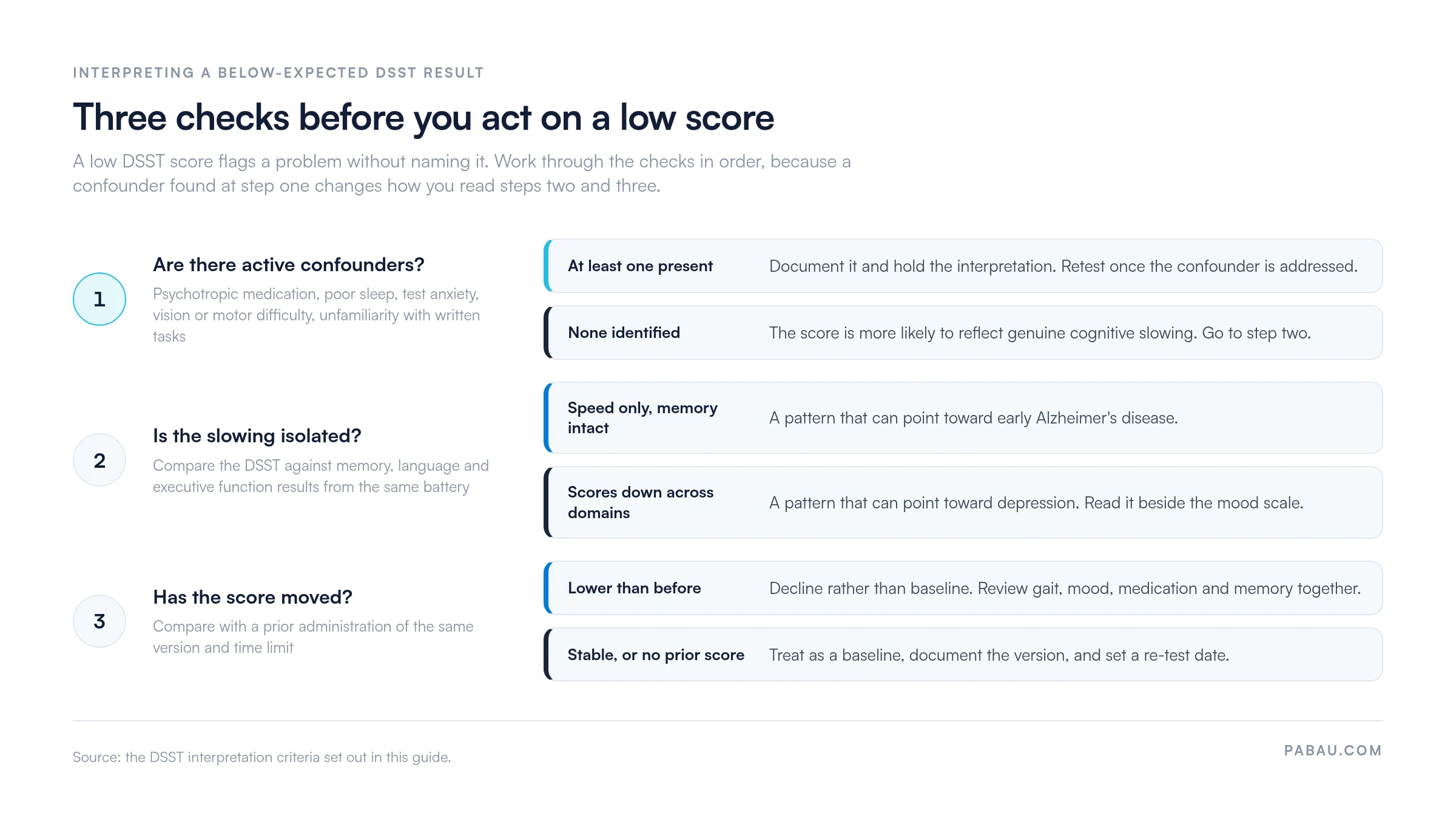
Whatever the answers, they belong in the record next to the number. A structured psychiatric evaluation template keeps score context, confounders, and referral decisions together with the raw result, which is what makes the next reading comparable.
The DSST earns its place in clinical workflows. It is quick, inexpensive, needs no specialist equipment, and is sensitive to a wide range of conditions. Its main use cases:
Practices running longitudinal cognitive monitoring gain the most here. A repeatable task like the DSST belongs in the assessment protocol, and each result belongs in the client record beside every other measure. Software built for therapy and psychology practices keeps those two things together, so a repeat score can be compared instead of hunted down.
A low DSST score signals broad vulnerability rather than a specific diagnosis. The Age and Ageing analysis drew on the Cardiovascular Health Study, a cohort of 5,888 older adults tested between 1992 and 1994. Researchers then tracked cognition, mobility, and mood annually through 1998-99.
Cognition was measured with the 3MS, mobility with gait speed, and mood with the CES-D scale. Over that five-year window, the lowest DSST quartile stood out clearly. Those participants had nearly double the odds of developing one or more clinical or subclinical disorders across the three domains.
Read the endpoint carefully. It was a composite of cognition, mobility, and mood outcomes, not an adjudicated diagnosis of dementia or Alzheimer’s disease. The distinction matters when you explain a result to a patient.
That breadth fits what the task measures. Processing speed depends on widely distributed white matter networks, so it registers early change in several systems at once. The same slowing that shows up on a symbol-matching sheet can also show up in how fast someone walks, or in a rising depression score.
For clinicians, that makes the DSST a broad early-warning screen rather than a dementia-specific one. A low score in an older patient is a prompt to review gait, mood, medication, and memory together.
The DSST’s core tradeoff is well established. It is highly sensitive to cognitive impairment but not specific to any particular cause. A low score tells you something is wrong. It does not tell you what.
Several factors suppress DSST performance with no neurological impairment behind them:
Any of these can produce a false-positive screening result. Highly educated or highly motivated patients present the opposite problem. They may compensate for early cognitive decline, producing a false negative.
So position the DSST as a sensitive screen that flags cases for further assessment, never as a diagnostic tool in isolation. The American Psychological Association’s neuropsychology guidance reinforces that framework.
Brief cognitive screens serve a gatekeeping role, and the referral pathway behind them needs to be agreed before the first flag is raised.
The traditional paper-and-pencil DSST remains the most widely normed and clinically validated format. Digital and smartphone-based versions offer genuine advantages in clinical trial and remote assessment contexts. The two formats are not directly interchangeable, though.
Practices moving toward remote or telehealth-based cognitive screening should compare digital scores against paper norms only with caution. Where possible, choose a platform that publishes its own normative data, and record the platform and version with every result.
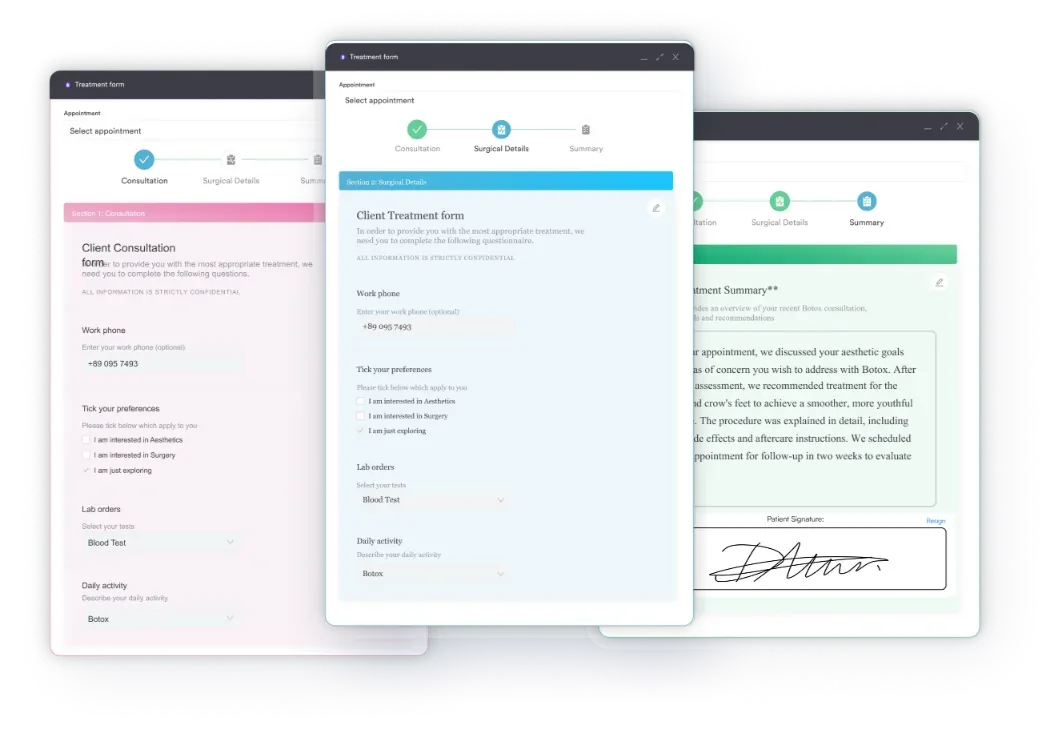
When using a digital DSST in a clinical or research context, document the platform name, version number, and its normative dataset alongside the score. Without those three details, longitudinal comparisons across administrations are unreliable. Treat it as you would a lab test: the result is only meaningful with the reference range attached.
The DSST is rarely used alone. Knowing how it compares to the tests it is usually paired with helps you build a battery that covers distinct domains without redundancy. The table below sets out the key distinctions:
The SDMT is the closest alternative to the DSST. Both use a symbol-digit substitution format, but the SDMT takes oral rather than written responses. That makes it the better choice when motor or writing difficulty is present, as in multiple sclerosis or post-stroke recovery.
The Trail Making Test adds the executive function and task-switching measurement the DSST cannot supply on its own. Pairing the DSST with TMT Part B gives you a fuller picture of both speed and mental flexibility.
The Montreal Cognitive Assessment does a different job again. It samples memory, language, visuospatial skill, and orientation, so it is the broader screen when dementia staging is the question. The DSST stays the sharper instrument for speed alone.
In ADHD presentations, the DSST pairs well with a symptom questionnaire. Where the Vanderbilt ADHD rating scale is already routine, a timed speed measure gives an objective counterpart to parent and teacher ratings.
The DSST takes under two minutes to administer, but its clinical value depends on how consistently it sits inside the assessment workflow. These steps support reliable, defensible use:
The National Institute on Aging’s guidance on memory loss and forgetfulness is useful context for step six. It gives you plain language for discussing a DSST finding with older patients and their families.
In most practices, a DSST result lives wherever the test was administered. The raw score gets written on a printed form, the scaled score goes into a letter, and the version used gets recorded nowhere. Six months later, nobody can say whether a score of 42 represents decline or a stable baseline.
Practice management software like Pabau keeps that context attached to the score. Practices running cognitive assessment programs in psychology practice software record each result directly in the client’s chart. The version, the time limit, the date, and any noted confounders sit alongside the number itself.
That is where the longitudinal value comes from. A single score is a data point, but three scores across 18 months tell a clinical story. Keep them in one record, with the version and the confounders attached. That is what lets you defend a trend in a report or a referral letter.

Pabau helps psychology and neuropsychology practices track assessment scores, document clinical notes, and manage longitudinal cognitive monitoring workflows, all in one place.

The DSST is worth its place in a battery for one reason. It picks up slowing that broader screens miss, in under two minutes of chair time. What it cannot do is tell you why the slowing is there.
So treat a low score as an instruction to look wider. Check the medication list, the sleep history, the gait, and the mood scale before the number carries any weight. A clinician who skips that step will over-refer, and a clinician who skips the re-test will miss the decline that mattered.
Record the version, the time limit, the date, and the confounders every time. Do that, and the second score becomes a comparison rather than a fresh data point. Book a demo to see how Pabau keeps cognitive assessment scores and re-test dates in one client record.

Choosing between a speed test and a broad screen? Montreal Cognitive Assessment test covers the multi-domain screen clinicians most often run alongside the DSST.
Assessing visual and spatial processing as well as speed? Visual spatial test explains what a visuospatial assessment adds to a cognitive battery.
Scoring an ADHD rating scale alongside cognitive testing? How to score the Vanderbilt ADHD rating scale walks through scoring and interpretation for parent and teacher forms.
The digit symbol substitution test (DSST) is a timed neuropsychological task. Participants match digits to symbols using a reference key, completing as many pairs as they can within the time limit. On the WAIS-IV that limit is 120 seconds. It was originally developed as a subtest of the Wechsler Adult Intelligence Scale, and it measures processing speed, sustained attention, working memory, and psychomotor coordination.
The DSST raw score is the number of correct symbol substitutions completed within the time limit. Each correct response earns one point, and errors are noted but do not subtract from the raw score in standard administration. Raw scores are then converted to age-adjusted scaled scores using published normative tables, since expected performance declines steadily with age.
Normal varies substantially by age, and expected raw scores fall steadily as patients get older. The raw-score norms themselves are published in the test manual rather than freely available, so there is no single public benchmark. A scaled score between 8 and 12, on the 0 to 19 scale, sits within the average range. Interpret every raw score against the normative dataset for the version administered, adjusted for age and education.
Both tests use a digit-symbol substitution format, but the response mode differs. The DSST requires written responses, while the Symbol Digit Modalities Test (SDMT) uses oral responses. That makes the SDMT preferable when fine motor impairment, tremor, or writing difficulty is present, as in multiple sclerosis or post-stroke assessment. Both primarily measure processing speed and sustained attention.
The DSST screens for cognitive impairment and does not diagnose Alzheimer’s disease or any other dementia. A Cardiovascular Health Study analysis published in Age and Ageing followed 5,888 older adults for five years. Those in the lowest DSST quartile had nearly double the odds of developing a clinical or subclinical disorder of cognition, mobility, or mood. That is a broad risk signal rather than a dementia prediction.
Yes, digital and smartphone-based versions of the DSST exist and have been validated in several research populations. However, digital versions use different motor demands than paper-and-pencil administration, and their normative databases are not yet equivalent to the extensive WAIS-IV paper norms. Clinicians using digital versions should document the platform, version, and normative dataset used. Avoid direct comparisons with paper-based historical scores without accounting for format differences.