Antipsychotic medication list
An antipsychotic medication list is a structured reference that organizes psychi...

2
Last Updated: Oct 13, 2026

Cognitive function assessment evaluates memory, attention, language, executive function, and visuospatial skills to detect impairment early and guide clinical decisions.
The MoCA, MMSE, Mini-Cog, and SAGE differ on time, licensing, and sensitivity. The wrong tool for your patient population leaves impairment undetected.
Cognitive screening tools detect risk rather than diagnose dementia. A score below the MoCA or MMSE threshold triggers a referral, not a diagnosis.
On the MoCA, 26 to 30 is generally normal, 18 to 25 suggests mild impairment, and a score below 22 warrants referral.
Pabau’s digital clinical forms let you send the screen before the visit, so the score sits in the patient record before the consultation starts.
About 57 million people worldwide are living with dementia, according to the World Health Organization. Most go undiagnosed until late in the disease course, and the step that usually goes missing is the screen itself. A well-chosen cognitive function assessment, run at the right moment, separates early intervention from a crisis presentation years later. This guide covers what these assessments measure, the four tools worth knowing, and how to choose between them. It also shows where the screen fits in a consultation without adding hours to your week.
A cognitive function assessment is a structured clinical evaluation of how well a person’s brain processes information across specific domains. The label covers a whole category of validated instruments, from a three-minute bedside screen to a full-day neuropsychological battery. Each one measures different aspects of cognition and answers a different clinical question.
The core domains every clinician should understand:
For practices running a mental health EMR, building the screen into intake captures these baseline data points systematically rather than by clinical impression. That consistency is what makes a comparison two years later mean something.
Early detection changes outcomes. The Alzheimer’s Association reports that an early diagnosis opens access to treatments that can slow progression, and gives families time to plan. Yet most primary care visits still include no structured screen. The clinical case for regular cognitive function assessment rests on four practical pillars:
Screens happen on schedule only when something other than clinician memory prompts them. Practices that rely on recall lose the patients who attend irregularly, or who arrive with several complaints competing for the appointment. Booking the screen as a recurring task inside your therapy practice management system removes that dependency.
The most common clinical mistake is conflating a brief screen with a diagnosis. They answer completely different questions.
The correct clinical pathway is screening first, battery second. A screen like the MoCA costs 10 minutes and identifies who needs the expensive, time-intensive battery. Ordering a full neuropsychological evaluation for every patient over 65 is neither feasible nor clinically indicated.
Four instruments dominate clinical practice. Each carries a distinct profile of strengths, limitations, and appropriate settings. Choosing the wrong one for your patient population costs you the detection the screen was supposed to deliver.
The MoCA is the workhorse of clinical cognitive screening. It was validated by Nasreddine et al. (2005) and confirmed across the meta-analyses cited in NCBI StatPearls. It covers seven domains: visuospatial and executive function, naming, memory, attention, language, abstraction, and delayed recall. Administration takes about 10 minutes, and it is scored out of 30 points. A score below 26 indicates possible cognitive impairment and warrants further investigation.
The MoCA outperforms the MMSE at detecting mild cognitive impairment. That makes it the preferred first-line screen for patients presenting with subjective memory complaints. Clinical use requires registration on the official MoCA site. Training and certification are free for students, faculty, academic researchers, and publicly operated healthcare institutions that provide proof of status. Other health professionals pay a one-time fee of around $125.
The MMSE is also scored out of 30 points. It covers orientation, registration, attention, recall, language, and visuospatial construction. It has been in clinical use since 1975 and remains embedded in many care pathway protocols. Its key limitation is a ceiling effect. Patients with high premorbid intelligence can score in the normal range despite measurable decline.
The MMSE is commercially licensed by PAR Inc. and cannot be reproduced freely. For practices already running it inside established pathways, continuing costs almost nothing. For practices setting up a new cognitive screening program, the MoCA’s sharper sensitivity for MCI makes it the stronger starting point.
The Mini-Cog combines a three-item recall task with a clock-drawing test and takes around three minutes. It requires no license fee and no specialist training. Its brevity makes it practical for high-volume primary care, where a full MoCA does not fit inside a standard appointment. Sensitivity for dementia is broadly comparable to the MMSE in primary care populations, though it captures fewer domains. Treat it as triage: a failed Mini-Cog prompts a MoCA or a referral, not a care plan.
The Self-Administered Gerocognitive Exam (SAGE) was developed at Ohio State University Wexner Medical Center. The patient completes it in the waiting room without clinician oversight, in roughly 15 minutes, and the clinician scores it afterward. SAGE covers orientation, language, memory, visuospatial, and executive function domains, and has shown sensitivity for early cognitive impairment. Because it takes no staff administration time, it suits practices with high throughput and limited clinical support staff. Returning the scored form to the clinician also creates a natural handoff point for the conversation.
Run a SAGE in your waiting room before every appointment for patients over 65. Staff time cost: zero. The clinician reviews the completed form before entering the room, so the cognitive conversation is already framed before the consultation begins.
A domain score only becomes useful once you know what that domain does. The table below pairs each one with the pathology it points toward, and with the complaint a patient or family is most likely to describe.
Record the domain-level detail, not only the composite. A patient who loses four points on delayed recall alone presents differently from one who drops four points spread across every domain. The composite score hides that difference, and the referral letter is where it matters most.
No single instrument suits every clinical setting. The right choice depends on four variables: your patient population, the appointment time available, staff capacity, and the clinical question you are actually asking.
Cost and licensing matter operationally. The Mini-Cog and SAGE are freely available. The MoCA requires registration, and most health professionals pay a one-time fee of around $125 for training and certification. The MMSE requires a PAR Inc. license. Factor these in before you build a screening program around a commercially restricted tool.
Computerized cognitive tests have moved into mainstream clinical use. Platforms such as Creyos and Cambridge Cognition’s CANTAB offer adaptive digital batteries. They measure reaction times, processing speed, and domain-specific performance against normative databases covering tens of thousands of participants. Their advantages over paper are standardized administration conditions, granular domain-level reporting, and remote delivery before an appointment.
Their limitations are equally practical. Patients unfamiliar with touchscreens may perform below their own cognitive level, which introduces floor effects unrelated to impairment. With no clinician in the room, you also lose the behavioral observation that contributes to differential diagnosis. Most digital platforms additionally require a separate subscription and an integration step that paper tools do not.
For most primary care and outpatient psychiatry settings, validated paper tools carry enough clinical information for the screening decision. Digital platforms add value in specialist contexts, particularly for monitoring change over time in clinical trial or research settings.
A screening score opens a clinical conversation rather than closing one. Turning that number into an action means knowing what the score covers, and what it leaves out.
On the MoCA, a score of 26 to 30 is generally considered normal. A score of 18 to 25 suggests mild impairment, and anything below 17 suggests moderate to severe impairment. Each band carries a different clinical response, mapped below. Education level also affects performance, so apply a one-point correction for patients with 12 or fewer years of schooling.
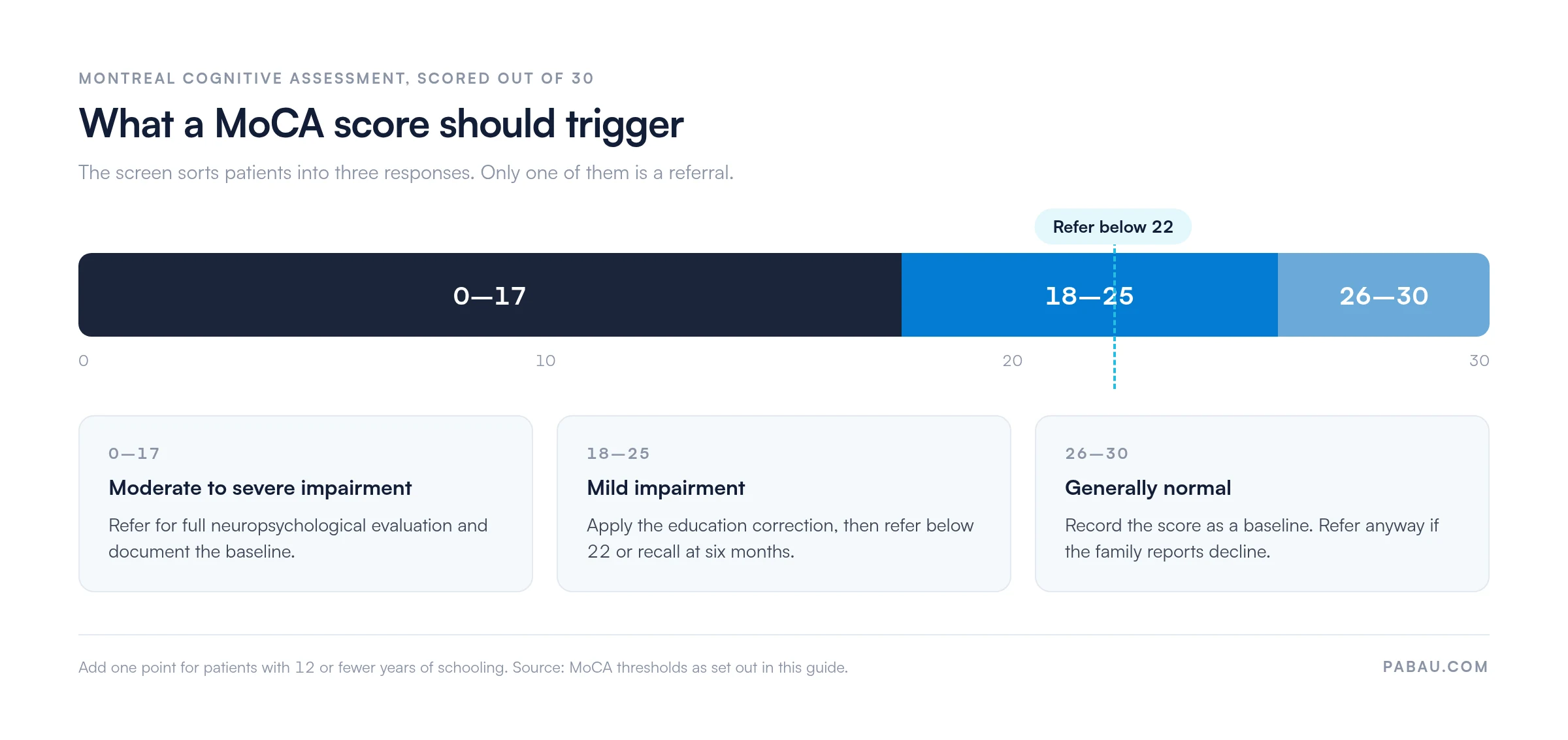
Write the raw score, the education correction you applied, and the clinical context into the same record entry. A score stored without its correction is unusable at the next visit, because nobody can tell which figure was compared.
When to refer for full neuropsychological evaluation:
Communicating results to patients takes plain language. “Your score suggests your memory is working normally for your age” carries the same clinical information as a 28 out of 30. It also avoids generating anxiety, and it spares the patient the job of interpreting a numerical scale.
No screening tool is perfect, and being honest about the limits protects both patients and clinicians. Knowing how these instruments fail prevents over-diagnosis in one direction and false reassurance in the other.
Education and cultural bias: All major screening tools were developed and normed predominantly on educated, English-speaking, Western populations. Performance on verbal fluency and naming tasks is affected directly by language background and educational attainment. The validated cutoffs do not fully account for either, so read a score in context rather than in isolation.
Ceiling effects: Patients with high premorbid intelligence can score in the normal range on both the MMSE and the MoCA despite clinically significant decline. When the history and the family report suggest impairment the screen did not capture, trust the history and refer. Neuropsychological evaluation is appropriate in these cases.
Practice effects: Repeat administration of the same tool within six months produces artificially improved scores in many patients. Where longitudinal monitoring is the goal, space repeat assessments six to twelve months apart, or use alternate test forms.
Screening is not diagnosis: the most consequential limitation of the four. A MoCA score below 26 does not mean the patient has dementia. It means the patient warrants further investigation, and communicating that distinction clearly is part of the clinical obligation. Where cognitive impairment overlaps with a psychiatric presentation, crisis intervention strategies help you hold a deteriorating patient safely while the referral is pending.
The clinical case for regular screening is settled. The operational barrier is workflow. When does the assessment happen, who administers it, where does the result live, and what triggers the follow-up?
Practice management software like Pabau closes that loop. Its patient intake forms let practices build the MoCA, Mini-Cog, or SAGE as a digital form and send it before the appointment. The completed form writes into the patient record automatically, timestamped and tied to the consultation. The clinician walks in with the score already on screen, instead of spending appointment time on administration.
Automated workflows then act on the score without anyone remembering to. A referral task opens for anything below threshold. A recall reminder fires at six months for borderline results, and a care plan template loads for confirmed impairment. The point is not to replace clinical judgment. It is to remove the administrative friction that causes screening to be skipped.
Practices building a formal memory assessment pathway need somewhere to document the full clinical picture, not only the score. A psychiatric evaluation template gives that documentation a structure the whole team can follow.

Send screening forms before the visit, store the result in the patient record, and automate the follow-up. Pabau connects the clinical encounter to what happens next.

Cognitive impairment goes unnoticed because the screening step gets squeezed out by appointment pressure, not because clinicians lack the knowledge. A three-minute Mini-Cog, a patient-completed SAGE in the waiting room, or a MoCA sent digitally before the visit costs almost nothing in clinical time. The alternative costs far more. A crisis presentation, a family asking questions, and a record with no baseline to answer them.
Pick one tool, attach it to a moment that already exists in your workflow, and record the score every time. The score matters less than the second score you can compare it against. Book a demo to see how the screen, the result, and the follow-up sit in one patient record.

Setting up a memory assessment pathway? Psychiatric evaluation template gives you a documentation framework for the full clinical encounter.
Patient deteriorating before the referral lands? Crisis intervention strategies for clinicians covers the steps that keep a destabilizing patient safe.
Screening executive function specifically? Executive function assessment gives you a form focused on planning, flexibility, and inhibitory control.
Explaining dementia progression to a family? 7 stages of dementia chart maps the course of decline in language relatives can follow.
Building the intake that comes before the screen? Mental health intake covers the history and risk questions to capture first.
A cognitive function assessment is a structured clinical evaluation of a patient’s cognitive abilities across domains including memory, attention, language, executive function, and visuospatial skills. It uses validated instruments to detect impairment, establish a baseline, and guide referral or treatment decisions. It is not a diagnosis in itself.
Four validated tools dominate clinical practice. They are the Montreal Cognitive Assessment (MoCA), the Mini-Mental State Examination (MMSE), the Mini-Cog, and the Self-Administered Gerocognitive Exam (SAGE). Each differs in administration time, domains covered, sensitivity for mild cognitive impairment, and licensing requirements.
The MoCA and MMSE are both scored out of 30 points, but neither contains exactly 30 questions in the conventional sense. The MoCA uses seven task categories: visuospatial and executive function, naming, memory, attention, language, abstraction, and delayed recall. Multiple items inside each category build the 30-point total. The MMSE uses 11 items across orientation, registration, attention, recall, and language subtests.
Administration time varies by instrument. The Mini-Cog takes approximately 3 minutes. The MoCA takes approximately 10 minutes. The SAGE takes approximately 15 minutes and is self-administered. A full neuropsychological battery can require 3 to 8 hours spread across multiple sessions.
Cognitive screening identifies patients who may have impairment and warrant further investigation. A full neuropsychological assessment characterizes the nature and severity of deficits across every cognitive domain. Normative data identifies which abilities are preserved and which are impaired. Screening takes minutes. A full battery takes hours and is administered by a specialist.
Brief screening tools such as the Mini-Cog, MoCA, and SAGE can be administered by primary care physicians, nurses, or trained practice staff. Full neuropsychological batteries must be administered and interpreted by a qualified neuropsychologist or clinical psychologist, depending on jurisdiction and qualification level.