Healthcare workforce planning: a practical guide for practice leaders
Healthcare workforce planning is the structured process of matching clinical cap...

Last Updated: Oct 13, 2026

DHA licenses clinics in Dubai, DoH licenses Abu Dhabi and MOHAP licenses the northern emirates, so your plan names one regulator, not several.
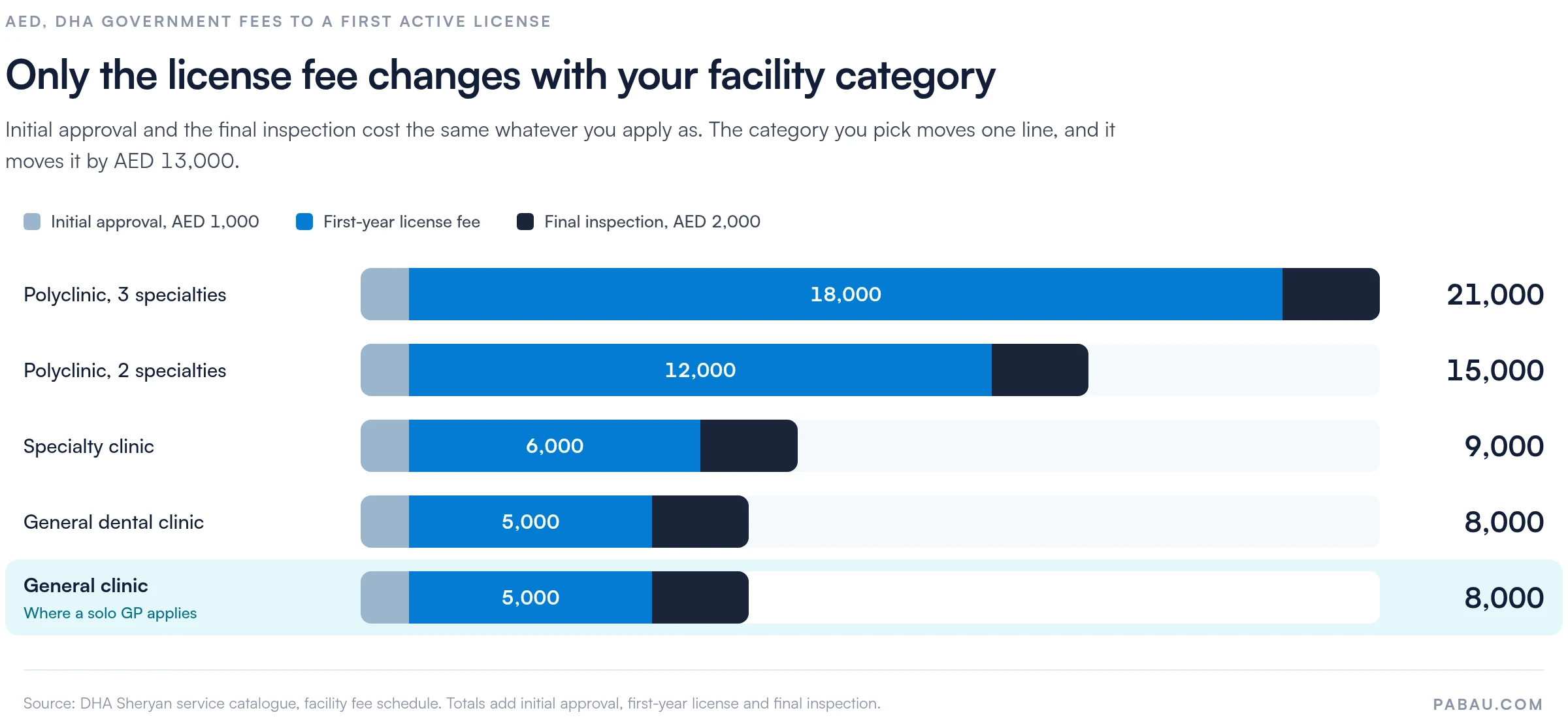
DHA government fees to a first active license come to AED 8,000 for a general or dental clinic and AED 9,000 for a specialty clinic.
Published all-in setup totals for a Dubai general practice clinic differ by roughly three times, and neither of the loudest two cites a source.
The license-first plan writes scope of services, room schedule, staffing matrix and premises first, because DHA’s initial approval application asks for those four.
Insurer payment can trail treatment by up to 141 days under Dubai’s own claim cycle standard, so month-one insured revenue overstates your cash.
A clinic business plan Dubai’s health authority will accept has nine sections, and the first four double as your license application. The regulator reads them before any bank or investor does.
Call that the license-first plan. Scope of services, room schedule, staffing matrix and premises come first, because the Dubai Health Authority asks for exactly those four at initial approval. The executive summary can wait.
Every AED figure below comes from a published fee schedule where one exists. Where no authority publishes a number, this guide names what sets the number instead of guessing. That distinction matters more than usual here. The two most-quoted setup totals for a Dubai general practice clinic differ by about three times, and neither credits a source.
A clinic business plan in Dubai needs nine sections, and the first four double as the pack your health authority reads at initial approval.
The DHA’s Manual for Licensing Health Facility sets out what a new facility application must carry. Clause 6.6.8 asks for a facility overview naming the services provided and the specialties of the professionals you will employ.
The same clause asks for a floor plan drawn by a prequalified health facility design consultant. Room and bed counts follow the DHA Health Facility Guidelines. It also asks for location details and the Makani number. That is a scope of services document, a room schedule and a staffing matrix, filed as a license application.
Consultancy guides often label section four a feasibility study. The DHA’s published manual does not use that term, so treat the label as the bank’s language rather than the regulator’s. If you want the generic structure without the UAE layer, our medical practice business plan guide covers it.
One document, two audiences, written in the order the license needs. That ordering is the whole point of the license-first plan. It also stops the common failure, which is a polished investor pack that no regulator will accept.
The DHA licenses clinics in Dubai, the DoH licenses Abu Dhabi, and MOHAP licenses private facilities in the northern emirates.
Those are three separate bodies with three separate submissions. The Dubai Health Authority (DHA) runs Dubai. The Department of Health – Abu Dhabi (DoH) runs Abu Dhabi. The Ministry of Health and Prevention (MOHAP) is the federal ministry, and it registers private facilities across the northern emirates.
No license crosses an emirate border. Two licenses also sit at different levels. The facility license belongs to the clinic. The professional license belongs to each clinician, and it is activated under the facility.
Sharjah is the row worth checking twice. MOHAP describes itself as registering private facilities in the northern emirates, and Sharjah Health Authority also regulates health services in that emirate. Ask which body licenses your facility category before you commit to a lease there.
Each emirate also runs its own health information exchange. NABIDH covers Dubai, Malaffi covers Abu Dhabi, and Riayati is the federal unified medical record. The three are now integrated with one another, but you still connect to the one your license sits under.
Choose Dubai Healthcare City for free-zone company setup and a healthcare-only address, and choose Dubai mainland for a wider patient catchment and cheaper occupancy.
One detail has changed since most guides on this topic were written. DHCC’s own regulations page now states that the Dubai Health Authority manages all healthcare regulations in the free zone. The page links straight to the DHA regulatory catalogue.
So the “own healthcare regulator” pitch no longer holds the way it used to. What still differs is the commercial layer and the clinician route.
DHCC still licenses healthcare professionals through its MASAAR system, and doctors sit the DHCA exam. DHCC publishes those fees: AED 1,000 initial application, AED 4,700 processing with a previous primary source verification, and AED 500 for the license card. Without a previous verification, processing is AED 5,700.
Mainland is cheaper per clinician. A DHA physician or dentist license costs AED 3,000 for one year, plus a AED 200 credentialing fee at registration. Multiply that difference by your headcount before you decide.
On the company side, DHCC’s published price list sets a commercial license at AED 15,000 a year. A single-specialty clinic with up to three physicians adds an operating permit of AED 6,750. Add AED 3,500 commercial registration, AED 2,000 for the pre-operational assessment and a AED 3,100 initial application fee.
That lands near AED 30,350 in year one before rent. Treat it as indicative: the price list is the 2018 edition, so confirm current figures with DHCA. A multi-specialty clinic with up to two specialties carries a AED 14,250 operating permit on the same list.
Three sections of the plan change with the route you pick. The licensing section names DHCA alongside DHA rather than DET. The premises section drops Ejari registration for a free-zone lease. The structure section names a free-zone company rather than a mainland limited liability company.
Full foreign ownership is no longer the deciding factor it once was. Federal Decree-Law No. 26 of 2020 removed the majority Emirati shareholder and local agent requirement for most mainland activities. Confirm your activity with DET rather than assuming the old rule.
Reserve the trade name, take DET initial approval, apply for the DHA facility license on Sheryan, fit out, pass inspection, then activate.
That is how to start a clinic in Dubai, in one line. The DHA clinic license comes in two halves, and the order surprises people. You receive an inactive license first, then activate it once the premises and the team are ready.
Two clauses in the licensing manual deserve a line in your plan. The inactive license is valid for one year. Miss that window and the licensing process is cancelled, and you re-apply from the start.
The second clause is blunter. During the initial approval period the facility may not provide healthcare services, receive or treat patients, or promote or advertise any health service. Your marketing calendar starts after activation, not before.
How to get trade license in Dubai is the question that usually comes first, and it is the wrong starting point. The trade name and activity have to match the facility category you will apply for, so decide the DHA category before you reserve the name.
On timing, DHA publishes durations for each service but not for the whole journey. The consultancy guides that do publish an end-to-end figure land between 18 and 26 weeks, which is four to six months. Plan on the upper end if the fit-out is complex.
Clinic setup cost in Dubai starts with AED 8,000 in DHA fees for a general or dental clinic, and AED 9,000 for a specialty clinic.
That figure is the government’s, not an estimate. For a general clinic that is AED 1,000 at initial approval and AED 5,000 for the first license year. The final inspection adds AED 2,000.
A general dental clinic pays the same AED 5,000 license fee. A specialty clinic, which is the category most dermatology and aesthetic practices apply under, pays AED 6,000. A polyclinic pays AED 12,000 for two specialties or AED 18,000 for three. The same three fees then come to AED 15,000 or AED 21,000.
Now the awkward part. One widely read guide puts an all-in Dubai general practice clinic at AED 450,000 to 700,000. Another puts the same clinic at AED 1.47 million to 2.25 million, including six months of operating costs. Neither credits a source for either number.
A threefold spread is not sloppiness on its own. Four variables move a total that far, and a serious plan states which one it assumed.
The cost of dental clinic setup in Dubai carries the same DHA fee as a general clinic, at AED 5,000 for the first license year. The difference lands in chairs, imaging and the room schedule, none of which any authority publishes a price for.
Two tax lines belong in the capex and opex tables. Corporate tax is 0% on taxable income up to AED 375,000 and 9% above it, for financial years starting on or after 1 June 2023. VAT registration becomes mandatory once taxable supplies pass AED 375,000.
The matching numbers are a coincidence. The two thresholds measure different quantities. One counts taxable profit, the other counts taxable supplies. Preventive and medically necessary care by a licensed provider is zero-rated, while elective cosmetic treatment carries VAT at 5%.
Budget the software line from a vendor quote rather than a table, and ask what the system covers before you compare prices. Our guide to practice management software sets out what belongs in that scope.
The DHA expects a named medical director, a professional license for every clinician, and malpractice cover for all of them. All three are conditions, not aspirations.
Appointing a medical director is a requirement of the activation service. The licensing manual makes that director responsible for governing clinical care and privileging, and for passing DHA regulatory messages into the clinic.
The DHA license for doctors runs on the same route for everyone. Each clinician clears primary source verification through DataFlow, passes any required computer-based assessment, registers with DHA, and is then licensed under your facility.
DHA publishes those license fees. A physician or dentist pays AED 3,000 for one year, AED 5,000 for two years, or AED 7,500 for three. Registration adds a AED 200 credentialing fee.
DHA nursing license requirements follow the same sequence at a lower fee. Nurses, midwives and allied health professionals pay AED 1,000 for one year, AED 1,500 for two years, or AED 2,500 for three. Part-time and trainee licenses are AED 1,000.
One sequencing detail catches new clinics out. Professional licenses stay inactive while the facility license is inactive, and they activate automatically the moment the facility does. So you can register the whole team early without paying for idle licenses.
In practices we onboard, the second clinician is where the plan slips. The clinic opens with one licensed doctor while the second is still in primary source verification. The revenue model quietly assumed both from week one.
Solo practitioner and multi-room clinic are two different license categories, not two sizes of the same one. A solo general practitioner under a General Clinic license pays AED 5,000 a year. A multi-specialty polyclinic pays AED 12,000 for two specialties or AED 18,000 for three. It also carries a AED 3,000 monthly late renewal penalty, against AED 1,000 for the solo license.
Residence visa allocation comes from the licensing authority and is tied to your premises. Confirm the number with DET or DHCA before the staffing matrix goes into the plan. Staff also need MOHRE work permits and Emirates ID, and each one adds days to the start date.
Insurer payment can trail treatment by up to 141 days in Dubai, so a plan that books insured revenue from month one is overstating cash.
Payer contracting runs on your facility license number, which means empanelment starts once the license is active. Credentialing with each insurer and third-party administrator then runs on their timetable, not yours.
After that, the regulator’s own claim cycle takes over. DHA’s Dubai Health Insurance Corporation standardised it in eClaimLink Standards Notice 03 of 2019, and the numbers are worth taking literally.
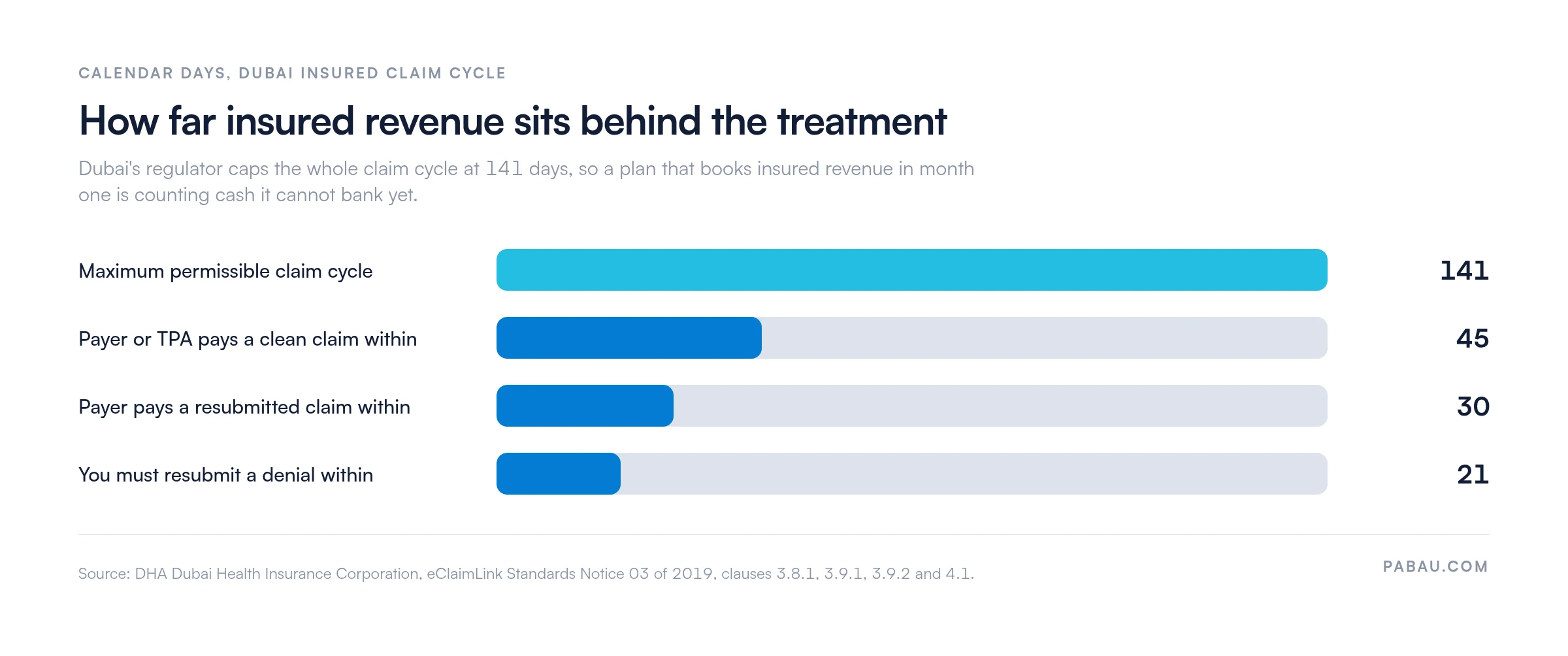
The submission end has a deadline too. You submit the claim no later than the 15th of the month after the service month. Late submission hands the payer a delay fee of 0.03% per day, and late payment hands you the same fee.
Payer mix is what turns that lag into a number. Dubai’s Health Insurance Law No. 11 of 2013 makes cover mandatory and sets the Essential Benefits Plan as the floor, with employers paying the premium. Most Dubai patients therefore arrive insured.
Abu Dhabi looks different, and a plan written for the wrong emirate will misprice its revenue. Thiqa is the Abu Dhabi government-funded scheme for UAE nationals, administered by Daman, and it covers 80% of treatment fees at private facilities.
Third-party administrators sit between you and the insurer. Nextcare, a licensed TPA and part of Allianz Partners, is one of the names you will contract with. Your tariffs, your denial codes and your remittance advice all come through the TPA.
Self-pay work behaves in the opposite way, and that is the lever inside your specialty mix. Elective cosmetic treatment collects on the day of service. A dermatology clinic with a strong self-pay list reaches positive cash months earlier than an insured general practice of the same size.
Be honest about what you cannot source. No UAE authority publishes tariffs, utilization benchmarks or EBITDA margins you could drop into a model. So build the ramp from your own price list and appointment capacity, and label it an assumption.
What you can pin down is the timing. Size working capital against the claim cycle rather than a round number of months. Apply corporate tax at 9% only above AED 375,000 of taxable income. Our five-year plan template gives you the structure for the projection itself.
Marketing in Dubai is a regulated activity, so this section of the plan carries an approval step that most templates leave out.
The DHA licensing manual requires a health facility to obtain prior approval for a temporary permit for media and advertisement materials. So a marketing plan that assumes free-form ad copy is wrong before it starts.
Social media has its own standard. DHA’s Standards for Medical Advertisement Content on Social Media took effect on 3 October 2022. The standard requires the facility’s official account to state its MOHAP medical advertisement license number.
The same standard puts the medical director on the hook for content. Any social media post naming the facility has to be approved by that director, and claims about treatment outcomes have to be substantiated.
Three practical consequences follow for the plan. Budget the advertisement license alongside the facility license. Name the person who approves content. And date the campaign calendar from activation, because advertising before then is prohibited.
Catchment does the rest of the work in this section. Dubai’s population is heavily expatriate, so language coverage and insurance network membership are acquisition levers rather than nice-to-haves. Name the nationality mix in your catchment and the payers those patients hold.
Referral relationships and a claimed Google Business Profile carry more early weight than paid media. Both work while your advertisement permit is still in process. Medical tourism deserves its own channel with its own packaging, not a line inside local marketing.
Retention belongs here too, and it is cheaper than acquisition in any market. A recall list and a rebooking habit will move year two more than the launch campaign moves month one.
Health information exchange integration is a licensing condition in the UAE, not an IT project you schedule for year two.
The DHA New Facility License service names electronic medical record compliance with NABIDH standards as a prerequisite. NABIDH is Dubai’s health information exchange, and it moves patient data between DHA-licensed facilities.
Malaffi is the Abu Dhabi equivalent, run by DoH and launched in 2019. Riayati is the federal National Unified Medical Record held by MOHAP. All three are integrated, and each one has its own onboarding and its own data standards.
So the operations section names the exchange for your emirate and the system that will connect to it. Budget the integration as a line item. Ask any vendor to put its exchange connectivity in writing, and put that answer in the plan.
Claims are the second system decision. DHA runs eClaimLink under the Health Insurance Law No. 11 of 2013, and it publishes the denial codes your team will be reading every month. Your system has to submit, track and resubmit there.
The rest of the operations section is ordinary practice management, written for a UAE clinic. Appointment scheduling, patient records with consent, VAT-compliant invoicing and a patient portal all belong in it. A system for growing clinics should cover those without a second tool.
Two questions are worth asking every shortlisted vendor before the plan is finalized. Where does patient data sit, and who has audited that arrangement? Our clinic management software guide sets out the rest of the evaluation.
A newly licensed clinic opens with an empty schedule, no patient history and a team learning one another’s habits. Practice management software like Pabau covers the day-one workflows so the front desk is not inventing them under pressure.
Pabau keeps patient records, treatment notes, consent forms and before-and-after photos on one timeline. So a clinician opening a follow-up sees the whole history in one screen, rather than checking a folder, a form and a photo library.
Online booking and appointment scheduling take the pressure off a small reception team. Patients book themselves in and reschedule without a phone call, so your staff spend the opening months on patients rather than the diary.
Invoicing and reporting sit in the same place as the calendar. That means the numbers you promised the bank get compared against what happened, every month, without a spreadsheet export. Every Pabau subscription includes every feature, and setup runs through structured onboarding rather than a trial you work out alone.

Pabau brings patient records, online booking, scheduling, invoicing and reporting together, so a newly licensed clinic runs on one system from its first appointment. Structured onboarding gets your team working before the doors open.

Write the plan in the order the license needs it. Scope, rooms, staffing and premises first, then the sections a bank reads. The license-first plan is not a formatting preference, it is what turns one document into two submissions.
On money, be the person in the room who can say where each number came from. AED 8,000 in DHA fees is checkable. A single confident all-in total is not, and the threefold spread across published guides is the proof.
Then model the lag. A clinic that plans for insured cash to arrive up to 141 days after treatment survives its first year. One that plans for month-one revenue runs out of working capital while its claims are still in the cycle.
Get the operations layer right before you open and the plan stops being a document you wrote once. Book a demo to see how Pabau handles records, booking and reporting for a new clinic from its first appointment.

Need the plan structure without the UAE layer? Medical practice business plan walks through each section and what belongs in it.
Want a document to start from? Business plan template gives you the sections laid out, ready for your own figures.
Opening a dental clinic specifically? Dental business plan template covers the chairs, room schedule and revenue lines a dental practice needs.
Choosing the records system next? EHR implementation sets out the rollout steps, so integration does not slip past inspection day.
Comparing platforms before you commit? Best medical practice management software ranks the options against what a small clinic needs day to day.
DHA government fees to a live license are AED 8,000 for a general or dental clinic and AED 9,000 for a specialty clinic. Every other cost depends on premises and fit-out. Published all-in totals range from AED 450,000 to AED 2.25 million, and neither end cites a source.
Reserve a trade name with DET, take initial approval, then apply for the DHA facility license through Sheryan. Fit out to the DHA Health Facility Guidelines, appoint a medical director, pass the final inspection, and activate. Budget four to six months end to end.
The seven types usually listed are start-up, internal, strategic, feasibility, growth, one-page and contingency. A UAE license submission draws on three of them. Start-up covers scope and staffing, feasibility covers the catchment, and strategic carries the growth case a bank reads.
No official source ranks Dubai sectors by profit, so treat any such list with care. Inside healthcare, margin follows payer mix and specialty more than size. Self-pay cosmetic work collects on the day, while insured general practice waits on a claim cycle of up to 141 days.
A dental practice applies under the DHA General Dental Clinic category. That costs AED 1,000 at initial approval and AED 5,000 for the first license year. The room schedule changes rather than the fee. Chair count, imaging and radiation approval drive the layout your design consultant files.
DHA does not ask for a document with that title. It asks for a facility overview, the services you will provide, the specialties you will employ, and a floor plan with room counts. Those are business plan sections, which is why the license-first order works.