Free patient payment form template to download
A patient payment form is a signed document that records how a patient will pay ...

Last Updated: Oct 14, 2026

A dental business plan lays out your practice’s goals, market position, day-to-day workflows, and financial projections for lenders, investors, and your own planning.
The template now runs 11 sections, from the executive summary and market analysis through legal and regulatory compliance, risk assessment, and your eventual exit strategy.
Realistic 2026 startup costs run $650,000 to $950,000 or more, with $750,000 to $800,000 a common midpoint, and a working capital reserve of roughly $145,000 is the line most new owners underfund.
Practice management software like Pabau connects the scheduling, billing, and reporting your plan assumes, so your projections match what actually happens day to day.
A ready-to-use strategic planning document covering practice description, market analysis, financial projections, staffing structure, marketing strategy, and operational workflows. Use this template when starting a new practice, acquiring an existing one, or applying for practice financing.
Download templateWalk into a bank with a strong clinical resume and no business plan, and you’ll walk out without a loan. Walk in with a plan that spells out your market, your numbers, and your timeline, and the same lender starts asking how much you need instead of whether you qualify.
New practice owners usually have the clinical training locked down. What trips them up is turning that knowledge into a document a loan officer will actually sign off on.
Below is the full template, the 2026 numbers behind each section, and the mistakes that turn a strong application into a rejected one.
A dental business plan serves three purposes: it clarifies your strategic direction, it proves financial viability to lenders, and it establishes measurable benchmarks to guide decision-making.
Without one, practice owners often underestimate startup costs, overestimate early revenue, and lack a framework for measuring performance against targets.
When applying for dental practice loans, banks and the Small Business Administration, known as the SBA, demand a comprehensive business plan as proof of concept. The plan demonstrates that you understand your market, have realistic financial projections, and have thought through operational execution.
Practices without a formal plan face higher loan rejection rates and less favorable terms.
Every dental business plan follows a consistent structure. Each section addresses a specific question lenders, investors, and team members want answered.
Write this section last. The executive summary distills your entire plan into 1-2 pages: who you are, what you’re building, why the market needs it, and what returns you project. Lenders often read only this section first, so make it compelling and credible.
Describe your practice entity type (solo, partnership, group), ownership structure, physical location rationale, and the menu of dental services offered. State your specialization focus, whether that’s general dentistry, cosmetic work, implants, or orthodontics, and how you differentiate from competitors.
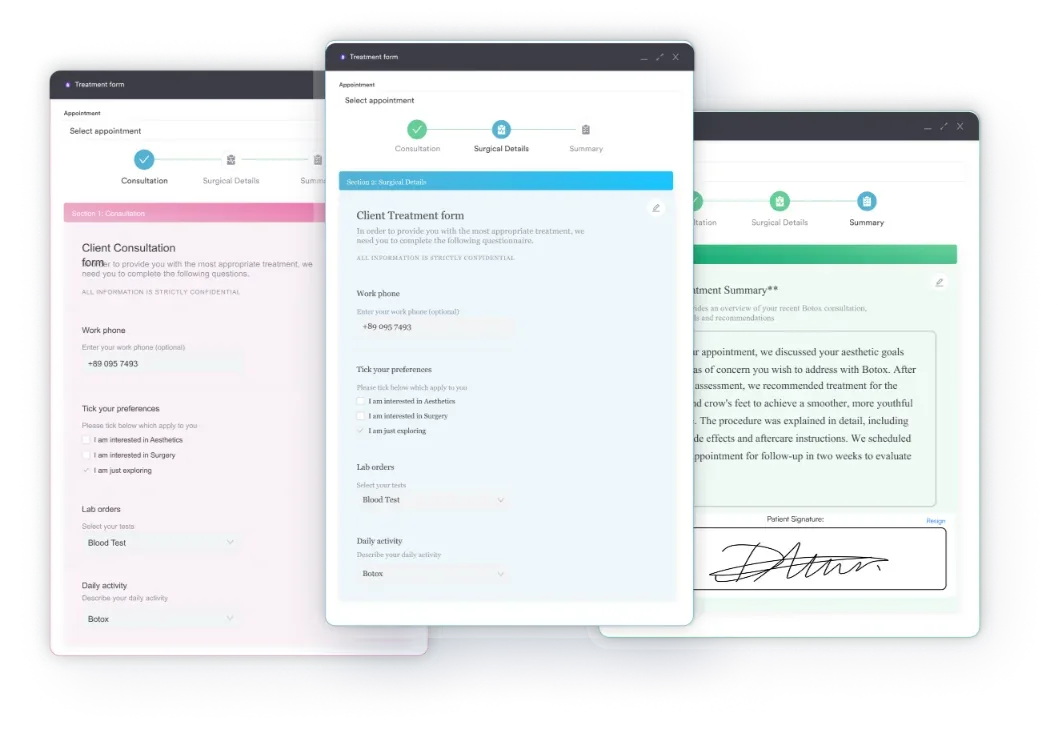
Many new practices set up patient intake software from day one rather than switching systems later. In states that allow it, a growing number also add facial esthetics such as Botox for TMJ or cosmetic fillers alongside core dentistry.
Analyze your target geography: population density, household income, age demographics, and dental insurance penetration. Research 3-5 competitor practices in your service area, and state the specific niche you’re filling, whether that’s an underserved market, premium positioning, convenience, or a specialized service.
Note how you’ll handle dental insurance verification for new patients from day one. This is the section that proves demand exists in the numbers, not just in your gut feeling about the neighborhood.
Outline how you’ll attract and retain patients. Budget for digital marketing (Google Ads, social media), referral programs, community outreach, and online reputation management. Specify launch-phase tactics and mature-phase strategies.

Detail daily operations: hours, scheduling workflow, sterilization protocols, patient flow, and administrative processes.
Describe how you’ll comply with HIPAA privacy and security rules and OSHA occupational safety standards. This section assures lenders that you’ve thought through the mechanics of running a compliant, efficient practice.
List key team members and their qualifications. Define roles: hygienists, dental assistants, front desk, and office manager. Include hiring timeline and compensation structure.
Show how you’ll delegate responsibility and grow the team as patient volume increases.
Budget for clinical equipment (digital X-ray, intraoral cameras, handpieces, sterilization units), office IT (computers, security systems), and practice management software. The same category of cloud platform that runs a general practice combines scheduling, charting, billing, and patient communication in one system, cutting the total cost of ownership compared to legacy tools that need separate subscriptions and hardware.
This is the section lenders scrutinize most. Provide realistic three-year revenue projections based on patient volume assumptions, average treatment values, and case acceptance rates. Break down startup costs by category, including a dedicated working capital line, and add a contingency reserve on top.
Lenders and your own attorney will expect this section to cover the paperwork, not just the clinical side. At minimum, document your business entity type, state dental board licensing for every treating dentist, and DEA registration for anyone prescribing controlled substances.
No lender expects a plan with zero risk. They expect you to name the real risks and show a mitigation for each. Address these at minimum:
Every business plan needs a stated exit, even if you don’t plan to use it for 20 years. Lenders read this section as a sign of how seriously you’ve thought about the practice’s long-term value, not a hint that you’re already planning to leave.
Common exits include selling to an associate you’ve developed within the practice, merging with or selling to a dental support organization, passing the practice to family, or a straightforward wind-down. State which one you’re leaning toward, even loosely. It shows a lender you’re building something with resale value, not just a job.
Total startup investment for a new general practice typically runs $650,000 to $950,000 or more in 2026, with $750,000 to $800,000 a common midpoint. The often-quoted $500,000 figure comes from an older American Dental Association baseline, and it hasn’t kept pace with construction and equipment inflation.
Rural practices in lower-cost markets can still start closer to $400,000, while a fully built-out location in a competitive metro can push past $1,000,000.
The table below shows a typical budget breakdown, including the working capital reserve that’s easy to shortchange when budgets get tight.
Treat these ranges as a starting point, not a quote. Costs vary by location, whether you’re leasing an existing buildout or a bare shell space, and the equipment tier you choose. Document every line item in your own plan to show lenders you’ve actually priced this out, not guessed.
Templates only help when the wider system works; managing a private practice starts with consistent processes.
Most dental practice startups need external financing. Common structures include SBA 7(a) loans and conventional bank loans.
SBA 7(a) loans go up to $5 million. Terms run up to 10 years for equipment and working capital, and up to 25 years when the loan covers real estate or leasehold improvements, which matters given how much of your budget goes into buildout. Dental-specific lenders like Henry Schein Financial Services understand practice-specific cash flow patterns and offer competitive rates.
Lenders evaluate your business plan to assess three factors: market demand, realistic financial projections, and management competency. A well-researched plan with conservative revenue assumptions and itemized cost breakdowns increases approval odds and may result in better loan terms.
Your online booking system directly supports the efficiency and patient retention metrics that drive your revenue projections.

Pabau’s integrated scheduling, patient records, billing, and reporting connect directly to the operational and financial sections of your dental business plan. See how successful practices automate the workflows outlined in their strategic plans.

Loan officers see the same plan mistakes on repeat. Run through this checklist before you submit, and you’ll look like an applicant who’s already done the work, because you have.
Your business plan should set baseline KPIs to measure against once the practice is open. Track these monthly, and adjust operations if you’re falling short of projections.
Every Pabau subscription includes built-in reporting to track these metrics as they happen, no manual spreadsheets required. If you need deeper cross-location analytics down the line, Insights Plus is an optional paid add-on built for that. When actual performance diverges from your plan, investigate the root cause and adjust your strategy.
These five mistakes show up again and again in early-draft dental business plans, and each one is an easy, specific fix.
A dental business plan turns ambition into a document you can act on. It forces you to validate your market, cost your operations honestly, and set the benchmarks you’ll actually be held to once the doors are open.
Work through each section methodically, stay conservative on revenue, fund the working capital reserve properly, and name your risks and your exit instead of skipping them. Once the plan is set, execution takes over: the scheduling, billing, patient communication, and reporting that either keep pace with your projections or don’t.
This is where practice management software like Pabau earns its keep. Every subscription includes the scheduling, billing, and reporting tools your plan assumes, so the numbers you project can actually be tracked once you’re seeing patients, without hiring extra staff just to run the software.
If you want to see how it fits alongside a plan like this, book a demo with Pabau.

Need guidance on practice management workflows? Practice management fundamentals explains the core operational components that feed into your business plan’s operational section.
Have a plan if a crisis hits? crisis communication plan template covers team roles, message templates, communication channels, escalation protocols, and HIPAA requirements.
Curious why practices choose one platform? reasons clinics choose Pabau software shows how a single platform avoids the fragmented tools driving up administrative costs.
Yes. SBA and conventional lenders require one before approving financing. It proves you understand your market, your costs, and your realistic path to profitability. Without one, approval is unlikely.
Realistic 2026 costs run $650,000-$950,000 or more, with $750,000-$800,000 typical. Rural practices can start near $400,000, and competitive urban markets can exceed $1,000,000. Budget roughly $145,000 in working capital on top of buildout and equipment.
Most from-scratch practices take 12-18 months from financing approval to opening day, covering site selection, buildout, permitting, and equipment installation. Acquisitions move faster, often closing in 60-90 days.
Solo startups typically need 600-900 active patients to break even, rising past 1,500 for a two-doctor practice. Multiply that by your average patient value to sanity-check your revenue projections.
Both work. Acquisitions cash flow from day one but come with inherited systems and staff. Starting from scratch costs more upfront and takes longer to ramp, but gives you full control over location and design.
Yes. Lenders want to see that licensing, DEA registration, HIPAA and OSHA compliance, and malpractice insurance are planned for before you open, not figured out afterward.