

ICD-10 code S63.121A: Right thumb IP subluxation

ICD-10 code S63.121A at a glance S63.121A is a billable ICD-10-CM diagnosis code for the 2026 fiscal year. It took effect on October 1, 2025 and stays valid for HIPAA-covered transactions through September 30, 2026. The CDC/NCHS ICD-10-CM web tool files it under S63.12, the subcategory for subluxation and dislocation of the interphalangeal joint of […]
Whipple test: Technique, accuracy, and interpretation
Shoulder pain that flares on overhead reaching usually starts in the rotator cuff, and the supraspinatus tends to go first. The hard part isn’t spotting a sore shoulder, but rather telling a torn tendon from an irritated one without sending every patient for an MRI. The Whipple test is one way to answer that question. […]
Modified Ashworth Scale
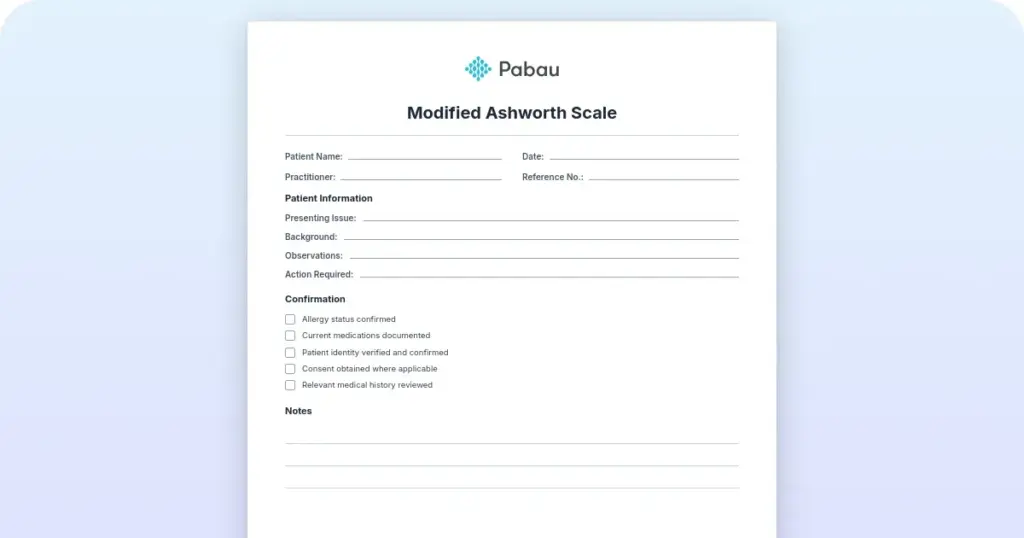
Download your free Modified Ashworth Scale form A single printable page carrying the Bohannon and Smith testing instructions and all six score definitions. The recording area has a name and date header, one muscle tested line, a score column from 0 to 4, and an additional comments box. Download template The Modified Ashworth Scale grades […]
ICD-10 Code S63.252D: Unspecified dislocation of right middle finger
What ICD-10 code S63.252D covers S63.252D is a billable ICD-10-CM diagnosis code. Its official long description is: Unspecified dislocation of right middle finger, subsequent encounter. Use it when a patient returns for ongoing care of a right middle finger dislocation. The word “unspecified” refers to the joint, not to laterality. Nobody named the proximal interphalangeal, […]
ICD-10 code S63.501D: Unspecified sprain of right wrist
ICD-10 code S63.501D: Definition and billable status S63.501D is a billable and specific ICD-10-CM code, valid for HIPAA-covered transactions. Its official description is Unspecified sprain of right wrist, subsequent encounter. The 2026 edition took effect on October 1, 2025. The code carries no exclusion flags that would block it as a principal or secondary diagnosis […]
HCPCS code L0622: Sacroiliac orthosis, custom fabricated
L0622 code details at a glance Use the quick-reference table below to confirm the code’s classification before billing. Field Detail HCPCS code L0622 Code system HCPCS Level II Category L-codes (orthotic procedures) Device type Sacroiliac orthosis (SO), flexible Fabrication Custom fabricated, not prefabricated Payer category DMEPOS (Medicare Part B) Typical biller DME supplier, orthotist, orthotic […]
CPT code 23146: Excision of bone cyst, clavicle or scapula with allograft
CPT code 23146 describes excision or curettage of a bone cyst or benign tumor of the clavicle or scapula, with allograft. The American Medical Association (AMA) maintains the CPT code set. It places 23146 in the Excision Procedures on the Shoulder subsection of the Musculoskeletal System chapter. Two details in that descriptor decide whether the […]
CPT code 23670: Open treatment of shoulder dislocation with greater tuberosity fracture
CPT code 23670 covers open treatment of a shoulder dislocation with a fracture of the greater humeral tuberosity. Internal fixation is included when the surgeon performs it. That is the official descriptor maintained by the American Medical Association (AMA). The code sits in the Musculoskeletal System section of the CPT codebook, under Shoulder, in the […]
CPT Code 01758: Anesthesia for humerus cyst or tumor excision

CPT Code 01758: Definition, billing rules, and reimbursement CPT Code 01758 stands for anesthesia for humerus cyst or tumor excision and covers anesthesia for open or surgical arthroscopic excision of a cyst or tumor of the humerus. It carries 5 ASA base units, and it is paid on anesthesia time rather than a flat fee. […]
Smooth pursuit neck torsion test: Complete clinical guide
Your patient still feels unsteady eight weeks after a rear-end collision. Their neck is stiff, the Dix-Hallpike is negative, and the vestibular screen explains none of it. The smooth pursuit neck torsion test was built for that moment. The test compares how smoothly the eyes track a moving target in two positions. First the head […]