Free model waiver form + what it is and when your practice needs one
A model waiver form is a signed document that lets a healthcare practice use a p...

7
Last Updated: Sep 29, 2026

Youthfill is two products, an HA filler and a PN skin booster, so consent has to name which one the patient is getting.
Youthfill HA settles at around two weeks and lasts 6 to 12 months, and patients should hear both numbers before they sign.
Youthfill PN runs as a course of 2 to 3 treatments, spaced 2 to 4 weeks apart.
Screen for pregnancy, active skin infection, bleeding disorders, and marine allergy before either treatment goes ahead.
Adult treatment records are kept for 8 years, so storage and retrieval matter as much as the signature.
The form opens with a treatment overview, contraindications, risks, and aftercare advice. Then come the informed consent and clinical photography wording, a yes-or-no medical history screen, and free-text fields for the patient’s own answers.
Download templateA Youthfill consent form has to name which Youthfill the patient is getting. The brand covers two different treatments. One is a cross-linked hyaluronic acid filler that replaces lost volume. The other is Youthfill PN, a polynucleotide skin booster that prompts the patient’s own collagen.
Each carries its own allergy questions, timelines, and aftercare windows. Consent that describes the wrong one stops matching the treatment you gave.
This page hands you the free form first, then covers what to screen for, what to record, and how long to keep it.
Youthfill HA is a cross-linked hyaluronic acid filler. Practitioners use it on nasolabial folds, marionette lines, and cheeks, where lost volume is the problem.
Results settle at around two weeks and hold for 6 to 12 months. Say both numbers out loud at the consultation. That is the expectation the patient will measure you against later.
Youthfill PN works the other way round. Salmon-derived polynucleotides prompt the skin to remodel its own collagen, so it acts as a skin booster rather than a volume filler. Patients see no change on the day. The effect builds over 4 to 6 weeks instead.
That difference matters on paper. The two formulations carry separate allergy lines, separate injection depths, and separate treatment schedules. A generic filler consent form covers one of them at best.
In the UK, informed consent rests on professional standards and case law rather than a single statute. Bodies such as the British College of Aesthetic Medicine set the clinical bar. What gets judged afterwards is whether the patient understood the treatment they were given.
A usable consent form proves three things. The patient understood the risks, you checked they were suitable, and both of you signed on a date you can point to. Here is what carries that weight:
Photography is the line people forget. Before-and-after images sit in the patient’s record, so the consent has to say that plainly and say who may see them.
Want a broader starting point? Our dermal filler consent form covers the same ground across brands. Add the Youthfill wording on top of it.
Paper works, but it dates quickly. Practices running digital intake forms send the consent ahead of the appointment, so the patient reads it at home rather than in the treatment chair. The signature then lands on the record with a timestamp attached.

Screening happens before the form is signed, not after. Work through these five steps and write down what you find, because the reasoning is as useful later as the answer:
Most of this belongs in the consultation rather than the treatment slot. If your consultations feel rushed, it is worth reading how to prepare for a consultation properly, since the screening and the consent both live there.
Youthfill PN needs its own consent wording, not a checkbox on the filler form. Seven things change, and the table below lines them up side by side.
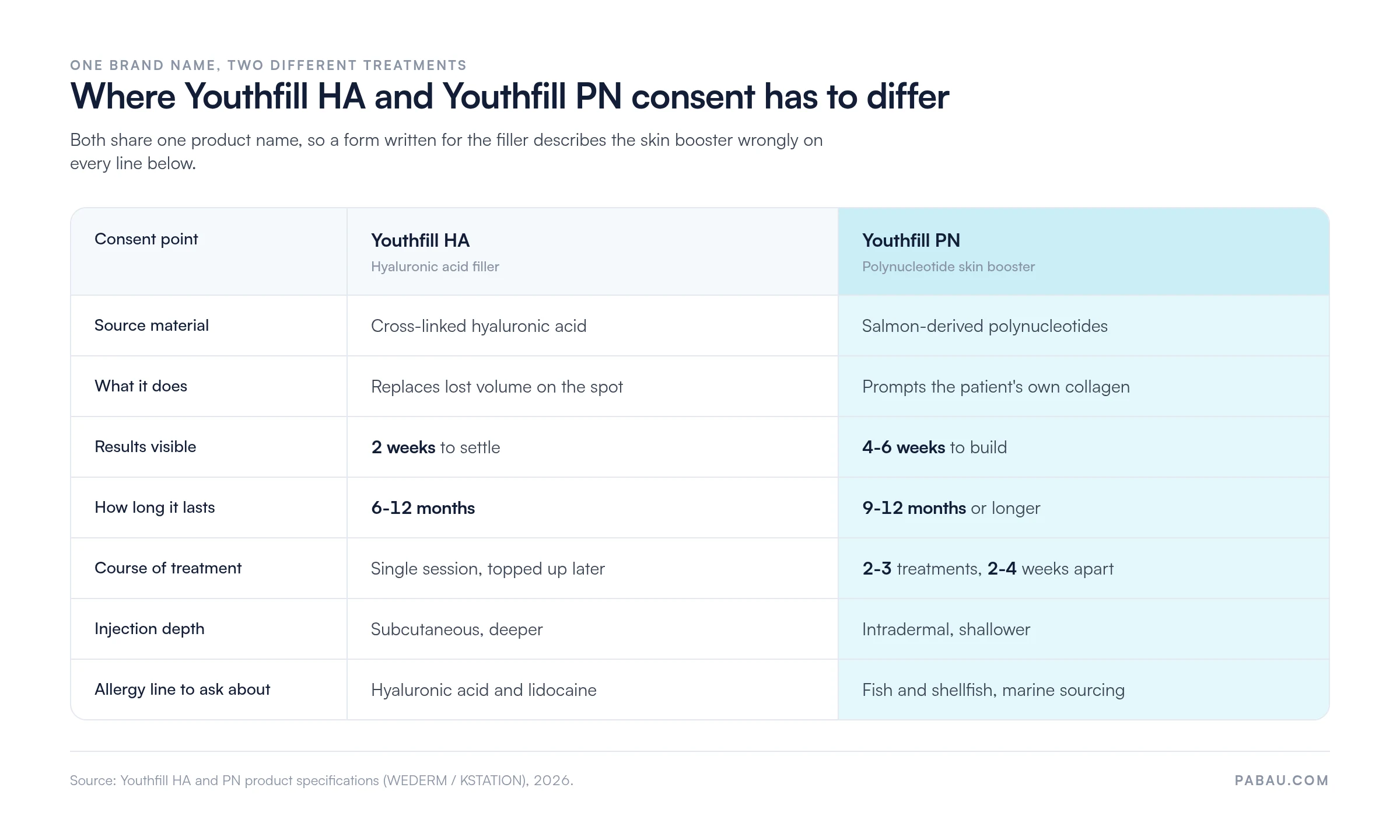
The marine sourcing is the one patients react to. Salmon-derived material rules out anyone with a fish or shellfish allergy, and some patients decline it on principle. Both outcomes need recording.
The treatment course matters just as much. PN is 2 to 3 treatments spaced 2 to 4 weeks apart, so the patient is consenting to a plan rather than one appointment.
Spell out the number of sessions, the spacing, and the total cost on the form itself. That way nobody arrives at session two expecting the job to be finished.
Consent covers the decision. The treatment record covers what you then did, and it lives alongside the signed form rather than inside it. These are the fields worth having:
Write it in the room, not at the end of the day. Contemporaneous notes carry weight that reconstructed ones never do.
Good patient record management helps here, because the injection diagram, the consent, and the photos sit in one file instead of three.
Aftercare only works if it names hours, not vague advice. The Youthfill form uses these windows, and they are short enough for a patient to remember:
Hand the sheet over and store a copy in the record. Automated messages at 24 and 48 hours then repeat the two windows that matter most. That is when a patient is most likely to book a hot yoga class without thinking.
A signed consent form is special category health data, so UK GDPR applies from the moment the patient fills it in. The Information Commissioner’s Office sets out what that means in practice. Five duties do most of the work:
Eight years is a long time for a paper file. Filing cabinets flood, fade, and get thinned out during a move, and a missing form is indistinguishable from a form that never existed.
Practices on medical spa software avoid that by keeping consent encrypted and searchable, with an access log behind it for CQC inspections.
The template gives you the structure. Six edits turn it into your practice’s document:
Before you hand the form to a patient, run one last check. Does it name the product they are getting, list the risks in plain words, and leave room for their own questions? If yes, it will hold up.
The consent form usually lives one step away from the notes. Someone prints it, the patient signs at reception, and it gets scanned in later or filed in a drawer. Then a complaint or an inspection arrives, and finding one form from 2023 takes an afternoon.
Practice management software like Pabau closes that step. You build the Youthfill consent once, keep an HA version and a PN version, and send whichever one the booking calls for. The patient signs on their phone before they arrive, and the signed form attaches itself to their record with a timestamp on it.
From there the record does the rest. Treatment notes, injection diagrams, batch numbers, and before-and-after photos sit in the same file, and aftercare goes out automatically at 24 and 48 hours.

Pabau sends your Youthfill consent form ahead of the appointment, captures the signature with a timestamp, and files it straight into the patient record. So aftercare goes out on its own and audits take minutes.

The safest Youthfill consent form is the one that could only describe the treatment you gave. Name the product, name the numbers, and let the patient sign against a plan they can repeat back to you.
That takes a little more work up front. In return, you get a record that answers a complaint, an insurer, or an inspector without a hunt through storage. Split the HA and PN versions now, while you only have one form to change.
Book a demo to see how Pabau captures filler consent digitally and keeps it with the treatment record for the full 8 years.

Need the sheet that goes home with the patient? Dermal filler aftercare form gives you the printable aftercare instructions to pair with the consent you just signed.
Offering a collagen stimulator alongside Youthfill? Sculptra consent form shows how a multi-session treatment plan gets consented in one document.
Want to know what else an inspector asks for? Medical spa compliance checklist walks through consent, data protection, and record-keeping in one pass.
Consultations running short on time? Why consultations matter for med spas explains how to use that appointment to screen, set expectations, and take consent properly.
Deciding which injectables to add next? Trending botox and filler treatments covers what patients are asking for and the paperwork each one brings with it.
Yes. Best practice is fresh consent for every session, even for a returning patient. Products, doses, and treatment areas change, and so does the patient’s medical history. A form signed six months ago does not describe today’s treatment.
No. In England it is a criminal offence to inject filler for a cosmetic purpose into anyone under 18. Booking the appointment is an offence too. Ask for photo ID whenever age is in any doubt.
Yes, provided the record shows who signed, when they signed, and the wording they saw. That audit trail is what an inspector or an insurer asks for. A scanned paper form without those details is weaker evidence.
Do not treat. Note the refusal, the date, and what you explained, then offer a further consultation. Treating without documented consent leaves you with no defensible record if a complaint follows.
Yes, at any point up to and during treatment. Stop, record the time, and write down what had already been administered. Then book a review so the partial treatment is documented properly.