GLP-1 usage by state: Who’s taking, searching and paying in 2026
GLP-1 usage by state peaks in West Virginia, America’s GLP-1 capital, with...

Last Updated: Oct 16, 2026
A workers compensation waiver form lets eligible business owners opt out of mandatory coverage under their state’s law. Specifically, sole proprietors, partners, and corporate officers are usually the people who qualify.
Most states allow certain business structures to waive coverage, but form names, eligibility rules, and filing steps all vary. For example, medical practices, med spas, and small health businesses commonly file during startup or after a change of ownership.
Waiving coverage removes the premium, and it also removes your own wage replacement and medical cover after a workplace injury. Specifically, this guide covers who qualifies, how filing works state by state, and the risks worth weighing first. Whatever template you start from, file your state’s own official form.
A general waiver form you can use as a starting point and adapt to your own practice. Then, check your state agency’s official requirements, and file its own form where one exists.
Download template
In short, a workers compensation waiver form lets certain business owners opt out of coverage under state law.
Eligibility depends on your business structure, so sole proprietors, corporate officers, and LLC members are treated differently.
In addition, form names, filing procedures, and required documents differ from state to state.
Some states renew a certificate on a fixed cycle, while New York ties each one to a specific permit, license, or contract.
Overall, waiving coverage removes your own injury insurance and leaves you personally liable for the cost.
A workers compensation waiver form is a legal document that lets eligible business owners exclude themselves from mandatory workers compensation insurance. Notably, it covers the owner or named officers, never the rest of the staff.
Employers in most U.S. states are required to carry workers compensation insurance. For instance, sole proprietors, certain corporate officers, and LLC members often qualify to file an exemption with their state labor commission. As a result, approval releases them from the duty to provide coverage, and it also forfeits the protection that insurance offers.
The waiver form is not a workers compensation claim form, which reports an injury and requests benefits. Nor is it a certificate of insurance, which proves coverage is active. In contrast, an affidavit of exemption is different again: a sworn statement supporting an exemption request in some states.
Healthcare practices, medical spas, therapy practices, and small medical offices all use waiver forms. Filing usually happens during startup, or when an owner converts to a business structure that qualifies for exemption. In addition, a compliance management system tracks waiver status and renewal dates alongside your other regulatory obligations.
Eligibility depends on your business structure and on state law. Overall, most states let sole proprietors and certain corporate officers opt out, though the conditions attached to that vary widely.
Sole proprietors in most states can file to exclude themselves from coverage. Specifically, that covers owner-operators with no employees, and in some jurisdictions those who employ only family members.
Clear staff records make the eligibility question easy to answer. In fact, team management software documents who is an employee and who is a contractor, which supports your application.
Corporate officers, S-corp shareholders, and LLC members in many states can elect to exclude themselves from coverage.
Medical directors, practice owners, and practice partners running multi-person businesses commonly use this exemption. Therefore, check the cap before you file, because a state that allows two officers to opt out will reject a third.
Each state’s labor commission or workers compensation board sets its own form, naming conventions, eligibility rules, and filing procedures. The table below summarizes how five states differ. Therefore, confirm the current requirements with your own state agency before you file.
Important: Treat the table as a quick reference only. State requirements change often, and some states have moved to online-only filing, as New York has with the CE-200. Instead, always take the current form straight from your state’s own labor commission or workers compensation board.
New York’s CE-200 is the state’s official exemption certificate form and can be filed entirely online through the New York Workers’ Compensation Board website.
A CE-200 is tied to the specific permit, license, or contract you applied for, so there is no annual renewal cycle. Instead, request a new certificate for each job or contract that asks you for proof of exemption.
Colorado’s Division of Workers’ Compensation (CDLE) allows sole proprietors and certain LLC members to file a waiver of coverage request with the state.
Colorado requires renewal every three years. Missing a renewal deadline therefore restores your mandatory coverage obligation.
Tennessee allows sole proprietors, partners, and corporate officers to apply for an exemption from workers compensation coverage through the Tennessee Department of Labor.
Tennessee exemptions expire and have to be renewed, so check the current term on the state’s exemption registry before your certificate lapses.
In addition, automated compliance workflows can remind a practice manager when a state renewal falls due, which keeps a certificate from lapsing unnoticed.

The exact process varies by state, but most filings follow the same five steps.
Approval usually takes two to four weeks. For example, certificate terms vary widely, from a single contract in New York to a three-year cycle in Colorado. Miss a renewal deadline and most states reinstate your mandatory coverage, often with penalties attached.
Healthcare practices, aesthetics practices, therapy offices, and wellness businesses file waiver forms in several situations.
If you are launching a healthcare practice, the waiver is often the first compliance decision your business structure forces on you.
Filing brings several operational and financial benefits for the solo and small practice owners who qualify.
Compliance advantage: An approved waiver on record shows auditors, regulators, and business partners that your staffing model matches state law. Indeed, that record is what you produce during state regulatory inspections, licensing board audits, and contract negotiations.
Document every waiver filing in your practice management system. Keep the filed form, the approval letter, and the exemption certificate together in one compliance folder. Set a reminder 60 days before any renewal date. Otherwise, a lapsed exemption can trigger reinstated coverage, fines, and back-premium assessments from your state labor commission.
Waiving coverage lowers your insurance costs, but hands you financial and legal exposure worth weighing first.
Personal liability for injuries: Without workers compensation insurance, you carry the medical expenses, lost wages, and legal fees from your own workplace injury. Consequently, a serious injury can end in personal bankruptcy without a disability policy, liability coverage, or savings to fall back on.
No wage replacement or medical coverage: Workers compensation normally pays for medical treatment and replaces part of your lost wages during recovery, and waiving coverage forfeits both. As a result, an injured owner pays out of pocket until returning to work.
Employee misclassification risk: Classifying an employee as an independent contractor to avoid covering them is a separate offense that exposes your practice to state penalties, back-premium assessments, and lawsuits. In fact, the IRS and state labor boards audit worker classifications regularly.
Client and contractor requirements: Many healthcare networks, insurance companies, and large clients require proof of workers compensation coverage before they contract with you, and a waiver can rule you out of that work. Otherwise, others proceed only if you buy supplemental liability insurance, which cancels out the saving.
Regulatory and compliance exposure: Regulators verify your waiver status during inspections and audits, and an incorrectly filed or expired exemption brings fines and reinstated coverage. Waiving insurance does not remove your duty to record what happened, so keep an incident report form ready for any workplace injury.

State monopoly fund restrictions: Ohio, North Dakota, Wyoming, and Washington run monopolistic workers compensation systems where private insurance is prohibited and every employer uses the fund. Consequently, waivers are not permitted, whatever your business structure.
These three terms get used interchangeably, yet each names a distinct document with its own purpose and legal standing. As a result, telling them apart prevents filing errors and arguments with your state labor commission.
First, you file the waiver form. The state then issues an exemption certificate once it approves you. Some states also ask for an affidavit swearing that your statements are true. The diagram below shows where each one lands, and which document sits outside the process altogether.
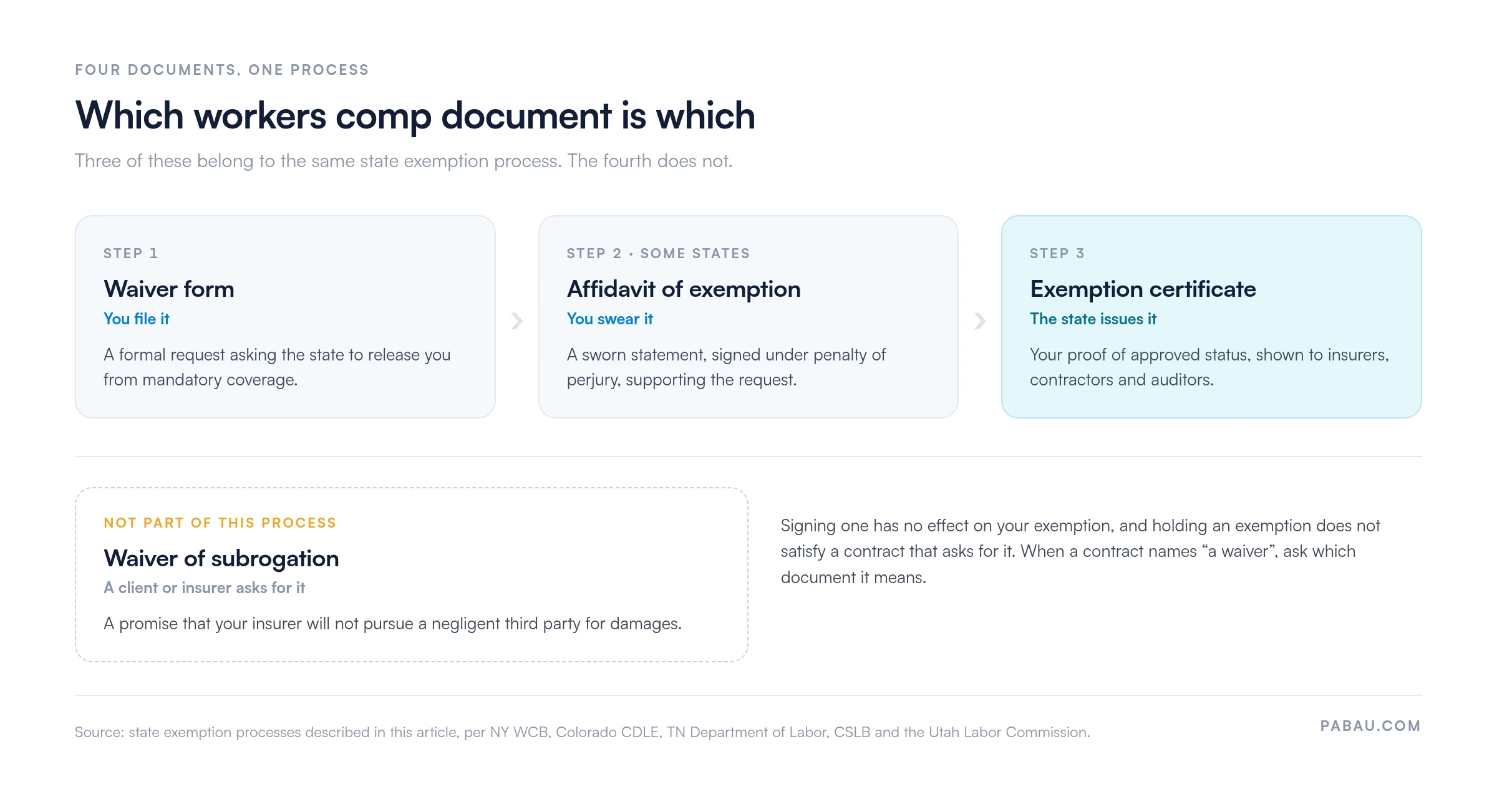
Do not confuse a waiver of subrogation with a coverage waiver or exemption. Instead, it is a separate document, usually demanded by clients, contractors, or insurers rather than by the state.
What is subrogation? Subrogation is an insurer’s legal right to pursue a negligent third party for damages after it pays a claim. For instance, say a vendor’s negligence causes an injury your workers compensation insurance covers. The insurer can then sue that vendor to recover the payout.
What is a waiver of subrogation? It is a document you sign agreeing that neither you nor your insurer will pursue another party for damages. For example, healthcare networks, hospitals, and large clients often require contractors and service providers to sign one before work starts.
When do you need one? Hospitals, health systems, medical building landlords, and major clients commonly ask for one as a condition of the contract. However, it is separate from your workers compensation exemption and has no effect on your eligibility to waive coverage.
Practice managers confuse the two often enough that it is worth asking outright. Therefore, when a contract simply names a waiver, ask the client or your legal counsel which of the two documents they mean.
Most practices keep the exemption certificate in an inbox, a desk drawer, or a folder nobody has opened since filing day. The renewal date lives in someone’s head. Consequently, when a contractor or an inspector asks for proof, the search starts from scratch.
Practice management software like Pabau gives that paperwork a home. In addition, digital forms capture a signature and file the signed copy against the record it belongs to. Automated reminders fire on a date you set months ahead, so a renewal deadline reaches your practice manager instead of passing quietly.
What you end up with is a compliance file you can produce on request. One search returns the form, the approval letter, and the certificate. An audit then takes minutes rather than an afternoon.

Pabau files signed forms, approval letters, and certificates against the record they belong to. Reminders go out before a renewal date passes, so proof of exemption is always to hand.

Waiving workers compensation coverage is a trade, and the terms of it differ by state. You keep the premium, and you take on the medical bills and lost income from your own workplace injury. That trade suits a solo practitioner with a disability policy behind them. However, it suits a growing practice far less.
Confirm eligibility with your state labor commission first, then file that state’s own form rather than a generic one. In addition, store the approved certificate with your business records, and diary the renewal date the same day it arrives.
Book a demo to see how Pabau keeps compliance documents and renewal dates in one system your whole practice can reach.

Still working out your workplace safety paperwork? OSHA emergency action plan template covers the written plan a practice is expected to keep on file.
Need to record a workplace injury? Incident report form template gives you one consistent record of what happened, when, and who was involved.
Wondering how long to keep all this paperwork? How long to keep medical records sets out the retention periods that apply to a practice.
A workers compensation waiver form is a legal document that lets eligible business owners exclude themselves from mandatory coverage. Specifically, sole proprietors, corporate officers, and LLC members are the usual candidates.
Eligibility varies by state and business structure. Most states allow sole proprietors and certain corporate officers to file a waiver. Some states limit exemptions based on employee count or business type. Therefore, verify your state’s specific requirements with your state labor commission.
No. A waiver covers only the owner or specified officers. Non-owner employees must be covered by your employer’s mandatory workers compensation insurance. Consequently, failing to provide employee coverage violates state law and can result in fines and penalties.
If your waiver expires without renewal, most states automatically reinstate your mandatory coverage obligation. In addition, you may be assessed back premiums, fines, and penalties. Missing renewal deadlines is one of the most costly waiver mistakes.
No. A coverage waiver exempts you from mandatory insurance. In contrast, a waiver of subrogation prevents your insurer from suing a negligent third party. These are separate documents with different purposes.