Free model waiver form + what it is and when your practice needs one
A model waiver form is a signed document that lets a healthcare practice use a p...

5
Last Updated: Sep 29, 2026

Vaginal HIFU heats the vaginal wall with focused ultrasound, and the new collagen builds over three to six months.
Screening carries the hard stops, including pregnancy, active infection, metallic implants, and malignancy.
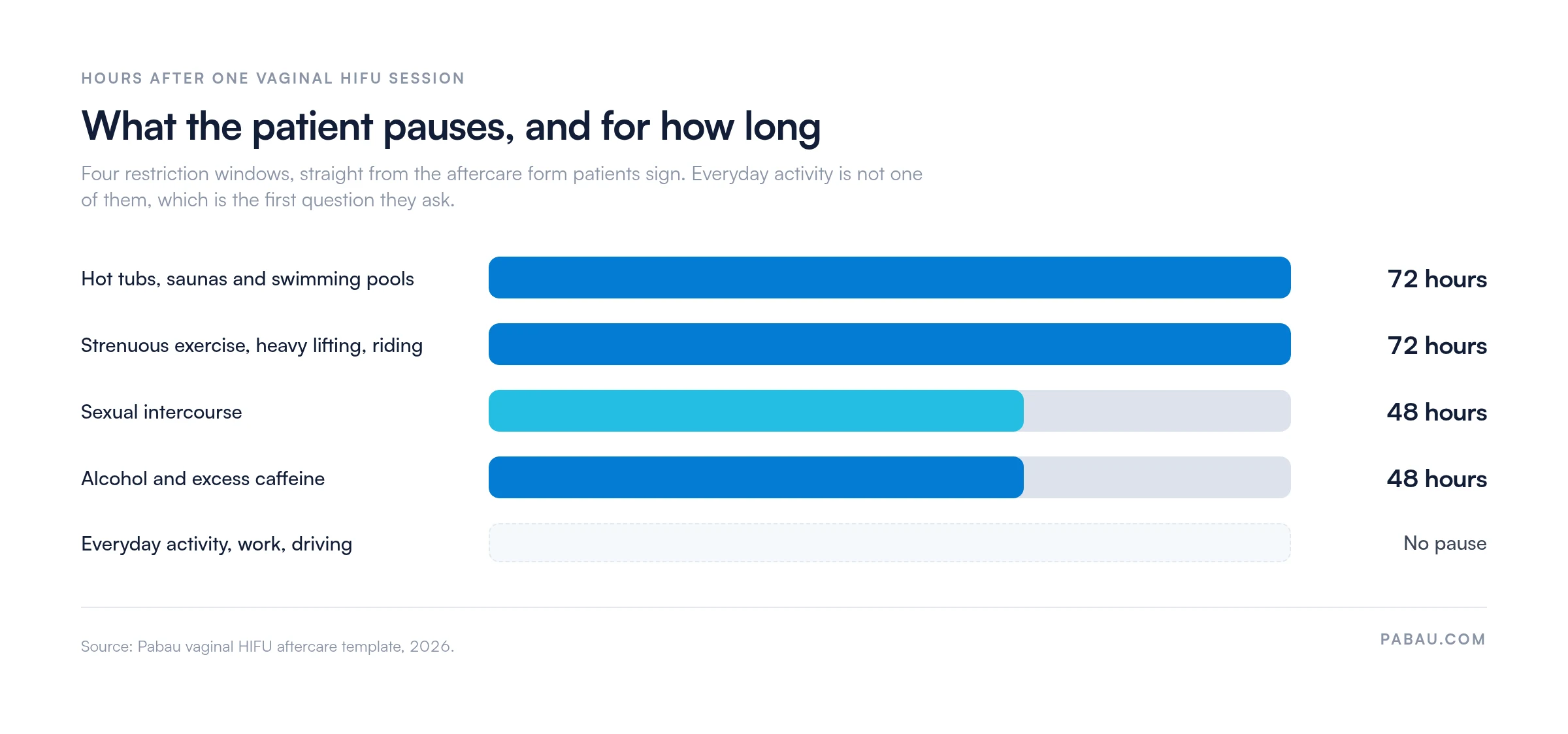
The aftercare form sets four windows, at 72 hours for exercise and heat, and 48 hours for sex, alcohol and caffeine.
No energy-based device is FDA cleared for vaginal laxity or incontinence, so the consent form has to say so.
Digital forms let a practice hold consent, screening, and aftercare acknowledgment in one client record.
The one-page form your patient signs after treatment. It covers the 72-hour and 48-hour restriction windows, washing advice, pain relief, follow-up attendance, and when to call you.
Download templateVaginal HIFU delivers focused ultrasound energy below the vaginal mucosa, where controlled heat sets off new collagen. If you are adding vaginal HIFU to your treatment menu, our list of med spa software covers scheduling and EMR charting. Controlled heat below the mucosa explains most of what follows. No incision means no wound to nurse, and no instant result either. Collagen builds for months.
Patients rarely arrive knowing that, and a practice that lets them believe otherwise inherits the complaint later. Your paperwork is where the expectation gets set, or missed.
This guide walks through candidacy, contraindication screening, consent wording, session planning, and the aftercare windows patients most often get wrong. The free aftercare template above is ready to hand out today.
Vaginal HIFU is a non-surgical treatment that focuses ultrasound energy on the submucosal and muscular layers of the vaginal wall.
The energy converts to heat at a set depth, and that thermal effect stimulates neocollagenesis and fresh elastin. Tone improves as the new collagen matures. Patients report better laxity and sexual satisfaction without an incision or general anesthesia.
Recovery bears no resemblance to surgery. Patients drive themselves home and go back to work the same day. The trade-off is patience. Remodeling runs for three to six months before the result settles, so the treatment sells on a promise the patient cannot see for a while.
The strongest candidates have mild to moderate symptoms, one clear goal, and the patience to wait for it. Look for:
Turn away the patient who wants a fix before a wedding in three weeks. Turn away the one whose underlying concern is prolapse, severe incontinence, or pain with a cause you have not investigated.
Those need a referral, not a device. Say it plainly at consultation and write down that you said it.
Screening is the one step in this pathway with a hard stop in it. Work through the table below at consultation, not on the treatment couch, and record an answer against every line.
Free-text notes are where screening quietly fails, because a blank line reads the same as a question nobody asked.
Structured patient intake forms in practice management software like Pabau force a yes or no against each criterion, and timestamp the answer. That record is what you reach for if an adverse event is ever reviewed.
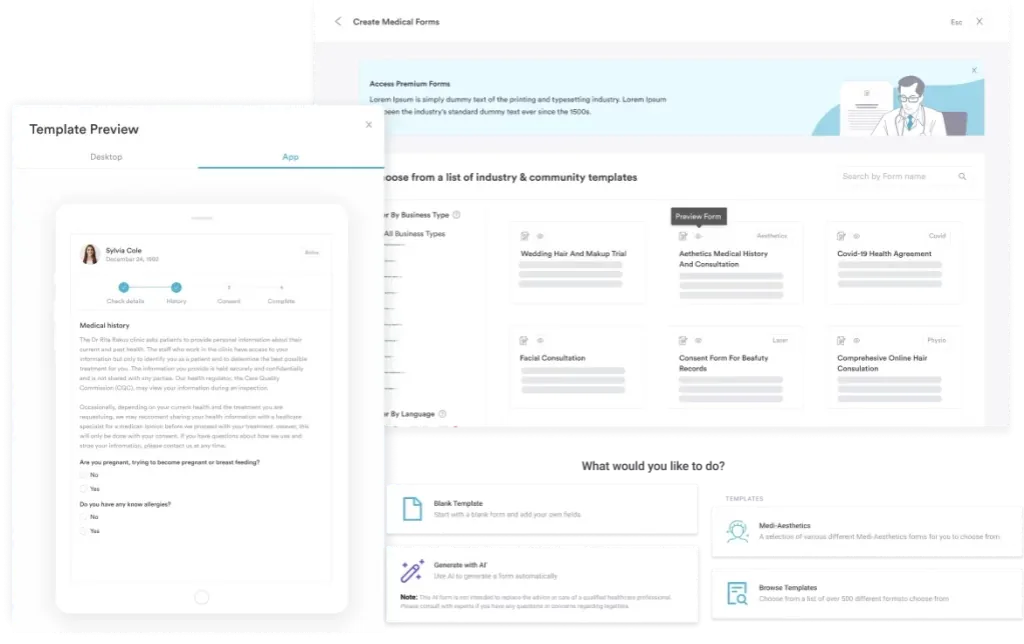
Consent has to cover what you are doing, why, what could go wrong, and what the patient is agreeing to wait for. Eight sections do that work:
The FDA has never cleared an energy-based device for vaginal laxity, incontinence, or menopausal symptoms. In 2018 it told providers and patients that safety and effectiveness for those uses had not been established. Clearances that do exist cover other gynecological uses.
So the treatment is off-label, and a consent form that stays quiet about it is doing the patient a disservice. Put the status in writing, in plain words, and note in the record that you talked it through.
Add a line stating that the template is a clinical starting point, and that medical-legal counsel should review it before you use it.
Most protocols run one to three sessions, spaced four to twelve weeks apart, depending on the device and how the patient responds.
Book the course, not the appointment. A patient who leaves with only one date in the diary tends to judge the whole treatment on it.
Vaginal HIFU usually sells beside injectables and lasers, so the record belongs in the same place as the rest.
Practices running software for med spas can build the session schedule into the booking flow. The second appointment then gets offered before the patient leaves the building.
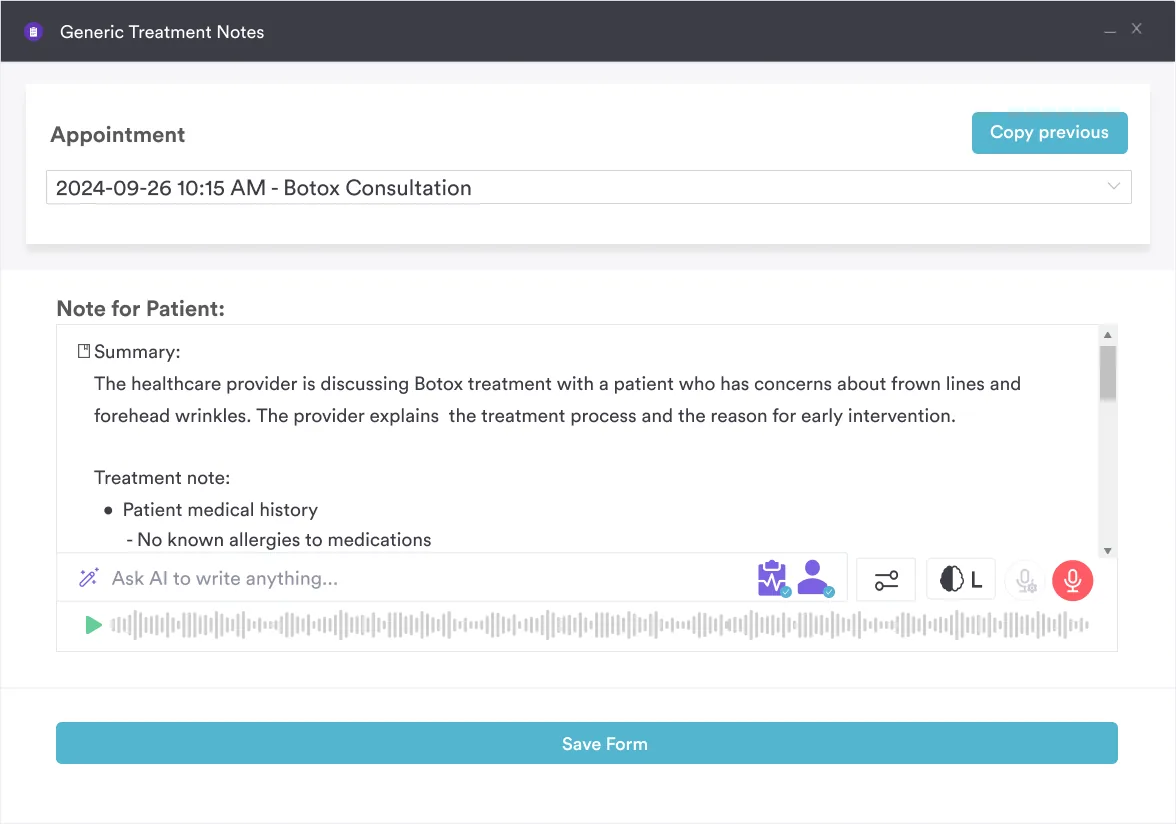
Whatever you use, write the note the same day. Device settings recalled a week later are a guess, and a guess is worth very little if the next session goes differently.
Most of what patients notice is mild and gone within a couple of days. Warn them about these four, in this order, because that is roughly how often they come up:
The published safety picture is reassuring so far, though the evidence base is small. One single-session trial in 28 women treated for incontinence recorded no ulceration, no lasting dyspareunia, and no hematoma. Four of the 28 reported mild discharge, and that was the extent of it.
Small studies cannot rule out rare harm, so teach the red flags anyway. Tell the patient to call you for persistent bleeding, fever, or severe pain. Put the phone number on the aftercare sheet, not in a folder at reception.
Nothing about this timeline is negotiable, so it is worth showing the patient at consultation rather than defending it at week two.
Book the six-week review while the patient is still in the room. It lands right as the first change becomes noticeable. That is a far better conversation than a day-10 phone call about a result the patient cannot feel yet.
Patients follow whichever version they read last. If your verbal advice says one week and the signed form says 48 hours, you have created the confusion yourself. Pick one set of numbers and use it everywhere. The downloadable template above sets four windows.
The same discipline applies to every energy device in the building. Our HIFU aftercare template covers the facial and body versions, so the whole team works from one shared format rather than five.
Run this before the device comes out of the cupboard. It takes about five minutes and it is the difference between a defensible record and a story.
That photography line trips up more practices than the clinical ones do. Intimate images carry their own rules on storage, sharing and withdrawal of consent. The photo consent requirements a med spa has to meet do not soften because the treatment was quick.
What are you holding? Sexual function, continence, pregnancy status and intimate photographs. That is a sensitive category under GDPR and protected health information under HIPAA, whichever side of the Atlantic you practice on.
How much should you collect? Only what informed consent and safe screening require. A field you cannot justify is a field you have to defend later, so cut it from the form now.
Where should it live? In an encrypted system with role-based access and an audit trail, not in a shared inbox or a scanned folder on the desktop. The HIPAA rules for med spas catch far more aesthetic practices than owners expect.
How long do you keep it? Set a retention period in writing, commonly seven to ten years for clinical files, with a destruction method to match. Then tell patients they can access, correct or ask you to delete their data, and name who to contact.
Contemporaneous notes are the whole defense, and there are only four entries to get right. Consultation notes carry the goal, indications, candidacy decision and expectations. Treatment notes carry date, device settings, tolerance and immediate response.
Adverse events get their own entry with your clinical response and what you told the patient. Follow-up notes carry the outcome scores and the recommendation.
Four failures account for most of the trouble. Notes written days later, when settings have blurred. Outcome measures that change scale between visits, so nothing can be compared. Verbal warnings that never reach the record. And a signed consent form filed apart from the record it belongs to.
That last one hurts most when somebody asks to see it.
Most practices run this pathway across four places. Consent is a PDF that gets printed, signed, scanned and uploaded. Screening answers sit in free text.
Aftercare goes out as an email someone retypes after each appointment. The photographs are on a phone. Every one of those steps is a chance for a record to go missing.
Pabau keeps the whole pathway in the client record instead. Digital forms handle screening and consent with conditional logic, so a yes to an absolute contraindication changes what the patient sees next.
Patients sign on screen. Before and after photographs attach to the file rather than the camera roll. The aftercare instructions send themselves when the appointment is marked complete.
Pabau GO, our iOS app for practitioners, adds a care pathway before the visit. Patients complete their forms, sign consent and get photo prompts at home, and it all flows into the record.
Your team walks into the treatment room with the screening already done. For a treatment this sensitive, that is exactly where you want to be.

Pabau captures vaginal HIFU screening and consent on digital forms, and attaches the photographs to the client file. Aftercare sends itself the moment the appointment is marked complete.

Vaginal HIFU is a low-drama treatment with a high-stakes paper trail. The clinical risk is modest. The reputational risk sits almost entirely in what the patient understood before they signed, and whether you can show it.
So pick your numbers once, write them into the consent form, the aftercare sheet and the verbal briefing, and stop letting three versions circulate. Say the off-label status out loud. Book the six-week review before the patient stands up. Do those three things and most complaints never start.
Want to see how screening, consent and aftercare stay attached to one client record? Book a demo and we will walk a vaginal HIFU pathway end to end.

Running HIFU elsewhere on the body? HIFU aftercare sets out the recovery timeline and restrictions for facial and body treatments, with its own downloadable form.
Taking before and after photographs? Before and after photo consent requirements explains what a med spa has to disclose before the camera comes out.
Auditing your paperwork this quarter? The medical spa compliance checklist walks through the records an inspector asks for, in the order they ask for them.
Still sending aftercare by hand? Automated pre and aftercare emails shows how to trigger the instructions off the appointment instead of the front desk.
Want fewer disappointed patients? The importance of consultations for med spas covers setting expectations that survive a three-month wait.
No. The FDA has not cleared any energy-based device for vaginal laxity, incontinence or menopausal symptoms. Existing clearances cover other gynecological uses. Treating for laxity is therefore off-label, so state that on the consent form and record the conversation.
All three heat tissue to provoke collagen. HIFU focuses ultrasound at a set depth and leaves the surface untouched. CO2 laser ablates the mucosa, so it creates a surface wound. Radiofrequency heats more broadly and more shallowly than either.
That depends on your state, or in the UK on qualification and registration. Some states restrict genital procedures to physicians or require direct supervision. Check the rule before you train staff, and keep the delegation or supervision agreement on file.
Almost never. Payers treat it as elective and cosmetic, even when the patient reports incontinence. Quote it as self-pay, and put the price and the number of planned sessions on the consent form so nobody is surprised at checkout.
Yes, examine before you treat. You are looking for active infection, unexplained bleeding, visible lesions or an IUD, which sits on the absolute list. Record the findings either way, because a normal exam is your evidence that screening happened.