Punch excision aftercare instructions template
Punch excision is a minor procedure that removes a small cylinder of skin with a...

1
Last Updated: Oct 15, 2026

Toskani is a Spanish professional cosmetics brand, and every product is labeled for practitioner use rather than retail sale.
The range covers mesotherapy cocktails, PDRN treatments, microneedling devices, hair protocols, and the Lumicen and Radiance Intimate skincare lines.
ToskaniMed is the medical sub-brand, so its prescription-only products need a prescriber or a supervising medical director.
Courses are long. Mesotherapy usually runs four to eight sessions, and hair protocols run six to 12 across three to six months.
The free consent form below covers eligibility, contraindication screening, risk disclosures, and post-treatment care in one document.
A ready-to-use consent form with fields for patient details, treatment eligibility, and contraindication screening. It also carries the risk disclosures, expected outcomes, and post-treatment care instructions a Toskani course needs on file.
Download templateToskani is a professional cosmetics brand used by aesthetic practitioners across Europe, with more limited availability elsewhere.
This guide maps the portfolio, the treatment course each product line implies, and the paperwork those courses generate.
It is written for the practice side of the job. That means booking a course of six or more visits, documenting each one, and being able to evidence it months later.
Toskani is a Spanish professional aesthetic brand built on bioregenerative principles. Its products blend peptides, polynucleotides, vitamins, and amino acids into treatment cocktails rather than volumizing fillers.
The pitch is regeneration instead of volume. Products aim to stimulate the skin’s own repair across a course of sessions, so change builds gradually rather than landing in one appointment.
That suits practices selling natural-looking results and repeat visits. It also puts more weight on your booking and recall process than a single-visit filler appointment ever would.
There is also ToskaniMed, a medical sub-brand carrying prescription-only products for dermatologists and medical directors. It shares the same bioregenerative foundation on a different regulatory footing, which the comparison further down sets out.
The range spans six categories. Each has its own clinical use and its own practitioner audience.
The brand’s real strength is combining three delivery methods under one philosophy. Those are mesotherapy by intradermal injection, PDRN polynucleotide therapy, and microneedling. Most practices run them in sequence or together.
Mesotherapy cocktails are the foundation. The formulations mix peptides, vitamins, and amino acids to hydrate skin and stimulate collagen in the dermis. A course usually runs four to eight sessions at two-to-four-week intervals, and results accumulate rather than arrive.
Recording injection depth, session number, and the interval since the last visit is what makes that course auditable a year later.
PDRN, short for polydeoxyribonucleotide, is a separate category derived from salmon DNA. It stimulates fibroblasts and may support regeneration through nucleic acid signaling. Peer-reviewed work on polynucleotide therapy has expanded over the past five years. Toskani positions PDRN alongside mesotherapy rather than in place of it.
Microneedling devices, including the brand’s own pen system, let you pair mechanical collagen induction with product delivery. Used with a mesotherapy cocktail or a post-treatment topical, the combined protocol pushes the regenerative signal further.
Toskani products are labeled professional use only, so no consumer can buy them at retail. Eligible practitioners include:
The split between the two lines is what decides who signs off on a treatment, not the injector’s skill.
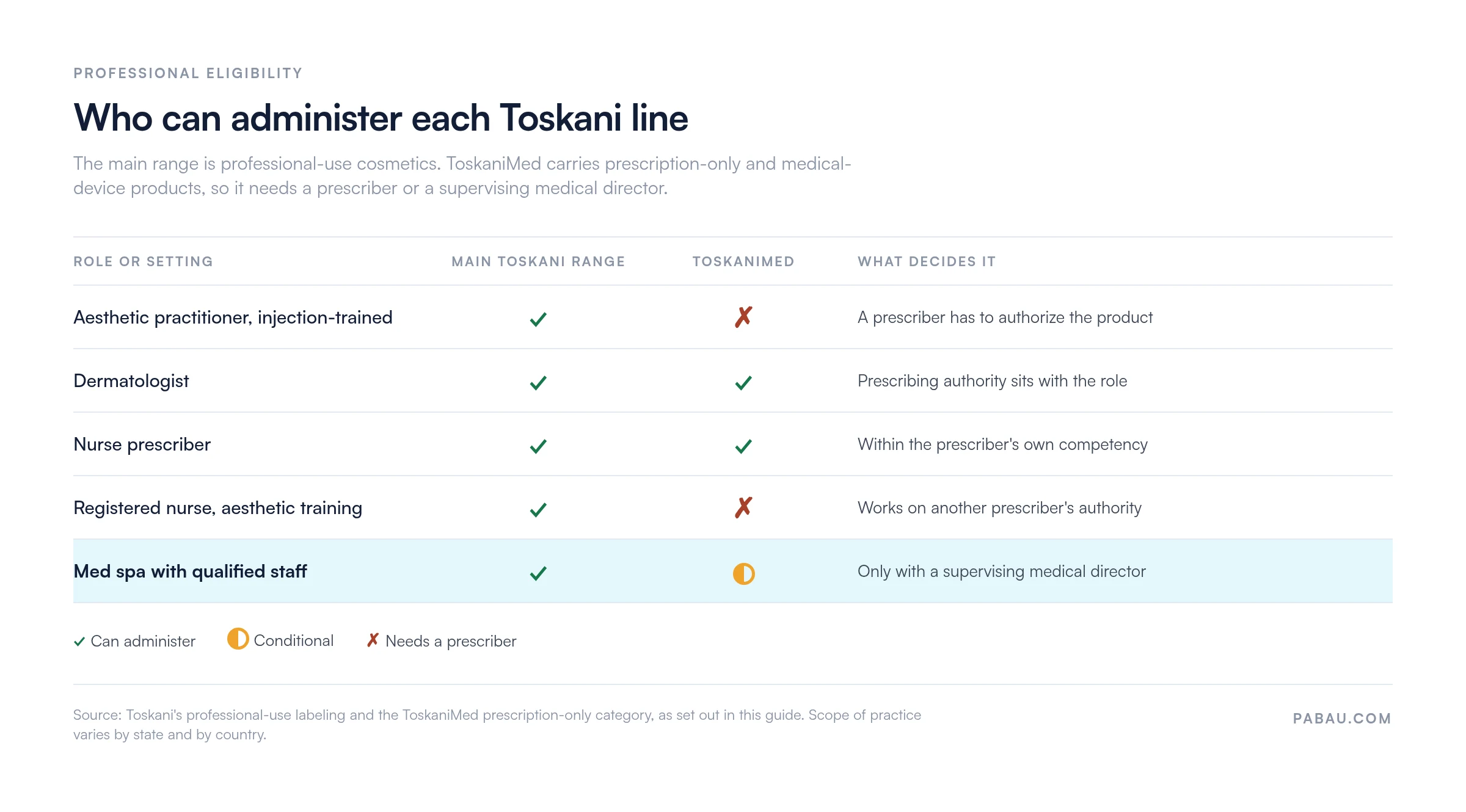
Each country’s framework governs who may administer injectables. UK practitioners need relevant qualifications and professional indemnity insurance. In the US, supervision and prescribing rules vary state by state. In the EU, CE marking on Toskani’s devices confirms compliance with the Medical Device Regulation.
Check your own scope of practice before you offer any of it. Where a product is prescription-only, a qualified prescriber has to authorize the treatment, whatever the injector’s competency.
A bioregenerative course only looks like it worked when you can show the sequence. That makes before-and-after photo software central to this modality rather than optional. Visual proof of gradual change is also what holds a patient through sessions five and six.
Digital intake forms should carry the screening questions this range needs. Contraindications, prior treatments, and stated expectations all belong on the form before the first injection. Setting out personalized treatment plans at that point fixes session counts and review dates before the patient books.
Consultation notes and patient letters are the other half of the record. Writing them the same way every visit keeps a six-session course readable to whoever picks it up next.
Automated recalls matter more on this modality than on most. Purpose-built software for aesthetic practices can fire a reminder when a patient is due for session five. That stops a long course stalling halfway. That protects the outcome and the revenue behind it.
Beyond injectables and devices, two skincare lines cover specific indications.
Lumicen is the brightening and pigment-control range. It targets hyperpigmentation, uneven tone, and post-inflammatory marks. Practitioners use it as a treatment adjunct, or as the patient’s maintenance product between mesotherapy sessions.
Radiance Intimate Cream is a sensitive-area product. Intimate skin is thinner and more reactive than facial skin, so the formulation is built for tolerability. It is professional skincare rather than an injectable, and practitioners can recommend it for vulvovaginal skin health.
Hair loss treatment by mesotherapy is a growing line of business. Hair Cocktail Plus is the formulation for it, delivered by multi-point intradermal injection into the scalp. Courses typically run six to 12 sessions across three to six months.
A course that long needs expectations set on day one. An aesthetic consultation form can be extended to capture hair loss history, previous treatments, and what the patient believes the outcome will be.
Both lines share the bioregenerative philosophy and overlap on active ingredients. They serve different audiences and sit under different rules.
Plenty of practices stock both. A site with an on-site medical director can run ToskaniMed for complex cases while the main range covers routine treatments.
Six things have to be in place before you administer any of it:
Toskani publishes training and clinical protocols for each range. Most practitioners start with foundational mesotherapy training before moving on to PDRN or device-assisted work.
A Toskani course is an administrative job before it is a clinical one. That means six appointments, six sets of photos, six notes, one consent record, and a batch number on every visit. Split across a paper form, a phone camera roll, and a spreadsheet, that record is hard to reconstruct later.
Practice management software like Pabau holds it on one client record instead. The consent form is signed digitally at intake. Photos attach to the visit they belong to. Treatment notes carry the product, the batch number, and the injection detail.
Recalls then run off the protocol rather than off memory, so session five gets booked without anyone chasing it. The patient engagement side of the course rides on the same schedule, including reminders, photo galleries, and aftercare instructions.
What you end up with is one audit-ready file per patient. So you can answer a regulator, an insurer, or a patient asking what has changed since March.

Pabau keeps consent, photos, batch numbers, and treatment notes on a single client record, so a six-session course stays auditable. Recalls fire on the protocol’s own schedule.

Toskani is a straightforward product decision and a demanding operational one. The clinical case for bioregenerative treatment is the easy part. Selling and delivering a course of six to 12 visits is what tests the practice.
So pick the line that matches your prescribing situation first. Then build the record-keeping around the length of the course rather than around the single appointment. The consent form above is the starting point, not the whole job.
Book a demo to see how Pabau tracks consent, photos, and batch numbers across a full Toskani treatment course.

Running a mesotherapy course? The mesotherapy aftercare template gives you the post-session instructions to hand out between visits.
Not sure who can inject what? Aesthetic qualifications sets out the training and scope behind each practitioner role.
Need a compliance baseline? The medical spa compliance checklist covers consent documentation and record-keeping standards.
Selling skincare alongside treatment? The Alastin skincare aftercare instructions show how a maintenance product fits into an aftercare handout.
Toskani is a Spanish professional aesthetic brand specializing in bioregenerative products. The range includes mesotherapy cocktails, PDRN injectables, microneedling devices, and skincare lines such as Lumicen and Radiance Intimate Cream.
Toskani is professional cosmetics for aesthetic practitioners and practices. ToskaniMed is the medical sub-brand for prescription-only and medical-device products. It needs dermatologist or medical director oversight and stricter regulatory compliance.
Aesthetic practitioners, dermatologists, nurses with injection training, med spas, and practices with a supervising medical director. The products are professional use only, so qualifications and local scope-of-practice rules decide eligibility.
PDRN stands for polydeoxyribonucleotide, a polynucleotide derived from salmon DNA. The injectables are designed to stimulate fibroblasts and support skin regeneration, usually as part of a multi-session bioregenerative protocol.
The cocktails contain peptides, vitamins, and amino acids delivered by intradermal injection. Those bioactives hydrate the skin and stimulate collagen in the dermis. Results build across four to eight sessions at two-to-four-week intervals.
Availability in the USA is more limited than in Europe, and distribution and regulatory status vary by state. Check current US availability through an authorized distributor before you plan a treatment menu around it.
No. Radiance Intimate is a professional skincare product formulated for intimate skin health. Practitioners recommend it as a treatment adjunct or as a home-care product for vulvovaginal skin support.