Kate Tarrant
Nursing care plan for aggressive behavior
A nursing care plan for aggressive behavior is a structured clinical document fo...

2
Last Updated: Oct 26, 2026
Free PDF 1 page, print-ready Clinician-reviewed
Download your free Alastin Skincare aftercare instructions Alastin Skincare aftercare instructions A comprehensive aftercare protocol for patients using Alastin Skincare products following aesthetic treatments. Includes step-by-step application instructions, tiered product recommendations by procedure type, post-treatment timeline, contraindications, and client education language for informed consent and product education. Download template Post-procedure skincare is one of the […]
A comprehensive aftercare protocol for patients using Alastin Skincare products following aesthetic treatments. Includes step-by-step application instructions, tiered product recommendations by procedure type, post-treatment timeline, contraindications, and client education language for informed consent and product education.
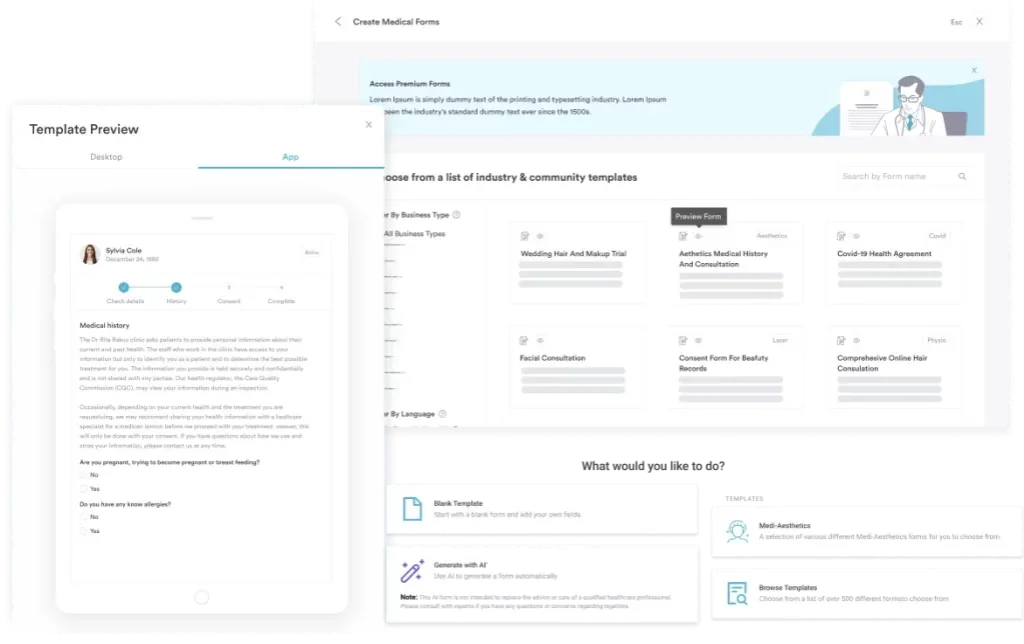
Upload this PDF, or any form you already use, and Pabau's AI Form rebuilds it with tick boxes, text fields and a signature. Attach it to the treatment once, and every patient gets it on time.
AI Form rebuilds the consent, history and aftercare forms you already use. You review each one, then publish.
Patients complete forms on their phone before they arrive, so the front desk stops retyping paper.
Every signed form is versioned and attached to the treatment record, ready when you need it.
Set how long a consent stays valid. Returning patients skip forms they have already signed.
Supports HIPAA and GDPR compliance AES-256 encryption 4.8 on G2 4.7 on Capterra Trusted by 4,000+ practices worldwide

Alastin Skincare is physician-dispensed, TriHex Technology-formulated skincare designed for post-procedure recovery and skin restoration.
Post-treatment skincare protocols must be tailored by procedure type (laser, microneedling, HydraFacial, Morpheus8) with specific product sequencing and application timing.
Client education and written aftercare instructions reduce complications, improve treatment outcomes, and increase product retail attachment for aesthetic practices.
Pabau’s digital forms and automated client communication features streamline aftercare protocol delivery and product recommendation tracking.
Post-procedure skincare is one of the highest-impact levers you have for improving aesthetic treatment outcomes. Alastin Skincare is a go-to brand in aesthetic practices and medical spas for accelerating recovery, strengthening the skin barrier, and enhancing the visible results of laser resurfacing, microneedling, HydraFacial, and Morpheus8 treatments.
When product recommendations are ad hoc, healing is slower and retail revenue slips through the cracks. These Alastin Skincare aftercare instructions give you a downloadable, practice-ready template that educates patients, protects clinical outcomes, and supports product sales.
The template covers post-procedure timelines, product selection by treatment type, application protocols, and client-facing consent language. Whether you’re establishing a new aftercare protocol or refining an existing one, it walks your team through the operational steps to deliver Alastin recommendations consistently.
An aftercare protocol is a standardized set of written instructions that practice staff and practitioners give to patients immediately after an aesthetic procedure. The protocol specifies which skincare products to use, when to apply them, how to apply them, and what to avoid during the healing window.
Alastin Skincare aftercare protocols are grounded in the brand’s clinically documented TriHex Technology — a proprietary blend of peptides and active ingredients formulated to support the skin’s natural ability to regenerate collagen and elastin after procedural trauma.
The Regenerating Skin Nectar, in particular, is recommended post-laser and post-microneedling for its gentle, anti-inflammatory formulation. It supports skin barrier recovery during the critical 48-72 hour window when patients are most vulnerable to complications.
For aesthetic practices, a documented Alastin Skincare protocol serves three functions:
Verbal instructions at checkout or a brief printed handout leave room for inconsistency across team members, thin documentation, and missed retail revenue. A structured template ensures every patient receives the same evidence-based guidance in writing.
The downloadable template provides a five-step operational framework your practice can follow before, during, and after each aesthetic procedure.
The template also integrates with digital forms so patients can confirm receipt of aftercare instructions and acknowledge understanding of product use before leaving your practice. This creates a documented compliance trail and reduces liability exposure if complications arise.
The right Alastin regimen depends on the procedure. Here is a procedure-by-procedure breakdown your team can lift straight into the downloadable template, so post-laser skin and post-peel skin each get the products and timeline they actually need.
For the first 24 hours, cleanse with Alastin Gentle Cleanser using lukewarm water, then apply Regenerating Skin Nectar to support barrier recovery while the microchannels close. Seal with Ultra Nourishing Moisturizer, and finish every morning with a broad-spectrum SPF (HydraTint Pro Mineral SPF 36 also tints over residual pink).
Prepping skin with Regenerating Skin Nectar for two weeks before treatment leads to a smoother recovery.
For three to seven days, patients should avoid the irritants that stall healing:
The template maps each product to the hour it should be introduced.
Ablative treatments strip the stratum corneum, so laser resurfacing aftercare centers on barrier repair and strict sun avoidance. Wait four to six hours for initial inflammation to settle, then begin Regenerating Skin Nectar twice daily, layered under Ultra Nourishing Moisturizer and Soothe + Protect Recovery Balm.
Non-ablative treatments usually need little to no downtime. Because full remodeling runs 30 to 90 days, keep patients on daily broad-spectrum SPF 30+ well past the point visible redness fades.
The first rule of chemical peel aftercare is hands-off: let the skin shed on its own and never pick at peeling skin. Reintroduce moisturizer on a gentle curve so the barrier is not overwhelmed:
Prep with Regenerating Skin Nectar before a deep peel to support recovery, then bring in Restorative Skin Complex during reintroduction. Protect with a broad-spectrum SPF 30+ that uses zinc oxide or titanium dioxide.
HydraFacial is the gentlest of the four procedures, so HydraFacial aftercare is the most forgiving. Most patients can apply Regenerating Skin Nectar immediately, follow with a hydrating serum such as HA Immerse and a light moisturizer, and hold off on active ingredients for about 24 hours. Daily SPF still applies.
Morpheus8 combines radiofrequency with microneedling, so Morpheus8 aftercare follows the microneedling routine but over a longer window. Lead with Regenerating Skin Nectar and Ultra Nourishing Moisturizer, avoid actives for up to a week, and stay strict on sun protection. The template’s Morpheus8 aftercare instructions carry the extended timeline so nothing gets reintroduced too early.
Many practices standardize on the Alastin Procedure Enhancement System, the Alastin post procedure kit that bundles Regenerating Skin Nectar with Ultra Calm Cleansing Cream, Ultra Light Moisturizer, and SilkSHIELD All-Mineral Sunscreen SPF 30. It gives staff one consistent Alastin post procedure regimen to reach for, whatever the treatment.
Before digitizing forms like this, see which aesthetic clinic platforms handle charting and consents best.
This template is designed for aesthetic practitioners and practice managers across multiple specialties and business models.
Improved treatment outcomes and patient safety. Documented, procedure-specific aftercare reduces the risk of infection, hyperpigmentation, and barrier damage. Patients who follow a clear protocol experience faster healing, more visible results, and higher satisfaction. This translates to fewer post-operative complaints and a stronger reputation for clinical excellence.
Increased retail attachment and revenue per patient. Pairing a written aftercare protocol with recommended Alastin products at checkout tends to lift retail attach rates compared with verbal recommendations alone. A formalized system removes the awkwardness of the product pitch and frames it as clinical necessity rather than upselling.
Liability protection and regulatory compliance. A documented protocol demonstrates that your practice operates to professional standards and has thought through the risks and benefits of post-procedure skincare.
If a complication arises, written evidence that you provided clear instructions and assessed contraindications strengthens your legal position. It also shows auditors (CQC in the UK, state boards in the US) that your practice is clinically rigorous.
Reduced staff training burden. A standardized template means new team members can deliver consistent aftercare recommendations from day one, without relying on senior practitioner mentorship. This scales your practice’s quality and reduces the onboarding time for new estheticians or nurse injectors.
Data-driven product recommendations. When aftercare instructions are tracked in your practice management system, you can report on which Alastin products your patients purchase, which procedures generate the highest attach rates, and which recommendations convert most frequently. This data informs your buying decisions and marketing strategy.
Document the cost of each Alastin product in your inventory management system and set the aftercare protocol template to reference those costs. This allows you to generate protocol recommendations that automatically calculate the patient’s out-of-pocket cost for the recommended kit — reducing cart abandonment at checkout and setting correct expectations before purchase.
Aesthetic practitioners widely recommend medical-grade, clinically-tested skincare in the post-procedure window. The rationale is straightforward: procedural treatments create controlled injury to the skin. Laser ablates the stratum corneum, microneedling creates microchannels, and HydraFacial applies vacuum and exfoliating suction.
In this vulnerable state, the skin barrier is compromised and prone to bacterial colonization, irritant reactions, and delayed healing.
Post-procedure skincare addresses this vulnerability by delivering peptides, antioxidants, and barrier-supporting lipids at concentrations higher than over-the-counter formulations. Alastin’s TriHex Technology — a proprietary peptide blend — was designed specifically to support the skin’s natural recovery process post-procedure, making it a clinically aligned choice for aesthetic practitioners.
Alastin’s claims regarding collagen regeneration come from company-sponsored research, so weigh them accordingly. The line is widely adopted across US aesthetic practices, which points to both clinical and commercial utility.
Practice-level data consistently shows that patients given clear, written aftercare instructions comply more reliably than those receiving verbal guidance only. Your documentation also serves as evidence that you’ve met the standard of care, a critical factor if a patient experiences a complication and initiates a complaint or legal action.
Patients who experience a smooth recovery with visible results are significantly more likely to book follow-up treatments and recommend your practice to peers. A professional, documented aftercare protocol communicates competence and attention to detail — qualities that build trust and loyalty.
When a patient receives a laminated aftercare card with specific timelines, product names, and your practice’s logo, it reinforces the professionalism of your operation.
Additionally, when patients become invested in a recommended product — especially one they’ve already purchased and are using successfully — they develop brand loyalty. Recommending the same Alastin protocol across multiple procedures encourages repeat purchases and increases the lifetime value of each patient.
A patient who receives Regenerating Skin Nectar post-laser may later ask for the same product post-microneedling or HydraFacial, creating an automatic upsell and cross-sell opportunity.
Your client portal can house the digital aftercare protocol, allowing patients to review instructions at home, set reminders for application times, and submit questions to your practice through a secure channel. This removes friction and creates a modern patient experience.

Track Alastin products in your inventory, deliver digital aftercare protocols, and measure retail attach rates, all in one integrated system.

A downloaded template only works if it leaves the folder. To make this one stick, embed it into your daily workflow from consultation through follow-up.
Pre-procedure step: During the consultation, your aesthetician or nurse practitioner completes the template’s assessment section (procedure type, skin condition, contraindications) and discusses product options. Patients see you’re being methodical and professional.
Point-of-care step: At checkout, print the completed protocol and package it with the recommended Alastin products. Some practices laminate the protocol card and allow patients to take it home as a keepsake; this reinforces your branding and ensures they have the instructions even if they lose the paperwork.
Post-appointment step: Scan the completed protocol into the patient’s digital record (or attach it as a PDF if using a practice management system). Send an automated text or email at 24 and 48 hours post-treatment reminding them of key aftercare steps and asking if they have questions. This proactive follow-up catches complications early and demonstrates your commitment to their care.
Long-term step: At the patient’s follow-up appointment (typically 2-4 weeks post-procedure), review compliance with the aftercare protocol and ask what worked well and what was challenging. Use this feedback to refine your protocol. Over time, your practice’s version of the template becomes a proprietary asset that reflects your clinical standards and patient population.
Aftercare documentation is a regulatory expectation in most jurisdictions. In the UK, the Care Quality Commission (CQC) expects practices to maintain evidence of patient education and informed consent. In the US, state medical boards and aesthetics boards similarly expect documented protocols.
Having a written, procedure-specific aftercare plan demonstrates that you’ve thought through patient safety and aren’t relying on ad-hoc guidance.
Ensure your template includes space for the patient’s signature confirming they understand the protocol and are able to comply with the timeline and product regimen. This creates a documented agreement and protects you if a patient later claims they weren’t informed.
If a patient has a contraindication, such as active infection, pregnancy, or immunosuppression, document your decision to recommend alternative products or defer further procedures until the contraindication resolves.

Need a full skin evaluation before treatment? Full skin assessment template guides a systematic evaluation of a patient’s skin before treatment planning.
Need a framework for consultation and treatment planning? Consultation templates walk practitioners through assessment, product recommendation, and outcome documentation for aesthetic treatments.
Treating patients with dermal fillers as well as skincare? Our Belotero aftercare instructions template gives you a matching protocol for filler patients.
Pairing skincare recovery with body contouring treatments? The Cellulaze aftercare instructions template covers the post-treatment window for that procedure.
A documented Alastin Skincare aftercare protocol is one of the highest-ROI moves an aesthetic practice can make. It improves patient outcomes, strengthens your documentation, increases retail revenue, and signals professionalism to prospective patients. The downloadable template above gives you a turnkey starting point that you can customize with your practice’s branding, logo, and contact details.
Once implemented, the template becomes self-reinforcing. Patients who follow the protocol experience faster healing and more visible results, leading to higher satisfaction and repeat bookings.
Your team gains consistency and confidence in product recommendations, reducing the time spent explaining aftercare at each visit. Your inventory data tells you which products are actually moving, so you can optimize your Alastin stock and margins over time.
Book a demo with Pabau to see how your practice can integrate aftercare protocols, inventory, and patient communication in a single system.
Alastin Skincare is a physician-dispensed, medical-grade skincare line formulated with TriHex Technology — a proprietary peptide blend clinically designed to support skin healing and collagen regeneration post-procedure. It’s recommended after laser, microneedling, HydraFacial, and Morpheus8 treatments because the procedural trauma temporarily compromises the skin barrier, and Alastin’s formulations deliver concentrated peptides and anti-inflammatory actives that accelerate barrier recovery and visible results.
Timing depends on the procedure. After laser or aggressive microneedling, wait 4-6 hours post-procedure before applying Alastin products to allow initial inflammation to settle. After gentler HydraFacial, most patients can apply Regenerating Skin Nectar immediately post-treatment. Always check the procedure-specific guidance in your practice’s aftercare protocol template. Never generalize across all procedures.
Most Alastin formulations are designed to be gentle on post-procedure, compromised skin. However, assess individual patient contraindications: active infection, severe barrier damage, severe allergic reactions, and concurrent use of active ingredients like tretinoin may require alternative recommendations. Document these decisions in the patient’s record and include them in the written protocol so staff can reference them at future visits.
Present the aftercare protocol and products together as a clinical package, not an optional upsell. Frame it: “This is the aftercare protocol we recommend to achieve the best results from your treatment.” Complete the protocol at checkout, show the patient the recommended products, and bundle them with a discount if possible. Patients are most receptive to product purchases immediately post-treatment when they’re invested in their healing outcome.
Provide written aftercare instructions regardless. Include the Alastin product names and prices so patients can purchase from home if they change their mind. Some practices email patients a 24-hour follow-up reminder with a link to purchase directly, or offer a post-purchase discount code to encourage delayed purchase. Never make the patient feel guilty; the protocol still educates them on proper aftercare even if they source products elsewhere.
Use your practice management system to track which products were recommended and purchased, and correlate that data with post-treatment complications or patient satisfaction surveys. Over time, you’ll identify which Alastin products have the highest patient satisfaction rates and which procedures benefit most from aftercare protocol compliance. Use this data to refine your recommendations and inform marketing.
Apply Alastin skincare in the order the products are built to layer: start with Gentle Cleanser, follow with Regenerating Skin Nectar on damp skin, then Ultra Nourishing Moisturizer, add Soothe + Protect Recovery Balm wherever the barrier needs extra support, and finish every morning with a broad-spectrum SPF 30+. Run the full routine twice daily, with sunscreen in the morning only.
Start it two weeks before microneedling or a deep chemical peel to prep the skin and shorten downtime. After treatment, apply it twice daily from roughly four to six hours post-laser or post-microneedling, and right away after a gentler HydraFacial. It goes on first, on clean and slightly damp skin, before the moisturizer.