Nutrition intake form
A nutrition intake form is a structured questionnaire that records a patientR...

2
Last Updated: Oct 22, 2026

The three day diet menu plan runs three days of controlled eating, then four days of normal intake.
The menus below come to roughly 755 to 935 calories a day on USDA values for the listed portions. The foods are fixed, mostly grapefruit, tuna, eggs, toast and peanut butter.
Weight loss is mostly water weight from glycogen depletion, not fat loss. Lasting results need lifestyle change beyond the three-day cycle.
Female clients usually need 150 to 200 extra calories a day, and pregnancy, diabetes on medication and eating disorder history rule the plan out.
The downloadable PDF is a clinical goal-setting, action and review form, not a copy of the menus themselves.
A printable clinical form for recording the goals, actions and review dates you agree with the client. It carries client details, a background box, support checkboxes, a review record, and signature lines for both of you.
Download templateThe three day diet menu plan promises up to 10 pounds in a week, and clients ask for it by name. It runs three days of fixed, low-calorie meals, then four days of normal eating.
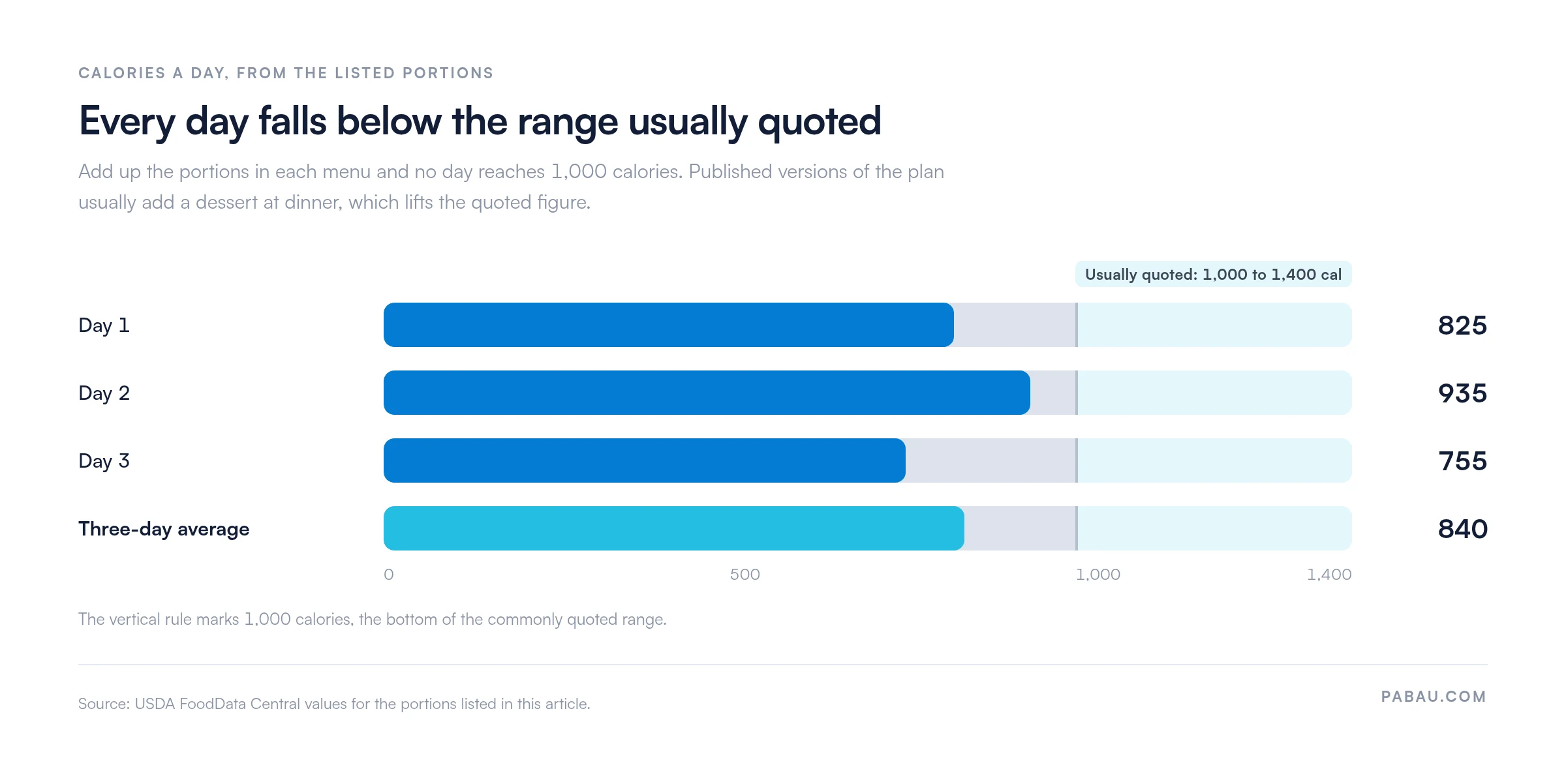
One figure matters more than the rest. The portions published for the plan come to roughly 755 to 935 calories a day, well under the 1,000 to 1,400 usually quoted. Hand over the quoted number and your record will not match what the client ate.
The menus, the calorie math, the safe swaps and the screening all follow below. Use the form above to write down the goals, actions and review dates you agree.
The three day diet menu plan is a fixed, calorie-restricted eating protocol you assign for a set window. Three days of strict restriction come first, then four days of normal eating. It also goes by “military diet,” although no military or government body created or endorses it.
Published menus for the plan get quoted at 1,000 to 1,400 calories a day. Add up the portions in the sections below and the totals come to roughly 755 to 935. Use the figures you hand the client, and record which version you agreed.
The appeal lies in the specificity and the time limit. A client can commit to three days rather than an open-ended regimen. Grapefruit, tuna, eggs and toast are also cheap, which removes one more reason to quit.
One caution before you go further. This is not a medically prescribed cardiac rehabilitation diet. Do not confuse it with a supervised hospital protocol given after an event or for a named condition.
The form records what you and the client agree. Run the protocol in five steps:
The form’s signature lines and review record give you a dated paper trail. Screening notes and risk acknowledgment go in the background box, since the form has no dedicated field for them.
Five items belong on your desk before the appointment starts. Miss one and the conversation stalls, or the client starts a day late.
Then settle expectations out loud. Ask the client what they expect to lose, and correct the number before they start rather than after.
The download is a clinical plan form, not a copy of the menus below. Print it, complete it with the client, and file it with the rest of the record. The PDF includes:
Print the menu and calorie sections alongside the form, or paste them into your own client handout.
Breakfast: 1 slice toasted white bread, 2 tablespoons peanut butter, 0.5 medium grapefruit (~305 cal)
Lunch: One 5-ounce can of tuna (in water, drained), 1 slice toasted white bread (~195 cal)
Dinner: 3 ounces lean meat (chicken, beef or fish), 1 cup cooked green beans, 0.5 medium banana, 1 small apple (~325 cal)
Total approximate calories: ~825 cal. Verify portions against USDA FoodData Central before you put a calorie figure in the record.
Breakfast: 1 large egg, 1 slice toasted white bread, 0.5 medium banana (~195 cal)
Lunch: 1 cup low-fat cottage cheese, 5 saltine crackers (~230 cal)
Dinner: 2 hot dogs (beef frank), 1 cup cooked broccoli, 0.5 cup carrots, 0.5 medium banana, 1 small apple (~510 cal)
Total approximate calories: ~935 cal. This is the highest-calorie and highest-sodium day, so check it against any hypertension or cardiac note on file.
Breakfast: 5 saltine crackers, 1 ounce cheddar cheese, 1 small apple (~255 cal)
Lunch: 1 slice toasted white bread, 2 tablespoons peanut butter (~255 cal)
Dinner: 3 ounces lean meat (chicken, beef or fish), 1 cup cooked green beans, 0.5 medium banana (~245 cal)
Total approximate calories: ~755 cal. Book the review before the client starts day 3, while the plan is still front of mind.
The portions listed above come to about 825, 935 and 755 calories across the three days. That is an average near 840 a day. Use this table when you set expectations with the client, and recalculate it if you swap a food.
The figures use USDA FoodData Central values for the exact portions named in each meal. They run below the 1,000 to 1,400 calories commonly quoted for this plan.
Published versions usually add a dessert portion at dinner, which lifts the quoted figure. Set against that range, the shortfall is easier to see than to describe.
Record the totals you gave the client rather than a figure copied from elsewhere.
Match the substitute to the original food’s protein and calorie content so the day’s total holds.
Write the agreed swaps into the form’s actions table so the next reviewer knows what the client ate.
The three day diet menu plan for women usually needs a small upward adjustment. At roughly 755 to 935 calories a day, the menus sit under the 1,200-calorie floor commonly recommended for women. Adding 150 to 200 calories closes most of that distance.
Consider these adjustments:
Where the standard menus sit too low for a client, a 1200 calorie diet plan gives a gentler daily floor to work from.
The four-day maintenance phase is where long-term adherence is won or lost. Clients regain water weight and often feel deprived after three days of restriction. Set the boundary early, because unrestricted eating does not mean unlimited eating.
Structured follow-up helps hold that line. Guidance for the four days off:
Yes for rapid initial weight loss, and no for sustainability. Most of the weight lost is water from depleted muscle glycogen. It comes back within one to two weeks of normal eating.
A 2014 randomized trial in The Lancet Diabetes and Endocrinology compared rapid weight loss with gradual weight loss. More people on the rapid plan reached their target. Three years on, both groups had regained a similar share of what they lost.
The appeal is psychological. Clients see the scale move, which keeps them engaged. So tell them plainly that the scale may drop 3 to 5 pounds in three days, and that most of it is water.
None of them are about the food. Each one happens in the conversation or the paperwork around it.
Notice the pattern. Four of the five are documentation problems, which is why the form matters as much as the menus.
The plan is not appropriate for every client. Screen for the following before you hand the form over:
Recommend clearance from a registered dietitian or physician before any client starts, especially one with an underlying condition. NIH weight-loss resources stress medical clearance before a very-low-calorie diet.
It suits weight-loss practices, wellness practices, functional medicine and integrative health settings. The protocol works best for clients who:
It is a poor fit for long-term lifestyle change. Clients who need that are better served by a 30-day meal plan with room to build habits. Anyone with a complex medical history, or a need for individualized macronutrient planning, should start somewhere else.
A short-term restrictive diet raises the documentation bar. Record the screening you did, the version of the menus you handed over, and the review date you set.
Four items belong in the client record before the first day of restriction:
Keep the review record current, so each entry carries the date, the progress, the changes you made, and who reviewed it.
Dietitians who chart in the assessment, diagnosis, intervention and monitoring format can carry the same detail into an ADIME note template.
One cycle of this protocol generates three loose documents. There is a printed screening questionnaire, a signed plan form and a handwritten weight log. They sit in a folder or a scanned PDF, so whoever runs the review has to hunt for them.
Practice management software like Pabau keeps them together instead. Digital forms capture the contraindication screen and the client’s signature before the appointment, and the answers land straight in the client record. Weight, adherence notes and side effects go on the same timeline, so the review starts from a complete picture.
Automated email and SMS reminders then cover the four days off, which is where most clients drift. Every subscription includes the full platform, so forms, records, reporting and client messaging work together from day one.
Weight-loss and metabolic practices can see the whole setup in our weight loss clinic software.

Pabau’s digital forms and client records capture the screening, the signed plan and every review in one place. Your team stops chasing paper, and the audit trail is ready when someone asks for it.

The three day diet menu plan earns its place as a short, structured starting point, and nothing more. Clients get a visible result in three days, which buys you their attention for the harder work that follows. Spend that attention on the maintenance phase rather than on the next cycle.
The trade-off worth remembering is that the rigidity is both the appeal and the risk. It suits a motivated, medically cleared client, and it can harm a client with a restriction history. So screen first, document the screen, and set the review date before day one.
Use the article for the menus and the form for the record. Book a demo to see how Pabau keeps the screening, the signed plan and the review notes on one client record.

Need a macro split for the four days off? The 30/30/40 diet plan sets out the balanced carbohydrate, protein and fat targets clients return to.
Want a longer structured window? The 2 week diet plan for weight loss gives you 14 days of menus instead of three, with the same documentation pattern.
Looking for a gentler daily floor? The 1200 calorie diet plan sits at the intake most guidelines treat as the minimum for women.
Ready to move a client to lifestyle change? The 30-day meal plan for weight loss swaps rapid restriction for habits that hold.
Charting the intervention properly? The ADIME note template records assessment, diagnosis, intervention and monitoring in the format dietitians are audited against.
Yes, the two names describe the same protocol. It runs three days of fixed low-calorie menus, then four days of normal eating. No military or government body created or endorses it, and the origin of the name is not documented.
Headaches, fatigue, irritability, dizziness and constipation are the common ones, and they follow the low calorie and fiber intake. Most ease once normal eating resumes. Tell clients to stop and call you if they feel faint or lightheaded.
Black coffee and unsweetened tea are fine, since neither adds calories. Alcohol is not, because it adds calories the menus never accounted for and it worsens dehydration. Water is the safer default across all three days.
Keep it light. At roughly 840 calories a day there is not enough fuel for hard training, and clients often report low energy. Walking or gentle stretching is enough. Save structured training for the four days off.
Treat it as a one-off unless there is a clear reason to repeat it. No published safety data covers repeated cycles, so back-to-back rounds are guesswork. If a client asks for a second round, review weight, mood and energy first.
It sits right at the line. Very-low-calorie diets are usually defined as under 800 calories a day, and day 3 comes to about 755. That puts at least one day in the category, which is why medical clearance matters.