Journal prompts for mental health
Journal prompts for mental health are guided questions that help people process ...

2
Last Updated: Oct 13, 2026

Stonewalling is an emotional shutdown where one partner stops engaging during conflict. Dr. John Gottman named it a leading predictor of divorce.
The partner on the receiving end feels anxiety, rejection, self-doubt, and a loneliness that can harden into lasting harm.
Stonewallers withdraw because of emotional flooding, a physiological overwhelm that mirrors a trauma response and calls for understanding rather than judgment.
Defensive stonewalling comes from overwhelm, while weaponized stonewalling is used for control. The difference decides how you treat it.
Chronic stonewalling can bring PTSD-like symptoms, attachment disruption, and eroded trust. Therapy and structured communication tools help couples break the cycle.
A client-facing explainer covering what the shutdown does to each partner, the physiology behind the withdrawal, and the recognition cues to watch for. It ends with the repair steps you can rehearse together in session.
Download templateStonewalling is an emotional shutdown during conflict. One partner stops responding, answers in single words, or leaves the room. It sits alongside criticism, contempt, and defensiveness among the Four Horsemen identified by Dr. John Gottman, the habits that predict divorce most reliably.
The damage runs in two directions. The partner on the receiving end feels anxiety, rejection, self-doubt, and abandonment. The partner who withdraws feels overwhelm, shame, and a version of the same loneliness. Withdrawal has a physiology behind it, so the response that helps is rarely the one that comes naturally.
There is also a fork in the road that decides treatment. Stonewalling driven by overwhelm needs regulation skills. Stonewalling used as control needs accountability. The sections below cover both sides of the pattern, how to tell the two versions apart, and what breaks the cycle.
Stonewalling is a communication breakdown marked by silence, withdrawal, and emotional disengagement during conflict. According to the Gottman Institute’s research, it happens when one partner tunes out, refuses to respond, or uses a non-verbal shutdown to avoid engaging.
Stonewalling differs from the silent treatment in intent. Stonewallers withdraw because they are overwhelmed and dysregulated, not always to punish. The impact on the recipient is similar either way, and it shows up as isolation, rejection, and unresolved tension.
The partner being stonewalled carries a distinct set of injuries. Open conflict at least keeps two people in the room. Stonewalling creates an invisible abandonment, where the relationship is physically present but emotionally absent.
The recipient’s pain is visible, while the stonewaller’s is usually misread as indifference. Stonewallers withdraw out of dysregulation rather than a lack of care. Emotional flooding is the physiological root of it.
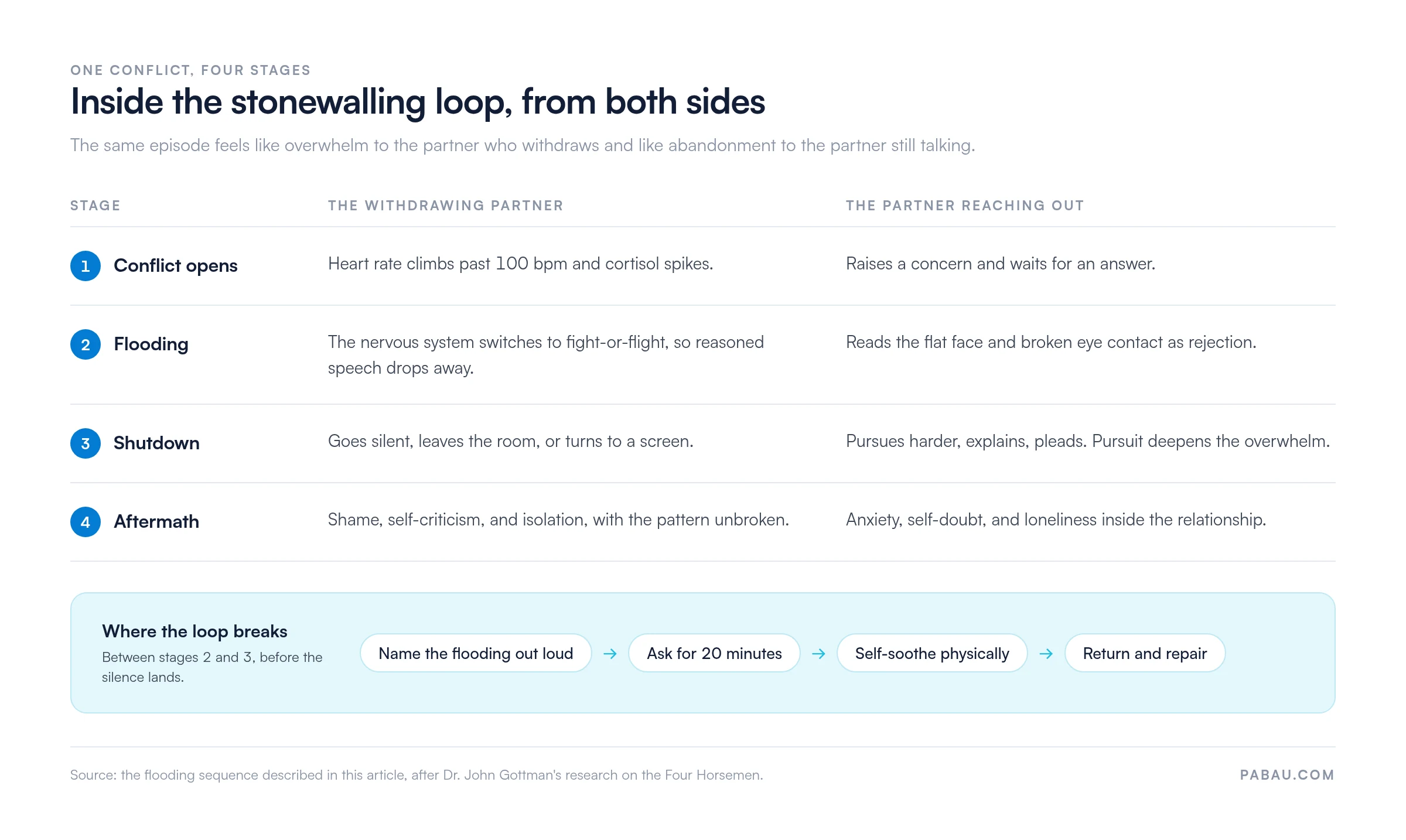
During conflict, the stonewaller’s nervous system becomes hyperaroused. Heart rate spikes above 100 bpm, cortisol floods the system, and the brain shifts into a survival state. Reasoned conversation is neurologically out of reach at that point. The stonewaller feels trapped and unable to regulate, so they shut down.
Set the two experiences side by side and they form a loop, and the loop repeats until one partner interrupts it.
When stonewalling becomes habitual, the psychological damage accumulates. Mental health professionals report that long exposure to emotional shutdown can produce outcomes resembling trauma.
Therapists working with couples affected by stonewalling describe a relational learned helplessness. Partners stop trying to reconnect, because past attempts failed so consistently.
Stonewalling can amount to emotional abuse, though not every episode does. Intent is what separates the two, and the question comes up in therapy rooms constantly.
Defensive stonewalling happens when a partner withdraws under emotional flooding. It is a survival response rooted in dysregulation. The harm it causes is unintentional rather than punitive.
Weaponized stonewalling happens when a partner uses silence and refusal deliberately, as a way to punish, manipulate, or dominate. That version is emotionally abusive.
Telling them apart takes an honest assessment. Is the stonewaller genuinely overwhelmed and willing to work on self-regulation? Or is the shutdown a way to dodge accountability and hold on to control? The distinction shapes treatment planning from the first session.
Stonewalling and gaslighting are separate harmful patterns. They often co-occur, and together they compound the emotional damage.
If you are the one being stonewalled, a few deliberate moves reduce the harm and leave room for reconnection.
For the withdrawing partner, the goal is not to suppress the urge to leave. It is to build the self-regulation skills that make re-engagement possible during conflict.
Many stonewallers carry histories of trauma, neglect, or emotional unsafety. The withdrawal is often a conditioned survival response, because the nervous system learned that engagement meant danger.
For these clients, opening up during conflict triggers a freeze or flight response. Trauma-informed therapy approaches work on the underlying nervous-system dysregulation, rather than the relational behavior alone.
Professional help is warranted once the shutdown shows up in most conflicts and both partners are suffering. The warning signs are specific:
Gottman Method therapy, emotionally focused couples therapy (EFT), and trauma-informed approaches are evidence-based treatments that help couples interrupt stonewalling cycles.
The handout is written for therapists working with couples and individuals caught in this pattern. Print it, send it digitally, or use it to frame a conversation you know will be difficult.
It explains what the shutdown does to each partner, validates that the pain is understandable, and lists the cues that identify an episode. Share it early. Clients who understand the mechanism carry less shame, and less shame means more room to change.
Sharing a handout is the easy part. Tracking it is not. A practice prints a copy, emails a PDF from a personal inbox, and keeps no record of what the client received.
Practice management software like Pabau keeps the resource and the record together. You can attach the handout to a client’s file, send it from their portal, and log it against the session note. The next appointment then opens with that history already in front of you.
That matters for a pattern like stonewalling, which is tracked across months rather than single sessions. Notes, forms, and shared resources sit in one client record. So you can see whether the couple worked through the material before you plan the next step.

Pabau lets therapists document each session, track a pattern across months, and share resources like this stonewalling handout from inside the client record. Nothing lives in a personal inbox.

Silence is rarely the whole story. A partner who goes quiet may be flooded, or may be exercising control, and those two situations call for opposite responses. Work out which one you are looking at before you decide what to do next.
Neither change is intuitive. The partner reaching out has to stop pursuing, and the partner withdrawing has to say the words before leaving the room. That is why couples rarely break the loop without help, and why the handout works best alongside structured sessions.
If you treat couples, the pattern is easier to interrupt when the evidence sits in one place. Book a demo to see how Pabau keeps session notes, client forms, and shared handouts in a single record.

Need a framework for assessing relational patterns? Clinical note-taking templates help you document stonewalling patterns and track progress in therapy.
Working with trauma-informed approaches? Crisis intervention strategies for clinicians guide responses when stonewalling triggers dysregulation.
Want to deepen couples work? Therapy practice management software centralizes client records, session notes, and downloadable resources like this handout.
Recipients experience anxiety, rejection, self-doubt, emotional abandonment, and a deep loneliness inside the relationship. Over time, chronic stonewalling can produce PTSD-like symptoms, including intrusive thoughts, emotional flashbacks, and hypervigilance. The core wound is invalidation. A refusal to engage says that the recipient’s feelings and needs are not worth addressing.
Stonewalling can be abusive when it is used deliberately as a control tactic, to punish or dominate. Many stonewallers, though, withdraw because of genuine nervous-system overwhelm. Separating defensive stonewalling from weaponized stonewalling is critical for both treatment planning and accountability.
Stonewallers typically withdraw because of emotional flooding. In that state the nervous system enters fight-or-flight, heart rate spikes, and the brain cannot reach rational communication. Underlying causes include childhood trauma, insecure attachment, anxiety, or patterns learned in the family of origin. Separating this from choice or malice is essential to compassionate therapy.
Yes. Chronic stonewalling can produce trauma responses in recipients, including intrusive thoughts, emotional flashbacks, hypervigilance, and conditioned helplessness. Repeated abandonment during moments of relational vulnerability creates wounds similar to neglect or abandonment trauma.
Regulate yourself first, name the pattern without accusation, create emotional safety, set clear boundaries around your own needs, and seek professional support. Do not pursue the stonewaller endlessly. State your need once and then allow space, because pursuit escalates their overwhelm and deepens your desperation.