HIPAA compliant texting: What you can send patients & how to communicate securely
HIPAA compliant texting is possible when a text holds no protected health inform...

Last Updated: Oct 16, 2026

A TB skin test questionnaire records exposure history, symptoms, contraindications, and prior test results before a tuberculin skin test is placed.
The form needs six sections: patient and employment details, risk factors, symptoms, contraindications, prior testing history, and provider-only read-out fields.
The reading has to happen 48 to 72 hours after placement. A test read outside that window is flagged repeat required.
CDC induration thresholds are 5 mm for immunocompromised patients, 10 mm for healthcare workers, and 15 mm for lower-risk people. Close TB contacts use the 5 mm threshold too.
Employment files keep the completed form for the duration of employment plus 30 years under OSHA record-keeping rules.
Five pages covering patient and employment details, TB exposure and risk factor questions, an active TB symptom check, contraindications, and prior testing history. The provider pages record placement, the induration reading in millimeters, and the CDC thresholds at 5, 10, and 15 mm.
Download templateA TB skin test questionnaire is the form that captures a patient’s exposure history, symptoms, and contraindications before a tuberculin skin test goes in.
Its most important job is telling you whether the test should be placed at all. Occupational health teams work through these forms constantly during onboarding, and one skipped question can invalidate an entire baseline file.
Miss the 48 to 72 hour reading window and the employee starts over, which pushes back their start date. The sections below walk through the required fields, the intake-to-read-out sequence, and the mistakes that force a repeat test.
The questionnaire captures four things: exposure history, current symptoms, contraindications, and any prior TB test results.
Practices collect it on paper or as a digital intake form at check-in. You will also see the test called the Mantoux or PPD test, and the questionnaire is the same either way.
The tuberculin skin test measures how the immune system reacts to TB antigen injected into the skin. A small, firm bump called induration appears where the immune system has met TB before.
A trained reader measures that bump in millimeters, 48 to 72 hours after the injection.
Anyone starting work in a healthcare setting needs a baseline TB risk assessment. The CDC baseline testing guidance puts it at the time of hire, before the new employee begins patient care.
Retesting is not automatic after that. The CDC stopped recommending routine annual testing for healthcare personnel without known exposure or ongoing risk.
Most practices now test at hire, then only when something triggers it. That makes the baseline file the one everybody comes back to, sometimes years later.
Six sections carry the whole form. Each one answers a question somebody will ask of that file later. That somebody might be a provider, an auditor, or the next occupational health nurse.
Collect name, date of birth, address, phone number, employer or facility, job title, and the screening date. Add the medical record number too, so the form can be matched back to the chart without guesswork.
Keep these as yes or no questions, because a screening nurse has to scan them in seconds. Ask about:
Any yes here stops the process and sends the patient for medical evaluation before the test is placed:
Document every reason the test should not go ahead today. Three come up most often:
Pregnancy is not a contraindication, although some protocols defer the skin test and substitute an IGRA.
Record the date, the method used, the result, and the induration size in millimeters for every prior TB test. This stops repeat testing in people already known to be positive. It also lets a clinician spot boosting, where induration grows on a repeat skin test within a year without any new infection.
Include the placement date, the reading date, and the induration size measured in millimeters rather than estimated. Then add the result classification, positive or negative, plus the test lot number, the clinician’s name, license number, and signature.
One more field earns its place: a test not read inside the 48 to 72 hour window is flagged repeat required. This section is the legal record of administration and interpretation.
The form moves through five stages, and only one of them carries a deadline. The employee fills in the history pages, then a nurse reviews every yes answer.
A trained staff member places the test, a trained reader measures the induration, and a provider signs the result.
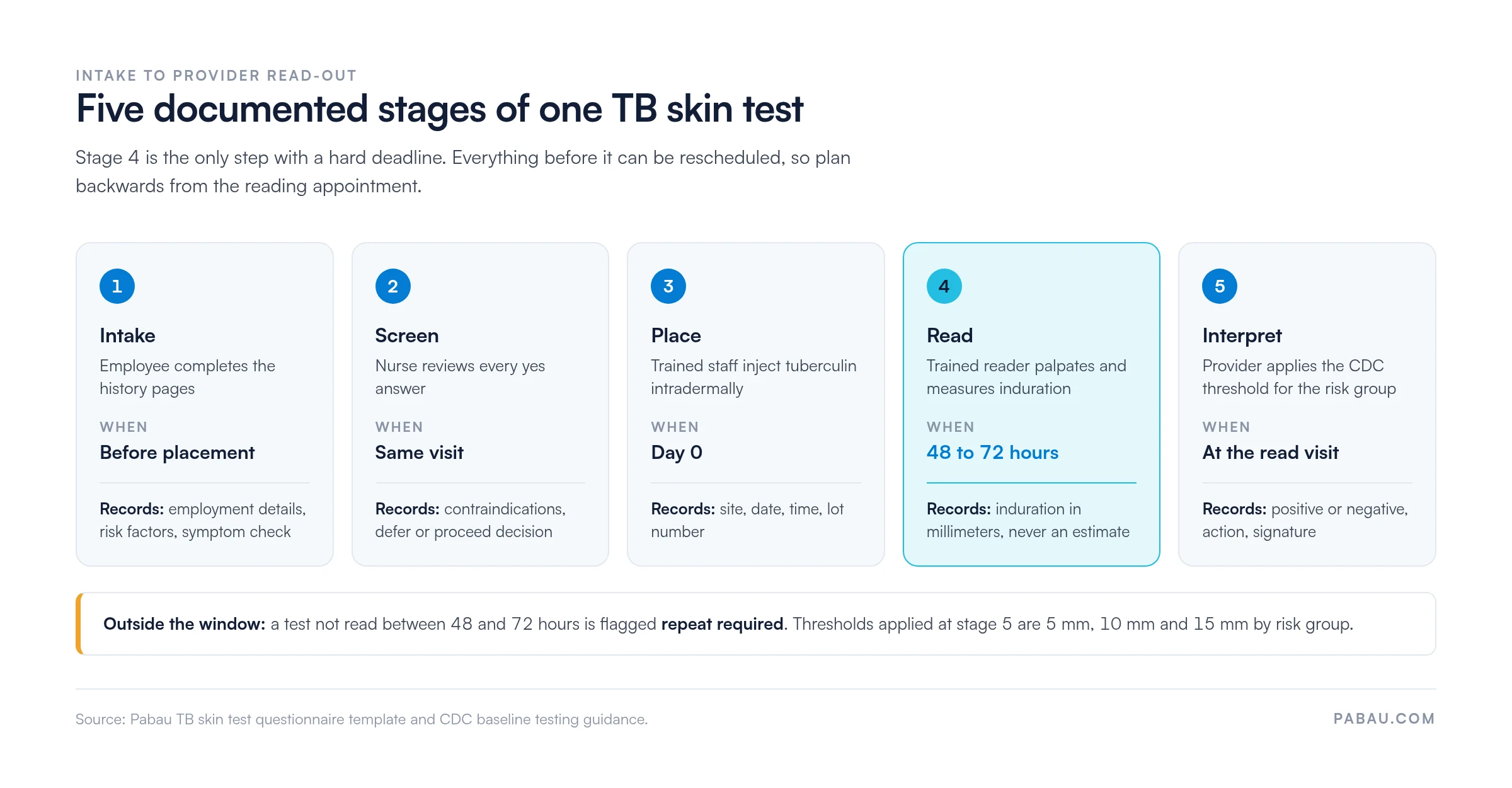
Because of that, it pays to work backwards from the reading appointment. Place a test on Monday morning and the read has to happen between Wednesday and Thursday morning. Place it on a Thursday and the window falls across the weekend, so keep placements early in the week wherever staffing allows.
Who does what matters as much as when. State scope-of-practice rules decide who may place the injection, and the reader has to be trained to palpate and measure induration. A patient reading their own arm is not an acceptable record.
Book the reading appointment at the moment you place the test, not afterwards. A reminder sent 40 hours later is too late to find a slot, and a missed window means repeating the test at the practice’s expense.
Positivity depends on who the patient is, not only on the size of the bump. The CDC sets three thresholds, and the lowest one applies to the patients with the most to lose.
Measure the induration across the forearm, at right angles to the arm’s long axis, and write the number down even when it is zero. Palpate the edges rather than eyeballing redness, because redness alone is not induration. A blank field reads as an unfinished test to anyone auditing the file later.
Both tests are valid for baseline screening, so the choice comes down to whether the patient will come back. The skin test needs a second visit inside the reading window.
An IGRA blood test needs one visit and a laboratory, plus a blood test consent on file before the sample goes out.
Prior BCG vaccination is usually the tie-breaker. BCG can push a skin test into a false positive, while an IGRA is not affected by it. That makes the blood test the cleaner option for anyone vaccinated abroad.
An employment file has to show who was screened, what the result was, who signed it, and how long you keep it. That last part is where practices get caught out.
For employment use, the completed form needs to carry:
Most of this screening runs through private GP practices and occupational health teams. The completed file usually sits in the same software for primary care that already holds the patient’s chart.
Retention is set by OSHA record-keeping rules under 29 CFR 1910.1020. Employee exposure and medical records are kept for the duration of employment plus 30 years. The file has to survive staff turnover and system migrations.
Retention that long is why compliance management software matters more than a locked cabinet. You may need to show who opened a record, and when, not just that you kept it.
Four problems account for most repeat tests and rejected files, and none of them are clinical.
Then file it alongside the rest of the new hire’s health record. A TB result and an immunization record form usually belong to the same onboarding packet, so keep the two together rather than in separate folders.
Plenty of occupational health teams still run TB screening on paper and chase the reading appointment by phone. The screening itself is rarely the hard part. Tracking who is still inside the reading window, and who now needs a repeat, is what eats the week.
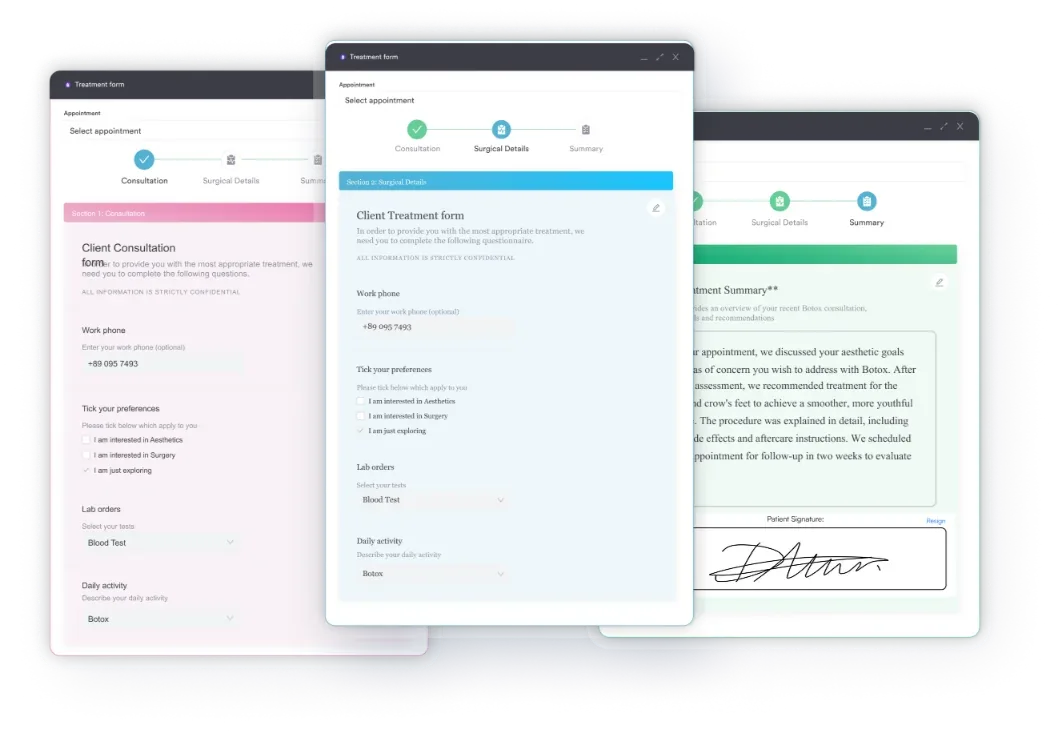
Practice management software like Pabau turns the questionnaire into a digital form the employee completes before arriving. Demographic fields carry over from the existing patient record, so nobody retypes a date of birth. The reading appointment can be booked in the same visit as the placement, and automated reminders chase it.
Completed forms then route to a clinician for review and signature, and access to the record is audit-logged. That is what an OSHA inspection asks for. The outcome is a baseline file that is complete on the day it is created, rather than one reconstructed two years later.

Pabau collects the questionnaire digitally, books the 48 to 72 hour reading appointment, and logs every access to the record. Your baseline files stay complete without a paper chase.

The questionnaire is only as good as the read that follows it. A form with every box ticked and no millimeter reading is still an incomplete file, and it will be the one an inspector pulls.
So build the schedule around the 48 to 72 hour window first and let the paperwork follow it. Download the template, pick your placement days, and decide now who on the team is trained to read induration.
Book a demo to see how Pabau turns that sequence into one tracked workflow, from the intake form to the signed read-out.

Need to store screening records the way an auditor expects? A complete HIPAA compliance checklist for primary care walks through access control, retention, and the audit trail behind both.
Filing TB results with the rest of a new hire’s health record? Immunization record form covers the fields an onboarding packet needs beside the TB questionnaire.
Running pre-employment physicals in the same visit? Annual physical exam checklist by age sets out what to examine and record at each life stage.
Standardizing how patients arrive in the first place? General practice intake form template gives you a reusable base your screening forms can sit on top of.
Two-step testing is recommended when a new hire will be tested again later. A first test can boost an old, faded reaction, which then looks like a new infection. A second test placed one to three weeks after a negative first read separates the two. A single test is acceptable when no serial testing is planned.
No federal rule sets an expiry date. Employers usually accept a baseline completed within the previous 12 months, and facility policy decides the rest. The CDC dropped its routine annual retesting recommendation for healthcare personnel in 2019. Retesting now follows exposure or ongoing risk rather than the calendar.
State scope-of-practice rules decide who may place the injection, and it is usually a nurse, medical assistant, or provider working under protocol. Reading is the stricter half. The reader has to be trained to palpate and measure induration, and patients must never read their own results.
Yes, because post-exposure screening is not the same as baseline screening. Test as soon as the exposure is identified, then test again 8 to 10 weeks after the last exposure. Record the exposure date on the form, since the second test date is counted from it.