HIPAA compliant texting: What you can send patients & how to communicate securely
HIPAA compliant texting is possible when a text holds no protected health inform...

Last Updated: Oct 16, 2026

A subleasing agreement template records the terms between the original tenant, called the sublessor, and the incoming subtenant.
In a sublease, the original tenant stays liable to the landlord for rent and damage until the term ends.
An assignment does not end that liability either, unless the landlord releases the original tenant in writing.
Most leases require written landlord consent first, and state law decides when a landlord may refuse it.
Commercial practice space carries different consent rules than a residential apartment, so confirm the property type before you draft.
A fill-in subleasing agreement covering the parties, the property, the term, rent and payment terms, and the security deposit. It also carries utility responsibilities, landlord consent provisions, and signature blocks.
Download templateA subleasing agreement template is the document you fill in when someone else takes over your leased space, or part of it. It matters because the handover is never as clean as it feels.
Sign a sublease and you stay liable to the landlord for the rent and the condition of the space, whatever the subtenant promised you. Even a full assignment leaves you exposed unless the landlord releases you on paper. Get the wording and the consent right and the arrangement holds.
Get them wrong and you can lose your own lease. The sections below walk the document clause by clause, then set out the checks to run before anyone signs.
It is a pre-structured contract between the original tenant, the sublessor, and the incoming subtenant. It records who occupies the space, for how long, at what rent, and on what conditions. It also states plainly that the sublessor’s obligations to the landlord carry on.
That last point drives most of the document. There is no direct contractual link between the landlord and your subtenant.
As the Legal Information Institute at Cornell Law School puts it, no privity of contract exists between the two. The original tenant still has to meet the lease obligations. So a subtenant who stops paying is your problem, not the landlord’s.
The template is not a lease, and it does not replace one. It governs the sublessor and the subtenant only. The master lease stays the senior document, so a sublease clause that contradicts it loses. If the subtenant breaches a condition, the landlord comes to you.
In all three arrangements, the original tenant normally stays liable to the landlord. What changes is how much of the lease moves across, and what it takes to be let go.
Assignment is the row worth reading twice. Transferring the lease hands the rights to the assignee, but it does not automatically end the assignor’s obligations.
Under most leases, and under most state law, the original tenant remains liable unless the landlord signs an express release. Lawyers call that a novation. Ask for it in writing at the point of transfer, or work on the basis that you are still the tenant.
Yes, subleasing is legal in every US state. What varies is whether your own lease permits it, and whether the landlord is allowed to refuse.
Most leases require written consent before a subtenant moves in. The Uniform Residential Landlord and Tenant Act gives states a common starting point for residential tenancies, and each state layers its own rules on top.
Going ahead without the consent your lease demands is a lease violation. That can put the tenant and the subtenant out of the space together.
Commercial space is the category that matters for a practice. Treatment rooms, suites, and whole buildings sit outside most residential protections.
So the consent standard comes from two places: the lease itself, and your state’s commercial transfer statute.
A complete document protects the sublessor and the subtenant equally. Leave a clause out and the ambiguity gets read against whoever drafted it, which is usually you.
Here is the whole shape of the agreement before we take it apart.
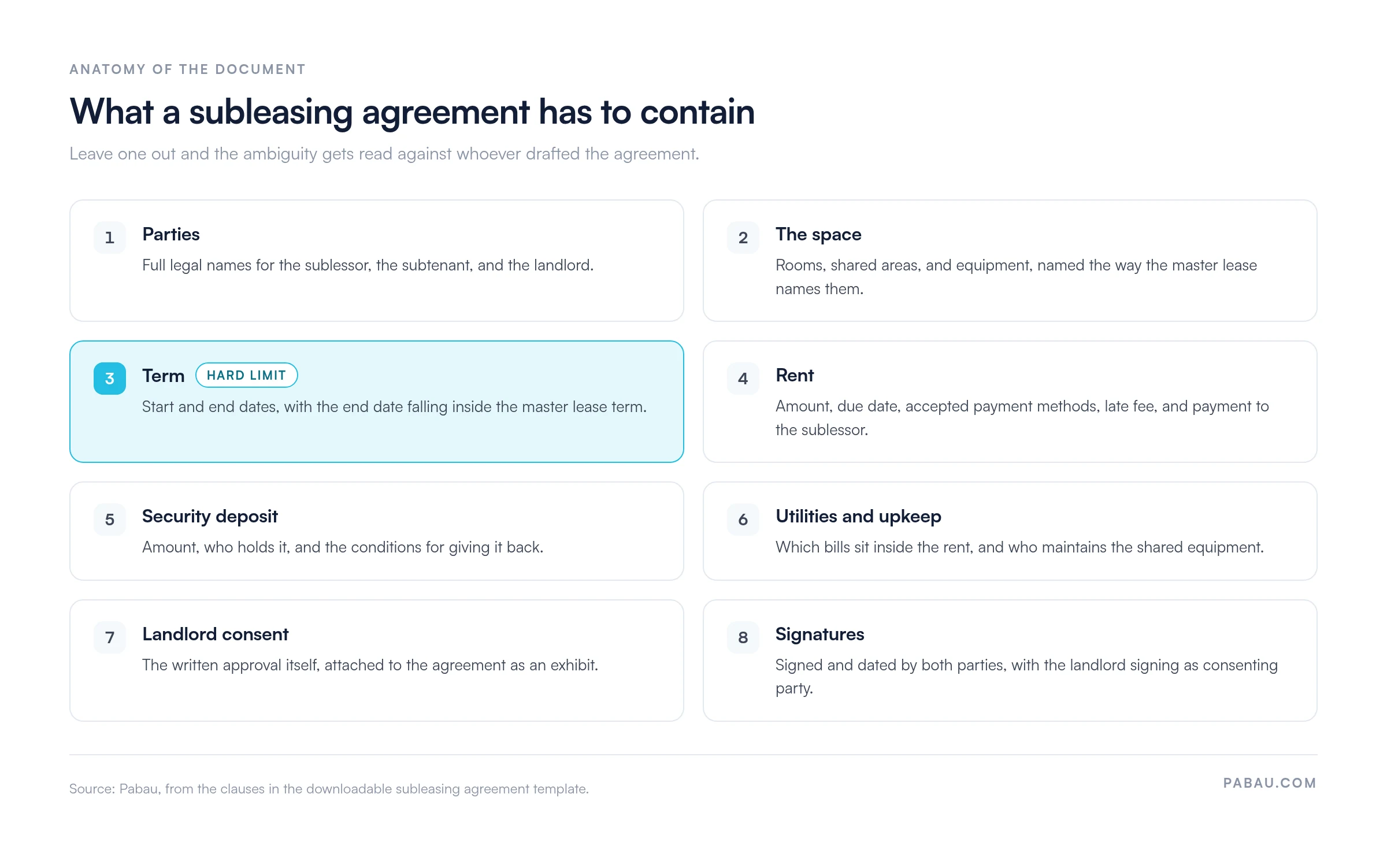
Full legal names, contact addresses, and roles for the sublessor, the subtenant, and the landlord. Name the landlord even though they are not signing as a party. It removes any argument later about who holds the underlying lease.
The property address, the unit or room number, and a description of what the subtenant gets. For a practice sharing a floor, list the treatment rooms by number and say which waiting areas, sinks, and storage are shared.
Start and end dates for the sublease. The end date has to fall on or before the master lease expiry, because you cannot grant more than you hold. Write the master lease end date into the agreement so both parties can see the ceiling.
The monthly amount, the due date, accepted payment methods, and what happens when payment is late. State clearly that rent goes to the sublessor, not to the landlord. A subtenant who pays the landlord directly creates exactly the confusion the document exists to prevent.
The deposit amount, who holds it during the term, and the conditions for returning it. Deposit rules that apply to the original tenancy may also reach a sublease of the same property. Check your state before you set the figure.
Which bills sit inside the rent, which the subtenant pays separately, and who handles cleaning between sessions. Practices with sterilizers, medical-grade air handling, or laser devices should name each one and say who services it.
A clause confirming that consent was given, with the signed approval attached as an exhibit. If the lease requires consent and the file does not contain it, the agreement is only as strong as the landlord’s memory.
Signature and date blocks for both parties, plus a line for the landlord as consenting party. Attach the master lease and the consent letter to the same file, so the whole arrangement reads as one set of documents.
Work through the sections in order. The sequence matters more than the drafting, because two of these steps can invalidate the finished document if you take them late.
Re-read the sublease against the master lease every time a term in the head lease changes, including a renewal or a new permitted-use clause. A sublease that contradicts an amended master lease can put the sublessor’s own tenancy at risk.
Each one catches a problem that is expensive to fix afterwards. None of them takes long.
Two mistakes cause most of the disputes. The first is a verbal landlord approval that nobody wrote down, which is worth very little once the landlord changes or the building sells.
The second is a sublease that copies the master lease’s rent but not its rules on hours, signage, or waste disposal. The subtenant then breaks a clause they never saw, and the landlord bills the sublessor for it.
Any tenant handing space to another person or business needs the arrangement in writing. In healthcare and aesthetics, that covers more situations than owners expect.
A verbal arrangement works right up until the money or the space is in dispute. The written version gives you four things a conversation cannot.
A basis for acting when rent stops. If the subtenant misses payments, the agreement sets out the late fee, the notice period, and the route to reclaiming the room. Without it, you are arguing about what was said in a corridor.
Cover when the landlord asks questions. A sublease that mirrors the master lease terms shows the landlord that the arrangement respects their document. That is a far better position than explaining an informal deal after an inspection.
A record for audits and licensing. Practices keep documentation trails anyway. Filing the sublease next to your HIPAA and state licensing records shows that the shared space is properly governed, which matters when someone asks.
Faster onboarding for visiting practitioners. A standard document turns a week of drafting into an afternoon of filling in fields. The practice manager completes the blanks, sends it for signature, and the room starts earning.
No sublease is automatically valid in every state. State landlord-tenant law decides how the agreement is read, what has to be disclosed, and when a landlord may refuse consent. Practices operating across state lines should treat this as a step, not a formality.
Read the source text rather than a summary of it. California publishes the commercial transfer sections on the California Legislative Information portal, and New York publishes section 226-b on the New York Senate legislation database.
Commercial healthcare leases add a further layer. Zoning rules, health authority permits, and infection control standards all affect whether a subtenant can lawfully treat patients in the room.
Confirm those before signing, because a sublease cannot make an unpermitted use lawful.
Subleasing a room changes who works in your practice, not only who pays for the space. A visiting injector needs a slot in the calendar, a way to collect intake forms, and somewhere for their notes to land. Most practices patch that together with a shared spreadsheet and a second booking link.
Practice management software like Pabau puts those pieces in one system. The visiting practitioner gets their own login, so their appointments sit in the same calendar as yours and their treatment notes stay attributed to them.
Pricing scales with locations and users, and every subscription includes every feature, so adding a subtenant never means changing plan.
Their patients complete paperless intake forms and consent before they arrive, and the signed copies attach to the client record on their own.
When the sublease ends, the record of who treated whom is already in order. That matters if an insurer, a licensing board, or the landlord ever asks.
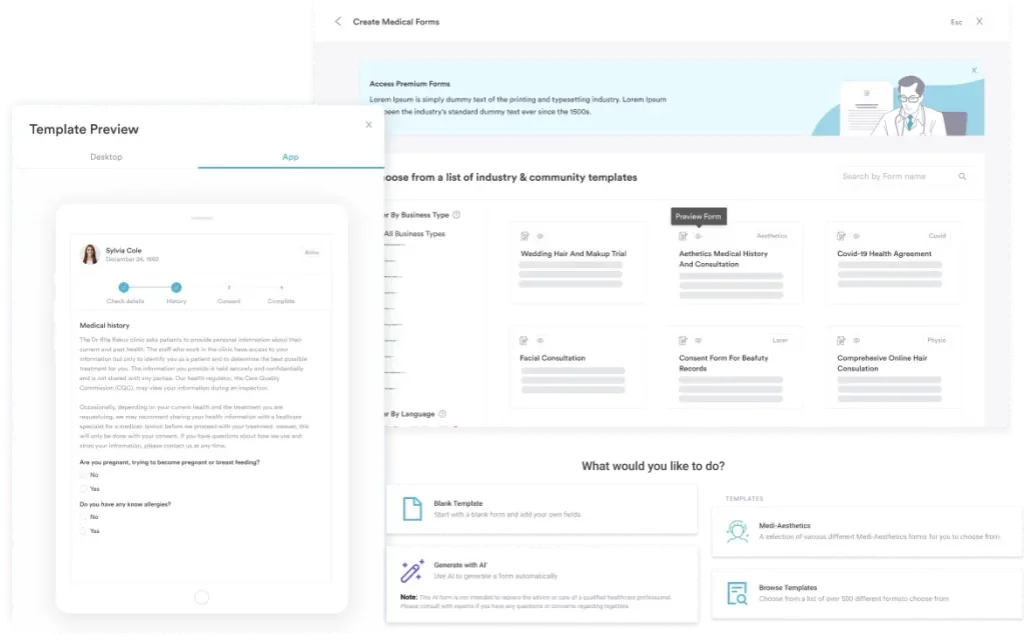

Pabau keeps every practitioner’s bookings, intake forms, consent, and treatment notes in one system. A subleased room then runs on the same records as the rest of your practice.

The document is the easy part. What decides whether a sublease works is the order you do things in. Read the master lease, get consent in writing, then draft to match. Reverse that order and you can end up with a signed agreement your own lease does not allow.
Keep the liability point in view as well. Subleasing does not hand your obligations to somebody else, and neither does an assignment unless the landlord releases you on paper. So price the arrangement, and choose the subtenant, as though you are still the tenant. You are.
Once the room is let, the operational work starts. Book a demo to see how Pabau keeps a visiting practitioner’s bookings, forms, and notes inside the same system as your own.

Sharing a room with a visiting practitioner? Non-disclosure agreement template covers the patient and business information that changes hands when someone else works out of your space.
Setting terms with the people your practice works with? Client agreement template sets out scope, payment, and cancellation terms in language you can adapt.
Wondering where signed documents should live? Best clinical documentation software compares the systems practices use to store and retrieve signed records.
Still chasing paperwork before appointments? Getting forms completed before appointments shows how to collect them ahead of the visit rather than in the waiting room.
Sometimes, but check first. Many master leases cap the sublease rent or require any surplus to go to the landlord. Rent-regulated units carry their own limits. In commercial practice space the lease usually decides, so read the transfer clause before you set a number.
Both parties, usually. The master lease normally keeps the original tenant responsible for property cover, and that duty does not move. A visiting practitioner should carry their own professional liability insurance. Ask to see the certificate, and check whether the lease wants the landlord added to it.
The sublease usually ends with it. A sublessor cannot grant more than they hold, so the subtenant’s right to occupy comes from the head lease. Add a clause covering early termination, including the notice each party gets and how the deposit is returned.
Only if both documents allow it. Most master leases ban a second layer of subletting, and a well-drafted sublease repeats that ban. If you want to keep the option open, ask the landlord for it in writing while the first consent is being negotiated.
Usually not. Most states enforce a signed sublease without notarization. Some commercial landlords ask for notarized signatures anyway, and recording rules can apply to very long terms. Check your lease, and use a notary when the landlord’s consent letter calls for one.