Journal prompts for mental health
Journal prompts for mental health are guided questions that help people process ...

2
Last Updated: Oct 13, 2026

The Spann-Fischer Codependency Scale is a 16-item self-report questionnaire that measures codependent relationship patterns on a 6-point response scale.
Total scores run from 16 to 96, and a higher total means more codependent traits. The scale has no validated severity bands and no clinical cut-off scores.
Items 5 and 7 are reverse-scored before you add up the 16 responses into a single total.
Fischer, Spann, and Crawford published the scale in 1991 in Alcoholism Treatment Quarterly, and it is reproduced freely for clinical use.
Practice management software like Pabau can send the SF-CDS before a session, score the responses, and file the result in the client record.
The two-page form carries all 16 statements, the 1 to 6 response anchors, and fields for the client, clinician, and date. It also prints the scoring note for the two reverse-scored items and the original source citation.
Download templateClients rarely arrive naming that pattern. They come in for anxiety, low mood, or a relationship that keeps hurting them, and codependency surfaces later. This Spann-Fischer Codependency Scale puts a number on it in under 10 minutes.
Totals run from 16 to 96, and the instrument carries no validated cut-off scores. Treat a total as a severity grade and you document something the evidence does not support.
What follows covers the item structure, the scoring steps, and a defensible way to read the result.
The SF-CDS measures codependent traits and relationship patterns through 16 statements. Fischer, Spann, and Crawford introduced it in a 1991 paper in Alcoholism Treatment Quarterly, and clinicians have used it for screening ever since.
Respondents rate each statement from 1 (strongly disagree) to 6 (strongly agree). Most people finish in 5 to 10 minutes. The scale screens and measures rather than diagnoses. Codependency is not a recognized diagnosis in the DSM-5-TR, so no total can confirm or rule one out.
The full item set appeared in the original paper. Since then the scale has been reproduced freely in clinical, research, and training settings, with no licensing fee to pay.
Codependency shows up as over-reliance on others for self-worth, excessive caregiving, poor boundaries, and emotional enmeshment.
Clients rarely present it in those words. They book for anxiety, depression, or relationship conflict, and a standard intake records what they said instead.
A brief screening tool catches the pattern early. Used at intake, the SF-CDS helps you:
That structure only pays off if the total is scored right. Two of the 16 items make that easy to get wrong.
All 16 statements are rated from 1 to 6. Fourteen of them are keyed so that agreement signals more codependency. Items 5 and 7 are worded in the opposite direction, so they get reverse-scored before the total is calculated.
Fischer and colleagues defined codependency around three features, and the items map onto them:
The scale yields one total and has no subscales. Items are written in plain language, so respondents need no clinical knowledge to answer them. Two of them read “It is hard for me to say no” and “I often put the needs of others ahead of my own.”
Scoring takes about two minutes once the form comes back. Follow these four steps:
A higher total means more codependent traits, and that is the full extent of what the score claims. The SF-CDS is dimensional rather than categorical. It places a client somewhere between 16 and 96 without sorting them into a severity group.
That design sits in the scale itself. Totals near the 16 floor reflect fewer endorsed traits, and the number climbs as a client agrees with more statements. No low, moderate, or high bands appear on the form or in the original paper.
Band tables do circulate online, and they contradict each other. One widely copied version splits 16 to 96 into three bands. Another splits the same range into five. Neither has published validation behind it, so neither belongs in a client record.
The chart below sets what the instrument gives you against what gets added to it afterwards.
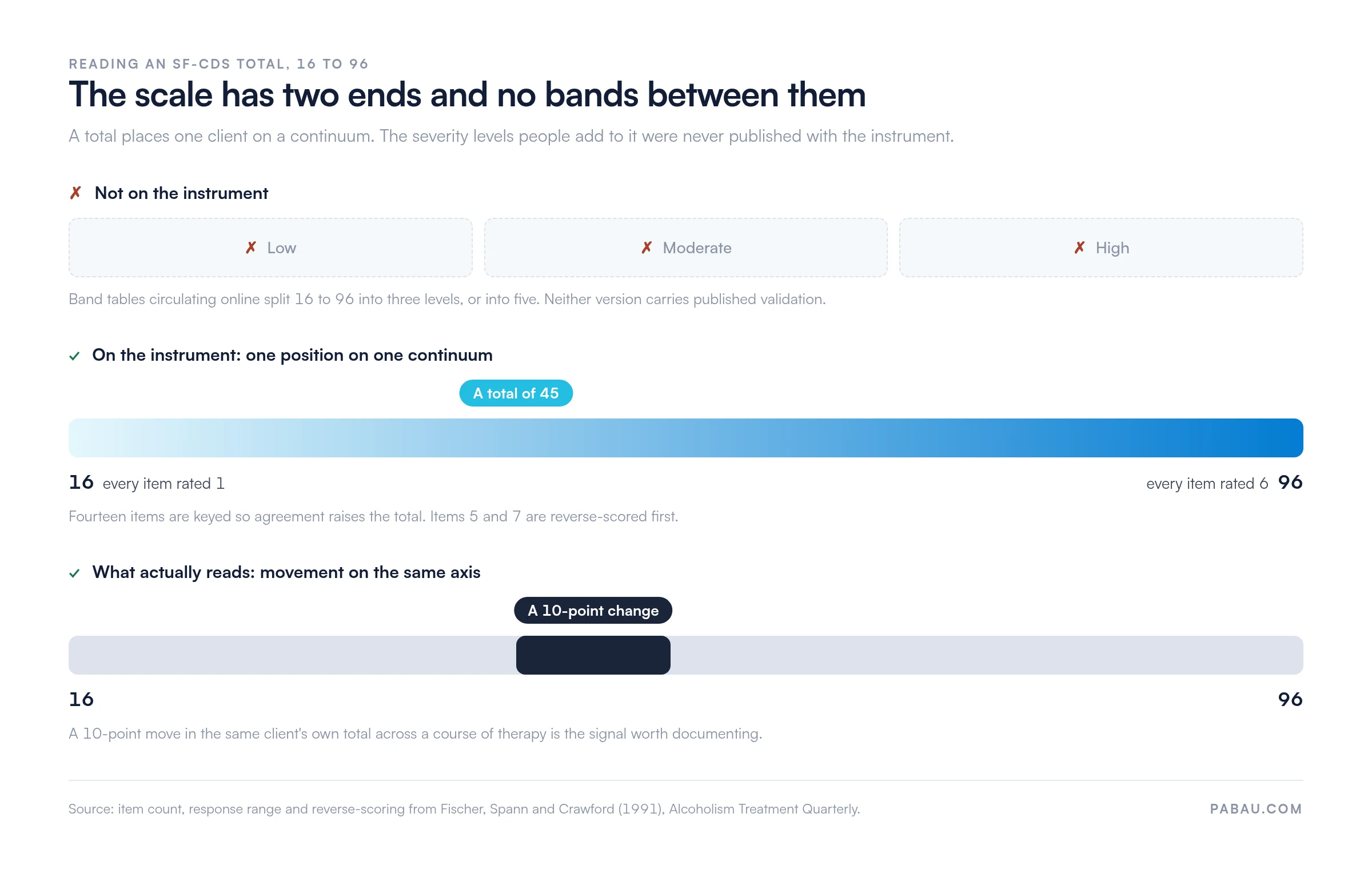
Read the total comparatively instead. Three reference points do the useful clinical work:
Item-level review is where most of the clinical value sits. Ask the client about the statements they rated 5 or 6, and the abstract total turns into a conversation about specific situations. A 12-step codependency worksheet gives that conversation somewhere to go between sessions.
Set every score in the full clinical picture. A number from a self-report form supports a clinical judgment. It never replaces one.
The developers reported a Cronbach’s alpha of .86 for the 16-item scale, which indicates good internal consistency across the item set.
Later research supports its convergent validity. Lindley, Giordano, and Hammer (1999) found the SF-CDS strongly related to two other codependency measures. The same study linked higher scores to lower self-confidence and to a stronger tendency to seek emotional support from others.
The evidence stops short in two places. The scale has no published clinical cut-off scores, so no total confirms or rules out a condition. Normative data for diverse populations is also thin, which matters whenever you compare a client’s score against an external benchmark.
Use the SF-CDS alongside clinical interview and observation, never as a stand-alone instrument.
Self-report bias moves totals in both directions. Clients carrying a lot of shame may underreport codependent traits. Those in an acute relationship crisis may overreport them. Clinician observation and collateral history give the number its context.
Cultural fit varies too. The SF-CDS was developed with Western, English-speaking samples. In cultures with different family structures or attachment norms, individual items may not carry the meaning they appear to carry.
The scale also leaves facets of codependency uncovered. Some clinicians add a measure of attachment style, such as the Experiences in Close Relationships scale, when they need that dimension as well.
Administer the SF-CDS at intake or in an early session, as part of your standard assessment battery. A short check first keeps the total usable later.
Re-administer every 8 to 12 weeks to track change. Keep the same interval for every client, so the comparison stays clean.
The SF-CDS suits mental health professionals across several settings:
Consistency matters most where several clinicians share a caseload. Standard measures, taken at the same intervals and stored the same way, are part of what good therapy practice management looks like day to day.
Many practices still print the SF-CDS, hand it over on a clipboard, total the ratings by hand, then scan the sheet into a folder. Each of those steps is a place for a score to go missing or get mis-added.
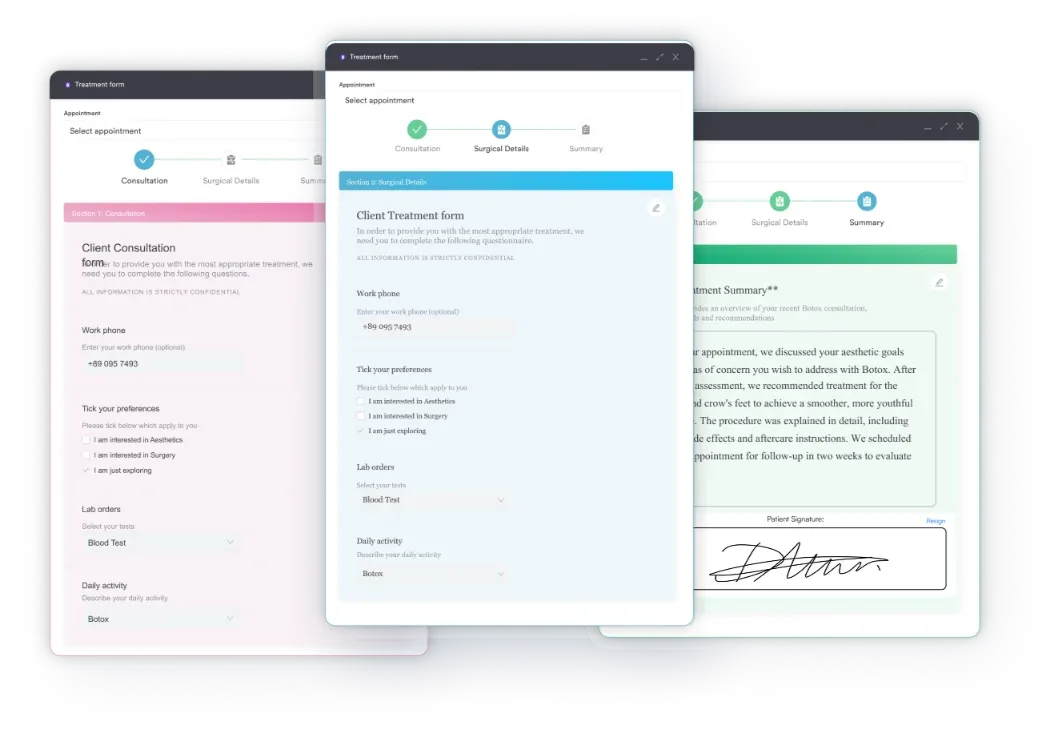
Practice management software like Pabau replaces that loop with one record. You build the SF-CDS once as a digital form and send it before the appointment. Responses land in the client’s chart on submission, and the total gets calculated for you, so nobody re-adds 16 numbers by hand.
From there, Pabau Scribe, our AI scribe, drafts the session note while the scored form sits beside it in the same chart. Every administration lands on one timeline, so comparing a client’s totals takes seconds instead of a search through paper files.
That removes the print-scan-file cycle and the arithmetic behind it. Re-testing gets easier too, because last quarter’s total is one click away.
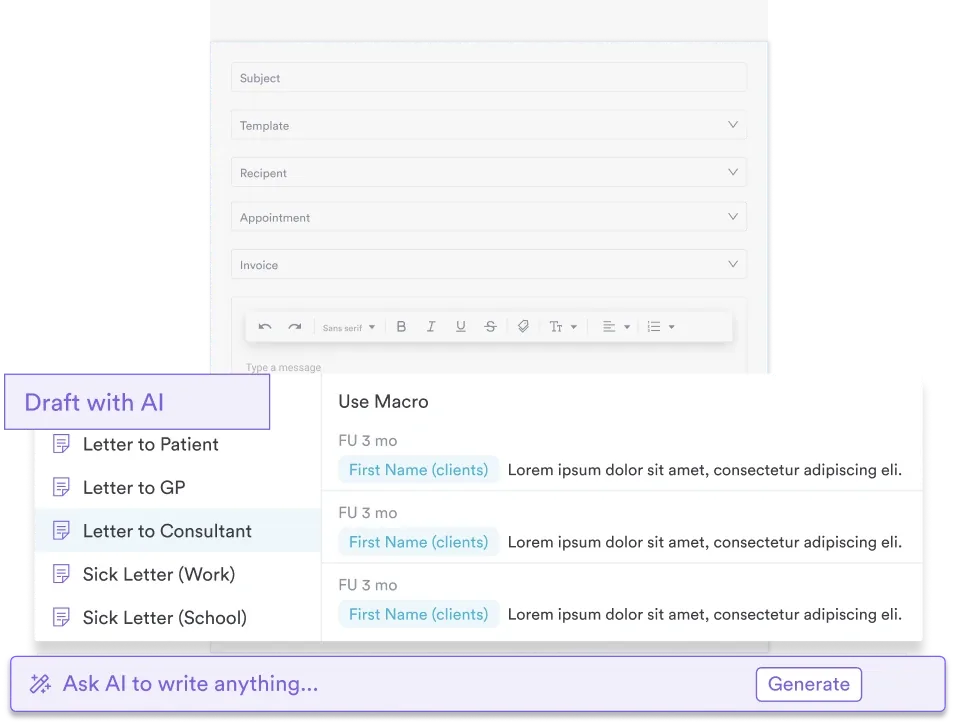

Pabau’s digital forms let you send the SF-CDS before the session, score it automatically, and store the result in the client record. Progress tracking then takes seconds instead of a hunt through paper files.

The SF-CDS earns its place in a mental health intake because it is short, free, and specific about a pattern clients rarely name themselves. What it will not hand you is a verdict. Any table that turns 16 to 96 into low, moderate, and high is someone’s invention, not the instrument’s.
So score it correctly, reverse items 5 and 7, and read the total as one point on a continuum. Then go back to the statements your client rated highest, because that is where the treatment plan comes from.
Track the same client against their own baseline every 8 to 12 weeks, and the number starts to mean something concrete. Book a demo to see how Pabau sends, scores, and files assessments like the SF-CDS for your practice.

Building a full mental health intake around the score? Psychiatric evaluation template adds the biopsychosocial history and risk sections the SF-CDS leaves out.
Need the attachment dimension the SF-CDS misses? Adult Attachment Scale (AAS) measures closeness, dependence, and anxiety in adult relationships.
Looking for the homework that follows a high total? Healthy boundaries worksheet turns boundary psychoeducation into something a client can practice between sessions.
Working on assertiveness after an item-level review? Assertive communication techniques handout gives clients scripts for the situations they rated highest.
Documenting assessment results in a shared record? SOAP notes for social work shows how to tie a score to the treatment plan.
No score does, because the scale has no validated cut-off. Codependency increases as the total rises from 16 toward 96. Band tables circulating online are unvalidated and disagree with each other.
The scale publishes no norms you could call typical, and normative data for diverse populations is thin. Compare a client with their own earlier totals rather than an outside average.
Yes. The items use plain language and need no clinical knowledge. Interpretation is the part that needs you, since there are no cut-offs to read a total against.
Yes. Administer it individually to each partner, family member, or group participant. Comparing the separate results shows how enmeshment and boundary problems play out across the relationship.
Yes. The full item set was published in the original 1991 paper. The scale is reproduced without a licensing fee in clinical, research, and educational settings.
The citation is Fischer, J. L., Spann, L., and Crawford, D. (1991). Measuring codependency. Alcoholism Treatment Quarterly, 8(1), 87 to 100. PsycNet and Google Scholar both index the record.