Despina Petrushevska

Good character traits list
What is a good character traits list? A good character traits list is a structur...

3
Last Updated: Oct 30, 2026
Free PDF 3 pages, print-ready Clinician-reviewed
A separation anxiety test measures how strongly a person fears being apart from the people they are closest to. This free PDF is the Adult Separation Anxiety Questionnaire (ASA-27), developed by Manicavasagar, Silove, Wagner and Drobny in 2003. Adults over 18 rate 27 statements from 0 to 3, giving a raw score between 0 and 81. A score of 22 or more suggests probable adult separation anxiety disorder, and 16 to 21 suggests some separation anxiety. It is a screening aid for adults only, not a diagnosis, and children need a different instrument.
The Adult Separation Anxiety Questionnaire (ASA-27) for adults over 18, with 27 self-report items rated 0 to 3. Boxes for the raw score, percentile and description follow the items. It also includes the scoring guide with both cut-offs and a clinician sign-off section.
Start from scratch, or upload this PDF or any form you already use, and Pabau's AI Form rebuilds it with tick boxes, text fields and a signature. Attach it to the treatment once, and every patient gets it on time.
AI Form rebuilds the consent, history and aftercare forms you already use. You review each one, then publish.
Patients complete forms on their phone before they arrive, so the front desk stops retyping paper.
Every signed form is versioned and attached to the treatment record, ready when you need it.
Set how long a consent stays valid. Returning patients skip forms they have already signed.
Supports HIPAA and GDPR compliance AES-256 encryption 4.8 on G2 4.7 on Capterra Trusted by 4,000+ practices worldwide

A separation anxiety test is a screening aid for measuring symptom severity, not a standalone diagnosis.
This free PDF is the ASA-27, a 27-item self-report questionnaire for adults over 18 only.
Raw scores run from 0 to 81, and a score of 22 or more suggests probable adult separation anxiety disorder.
Children and adolescents need a different, age-validated instrument, such as the SCARED or the Spence Children’s Anxiety Scale.
Pair the questionnaire with DSM-5-TR criteria and a full clinical interview before forming a diagnosis.
A separation anxiety test is a questionnaire that measures how intensely a person fears separation from attachment figures, such as a partner, parent or child. The version on this page is the Adult Separation Anxiety Questionnaire (ASA-27), a self-report screen developed by Manicavasagar, Silove, Wagner and Drobny in 2003.
Practitioners use it at intake, at baseline and to track change over treatment. Results support documentation and the clinical conversation, but they do not replace a full diagnostic evaluation.
DSM-5-TR defines separation anxiety disorder by fear or anxiety about separation from attachment figures that is excessive for the person’s developmental stage. The 27 ASA-27 items cover how that fear shows up in adult life, including:
Every item asks about symptoms experienced as an adult over 18. The form does not record how long symptoms have lasted or how much they affect daily life. Capture both in your clinical notes. DSM-5-TR criteria call for adult symptoms that typically last six months or more and cause significant distress or impairment.
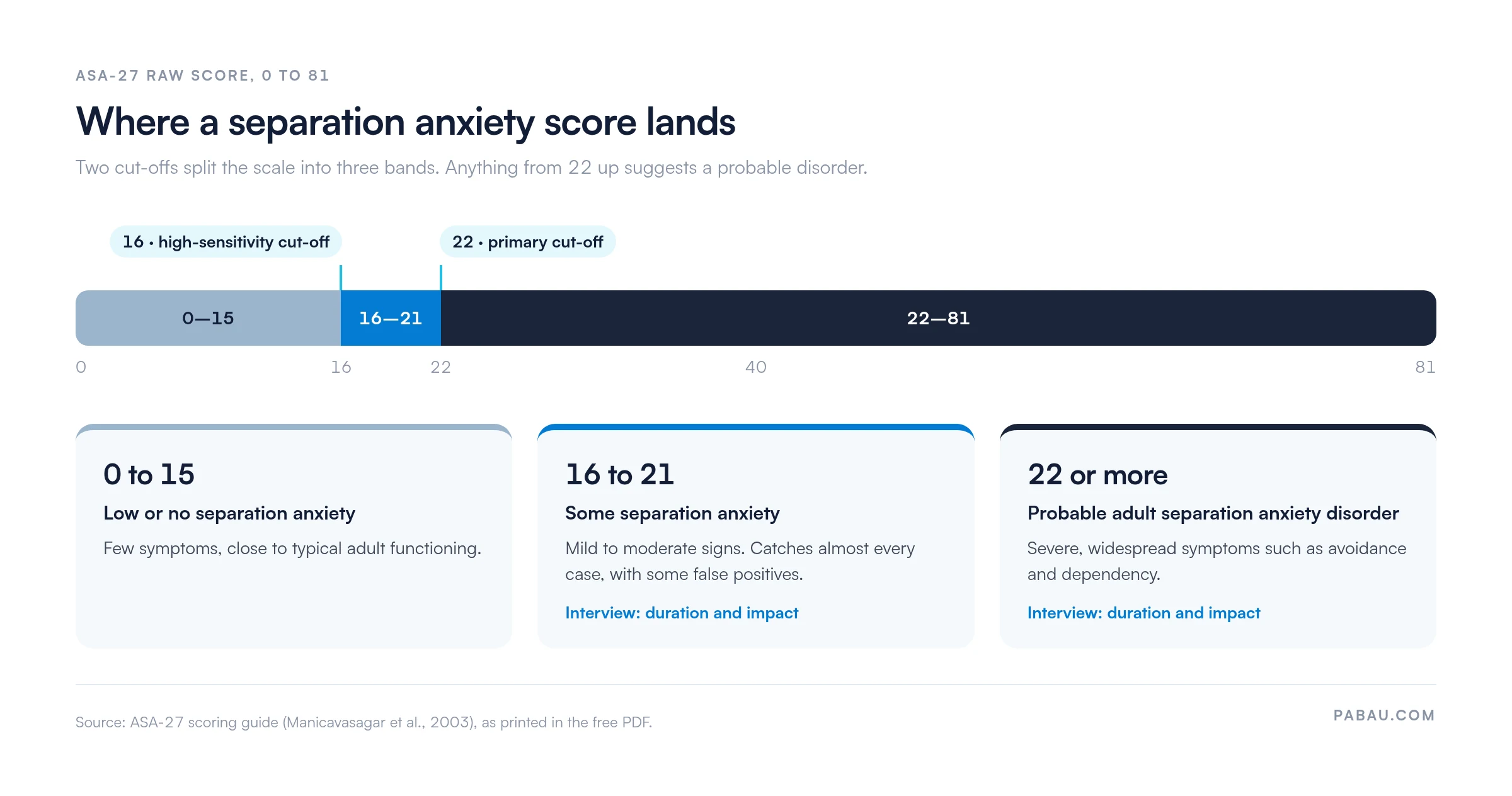
The patient rates each item from 0 to 3, and the 27 ratings add up to a raw score between 0 and 81. Higher scores indicate more severe adult separation anxiety symptoms. The scoring guide on the form sets out two cut-offs and three bands.
| Raw score | Band on the form | What it suggests |
|---|---|---|
| 0 to 15 | Low or no separation anxiety | Few symptoms, close to typical adult functioning. |
| 16 to 21 | Some separation anxiety | Mild to moderate signs. This high-sensitivity range catches almost every case but includes some false positives. |
| 22 or more | Probable adult separation anxiety disorder | Severe, widespread symptoms, such as avoidance, dependency and excessive concern for the safety of attachment figures. |
On the full 0 to 81 scale, the middle band spans only six points. One or two item ratings can move a patient across a cut-off. Use 22 as the primary cut-off for a probable disorder. Use 16 when missing a case would cost more than a few false positives, and follow every positive screen with an interview.
The form also has Percentile and Description fields. A percentile compares the score with a community sample, where 50 is the general-population average. The PDF has no percentile lookup table, so leave that field blank unless you have the published norms on hand.
Yes, but it is not this download. The ASA-27 is an adult self-report measure for people over 18, and its items describe adult life, such as work, travel and relationships. Children and adolescents need an instrument validated for their age group, for example:
Check the scoring rules and licensing terms of any of these against the publisher’s own materials before you use them.
The Separation Anxiety Test (SAT) is a separate projective measure, developed by Henry Hansburg and later adapted for young children by Klagsbrun and Bowlby. Children respond to pictures of separation scenes, and the clinician interprets their answers. Despite the shared name, the SAT is not what this download contains.
Your choice of instrument should match your setting, the patient’s age and the level of psychometric evidence you need. For adults, the ASA-27 gives you a short, scored screen with published cut-offs. If the question is attachment style rather than separation distress, the Adult Attachment Scale is the closer fit.
Use the ASA-27 as a structured screen within a full assessment. The steps below fit a typical intake workflow.
The printable PDF runs to three pages. It holds the 27 ASA-27 items, each with a 0 to 3 rating. Below them sit raw score, percentile and description fields, plus the scoring guide with both cut-offs. The final section has name, license ID, signature and date fields for the reviewing clinician.
Paper questionnaires tend to be completed in the waiting room, scored by hand and filed away from the rest of the notes. Pabau, the therapy practice management software we build, sends screening questionnaires through its digital forms before a session. You arrive with the responses already in hand.
Completed forms are saved to the patient record next to notes and intake forms, so you can compare ASA-27 scores across reviews. Store only what your data protection obligations allow, and review how you handle patient data under HIPAA or UK GDPR where they apply.

Pabau’s digital forms send questionnaires like the ASA-27 to patients before their session and save completed responses to the patient record. Screening history stays in one place for every review.

The ASA-27 gives you a quick, scored read on adult separation anxiety, with cut-offs that tell you when a full assessment is warranted. Its value depends on using it with the group it was built for. Keep it for patients over 18, and use an age-validated child measure for anyone younger.
Treat a score of 22 or more as the trigger for a clinical interview. Duration and functional impact come from your assessment, since the form does not record them. Book a demo to see how Pabau sends, stores and tracks screening questionnaires for mental health practices.

Exploring fear of being left? Abandonment issues quiz gives you a free screen for abandonment fears in adult relationships.
Working on attachment patterns? Attachment theory worksheet helps patients reflect on attachment patterns in their relationships.
Is the anxiety mainly social? Social Interaction Anxiety Scale covers the 20 SIAS items and how to score them.
Screening for broader symptoms? Anxiety and depression test screens for anxiety and depression symptoms together.
Looking for a mental health workflow? Mental health EMR software covers the practice side of assessment records.
A separation anxiety test is a questionnaire that measures how strongly a person fears separation from attachment figures. The free PDF on this page is the ASA-27, a 27-item self-report screen for adults over 18.
Yes, the ASA-27 template is available as a free PDF download from this page. Use it as a screening aid alongside a full clinical interview.
Yes. The ASA-27 on this page was built for adults over 18, and a raw score of 22 or more suggests probable adult separation anxiety disorder. Confirm the result with a clinical interview.
No. The ASA-27 is an adult measure for people over 18. For children and adolescents, use an age-validated instrument such as the SCARED, which has child and parent versions for ages 8 to 18.