Pabau GO app

The new Pabau GO is heredownload on the App Store

Download on the App Store
Book a demo Book a demo
Uncategorized

respect worksheet

Key Takeaways

Key Takeaways

A respect worksheet is a self-reflection tool that helps individuals explore their understanding of respectful behaviour, personal boundaries, and how to communicate with integrity in relationships.

Respect worksheets are used by therapists, school counsellors, HR trainers, and teachers as part of social-emotional learning (SEL) and cognitive behavioural therapy (CBT) frameworks to address interpersonal skills.

The worksheet can be adapted for kids, teens, adults, and workplace settings – from elementary school character education to professional team building and clinical therapy.

Pabau’s digital forms and client portal help therapists and counsellors distribute worksheets efficiently and track completion as part of integrated client care workflows.

Found our content helpful?

Download Your Free Respect Worksheet

Respect Worksheet

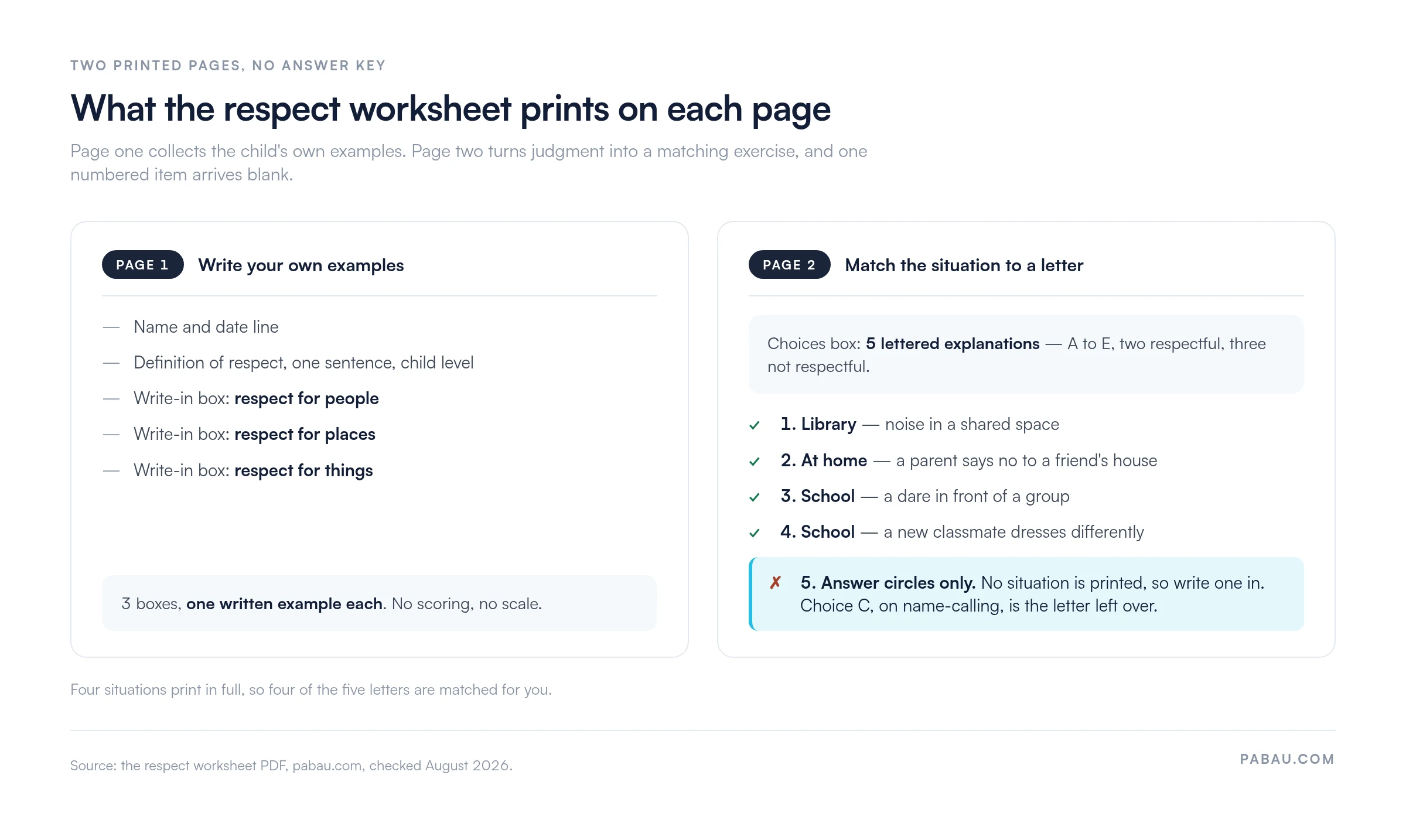
A ready-to-use therapy and classroom worksheet guiding self-reflection on boundaries, communication patterns, and showing respect. Includes reflective questions, scenario prompts, and space for journaling respectful behaviours in personal and professional relationships.

Download template

What Is a Respect Worksheet?

A respect worksheet is a therapeutic and educational tool that guides individuals through structured self-reflection on what respect means in their relationships and daily life. It prompts users to explore boundaries, recognise respectful vs disrespectful behaviours, and practise respectful communication patterns. The worksheet is widely used in mental health settings, schools, and professional development to support therapy practice management and social-emotional learning (SEL) frameworks.

In clinical contexts, therapists use respect worksheets to help clients examine self-talk, interpersonal boundaries, and how they show up in relationships. Counsellors in schools integrate them into character education and SEL curricula. HR departments use workplace versions to build team cohesion and address conflict. The tool is informed by cognitive behavioural therapy (CBT) principles – helping individuals identify thought patterns that either support or undermine respectful behaviour.

The worksheet functions as both an assessment and an intervention: users complete it during a session (or independently as homework), and the responses become material for deeper therapeutic discussion or classroom dialogue. No special qualifications are required to administer – teachers, counsellors, and therapists simply print and use.

Respect Worksheet for Kids and Students

Young learners benefit from age-appropriate respect worksheets that are concrete and relatable. Elementary school teachers use respect worksheets as part of classroom behaviour expectations, character education, and social-emotional learning programs. School counsellors integrate them into small-group sessions addressing bullying, peer conflict, or friendship struggles.

  • Elementary (K-5): Simple visual prompts (drawings of respectful vs disrespectful actions), fill-in-the-blank sentences, and colour-coded scenarios help younger children grasp concrete examples of respect.
  • Middle school (6-8): Worksheets become more reflective – prompting students to identify how they show respect in different settings (classroom, home, sports team), and what respect looks like when they feel disrespected.
  • High school (9-12): Adolescents engage with nuanced topics like respecting boundaries, consent, digital respect, and handling disagreement respectfully – preparing them for adult relationships and workplace norms.

Teachers report that respect worksheets reduce classroom conflict and provide a shared language for expected behaviours. School counsellors use them in digital forms to streamline administration and track which students have completed SEL activities.

Respect Worksheet for Adults and Workplace Settings

Adults and professionals use respect worksheets in therapy, coaching, and organisational development contexts. In the workplace, respect in the workplace worksheet formats help teams address communication breakdowns, rebuild trust after conflict, or establish norms for respectful collaboration.

  • Clinical/therapy: Adults working with therapists on relationship issues, self-esteem, or assertiveness use respect worksheets to examine how they learned to (or failed to) respect themselves and others.
  • HR and team training: Organisations use respect worksheets during team-building, diversity and inclusion training, or conflict resolution workshops to establish shared expectations.
  • Coaching: Executive and life coaches use them to help clients clarify their values and reflect on how their daily choices align with how they want to be treated and to treat others.

For adults, the worksheet often explores deeper themes: respecting personal boundaries, navigating power dynamics, and how childhood experiences shaped their current patterns of respect. This adult version is longer and more psychologically nuanced than the classroom version.

Self-Respect Worksheet: Building Personal Dignity

A self-respect worksheet focuses specifically on an individual’s relationship with themselves. Many people struggle with self-respect – tolerating disrespectful treatment, negative self-talk, or neglecting their own boundaries. Therapists use self-respect worksheets to help clients build confidence and reclaim their sense of personal dignity.

Self-respect exercises often include: identifying moments when they compromised their own values, recognising patterns of self-critical thought, and practising self-compassion. These worksheets are particularly valuable in psychology practice settings for clients working on anxiety, depression, codependency, or trauma recovery.

Respectful Communication Worksheet

A respectful communication worksheet teaches the mechanics of how to speak to others with respect. It covers active listening, tone awareness, assertiveness without aggression, and how to deliver feedback constructively. School counsellors and therapists use it to help clients move from passive or aggressive communication patterns into assertive, respectful ones.

The worksheet typically includes scenarios: “Your friend made a plan with you and cancelled last minute. How would you respond respectfully?” Users practise writing or discussing responses, then reflect on how their tone, word choice, and approach affect the relationship. This builds concrete communication skills that transfer to real-world conflicts.

How to Use a Respect Worksheet in Therapy or Counselling

Clinicians integrate respect worksheets into structured therapy sessions in five practical steps.

  1. Introduce the worksheet early in the session. Frame it as a tool to explore their thoughts and feelings about respect, not a test. Set expectations for completion time (typically 10-20 minutes depending on depth).
  2. Guide completion with open-ended dialogue. Rather than sending it home as homework, complete it *with* the client in session. Ask follow-up questions: “What made you choose that answer?” or “Can you think of a real example from your life?” This surfaces unconscious patterns.
  3. Identify themes and patterns. Look for contradictions (e.g., the client says they value respect but describes disrespectful behaviour they tolerate). These inconsistencies are rich material for therapeutic work.
  4. Connect to treatment goals. Link worksheet responses to the client’s presenting issue. If they’re working on assertiveness, use the communication section to practise saying no respectfully. If they’re addressing self-esteem, focus on self-respect reflections.
  5. Store securely in the client record. Therapists using practice management with secure client records save the completed worksheet as part of ongoing documentation. This allows clinicians to track progress over time and reference patterns in future sessions.

CBT-informed therapists may use the worksheet to identify cognitive distortions (e.g., catastrophising about conflict, mind-reading what others think). The worksheet becomes a springboard for thought-record work or behavioural experiments testing new respectful communication approaches.

See how Pabau streamlines worksheet distribution

Therapists and counsellors use Pabau’s digital forms and secure client portals to send worksheets, track completion, and keep all therapeutic materials in one place.

Pabau practice management interface

Showing Respect: Scenarios and Discussion Prompts

Respect worksheets are most effective when they include real-world scenarios. Users see examples of both respectful and disrespectful behaviour and practise responding. This builds emotional recognition and practical skills in parallel.

  • Scenario: A colleague interrupts you repeatedly in meetings. How would you handle this respectfully?
  • Scenario: Your child disagrees with your decision. How do you listen respectfully while maintaining your boundary?
  • Scenario: Someone makes an insensitive comment. Do you speak up? If so, how do you do it without attacking them?

Classroom and group settings benefit especially from scenario-based reflection. Teachers can facilitate whole-class discussion of a single scenario, letting students hear different perspectives on what “respectful” looks like. This normalises respectful problem-solving and shows that respect isn’t rigid – it requires context and emotional intelligence.

Respect worksheets work best as part of an integrated toolkit. Clinical practice management systems make it easy to pair the respect worksheet with complementary resources. Two natural partners are boundaries worksheets and empathy worksheets. Respect without empathy can feel cold; empathy without boundaries risks being taken advantage of. Together, they form a complete framework for healthy relationships.

Therapists often run a “respect + boundaries + empathy” sequence over 3-4 sessions, building each competency in turn. Schools incorporate all three into their SEL curriculum. This integrated approach deepens learning and gives clients a richer toolkit for navigating complex social situations.

Who Is the Respect Worksheet Helpful For?

Respect worksheets serve multiple professional groups and settings:

  • School counsellors use respect worksheets to address bullying, peer conflict, and character education aligned with SEL standards (CASEL framework).
  • Therapists and counsellors integrate them into treatment for clients working on self-esteem, relationship patterns, and interpersonal skills – especially those with anxiety, depression, or trauma histories.
  • Teachers incorporate respect worksheets into classroom behaviour management and PSHE (UK) / social-emotional learning curricula.
  • HR trainers and organizational development professionals use them in team building, conflict resolution, and diversity & inclusion initiatives.
  • Coaches (life, executive, relationship) use worksheets to help clients clarify values and align behaviour with what they claim to believe.
  • Correctional and probation services use respect worksheets as part of rehabilitation programmes addressing behaviour change and interpersonal accountability.

Benefits of Using a Respect Worksheet

Respect worksheets deliver concrete benefits across educational and clinical settings.

  • Structures reflection on values. Instead of abstract discussion, worksheets guide users through specific prompts that surface inconsistencies between what they value and how they act.
  • Builds shared classroom/team language. When everyone completes the same worksheet, the group develops common understanding of what respect means in their specific context, reducing conflict.
  • Creates documentation for clinical care. Completed worksheets become part of the therapeutic record, allowing clinicians to measure progress and reference patterns over time.
  • Supports homework and continuity. Clients can complete worksheets between sessions, extending therapeutic work into daily life and increasing engagement.
  • Meets compliance and documentation requirements. Structured worksheets help therapists and schools document that they’ve addressed SEL competencies or treatment goals in a systematic way.

Conclusion

A respect worksheet is a versatile, evidence-informed tool that bridges educational and clinical practice. Whether you’re a classroom teacher building character, a school counsellor addressing peer conflict, or a therapist helping clients navigate relationships, the worksheet provides structure and reflection that drives real behavioural change. Download the free template above and adapt it to your specific audience and setting. To streamline distribution and track completion across your practice, book a demo of Pabau’s practice management system with integrated digital forms.

Continue your research

Continue your research

Looking for a structured therapy intake process? Psychiatric evaluation template guides comprehensive mental health assessment and complements respect-building work in treatment planning.

Need to teach active listening alongside respect? Digital forms in Pabau let you distribute and collect listening and respect worksheets efficiently as part of your client onboarding workflow.

Want to track client progress over time? Secure client portal stores completed worksheets, session notes, and progress tracking in one HIPAA-compliant record for continuity of care.

Frequently Asked Questions

What is a respect worksheet?

A respect worksheet is a therapeutic and educational tool that guides self-reflection on what respect means, how to show respect, and recognising disrespectful behaviour. It is used by therapists, counsellors, teachers, and HR professionals to support social-emotional learning and relationship skill-building.

Can respect worksheets be used in therapy sessions?

Yes. Therapists complete respect worksheets *with* clients during sessions (not just as homework) to surface patterns in how they view respect, boundaries, and relationships. The worksheet responses become material for deeper therapeutic exploration.

What age group are respect worksheets suitable for?

Respect worksheets can be adapted for all ages – from elementary school (with visual prompts and simple language) to high school and adults (with complex scenarios and nuanced reflection). Younger children benefit from concrete, action-based examples; older users engage with abstract and relational nuances.

Are there free printable respect worksheets for teachers?

Yes. The template above is free to download as a PDF. Teachers can print and use it in classrooms, modify it for their grade level, or distribute it digitally via learning management systems or secure practice management platforms.

What is the difference between self-respect and respecting others?

Self-respect is how you treat and value yourself – maintaining boundaries, not tolerating disrespect, and honouring your own needs. Respecting others is recognising their worth, listening actively, and honouring their boundaries. Both are essential; worksheets often address both dimensions to build comprehensive interpersonal health.

How do you use a respect worksheet in therapy?

Introduce it early in the session, guide completion with dialogue, identify themes and patterns in responses, connect findings to treatment goals, and store the completed worksheet in the client record. This integrates the worksheet into ongoing therapeutic documentation and progress tracking.

Found our content helpful?
×