Monika Lazarevska

DASES: Drug Avoidance Self-Efficacy Scale
DASES at a glance and what it measures DASES stands for Drug Avoidance Self-Effi...

1
Last Updated: Oct 29, 2026
Free PDF 5 pages, print-ready Clinician-reviewed
The preschool anxiety scale (PAS) is a 28-item questionnaire that parents complete to screen children aged about 3 to 6 for anxiety. Clinginess at drop-off, a fear of dogs and endless “what if” questions are all common at this age. The hard part is telling a passing phase from a pattern that needs help.
The PAS gives you five subscale scores, from separation anxiety to physical injury fears, set against community norms. It screens rather than diagnoses, so a high score leads to a fuller assessment, not a label. Scoring it right matters, because a misread cutoff can delay help or send a family to a specialist they don't need.
The original 28-item parent questionnaire, with a five-point rating for every item. It also includes six questions on traumatic events and the child's reactions since.
Start from scratch, or upload this PDF or any form you already use, and Pabau's AI Form rebuilds it with tick boxes, text fields and a signature. Attach it to the treatment once, and every patient gets it on time.
AI Form rebuilds the consent, history and aftercare forms you already use. You review each one, then publish.
Patients complete forms on their phone before they arrive, so the front desk stops retyping paper.
Every signed form is versioned and attached to the treatment record, ready when you need it.
Set how long a consent stays valid. Returning patients skip forms they have already signed.
Supports HIPAA and GDPR compliance AES-256 encryption 4.8 on G2 4.7 on Capterra Trusted by 4,000+ practices worldwide

The preschool anxiety scale is a 28-item parent questionnaire for children aged about 3 to 6 years.
This form is the original version, scored on five subscales including obsessive-compulsive symptoms.
Each item scores 0 to 4, for a maximum total of 112, and items 29 to 34 are never scored.
A T-score of 60 or above is elevated, and many clinicians treat 65 as the clinical cutoff.
One set of norms covers every age and gender, and a high score calls for assessment, not a diagnosis.
The preschool anxiety scale is a 28-item questionnaire that a parent or main caregiver fills in about their child. Susan Spence and colleagues built it in 2001, adapting items from the Spence Children’s Anxiety Scale for younger children.
It suits children aged about 3 to 6 years. That’s the range its community norms cover, so a score outside it has nothing reliable to compare against. For school-age children, pick a tool normed for that age group.
Its main job is early identification. A result tells you whether a child’s anxiety sits in the typical range or deserves a closer look.
This form is the original version from Spence et al. (2001), and it scores five subscales. Each one matches a pattern clinicians see in young children.
A revised version, the PAS-R (Edwards et al., 2010), removed the obsessive-compulsive items. It scores four subscales instead: generalized anxiety, social anxiety, separation anxiety and specific fears. So check which version you hold before you score, because the two keys differ.
Separation anxiety is the subscale parents recognize fastest. It shows up at drop-off, at bedtime and in a new childcare setting. A high score points to distress about being apart from a parent, which is different from shyness.
Social worries look quieter. A child may hang back at playgroup, cling to a parent around new adults or stay silent at show and tell. Parents often put this down to temperament rather than anxiety.
Generalized worry, rituals and fears of injury present differently again. Reading the five subscales together shows whether you’re seeing one fear or a broader pattern. That matters, because early help is easier to start before a pattern sets in.
The parent completes the questionnaire, not the child. Run through this list first, and the scores you get back will be worth reading.
Most parents finish it in a few minutes. If you also need developmental and family history, pair it with a parent intake questionnaire so both arrive together.
Scoring is simple arithmetic. Each of items 1 to 28 scores 0 to 4, from “not true at all” to “very often true”. Add the items for each subscale, then add items 1 to 28 for the total, which tops out at 112.
The key below shows which items belong to each subscale, so you can score a paper form without hunting through a manual.
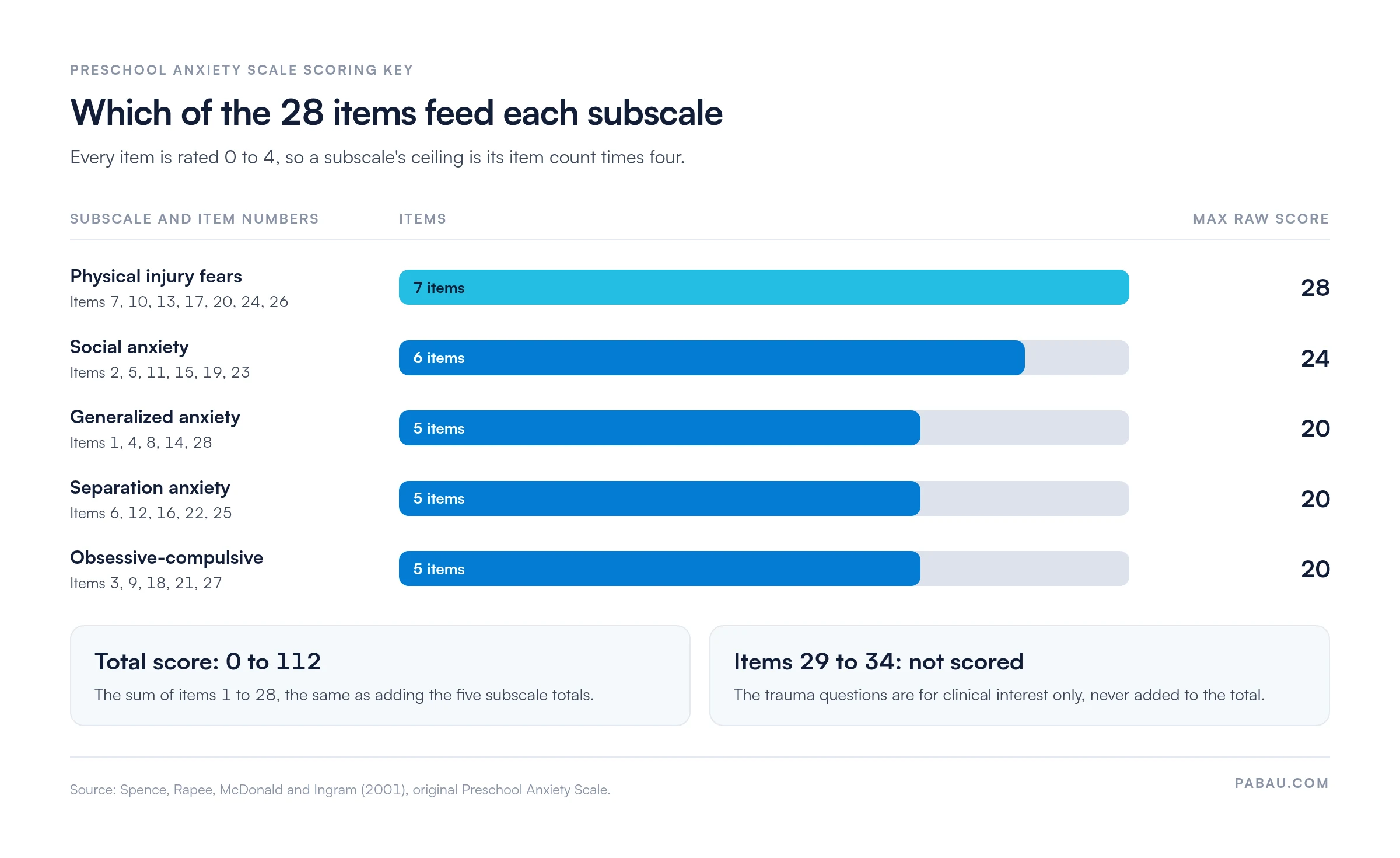
Items 29 to 34 sit outside the score. They record whether the child has lived through a traumatic event and how they’ve reacted since. They’re for clinical interest only, so read them but never add them in.
Say a parent rates the five separation items. Items 6 and 22 score 3, item 12 scores 4, and items 16 and 25 score 2. The separation anxiety raw score is 14 out of 20. Next, you convert 14 to a T-score using the SCAS norms table.
The SCAS norms come from an Australian community sample of 1,368 preschoolers aged 3 to 6. Age and gender effects were too small to justify separate norms. As a result, one set of norms and T-scores applies to every child, whatever their age or gender.
T-scores are scaled to a mean of 50 and a standard deviation of 10. Use the published table rather than a conversion chart of unknown origin.
A T-score of 60 or above is elevated, sometimes called borderline or sub-clinical. That’s about one standard deviation above the mean, around the 84th percentile. Many clinicians use 65 as the clinical cutoff, which marks roughly the top 6% of children.
Most scoring errors come from mixing versions or reading too much into one number. Watch for these five.
When those signs appear, a childhood ADHD questionnaire or a pediatric depression screening tool helps you separate the threads.
The original study (Spence et al., 2001) asked parents of a large community sample to rate their children. A five-subscale model fit the data best, with all five linked to a general anxiety factor.
The revised version has the most published figures. Edwards and colleagues (2010) tested it with 764 mothers and 418 fathers of children aged 3 to 5. They reported these results:
Scores also tracked emotional distress, diagnosed anxiety disorders and observed anxious behavior. These figures describe the PAS-R, so label them that way when you report on the original form. The abstract is in the published study.
Clinicians choosing an anxiety screen usually weigh age range, who answers and how the subscales fit. The PAS is most often compared with the Spence Children’s Anxiety Scale and the SCARED.
Choose the tool that matches the child’s age and your question. For a child past preschool age, the SCAS or a SCARED questionnaire fits better.
The scale is copyrighted, and the terms depend on who’s using it. According to the SCAS website, these rules apply:
If your practice runs as a business, check which group you fall into before adding the form to routine intake.
Paper forms filled in at reception tend to come back rushed, often with a toddler on the parent’s lap. Sending the questionnaire ahead lets the parent spend the few minutes it takes at home, without distractions.
Pabau, the practice platform we build, lets you send digital intake forms before the appointment. Completed answers land on the child’s patient record, so the clinician starts the session with the scores in view.
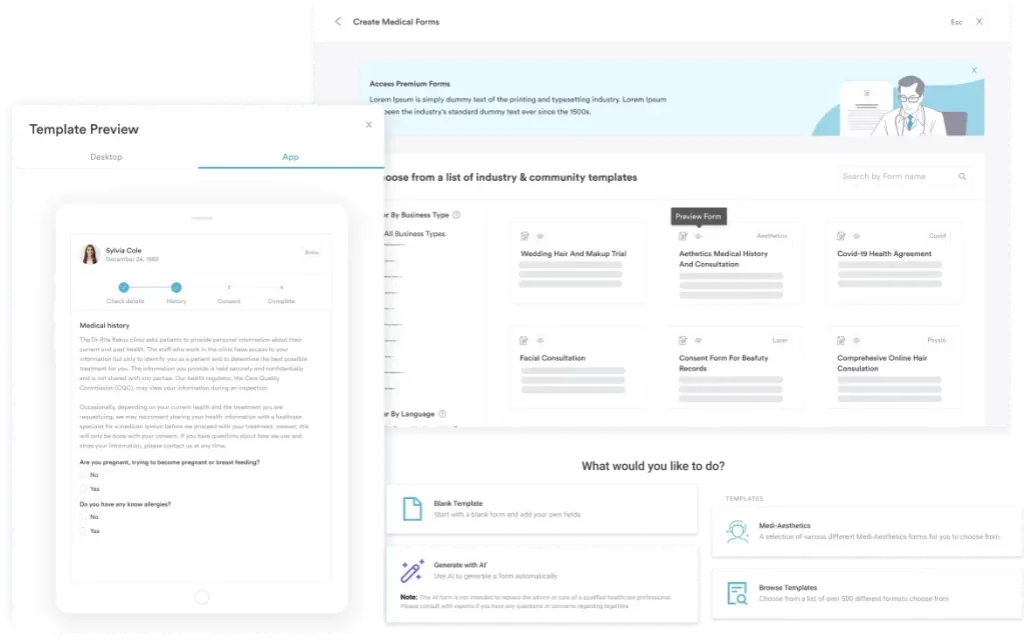
Because results sit beside notes and bookings, repeating the scale after treatment and comparing the two takes minutes. That joined-up record is what simpler therapy practice management looks like day to day.

Pabau sends intake forms and questionnaires ahead of appointments and files each response on the patient record. Your team spends less time chasing paperwork and more time with families.

The preschool anxiety scale works best as a quick, structured first look. It turns a parent’s worries into five scores you can compare with other children of the same age.
Treat 60 as a reason to look closer and 65 as the common clinical marker. Then let the clinical interview make the call, not the number.
Before you add it to intake, confirm your form is the original version and your use fits the license terms. Book a demo to see how Pabau gets parent questionnaires completed and filed before the first session.

Screening for low mood as well? Children’s Depression Inventory (CDI) covers a self-report depression screen for school-age children.
Seeing social withdrawal in a toddler? M-CHAT autism screening checklist explains the parent-completed autism screen used at 16 to 30 months.
Planning exposure work for a specific fear? Fear hierarchy worksheet helps you rank feared situations and plan gradual steps.
Working with older children? SCARED anxiety screening template gives you the anxiety screen built for children and teens.
Looking at mental health workflows? Mental health EMR software covers documentation needs across a mental health practice.
Yes, for researchers and individual practitioners. Commercial or for-profit use needs a license, and not-for-profit or government services need the author’s permission. The scale is copyrighted and can’t be modified.
Yes, with care. In the revised version, scores stayed fairly stable over 12 months, so a clear drop after therapy suggests meaningful change. Ask the same parent each time, because mothers and fathers agree only moderately.
Arrange a full assessment, usually a structured clinical interview with the parent. If anxiety is confirmed, parent-focused cognitive behavioral therapy is the most studied treatment at this age.
Yes. The SCAS website hosts translations, and researchers have validated versions in languages including Dutch, Turkish and Italian. Use a checked translation rather than translating the items yourself.