Trauma response test: Free template for clinicians
A trauma response test is a structured screening questionnaire that helps clinic...

7
Last Updated: Oct 15, 2026

The downloadable pathological liar test is a nine-statement screening form, rated from 1 (strongly disagree) to 7 (strongly agree).
Pathological lying is not a DSM-5 diagnosis, so treatment targets the personality, mood, or trauma pattern sitting underneath it.
The signs worth chasing are a history that shifts between sessions and elaborate lies told with nothing to gain.
Adding the nine ratings gives a total between 9 and 63. Divide that by nine to read it against the published Pathological Lying Inventory.
Practice management software like Pabau files the completed form and its total in the client record, so you can compare sessions.
A ready-to-use screening form for mental health practitioners. Nine statements about lying, each rated from 1 (strongly disagree) to 7 (strongly agree), with space for the name, date, and total score.
Download templateA pathological liar test you find online usually scores you in a pop-up and never prints what the number means. This page does the opposite. You get the nine-statement form as a PDF, plus a table that maps its total onto the published Pathological Lying Inventory. A second table separates pathological, compulsive, habitual, and ordinary white-lie behavior.
The form is written for clinicians, and it gives you a structured way to raise chronic lying without accusing anyone. Some patients lie so often, and with so little to gain, that the dishonesty becomes the clinical problem itself. It strains the working relationship and clouds every history you take.
Below you will find the signs, the causes, the scoring bands, and the treatment routes. You will also see how the nine statements differ from the 19-item Pathological Lying Inventory, and where screening fits inside a structured clinical evaluation.
A pathological liar is someone who lies chronically and compulsively, often with no benefit and no outside pressure to do it. That pathological liar meaning is narrower than everyday use, which stretches to anyone caught in a big lie.
The lying runs across contexts and relationships rather than showing up in one corner of life. It causes the person distress and damages how they function with other people.
Critical clinical distinction: pathological lying is not a standalone diagnosis in the DSM-5. It shows up instead as a symptom cluster attached to other conditions, tracked over time in a mental health electronic medical record (EMR). Research links it to antisocial, narcissistic, and borderline personality disorder, and to some mood and anxiety disorders.
The Pathological Lying Inventory (PLI) is the main published measure in this area. Hart, Curtis, and Terrizzi reported its development and validation in Current Psychology in 2024. The final version has 19 items, each rated from 1 (strongly disagree) to 7 (strongly agree).
Those items load onto three factors: excessive lying, social dysfunction, and distress. The PLI is scored by averaging the items rather than adding them up. Its authors describe an average of 4 or higher as suggesting possible pathological lying.
The test you can download here is shorter and separate from that instrument. Its nine questions work as a structured conversation starter at intake. It is not the validated PLI, and it does not carry the PLI’s norms or cutoff.
Labels overlap here, which matters when you read another clinician’s notes. Another word for compulsive liar is pathological liar, and the two get used interchangeably. Every compulsive liar synonym below carries a slightly different shade of meaning.
Pathological liar vs compulsive liar comes down to what drives the lie. A pathological liar is usually chasing something, whether that is status, control, or escape from a consequence. A compulsive liar lies on impulse and often cannot say why afterward.
That distinction sits inside a wider spectrum. Compulsive liar vs pathological liar vs habitual liar is a three-way comparison, and the ordinary white-lie teller belongs on the same scale. The table below sets all four out on five dimensions.
| Type | Definition | Frequency | Awareness and intent | Typical cause |
|---|---|---|---|---|
| Pathological liar | Chronic lying that spans contexts and persists without outside pressure. | Near constant, across most relationships. | May deny lying, and can come to believe the story. | Personality structure, often antisocial, narcissistic, or borderline. |
| Compulsive liar | Lying driven by internal impulse rather than any payoff. | Frequent, and usually unplanned. | Knows it is a lie, but feels unable to stop. | Anxiety, obsessive-compulsive traits, low distress tolerance. |
| Habitual liar | Lying that has hardened into a default response over years. | Regular, but tied to familiar situations. | Aware, and largely untroubled by it. | Learned in a home or workplace where lying paid off. |
| White-lie teller | Occasional social lies that spare someone’s feelings. | Rare, and specific to the situation. | Fully aware and deliberate. | Ordinary social convention, not a clinical concern. |
The rows blur in practice. One patient can show pathological and compulsive features in the same session. Impulsive vs compulsive liar is a related distinction worth holding onto. Impulsive lying is a one-off reaction under pressure, while compulsive lying repeats even when nothing is at stake.
Those drivers point to different entry points for treatment. Pathological presentations usually need work on the underlying personality traits, plus time spent building motivation. Compulsive presentations respond better to impulse-control techniques and treatment of the anxiety underneath.
What matters for screening is the scope of the pattern and how the patient experiences it. The nine statements on the downloadable form ask about both.
The clearest pathological liar signs are a history that changes between sessions and elaborate stories told with nothing to gain. Denial when you point out the contradiction is the third.
Standard ways to tell if someone is lying, such as watching for broken eye contact or fidgeting, do not hold up in research. Chronic patterns across sessions are far more reliable than any single tell.
Pathological liar symptoms often go unrecorded because patients conceal well and clinicians rarely ask directly. Clinician burnout and assessment time pressure make thorough screening harder still. These are the red flags that warrant a closer look.
Two pathological liar examples show how differently this presents. One patient describes a graduate degree, a former employer, and a bereavement that no record supports. The account repeats word for word across four sessions.
Another admits inventing a minor illness to leave work early, cannot say why, and is visibly ashamed. The first points toward personality pathology. The second points toward impulse and shame, and it usually responds faster to treatment.
Pathological liar causes cluster into three areas: personality structure, early relational trauma, and a low tolerance for shame or confrontation. Neurobiology and comorbid conditions sit on top of those.
Naming the driver changes what you do next. A patient lying to escape shame needs a different plan from one who enjoys the deception.
Explore these domains without judgment during assessment. Comprehensive patient care documentation covering developmental history, trauma screening, and comorbidity will sharpen your formulation and guide treatment.
The downloadable form is a single page. It opens with fields for the patient’s name and the date of the test. Nine statements follow, and a total score box closes the form.
Every statement uses the same seven-point rating scale. It runs from strongly disagree (1) at one end to strongly agree (7) at the other. The midpoint is neither agree nor disagree (4). The remaining points are disagree (2), somewhat disagree (3), somewhat agree (5), and agree (6).
These are the nine statements the patient responds to.
The form prints no reverse-scoring rule, no subscale breakdown, and no interpretive cutoff. Two of the statements ask about guilt and about seeking help, so a high total can reflect insight as much as deception. The individual answers matter more than the number at the bottom.
Use it inside a psychiatric or psychological evaluation, never as a self-diagnosis quiz. Its statements cover how often the patient lies, how they feel afterward, and what the lying has cost them.
Key principle: this is a screening form, not a diagnostic test. The PDF prints no cutoff score, and these nine statements carry no published norms. Treat a high total as a prompt for better questions, never as a finding on its own.
Add the nine ratings for a single total between 9 and 63, then divide that total by nine. The result is an item average on the same 1 to 7 lie scale the Pathological Lying Inventory uses. That gives you a reference point the form itself does not print.
The bands below are arithmetic, not a validated cutoff. They convert the total into the PLI’s item average, so a total of 36 equals an average of exactly 4. The PLI’s authors treat an average of 4 or higher as suggesting possible pathological lying.
| Score range | Category | What it means clinically | Suggested next step |
|---|---|---|---|
| 9 to 17 | Minimal endorsement | Item average below 2. The patient rejected most statements about lying. | No screening follow-up needed. Carry on with the standard interview. |
| 18 to 26 | Low | Item average of 2 to just under 3. Some agreement, usually on the milder items. | Note which statements scored highest and ask about those in session. |
| 27 to 35 | Moderate, below the PLI marker | Item average of 3 to just under 4. Consistent agreement without reaching the PLI’s level. | Explore context, triggers, and consequences before drawing a conclusion. |
| 36 to 63 | At or above the PLI marker | Item average of 4 or higher, the level the PLI’s authors link to possible pathological lying. | Administer the full 19-item PLI, or move to a targeted psychiatric interview. |
Treat those bands as a reading aid. The nine statements are not the PLI and carry no validation study. The equivalence is arithmetic rather than psychometric.
The band is only half the read. Look next at which statements carried the weight, because two of the nine ask about guilt and help-seeking. A high total built on those items reflects insight rather than deception. The nine items fall into four groups.
| Group of statements | Items on the form | What a high rating points to |
|---|---|---|
| Lying without a clear reason | Items 1, 8 and 9 | Lying that is habitual and elaborate rather than tied to a specific gain. |
| Guilt and help-seeking | Items 2 and 7 | Insight and discomfort about the pattern. This often signals motivation to change. |
| Enjoyment and perceived skill | Items 3 and 5 | Deception that is rewarding in itself. Worth exploring alongside personality traits. |
| Consequences and context | Items 4 and 6 | Measurable fallout at home or at work, and the situations that trigger the lying. |
These four groups are a reading aid for the clinician. They are not validated subscales, and the form does not score them separately.
Two totals in the same band can still mean different things. Strong agreement on frequency with low guilt points toward personality pathology. Strong agreement on both suggests a patient who already knows there is a problem.
If you need a validated measure: use the published Pathological Lying Inventory instead of this short form. It runs to 19 items on the same 1 to 7 scale and is scored by averaging.
Next steps after scoring: if the answers point that way, run a targeted psychiatric interview covering personality traits, trauma history, mood symptoms, and relational patterns. Consider referral for full psychological testing where the diagnosis stays unclear. Secure messaging through your client portal lets you follow up on results in a contained, documented way. A psychology practice running several assessments needs them scored and stored the same way each time.
The form suits any clinician who needs to raise the subject of chronic lying without accusing the patient of anything. It gives you a neutral piece of paper to point at.
The form is not built for forensic or legal work, and it should not be handed to a patient as a self-diagnosis quiz. It has no validation study behind it and no norms, so any conclusion still rests on your clinical interview.
Pathological liars treatment works through the condition underneath. Cognitive behavioral therapy (CBT), dialectical behavior therapy (DBT), and motivational interviewing are the routes with the most support. No medication and no therapy targets lying on its own.
Compulsive liar treatment overlaps heavily, which is why the terminology confusion rarely changes the plan. Where the two diverge is the entry point. Impulse-control work comes first for compulsive presentations, while personality and motivation work comes first for pathological ones.
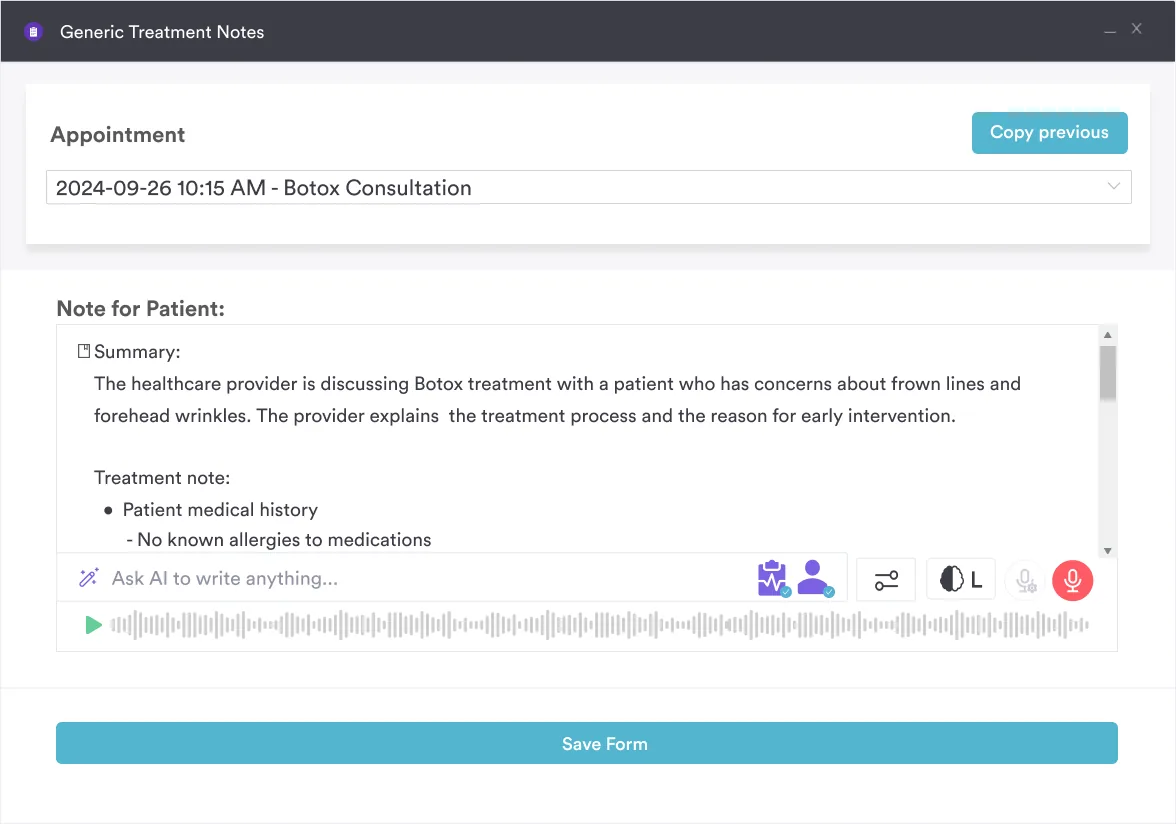
Therapeutic stance matters: avoid accusatory language. Instead of “You’re lying,” try “I notice these details don’t align. Help me understand.” That names the pattern while preserving the alliance. Automated clinical notes from an AI medical scribe cut the documentation burden, which frees your attention for the therapeutic work.
Pathological lying creates a specific documentation problem. You have to record findings accurately, protect confidentiality, and keep patient self-report clearly separate from what you observed yourself.
Paper screening forms make that harder than it needs to be. The completed test sits in a folder and the score never reaches the note. Nobody can see whether item 4 was rated higher this month than last.
Practice management software like Pabau keeps the form, the total, and your notes in one client record. You can send the nine statements as a digital form before the session. The answers are then waiting in the chart when the patient sits down. Repeat the form later and you can compare both sets of answers side by side.
Your records are your defense in ethics complaints, licensing board inquiries, or malpractice claims. Thorough, objective documentation of these presentations shows clinical competence and protects the therapeutic relationship.

Pabau is practice management software for mental health practices. Send the pathological liar test as a digital form and capture the total against the client record. Pull it up next to your notes at the next session.

Pathological lying usually sits on top of something else, whether that is personality structure, mood, or old trauma. Screen for it, then spend your effort on what the screening points at. The nine statements are the opening question, not the answer.
Keep the number in proportion. The bands on this page convert the total into the PLI’s scale, but they are arithmetic rather than a validated threshold. A high total earns a better interview, nothing more.
Want those nine statements scored, filed, and sitting beside your treatment notes? Book a demo and we will show you how Pabau keeps screening results and clinical notes in the same client record.

Assessing a patient with low motivation or apathy? Apathy test template screens for apathy and motivation deficits in neuropsychiatric and post-stroke patients.
Need a framework for documenting behavior patterns? Behavior causes and interventions guide guides clinicians through documenting behavior patterns, causes, and evidence-based interventions.
Helping a client move past appearance-focused thinking? Body neutrality worksheet uses guided prompts to move clients from appearance to what their body does.
Pathological lying is not a standalone diagnosis in the DSM-5. It is a symptom cluster associated with personality disorders (antisocial, narcissistic, borderline), mood disorders, anxiety disorders, and trauma. Accurate diagnosis requires a comprehensive psychiatric evaluation beyond the screening test.
Most clinicians say pathological liar, and the two terms are used interchangeably in practice. Another word for compulsive liar you will meet in older records is mythomaniac. Pseudologia fantastica is the closest formal term, and it describes elaborate lies the person may half believe. None of these is a DSM-5 diagnosis.
Sometimes. Polygraph tests measure physiological arousal such as heart rate, sweating, and breathing. Some people with pathological lying patterns show reduced autonomic reactivity because they have rationalized or become desensitized to their dishonesty. Polygraph reliability is contested in the scientific literature, and results are not admissible in most US courts.
Pathological liars are not inherently violent. Chronic dishonesty does damage relationships, erode trust, and enable exploitation or fraud. Risk depends on the underlying diagnosis and motivation, so run a proper risk assessment rather than assuming danger from the lying alone.
Yes, but the relationship is complicated. Pathological liars can experience genuine emotional attachment. Chronic dishonesty typically prevents the trust and intimacy a healthy partnership needs. Treatment that addresses the underlying cause can improve relational capacity.
Situational lying is context-dependent and usually driven by outside pressure, such as avoiding punishment or gaining an advantage in the moment. Pathological lying is pervasive, crosses situations, and often carries no clear external reward. The nine statements on this page screen for that chronic, compulsive pattern.
Nine. Each statement is rated from 1 (strongly disagree) to 7 (strongly agree), so the total falls between 9 and 63. The form prints no cutoff score and has no published norms. Treat it as a screening prompt rather than a validated diagnostic instrument. The published Pathological Lying Inventory is a separate 19-item measure.