Cervix length during pregnancy chart
A cervix length during pregnancy chart records cervical length in millimeters ag...

3
Last Updated: Oct 14, 2026

The period cramps pain scale rates menstrual pain from 0, meaning no pain, to 10, meaning the worst pain imaginable.
Pain that consistently scores below 5 usually reflects primary dysmenorrhea and responds to NSAIDs, heat, or both.
Scores that stay at 7 or above, or climb across cycles, justify a workup for endometriosis, fibroids, or adenomyosis.
The Numeric Rating Scale and the Visual Analogue Scale both standardize documentation, so patients and clinicians describe severity the same way.
Two or three cycles of logged scores make a stronger case for imaging than a single high reading at one visit.
The period cramps pain scale is a 0-10 numeric rating that turns menstrual pain into a score you can chart and act on.
A 0 means no pain and a 10 means the worst pain imaginable. Pain that sits below 5 usually falls within normal primary dysmenorrhea. Scores that stay at 7 or above, or climb across successive cycles, point toward secondary dysmenorrhea and warrant investigation.
This page sets out what each band on the scale means clinically. It also covers how to score menstrual pain across a full cycle, and when a score justifies imaging or referral. The free template below turns the scale into a form your patients can complete daily.
A daily log for scoring menstrual pain from 0 to 10 across a full cycle. It carries a symptom checklist, a medication and relief record, and space for the work or school days a patient missed.
Download templateMenstrual cramps affect up to 84% of women of reproductive age, yet patients and clinicians often lack a shared language for describing severity. The period cramps pain scale uses a 0-10 numeric rating to standardize how people report dysmenorrhea intensity. That turns a subjective complaint into measurable clinical data.
The Numeric Rating Scale (NRS) is the most commonly used menstrual pain scale in practice. Patients rate their discomfort from 0, meaning no pain, to 10, meaning the worst pain imaginable. The measure is quick, reproducible, and sensitive enough to detect changes in dysmenorrhea severity across cycles.
Scores that reach 5 or 6 during menstruation usually still fit primary dysmenorrhea, which is menstrual pain with no underlying condition. Pain at 7 or above, or pain worsening over time, may indicate secondary dysmenorrhea linked to endometriosis or uterine fibroids. Clinicians use these thresholds to decide whether to order imaging or refer.
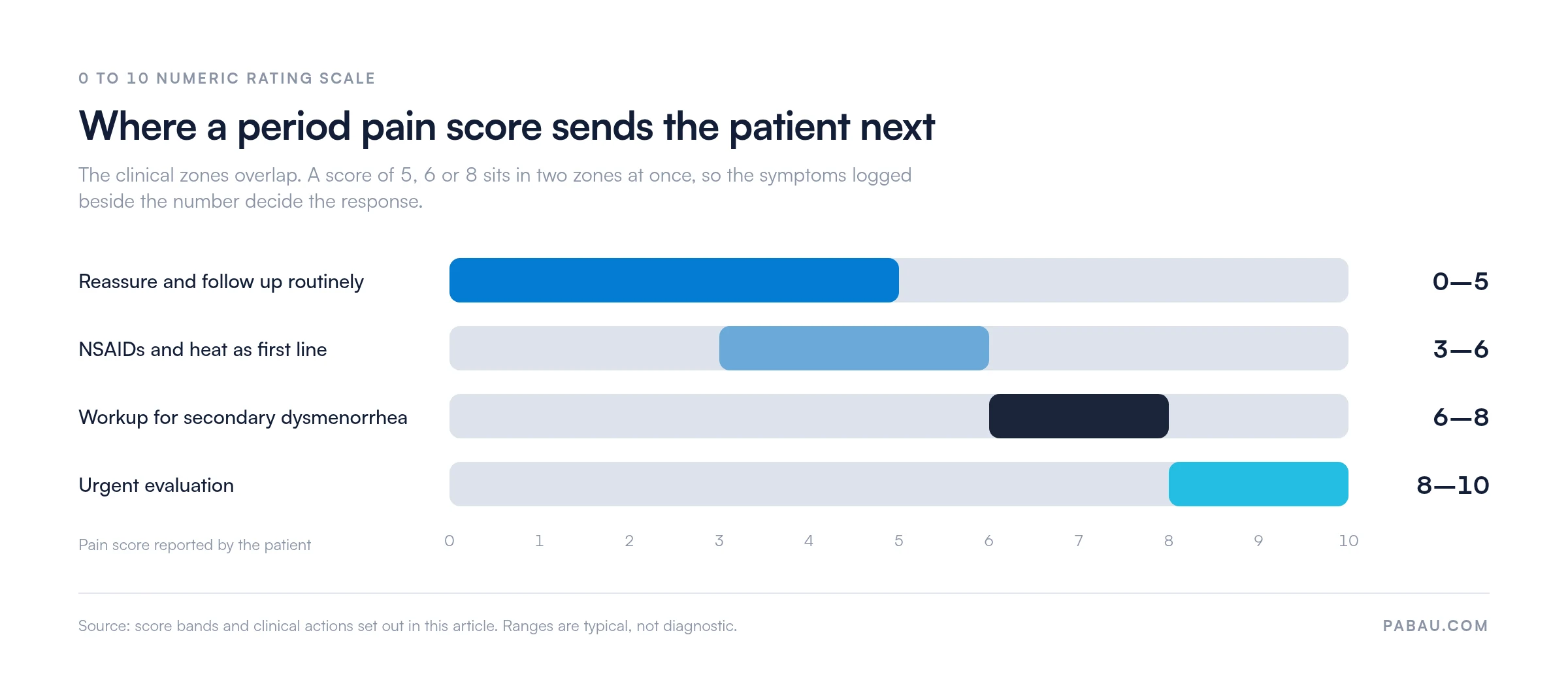
Each band on the scale carries a clinical meaning. Knowing where a patient’s pain falls guides both the conversation and the next step.
Individual thresholds vary widely. One patient’s 6 may carry a completely different functional impact from another patient’s 6. Read every score alongside the symptoms and history recorded with it.
Those bands also overlap once you map them onto clinical action, which is why the number on its own rarely settles the decision.
The downloadable template turns the 0-10 scale into a practical workflow. Here is how to work it into your practice.
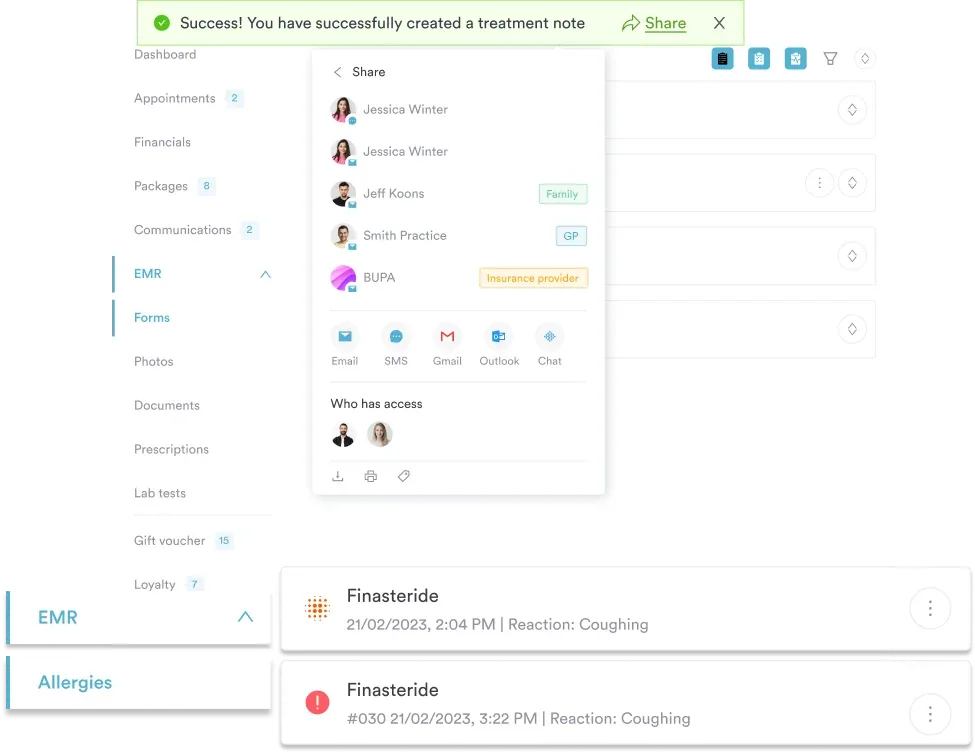
Patients who already keep a period tracker can copy their cycle dates straight onto the log, which cuts recall error in the first column. Practice management software like Pabau can send an automated reminder on the first day of bleeding. The daily entries then keep arriving without a call from your front desk.
Ask patients to rate their pain at the same time each day, morning or evening, to reduce variability. Pain felt at 11 PM after a long workday can score higher than the same discomfort at 8 AM on a rested day. Consistent timing makes the log more reliable.
A templated form standardizes pain documentation across the practice. Vague recall and inconsistent notes from different staff both drop away. Every patient reports on the same 0-10 scale, with the same symptom categories and the same medication fields.
Legal and compliance grounding: HIPAA in the US, GDPR in the EU, and CQC standards in England all expect documented pain assessment. Each also expects a record of the decisions that followed it. A pain scale template gives you audit-ready proof that dysmenorrhea was evaluated systematically. That matters most when you are ruling out endometriosis or fibroids.
Any practice evaluating or managing dysmenorrhea can use it. Gynecology and obstetrics practices are the main users, and most keep the log inside their OBGYN EMR software so scores sit beside the exam notes. Primary care practices, pain management specialists, and nurse-led menstrual health services use it too.
Fertility practices see these patients as well. Severe dysmenorrhea that resists NSAIDs is a common route into an endometriosis diagnosis, and endometriosis is a leading cause of subfertility. A cycle-by-cycle log held in fertility clinic software gives the first consultation a documented history rather than a recollection.
General practitioners, nurse practitioners, and physician assistants in family medicine reach for it too. They tend to use it when a younger patient reports severe cramping, or when an existing patient’s dysmenorrhea starts getting worse.
Sharper diagnosis: Standardized tracking exposes patterns. Pain confined to Days 1 to 3 reads differently from pain spreading across the cycle. Stable mild cramping also differs from scores that worsen year on year. Endometriosis often produces pain that peaks mid-cycle and resists NSAIDs, while primary dysmenorrhea usually improves with heat and ibuprofen.
Pain that peaks mid-cycle rather than on Day 1 is easier to spot when the score log sits beside a hormone cycle chart. Two records on one timeline turn a vague complaint into a shape you can name.
Better treatment planning: A completed log shows which interventions worked. Did acetaminophen fail where naproxen succeeded? Did heat alone hold one patient while another needed medication and rest? That evidence beats guesswork and lets you personalize the next recommendation.
Measurable follow-up: Two or three cycles of logged scores show whether a prescribed treatment is working. A patient still at 7 despite ibuprofen 400 mg three times daily has earned an escalation. That might be naproxen, a hormonal contraceptive, or imaging for secondary causes.
Lower compliance risk: Documented pain assessment protects the practice at audit and supports the consent conversation. When you order imaging or make a referral, the recorded score progression is what justifies the decision.
Patients ask one question more than any other: is my pain normal? The scale gives you an objective way to answer it. Normal primary dysmenorrhea usually produces scores below 5. Occasional 5 or 6 episodes still count as normal when they pass quickly and last no more than three consecutive days.
When scores consistently exceed 5, or climb from 5 to 7 or 8 across several cycles, a secondary dysmenorrhea workup becomes justified. That usually means pelvic ultrasound first, then pelvic MRI or laparoscopy if the scan is unrevealing. The logged history is what supports the referral.
Three validated tools dominate menstrual pain measurement in research and in practice. Knowing their strengths helps you pick the right one for your patient population.
For most practice workflows the NRS on a 0-10 scale is enough. It is quick, reproducible, and sensitive to change. Reserve the McGill or the VAS for research, or for diagnostic questions where pain quality matters. Sharp, cramp-like pain suggests primary dysmenorrhea, while deep, dull, constant pain points toward endometriosis.
Not every high score needs an urgent referral. Certain patterns do warrant timely investigation. Use these thresholds to decide the response.
Record what you find on a pelvic exam documentation form, so the referral letter carries the exam alongside the score history. A log showing scores climbing from 4 to 7 across three cycles is stronger evidence than a single complaint at one visit.
Tell patients that a score is not a judgment call. Someone worried that her 5 out of 10 is not bad enough to mention needs reassurance. On this scale a 5 means the pain is noticeable and worth attention, so treat the conversation as routine.
Most practices still collect the pain scale on paper. The patient fills it in at home, brings it to the follow-up, and the clinician reads it once and files it. The scores never become searchable, so the next clinician starts from the patient’s recollection again.
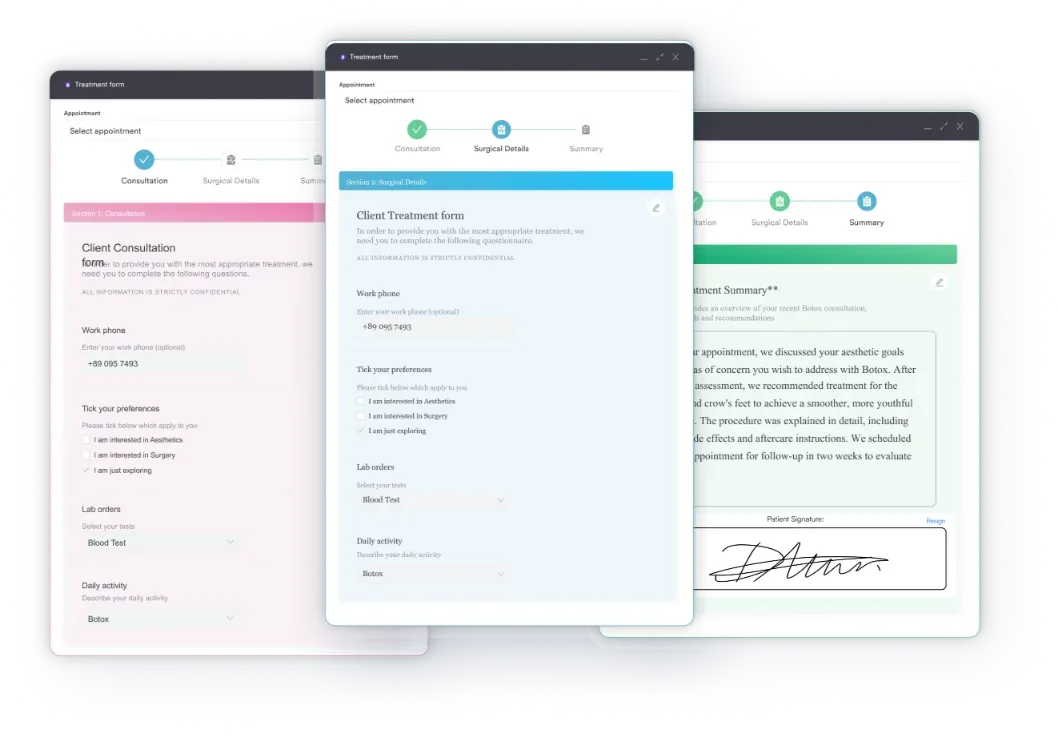
Pabau handles the same job differently. The pain log goes out as a digital form before the appointment. Scores then arrive in the client record instead of on a sheet of paper. Automated reminders chase the daily entries, and the full history sits on one screen at the review.
The result is a dysmenorrhea record you can act on. You can read the trend across cycles, show the patient why a referral is warranted, and attach the same evidence to the referral letter. Audit documentation then falls out of the workflow rather than being reconstructed afterwards.

Pabau sends the pain log as a digital form, reminds patients to score each day, and files every cycle in the client record. Your follow-up starts with the trend already on screen.

The period cramps pain scale earns its place because it converts a complaint into a number you can track. “My periods hurt” becomes “a 6 on Days 1 and 2, and NSAIDs take the edge off”. That is the difference between a conversation and a record.
The trade-off is worth naming. A score is only as useful as the context logged beside it. The symptom, medication and missed-day columns do more diagnostic work than the number alone. Ask for two or three cycles before you decide anything.
Download the template, give it to the next patient who reports severe cramping, and read the log at her follow-up. Book a demo to see how Pabau sends the pain log, chases the daily entries, and keeps the score history in the patient’s record.

Need a form for the full annual visit? Women’s wellness exam template covers history, screening and exam findings on one sheet.
Investigating a hormonal cause behind painful, irregular cycles? PCOS hormone levels template sets out the reference ranges and where each result belongs.
Is the pain reaching the pelvic floor? Pelvic floor distress inventory scores bladder, bowel and prolapse symptoms alongside the pain log.
Choosing a system to hold all of this? Best gynecology EHR compares the platforms that store cycle-by-cycle assessments.
Normal primary dysmenorrhea typically scores 0 to 5 on the period cramps pain scale. Scores of 5 or 6 are acceptable when they pass quickly, in under 10 minutes, and respond well to NSAIDs or heat. Scores consistently above 6, or pain that worsens over cycles, suggest secondary dysmenorrhea and warrant investigation.
Seek medical evaluation if your score consistently reaches 6 or higher, or if it does not respond to over-the-counter pain relief. The same applies when pain disrupts work or school, or worsens over successive cycles. Scores of 8 to 10 with fever, heavy bleeding, or fainting warrant urgent evaluation the same day.
Research suggests period cramps can produce pain scores comparable to labor pain for some people, though labor pain tends to progress more consistently. Both involve uterine contraction. Individual pain thresholds vary widely, so the comparison is imprecise. Focus on your own score and its functional impact instead.
Log a score from 0 to 10 every day of your cycle for at least two to three months. Record the symptoms that came with it, such as bloating, nausea or heavy bleeding, plus any medication you took and whether it helped. Note the days you missed work or social activity, and bring the log to your appointment.
A score of 7 or above can reflect primary dysmenorrhea at the severe end of its range. It can also reflect secondary dysmenorrhea from endometriosis, uterine fibroids, pelvic inflammatory disease, or adenomyosis. Imaging and clinical evaluation are needed to tell these causes apart and to guide treatment.