CRM for chiropractors: how to manage patients, bookings and marketing
A CRM for chiropractors is a patient relationship management system built around...

Last Updated: Oct 13, 2026
An oral allergy syndrome chart maps each pollen type to the raw foods that cross-react with it. A patient who says apples make their mouth itch is rarely allergic to apples. They are sensitized to birch pollen, and the apple protein resembles it closely enough to set off a local reaction.
Getting that distinction right shapes the next move. Around one in three people with seasonal allergic rhinitis reacts this way, and most need preparation advice rather than a referral. Below you get the cross-reactivity chart, the downloadable form, and the warning signs worth acting on.
A one-page clinical form that pairs a patient intake and oral symptom checklist with a seasonal cross-reactivity chart. The chart covers four pollen groups, birch, grass, ragweed, and mugwort, and lists the fruits, vegetables, seeds, spices, nuts, and legumes tied to each.
Download template
Oral allergy syndrome is an IgE-mediated cross-reaction between pollen proteins and structurally similar proteins in fresh fruits, vegetables, and nuts.
Birch pollen carries the longest cross-reactor list, covering apples, pears, peaches, hazelnuts, carrots, celery, and soy.
Symptoms stay in the mouth and throat and settle quickly, so a systemic reaction points to a different diagnosis.
The downloadable chart covers four pollen groups, birch, grass, ragweed, and mugwort, alongside an intake and symptom checklist.
Using digital intake forms captures allergy history systematically, which speeds up OAS screening and referral.
Oral allergy syndrome, also called pollen-food allergy syndrome, is a cross-reaction between pollen proteins and similar proteins in raw fruit, vegetables, and nuts.
The immune system reads the food protein as pollen. IgE antibodies bind, histamine is released locally, and the lips, mouth, and throat react within seconds of the first bite.
The reaction stays in the oropharynx. Patients describe itching, tingling, or mild swelling of the lips, tongue, or throat. Heating or processing the food usually removes the trigger, because the proteins behind most of these reactions break down with heat.
That heat sensitivity is also the first clue that separates OAS from a food allergy.
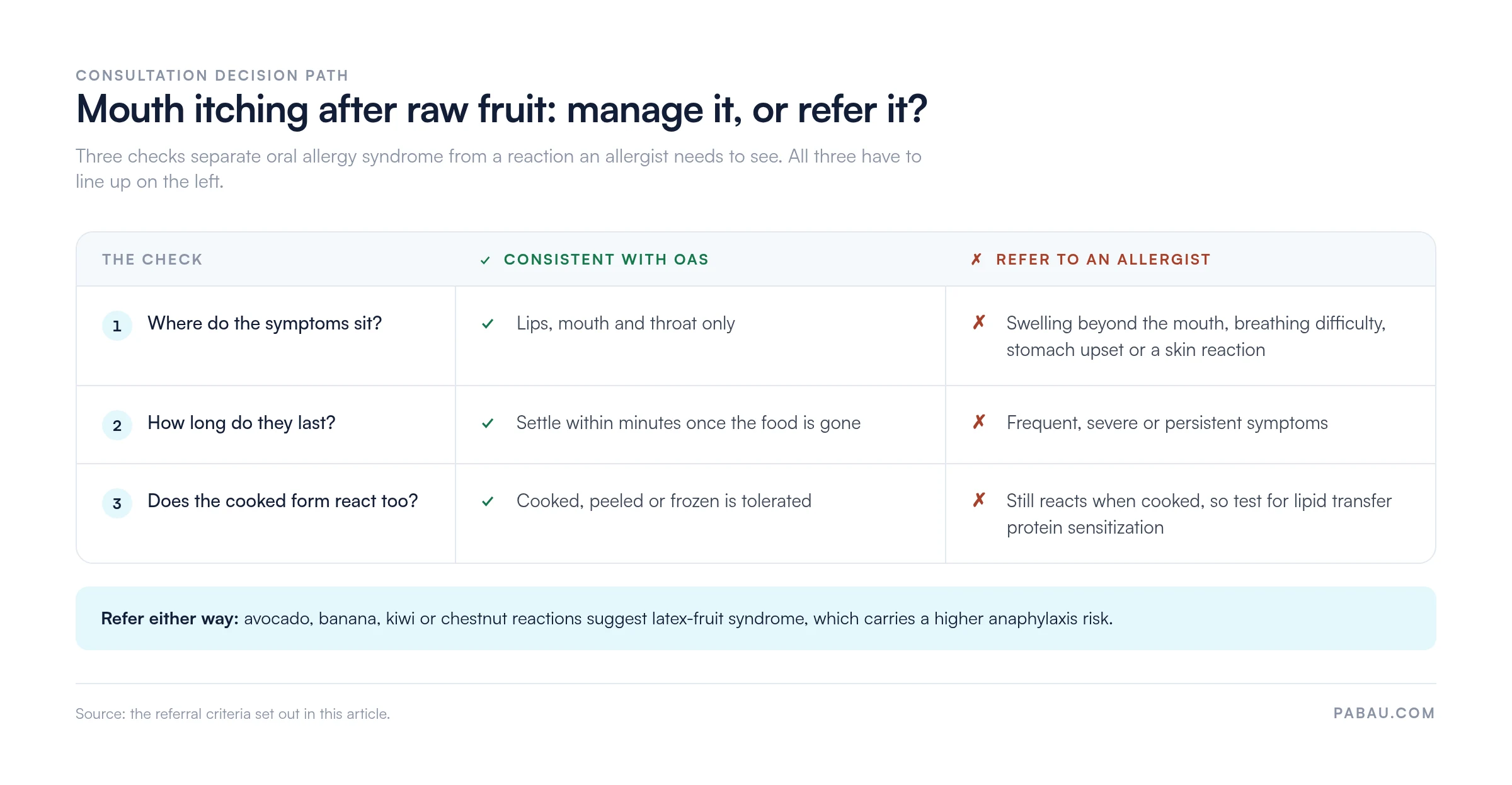
Three things separate them: where the symptoms sit, how long they last, and whether cooking changes anything. OAS symptoms are mild and short-lived. Patients report itching or tingling within seconds of eating the raw food, and it settles within minutes once the food is gone.
A food allergy behaves differently. It reacts to the food in any form, raw or cooked, and it can progress to anaphylaxis. Anaphylaxis is a rapid multi-system reaction that needs epinephrine. Where OAS does cause it, latex-fruit syndrome is usually behind it.
Running the checks in the same order every time keeps the decision short, and it keeps epinephrine auto-injectors with the patients who need them.
When the picture points to a food allergy instead, a structured food allergy form captures the reaction history an allergist will ask for.
The table below maps each major pollen allergen to the foods most often linked with cross-reactivity. Use it in the room to show a patient why one fruit bothers them in April and leaves them alone in October.
The downloadable PDF is a single-page clinical form, built to be filled in during the appointment. The top section captures the patient’s name, date of birth, gender, and relevant medical history, followed by the referring physician’s name and contact number.
A symptom checklist sits between the two, with tick boxes for the presentations that show up most often:
The chart itself fills the lower half. Four rows cover the pollen seasons: spring (birch), summer (timothy and orchard grass), late summer to fall (ragweed), and fall (mugwort). Each row is split into fruits, vegetables, seeds and spices, and nuts and legumes, so you can circle what the patient reacts to.
An additional notes box closes the form. Latex-fruit syndrome sits outside the chart’s four pollen groups, so use the table above when a patient reacts to banana, avocado, kiwi, or chestnut.
The form is a consultation tool for patient education and symptom assessment. Follow these five steps to work it into your appointments.
Record the pollen season when a patient’s symptoms peak, because not every patient reacts year-round. Spring points to birch, and late summer to fall points to ragweed. That timing guides both treatment and any immunotherapy referral.
Two minutes of checking saves a follow-up call. Run through this before the patient leaves with their copy:
Three mistakes come up again and again. The first is handing over a fully circled row, which a patient reads as a list of foods to avoid for life. The second is leaving the season off, so a patient who tolerates melon in March avoids it all year.
The third mistake is filing the completed form as a scanned image. Nobody can search it at the next visit, so the history gets taken again from scratch.
First-line management is avoiding the raw trigger foods and eating cooked versions during high-pollen periods. Most patients need no medication at all. An oral antihistamine such as cetirizine, taken before a meal, reduces itching for those who react more often.
Allergen immunotherapy for the underlying pollen allergy can lower OAS symptoms by reducing sensitization. It works best for birch-driven OAS and needs an allergist referral. Patients with a history of symptoms beyond the mouth should also leave with a written allergy action plan.
Whatever the plan, it only works if the next clinician can see it. Primary care software that keeps allergy history in a structured field holds the pollen type, the foods, and the advice together.
Refer when the picture stops looking like straightforward OAS:
Most adults with uncomplicated OAS manage well on the chart and a few preparation changes. Referral is a judgment call, weighed on symptom severity, diagnostic certainty, and whether the patient wants immunotherapy.
Send the completed chart with the referral. Structured allergy consultation notes give the allergist the seasonality and the food list without a second history.
Allergy specialists, ENT clinicians, and dermatologists managing seasonal allergic rhinitis get the most from it. Primary-care physicians and nurse practitioners use it to screen for food reactions in pollen-allergic patients. Practices running GP clinic software can attach the completed form to the record, so the pollen history travels with the patient.
Patients use it too. Sharing the PDF after the appointment gives them a record of their own trigger foods and the seasons to watch. That cuts down on follow-up calls.
Most practices collect allergy history on paper or in a free-text box. The answers land in a different place each time, so the next clinician has to ask again. The pollen season that matters never reaches a searchable field.
Practice management software like Pabau moves that step in front of the appointment. Digital intake forms go out with the booking confirmation, and the answers write straight into the patient record. The allergy history is on screen before the patient sits down.
From there the chart becomes part of the visit rather than a printout someone has to find. You can attach the completed form to the patient file and share it through the Client Portal. A recall can then be set for the season that triggers their symptoms.

Pabau’s digital intake forms capture pollen and food allergy history before the visit. The answers write into the patient record, so OAS screening runs the same way every time.

The chart earns its place by narrowing what you have to decide. Once the pollen season and the trigger foods are on the page, the choice comes down to preparation advice or a referral. Most patients need the first.
The trade-off worth remembering is that the chart describes patterns, not individual patients. A food listed under birch will not bother every birch-sensitized patient, and some patients react to a food the chart leaves out. Treat it as the structure for the conversation, not the verdict.
So print it, or keep it in the patient record where the next clinician will find it. Book a demo to see how Pabau captures allergy history at intake and keeps it searchable for the next visit.

Treating the airway side of the same pollen allergy? Asthma action plan gives you a one-page plan for the patients whose seasonal symptoms reach the chest.
Referring a patient on to allergy and immunology? Allergy and immunology consultation notes set out what the specialist needs from your referral letter.
Collecting allergy history at the front desk? GP intake form template covers the wider history the pollen and food questions sit inside.
Yes. OAS appears after pollen sensitization is already established, so it often starts in adolescence or adult life, years after hay fever began. A new reaction in an adult with long-standing seasonal allergy is expected rather than surprising.
Not reliably. Commercial food extracts lose the fragile proteins that drive OAS, so skin prick testing often reads negative. Allergists use prick-to-prick testing with the fresh food, or component-resolved IgE testing, when the diagnosis needs confirming.
Usually. Heating and processing break down the proteins behind most OAS reactions, so cooked, canned, and pasteurized forms are tolerated. A patient who still reacts to processed food may be sensitized to lipid transfer proteins (LTP), which survive heat, and needs specific IgE testing.
They can. Chamomile tea and sunflower seeds sit in the ragweed group, while fennel, coriander, and caraway sit in the mugwort group. Ask about teas, seeds, and spice blends, because patients rarely count them as food.
Often, yes. Reactions tend to peak while the matching pollen is in the air, then settle outside that window. Many patients tolerate the same fruit in winter, which is worth checking before they drop it from the diet for good.