Nutrition intake form
A nutrition intake form is a structured questionnaire that records a patientR...

2
Last Updated: Oct 22, 2026

The NHS 12-week weight loss plan is free and open to healthy adults with a BMI of 25 or over.
It works to a 500 to 600 kcal daily deficit, which produces 0.5 to 1 kg of loss a week.
Daily activity climbs from 10 to 15 minutes in weeks 1 and 2 to 30 minutes most days by week 7.
The NHS Digital Weight Management Programme is separate and referral-only, and referrals come from a GP or a community pharmacy.
Running the plan as a tracked pathway takes digital forms for the weekly numbers and AI clinical notes that stay consistent.
A ready-made 12-week plan you can hand a patient at their first visit. It covers intake details, weekly goals, calorie and activity targets, and prompts for behavior change.
Download templateThe NHS 12-week weight loss plan is a free, week-by-week program for adults who want to lose weight steadily. It matters because it is the resource many UK patients meet first, long before they reach a specialist service. One threshold decides who it is for.
The guide is written for healthy adults with a BMI of 25 and over, and it paces loss at 0.5 to 1 kg a week. Push harder than that and patients tend to put it back on.
Below you will find the week-by-week structure, the calorie and activity targets, and the referral rules. The last section covers how to run the plan as a supported service.
The plan is a free behavior change program, published as a printable guide and a mobile app. It walks an adult through 12 consecutive weeks of small, specific goals.
There is no product to buy and no subscription attached. The NHS still lists it among its most downloaded self-help resources.
Eligibility is broader than people expect. The guide is written for healthy adults with a BMI of 25 and over, which is lower than the threshold for NHS specialist services. A patient who is overweight but not obese still has a structured NHS program available, with no referral and no wait.
Behavior science, rather than restriction, drives the design. The weekly goals are deliberately modest, and each one stacks on the last. That is the whole point.
The plan gets judged on what a patient still does in month six, not on the number in week two.
Two routes are open to anyone, and both start at the NHS Better Health website. A third route exists for patients who need more support, but it is referral-only.
Flag that third route early with patients who might qualify, because the entry rules are much narrower than most people assume. We come back to them further down.
Each week adds one goal and keeps the ones before it. Two schedules run in parallel, though, and they do not line up. The dietary focus moves in four-week blocks, while the activity target steps up after week 2 and again after week 6.
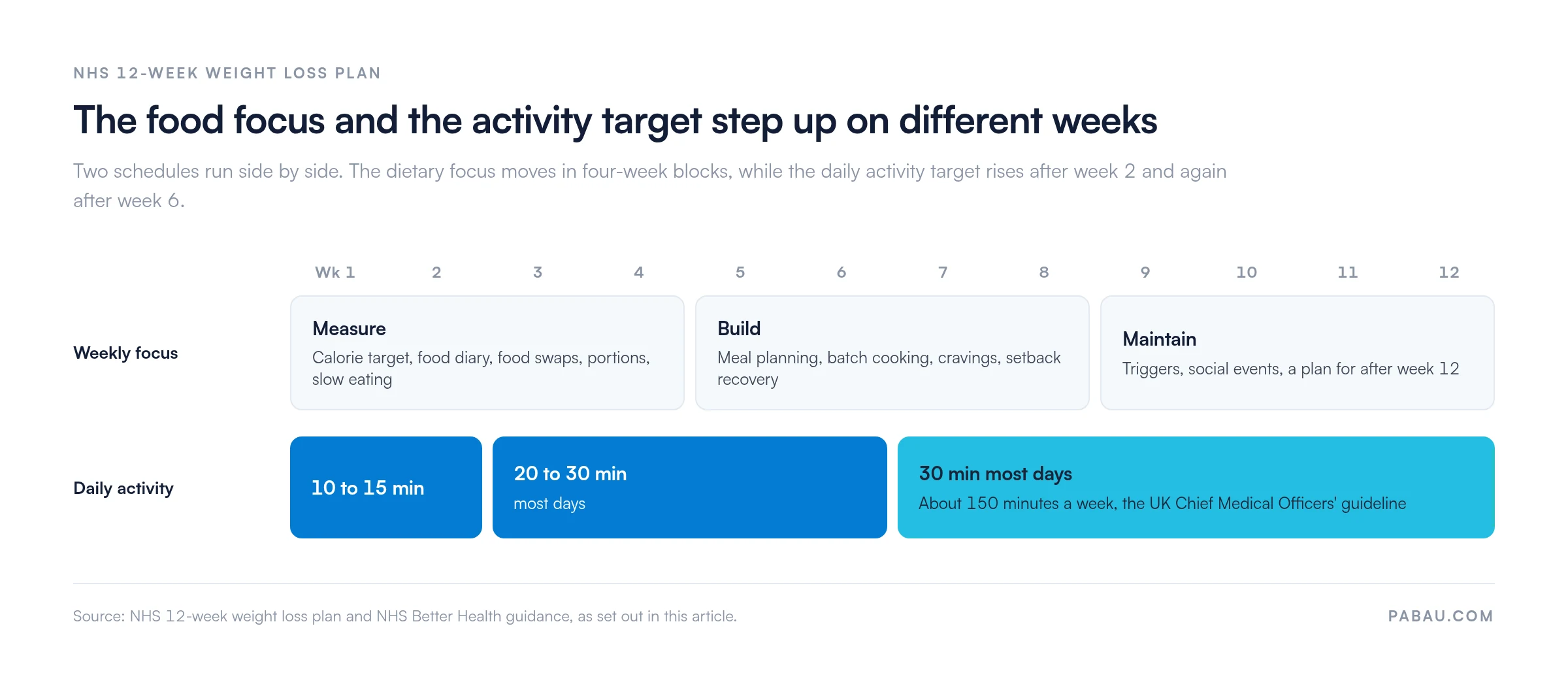
The first four weeks are about measurement. Patients record a starting weight, work out a daily calorie target, and open a food diary. Activity starts here too, at 10 to 15 minutes a day, rather than waiting until the diet is settled.
Each week then adds one change. Calorie awareness comes first. Week 2 introduces the food swap, so skimmed milk replaces whole milk and grilled replaces fried. Portion size follows in week 3, and slow eating arrives in week 4.
A scrap of paper works for the diary, but most patients abandon it by week three. A structured food diary template is easier to keep, and far easier for you to read back at a check-in.
This block is where the plan gets harder and where most patients stall. Activity has already stepped up to 20 to 30 minutes on most days.
Weeks 5 and 6 add meal planning and batch cooking, week 7 covers cravings and emotional eating, and week 8 deals with setbacks.
Weight loss slows here for almost everyone, so give patients something else to look at. Energy, sleep quality, and how clothes fit all shift before the scale does.
The last four weeks work as a handover. Week 9 consolidates habits and names personal triggers. Then come the rehearsals for social events, holidays, and celebrations, in weeks 10 and 11. Week 12 sets the next goals and writes the maintenance plan.
Regain is the risk in this block, and it starts the week the structure disappears. So book the follow-up before the patient leaves week 12, not after.
The plan works to a daily deficit of roughly 500 to 600 kcal, which produces 0.5 to 1 kg of loss a week. In practice that means about 1,400 kcal a day for women and 1,900 for men.
Those figures describe an average person, and they behave like averages. Current weight, age, metabolism, and activity level all shift that figure. One floor is fixed, though. No patient should drop below 1,200 kcal a day without medical supervision.
The common failure is easy to spot at a check-in. A patient takes a number from a calculator, hits it for nine days, then quietly stops counting. A target the patient helped set tends to survive longer than one you handed them.
No menus come with the plan. It points instead at the Eatwell Guide, the NHS model of a balanced plate, and asks patients to shift their proportions toward it.
Patients do not have to hit those proportions at every meal. The plan asks them to move toward the shape over 12 weeks, one habit at a time.
The activity target starts small and steps up twice. Weeks 1 and 2 ask for 10 to 15 minutes a day. By week 3 that rises to 20 to 30 minutes on most days. From week 7 it holds at 30 minutes most days, which lands near the 150 minutes a week the UK Chief Medical Officers recommend.
None of it has to happen in a gym. Brisk walking, cycling, swimming, dancing, and gardening all count toward the total.
Some patients get on better with sets and reps than with a daily minutes target. For them, a written weight loss workout plan gives the same progression in a form they can tick off.
The NHS Digital Weight Management Programme, or DWMP, is a separate 12-week online service. Its entry rules are far tighter than those of the open plan, so it is worth knowing them precisely.
BMI is a blunt instrument at these thresholds, and a muscular patient can land on the wrong side of them. Our guide to BMI assessment covers when to reach for a waist measurement instead.
Referrals in England run through NHS England. In Scotland the pathway sits with NHS Inform instead.
A patient who downloads the PDF and walks out alone finishes about as often as a January gym member. The plan does much better when someone is expecting to see the numbers.
The operational shape is simple enough to run in a busy week. It takes one baseline appointment, five or six short check-ins across the 12 weeks, and one booked follow-up.
Before you start a patient, get these four in place:
Two mistakes come up repeatedly. Check-ins get booked one at a time, so a single missed week turns into a missed month. And weight gets typed into a free-text note, so nobody can see the trend without reading 12 entries.
Medication deserves one line in the baseline. Some antipsychotics and corticosteroids raise appetite or weight. If one is in play, raise it with the prescriber before the patient blames themselves for a flat month.
The baseline is also the piece worth automating first. Patient intake software collects weight, height, medications, and the patient’s own goals before they sit down.
Practices running weight management at any volume move this off spreadsheets eventually. Purpose-built weight loss software holds the plan, the weekly numbers, and the appointments in one record.
Most practices run this on paper and goodwill. The plan lives in a printout, and the weekly weight goes into a free-text note. Nobody books the next appointment until the patient asks for it.
Practice management software like Pabau moves all 12 weeks into one patient record. Digital forms capture the baseline and each weekly check-in as fields rather than prose. Because they are fields, you can read week 9 against week 1 without opening a dozen notes.
Scheduling runs off the same record. You can book all six check-ins at the baseline visit, and automated reminders chase the ones patients forget. Pabau Scribe, our AI scribe, drafts the visit note, so a rushed 15-minute check-in still leaves a usable record behind.
The outcome is a plan you can audit. You can see who is still in at week 8, who has not been weighed for three weeks, and who now meets the DWMP criteria. That turns a printout into a service you can staff and report on.

Pabau keeps the baseline, the weekly numbers, and the check-in schedule in one patient record. You can see who is still on track at week eight without opening a single note.

The plan itself is not the hard part. It is free, it is already written, and a patient can start it this afternoon. What decides the outcome is whether anyone is watching the 12 weeks alongside them.
So pick the version you can genuinely staff. Six short check-ins you actually keep will beat a weekly program you abandon in week four. And book that follow-up past week 12 now, because regain starts the moment the structure stops.
A folder of printouts is hard to audit. Book a demo to see how Pabau tracks a weight management pathway from baseline to follow-up.

Wondering when lifestyle change stops being enough? Lifestyle vs pharmacologic interventions sets out where behavioral work ends and prescribing begins.
Need a baseline you can measure against? New patient weight loss intake form template captures weight, history, and goals at the first visit.
Want to make the food advice practical? Grocery list for weight loss turns the Eatwell proportions into a shopping list a patient can work from.
Looking for a way to hold motivation past week six? Weight loss reward chart gives patients a marker of progress that is not the scale.
Outgrowing spreadsheets for weight management? EMR for weight loss clinic compares what these practices need from a record system.
No. The PDF and the app are open to any healthy adult with a BMI of 25 or over. Only the NHS Digital Weight Management Programme needs a referral, and that comes from a GP or a community pharmacy.
The NHS guide is written for healthy adults, and it is not suitable for children or during pregnancy. Anyone with a medical condition, or a history of an eating disorder, should speak to their GP first.
The plan aims at 0.5 to 1 kg a week, so 6 to 12 kg over the full 12 weeks. That works out at 13 to 26 lb. Faster loss raises the risk of muscle loss and later regain.
The plan is behavioral, so it sits alongside medication rather than replacing it. Any patient on a prescribed weight loss medicine should follow their prescriber’s instructions on diet and activity.
There is no subscription, no meal replacement product, and no meeting to attend. The food advice is the Eatwell Guide, the same model used across NHS services. NHS England and OHID, the Office for Health Improvement and Disparities, fund the materials.