OSHA respirator medical evaluation questionnaire
The OSHA respirator medical evaluation questionnaire is the mandatory health for...

1
Last Updated: Oct 15, 2026
The neonatal infant pain scale (NIPS) is a six-indicator behavioral tool for scoring pain in babies who cannot report it. It scores facial expression, cry, breathing patterns, arms, legs and state of arousal, giving a total from 0 to 7. A score above 3 signals pain that needs clinical attention.
The tool was developed for preterm and term neonates, and the original validation was carried out in term infants. It is used up to 6 weeks post-term. The template below turns that scoring into a bedside record every nurse completes the same way.
A printable template covering the six NIPS indicators, a scoring grid, a total score field and space to record reassessment times and interventions.
Download template
NIPS scores six behavioral indicators, with a total range of 0 to 7.
Scores above 3 (4 or more) typically indicate pain that needs clinical attention.
It was developed for preterm and term neonates, originally validated in term infants, and is used up to 6 weeks post-term.
It is not validated for paralyzed or deeply sedated neonates.
Pabau, our practice management platform, keeps each score in the patient record with its time stamp.
The neonatal infant pain scale is a behavioral observation tool for assessing pain in neonates who cannot self-report. It was developed to score procedural and postoperative pain in neonatal intensive care, with the original validation carried out in term infants.
The scale sits alongside clinical judgment rather than replacing it. Scores support documentation and help teams decide when to reassess or act. Any treatment decision stays with the treating clinician under local protocol.
NIPS is one of several observational tools, and a wider review of pain assessment scales shows which one suits which patient group.
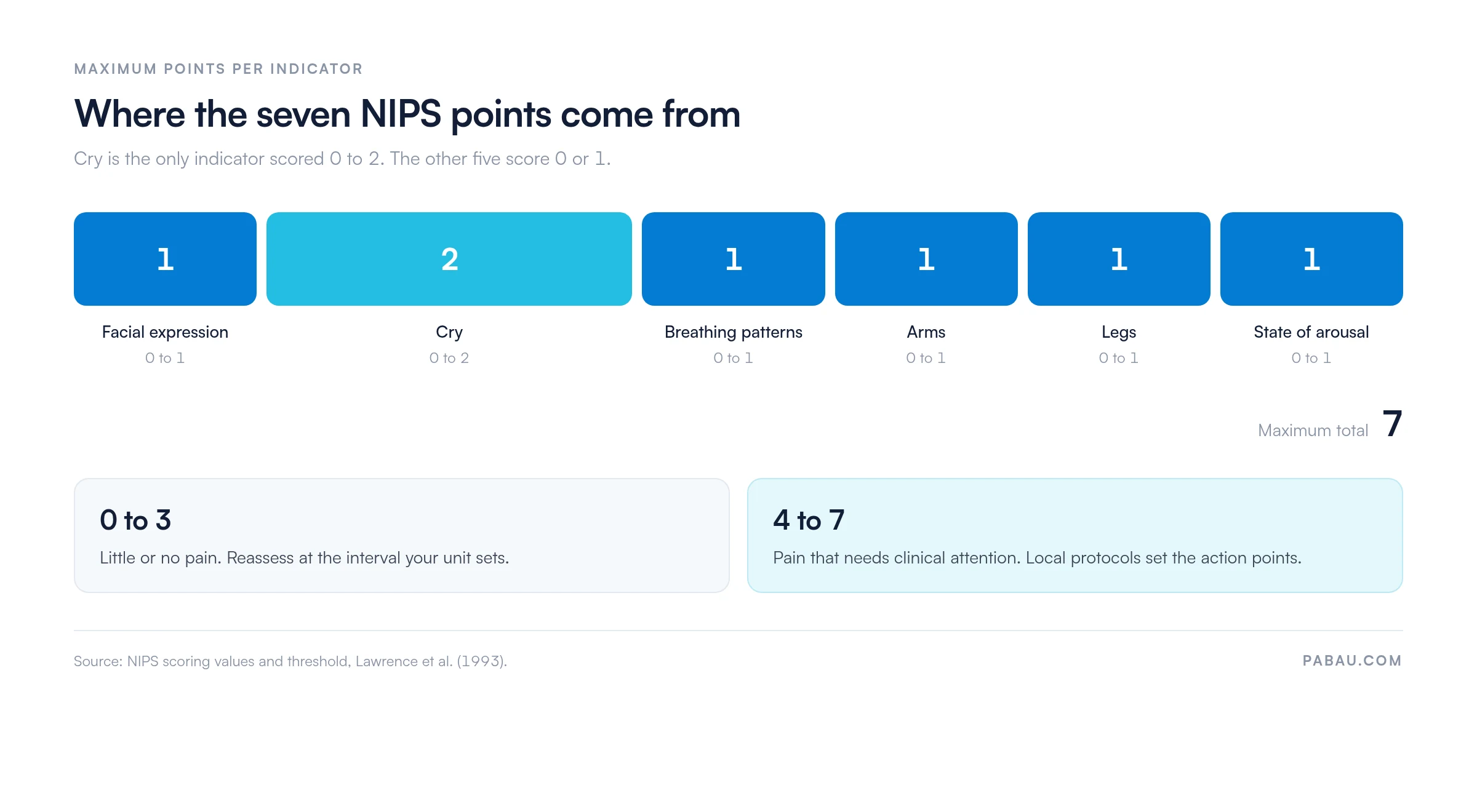
Each indicator is scored at the bedside, and the total gives a single pain figure. The table below summarizes the scoring values for each indicator.
The total ranges from 0 to 7. A score above 3 (4 or more) typically indicates pain, following the threshold in Lawrence et al. (1993). Some units grade 3 to 4 as moderate, so check your unit’s policy before acting on a score.
The points are not spread evenly across the six indicators, which matters when you read a total back later.
The template follows the same order as the scoring workflow, so a nurse can complete it at the bedside in a few minutes. Work through the steps below during each assessment.
Neonatal intensive care units use the tool most often, particularly for heel sticks, venipuncture and IV insertion. Postoperative wards and neonatal follow-up services also use it to document pain over time.
Teams that run regular neonatal procedures benefit most, because a shared scoring method keeps assessments comparable across shifts and staff. Once a baby is past the neonatal window, many units move to the FLACC scale, which covers older infants and young children.
The scale is specific to neonates. Critical care teams scoring nonverbal adults reach for the CPOT pain scale instead, and rehabilitation services use self-report tools once a patient can answer.
Infants discharged from the unit often move on to follow-up appointments and therapy. The same documentation habits apply in allied health practices, which record each score against the patient’s file.
A standard template makes scoring consistent. Staff who learn one structure can read each other’s records without translation.
It also creates an audit trail. Timed scores and recorded interventions show what was assessed and when, which supports governance reviews.
A number on its own travels badly. Three fields decide whether an assessment still means something a month later.
A total of 5 after a heel stick reads differently from a 5 at rest. Only the form keeps that context attached to the number.
The scale depends on observable behavior, so it cannot be used reliably in infants who are paralyzed or on neuromuscular blocking agents. Deep sedation also limits the behaviors the tool measures.
Validation in very preterm neonates, roughly under 32 weeks, is limited. Scores may under-read in that group because behavioral responses are blunted, so interpret them with added caution.
Reassess at the interval set by your unit protocol and document each score with its time. A single score shows a moment, while a series shows whether an intervention is working.
On paper, the score lives on a chart at the cot side and reaches the patient record later, once someone transcribes it. The scores taken on the busiest shifts are the ones most likely to wait.
Pabau, the practice management platform we build, stores the form as a digital record against the patient. A nurse completes the six indicators on a tablet, and the total, the time and the intervention save straight to the file.
That makes a series easy to read back. A reviewer sees every score for one baby in order, with who recorded it and when. A governance review then starts with the record instead of a hunt through paper.

Pabau’s digital forms and clinical records help teams store pain assessments alongside the rest of the patient file.

Scoring pain in a baby who cannot describe it will always involve judgment. A shared form narrows how much that judgment varies between two nurses on the same unit.
Print the template, agree your reassessment interval, and hold the team to recording the time and the intervention with every score. The scores then become a record you can defend and act on.
Pabau keeps those records with the patient file, so reviewers see each score in context. Book a demo to see how neonatal pain assessments fit into your documentation workflow.

Caring for older infants and children? The FLACC pain scale covers the age range the NIPS stops at.
Comparing the options? Pain assessment scales sets out which tool fits which patient group.
Scoring nonverbal adults? The CPOT pain scale is the critical care equivalent for intubated patients.
Taking a pain history? The PQRST pain assessment form structures the questions for patients who can answer.
The neonatal infant pain scale is a six-indicator behavioral tool that scores pain in neonates from 0 to 7. It was developed for preterm and term infants, with the original validation in term infants, and is used up to 6 weeks post-term.
A score of 0 to 3 indicates little or no pain. A score above 3 (4 or more) typically indicates pain needing clinical attention, and local protocols set the action points.
Yes. The tool was developed for preterm and term infants, but validation in very preterm infants, roughly under 32 weeks, is limited. Scores in that group may under-read, so interpret them with caution.
No. The tool is not validated for infants who are paralyzed or on neuromuscular blocking agents. Deep sedation also limits the behaviors it measures.