OSHA respirator medical evaluation questionnaire
The OSHA respirator medical evaluation questionnaire is the mandatory health for...

3
Last Updated: Oct 15, 2026

The N-PASS pain scale is a validated tool measuring pain, agitation, and sedation across five behavioral and physiological indicators in NICU infants.
Scores run from -10 (deep sedation) to +10 (maximum pain and agitation), with intervention typically triggered at +3 or above under institutional guidelines.
Gestational age points are added to the pain/agitation score for preterm infants, up to +3 below 28 weeks. The correction stops limited pain responses from being under-treated.
The correction applies to the pain/agitation score only, never to the sedation score. It lifts the corrected pain total to a maximum of 13.
Practice management software like Pabau builds the scale into a scored clinical form, so the corrected total lands in the record without a copying step.
A ready-to-use assessment structure for pain evaluation in NICU infants, covering behavioral and physiological indicators, gestational age adjustments, scoring thresholds, and documentation checkpoints.
Download templateThe N-PASS measures pain, agitation, and sedation with one tool, scoring five behavioral and physiological criteria from -10 to +10.
For a preterm infant, gestational age points are then added to the pain side of the score. They are never subtracted.
That direction is the part teams get wrong, and reversing it hides pain in the infants least able to signal it. This guide covers the five criteria, the gestational age brackets, the intervention thresholds, and what to record so a reviewer can check the arithmetic.
The N-PASS (Neonatal Pain, Agitation and Sedation Scale) is a multidimensional behavioral assessment used across neonatal intensive care units. It covers neonates from 23 weeks gestational age through 100 days of postnatal age. Most pain tools do one job. This one reads the full range of neonatal arousal states, from deep sedation through pain and agitation.
Hummel and colleagues developed and validated the tool, testing it in infants from 0 to 100 days old and 23 to 40 weeks gestation. It became a standard NICU reference because it evaluates pain and sedation at the same time. That settles the question a nurse faces when an unsettled infant could be in pain or over-sedated.
The assessment runs as a five-step sequence and takes one to two minutes per infant. Nursing teams log each score in comprehensive client records, so intervention responses can be tracked over the whole admission.

Consistent training keeps clinicians reading the same behavioral cues the same way. Safer clinical notes make the case for recording the behaviors you observed, not only the final score. Trends then become visible across shifts and days.
The N-PASS evaluates five behavioral and physiological dimensions. Each is scored independently from -2 (deep sedation) to +2 (maximum pain or agitation). That gives a theoretical total range of -10 to +10.
Scoring vital signs means comparing the current reading to the infant’s own baseline, not to population norms. A heart rate of 145 bpm may signal pain in a deeply sedated infant whose baseline is 120 bpm. In an alert infant with a baseline near 150 bpm, the same reading signals nothing at all.
The N-PASS applies gestational age corrections only to the pain/agitation subscale, the positive half of the scale. They are never applied to the sedation score. Preterm infants have a limited physiological and behavioral capacity to display pain. They show less of it than a term infant feeling the same thing.
Points are therefore added to the raw pain/agitation score, to approximate the response a full-term infant would have produced. Every bracket adds points. None subtracts them. The purpose is to stop preterm pain from being missed and under-treated.
Example: a 26-week infant shows behavioral and physiological signs adding up to a raw pain/agitation score of +2. The under-28-week bracket adds 3 points, so the corrected score is +5. That crosses the typical intervention threshold of +3, and the infant gets the pain management an uncorrected score would have withheld.
The same arithmetic runs through every bracket, and it is what decides whether a score reaches the threshold at all.
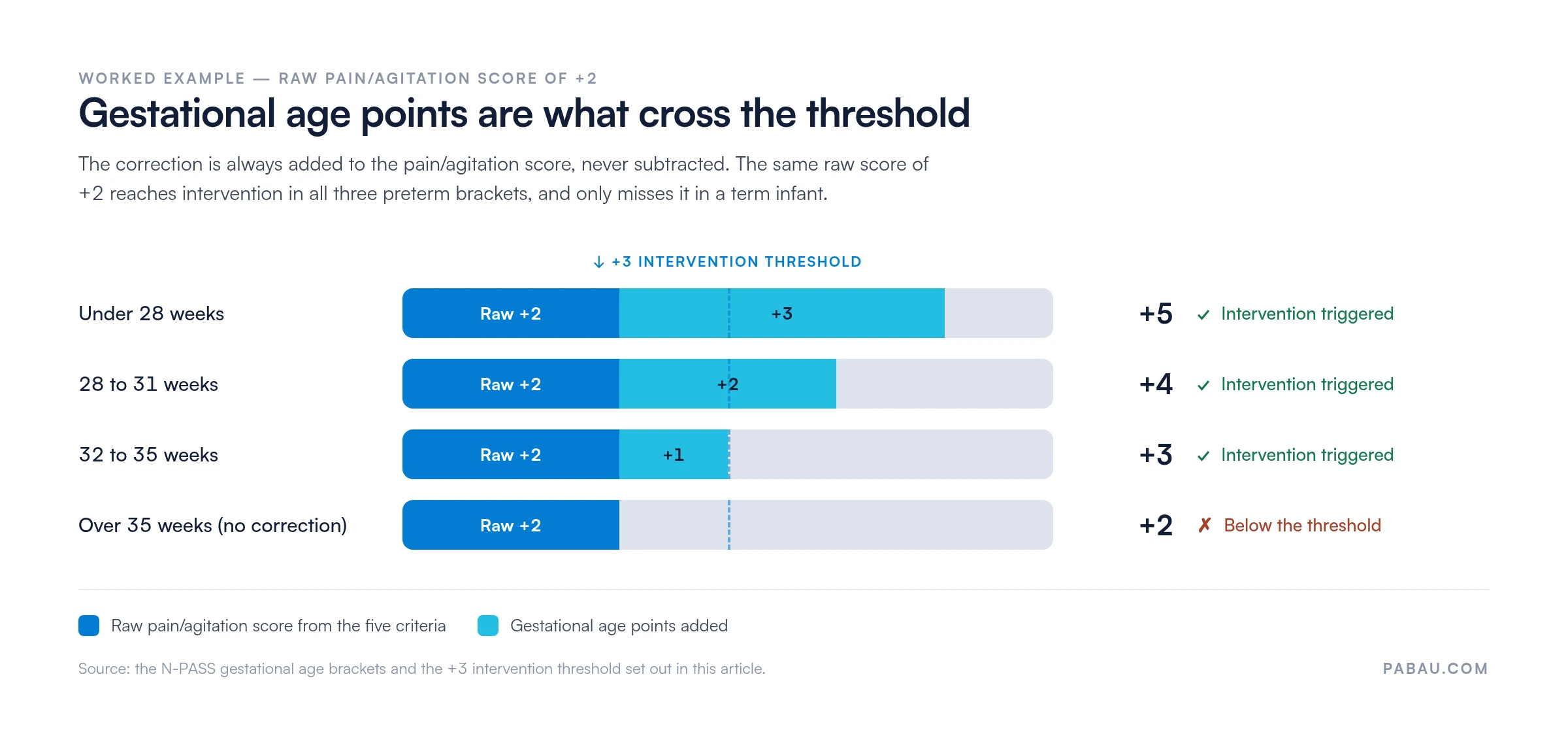
The corrected pain score therefore has a maximum of 13. That is up to 10 from the five criteria, plus 3 for the youngest bracket. If your unit ever records a corrected score lower than the raw one, the correction has been applied the wrong way round.
The corrected score guides the clinical decision. Most institutional NICU pain protocols set their thresholds along these lines.
Read the sedation half of the scale in context. A negative score means little in an infant receiving no sedatives. There it usually reflects sleep state rather than drug effect.
Intervention covers drug-based options such as opioids and acetaminophen, and comfort measures such as swaddling, sucrose, and kangaroo care. Your unit’s protocol should say which measures are triggered at which score ranges, so the response stays the same across every nursing shift.
The NICU is the scale’s home. Nurses, respiratory therapists, neonatologists, and anesthesiologists use it for routine pain monitoring and post-operative assessment. It also has a place in perinatal hospice care, where comfort assessment guides end-of-life decisions.
Some tertiary pediatric units adapt it for older infants, though it is not validated beyond 100 days postnatal age. The record outlasts the admission either way. A NICU graduate’s pain history gets read again at pediatric follow-up. That is why primary care practice software has to hold the discharge documents next to its own notes.
Systematic scoring takes the guesswork out of pain recognition. It prevents under-treatment of pain that was missed, and over-sedation from medication the infant did not need.
Regulatory compliance also gets easier to evidence. Accreditation bodies such as The Joint Commission and the Centers for Medicare and Medicaid Services require documented pain assessment in NICUs. The N-PASS supplies the structured record an audit asks for.
Consistent scoring across the team also improves handover, especially between nursing shifts. Tracking N-PASS trends over days of care shows whether your pain management protocol is working. You can then adjust therapy on evidence rather than impression.
Several validated neonatal pain tools exist. The N-PASS is the only one that assesses pain, agitation, and sedation together, which removes the need for a second instrument at the cot side.
CRIES is the closest of these to the N-PASS in a surgical setting. Our CRIES pain scale template sets out its five criteria and the postoperative scoring window.
The N-PASS reads behavior and vital signs, so it infers pain rather than measuring it. A handful of errors account for most of the scores that mislead a team.
The N-PASS holds strong interrater reliability when nurses are trained on it. Inconsistent scoring erodes the value of any assessment tool, so credentialing standards call for regular competency checks.
Run quarterly calibration exercises. Have two nurses independently assess the same infant, then compare scores. Talk through any discrepancy, including the gestational age points each of them applied.
Video-based training modules showing behavioral indicators help standardize interpretation, particularly crying quality, muscle tone changes, and facial grimacing. Record every training completion and competency check in your personnel files.
A total score on its own is hard to defend at handover or in an audit. Record the working, not just the answer, so the next clinician can see how the number was reached.
Writing the correction out in full protects the record. Anyone reviewing it later can confirm the points were added rather than subtracted.
Most NICU teams score the N-PASS on a printed flow sheet at the cot side. The total gets copied into the record later in the shift. That copying step is where the gestational age correction gets dropped and reassessment times drift.
Practice management software like Pabau replaces the step with a custom form. You build the five criteria and the gestational age bracket as a scored section of the clinical note. The corrected total is written the moment you save it.
Reassessment prompts can fire automatically 15 or 30 minutes after an intervention, so the follow-up score does not depend on someone remembering. The score sits next to medications and the rest of the chart. The nurse taking over reads the pain trend in seconds.

Pabau’s digital forms score the N-PASS and store the corrected total in the client record, so the whole team reads the same pain trend.

Getting the direction of the gestational age correction right matters more than any other detail on this page. Added points find pain in the infants least able to show it. Subtracted points hide it.
So train the team on the correction first, calibrate scoring every quarter, and write the arithmetic into the record rather than the total alone. The template above gives you that structure to start from. A reviewer can then check the work, and so can the next shift.
Book a demo to see how Pabau scores clinical assessments and keeps the corrected total in the client record.

Documenting the first full exam after birth? The newborn exam template covers the head-to-toe checks that sit alongside a pain score in the neonatal record.
Need the baseline your vital-sign scoring depends on? The pediatric vital signs chart sets out normal ranges by age, so an abnormal reading is easy to spot.
Scoring pain in a patient who cannot self-report? The Abbey pain scale applies the same observational approach to adults who cannot describe what they feel.
Building a wider pediatric assessment routine? Our guide to pediatric assessment walks through the structure of a full clinical review for younger patients.
The N-PASS is used in neonatal intensive care units to assess pain, agitation, and sedation. It covers infants from 23 weeks gestational age through 100 days after birth. The score guides clinical decisions about pain management and sedative therapy.
Each of the five criteria (crying/irritability, behavior/state, facial expression, extremities tone, vital signs) is scored from -2 (sedation) to +2 (pain/agitation). The scores are summed for a total between -10 and +10. Gestational age points are then added to the pain/agitation score of a preterm infant, giving a corrected pain score of up to 13.
A score of +3 or above typically triggers pain management intervention under most institutional NICU protocols. Thresholds vary by hospital policy, so verify yours against your own guideline.
Preterm infants have points added to their pain/agitation score. The brackets are +3 under 28 weeks, +2 at 28 to 31 weeks, and +1 at 32 to 35 weeks. Infants over 35 weeks need no adjustment. The points compensate for a preterm infant’s limited ability to display pain, so that pain is not under-treated. They are never applied to the sedation score.
The N-PASS simultaneously measures pain, agitation, and sedation, making it unique. NIPS (Neonatal Infant Pain Scale) and FLACC (Faces Legs Activity Cry Consolability) assess pain only. Clinicians who also need to monitor sedation must add a second tool.
Yes. The N-PASS includes a sedation subscale, using negative scores from -2 to 0, that evaluates depth of sedation. It lets clinicians tell an infant in pain apart from one who is over-sedated, with a single tool.