Grains food list: whole vs refined grains (free PDF)
A grains food list sorts grain foods into whole and refined groups, so patients ...

1
Last Updated: Oct 20, 2026
A consent form for trip is a document in which a parent or guardian authorizes a minor to travel with a named adult or group. Schools, youth groups and families use it to show that a child has permission to travel. It also gives the travel companion emergency contact and medical details. Online form tools, including the digital forms in Pabau’s practice software, can collect the same details before the trip.
The sections below explain when you need one, what it should include, and when notarization applies. A consent form is evidence of permission, not legal advice, so have a legal professional review any version before you rely on it.
A ready-to-use form covering the child’s details, trip dates and destination, parent or guardian contacts, and an emergency contact. It also includes medical authorization, liability release and signature blocks.
Download template
Trip consent forms cover school trips, non-parent travel, and cross-border journeys.
Border officials may request consent documents for minors traveling without both parents.
Medical sections should be limited to emergency treatment and known conditions.
Notarization requirements depend on destination and should be checked in advance.
Pabau’s digital consent forms can collect trip details online.
A consent form for trip is a parent’s or legal guardian’s signed authorization for a minor to travel with a named adult, group, or school. It works as a written record of permission, which schools, travel operators and border officials may ask to see.
Its legal weight depends on jurisdiction, so it is generally treated as a declaration of consent rather than a contract. Most versions include the child’s details, the parent’s contact information, trip dates, an emergency contact and a signature.
The right version depends on who is traveling and where they are going. Each situation below starts from the same base form and adds its own details on top.
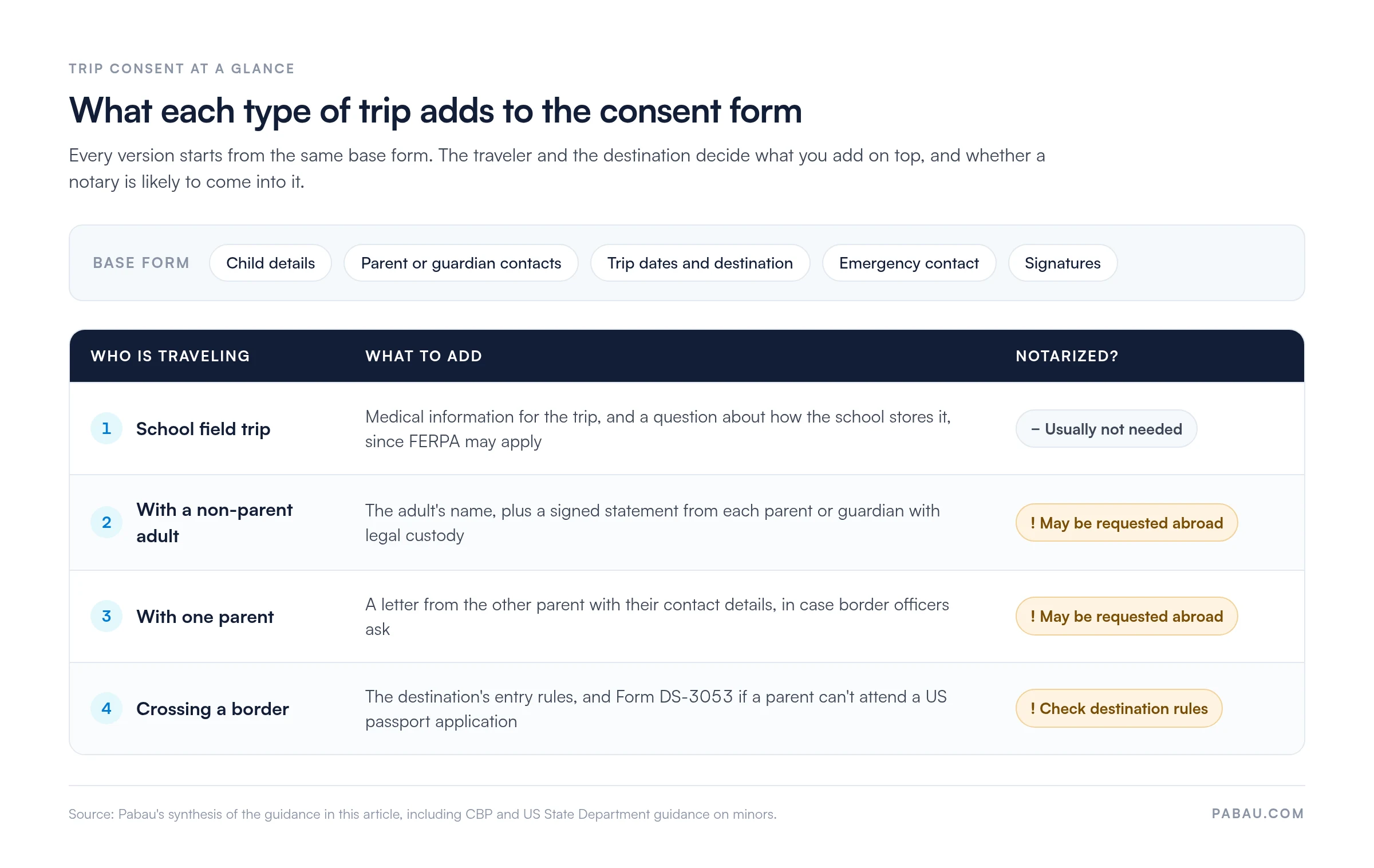
A school field trip consent form is the most common version. Schools usually ask for a parent signature, an emergency contact and medical information before departure. If the form records student information, the Family Educational Rights and Privacy Act (FERPA) may apply. Check the FERPA guidance from the U.S. Department of Education and ask how the school stores the form.
When a minor travels with an aunt, coach or family friend, the form should name that adult, the destination and the travel dates. Include a signed statement from each parent or guardian with legal custody, not only the person completing the form.
When a child travels with one parent, many families add a letter from the other parent with their contact details. U.S. Customs and Border Protection (CBP) officers may ask for documentation when a minor travels without both parents. A signed letter is a sensible precaution.
Cross-border trips add rules that vary by country. For US passport applications where a parent cannot attend, the Department of State uses Form DS-3053, the Statement of Consent. Check the State Department’s minor travel guidance before you book.
A complete form covers seven areas. Use this table as a checklist before you print or send the form.
The medical section needs the most care. Ask for known allergies, current medications, relevant conditions and insurance details, then limit the authorization to emergency treatment. Make it clear that the companion should contact a parent whenever possible.
If the companion also needs authority for routine care during a longer stay, put that in a separate minor medical consent form. Keeping the two apart stops the trip form from granting more than the parent intended.
The Health Insurance Portability and Accountability Act (HIPAA) may apply when a covered healthcare provider holds this information, but many trip forms fall outside it. Ask a legal adviser which HHS HIPAA rules apply to your situation.
No, a domestic school trip usually does not need a notarized form, but international travel may. Many countries may request a notarized letter when a minor travels with only one parent or a non-parent adult.
Requirements vary by destination and change over time, so check the entry rules for each country before departure. A notary confirms the signer’s identity, which is why border officials sometimes ask for one. Notary rules also differ by state and country, so a notarized form does not replace checking destination requirements.
Complete the form in this order so the signatures come last and nobody signs in a rush.
Keep one signed copy with the traveling adult and another with the school or organizer.
Families often bring a trip form to their child’s practice so someone can complete the medical section. Staff copy allergies and medications from the chart onto paper, and the signed copy gets scanned back into the file.
In Pabau, parents complete and sign the consent form online before the visit. The signed form is stored against the patient record, so nobody retypes it. Through the Client Portal, practices and organizers can keep family contact details current between trips, so the next form takes less time.
Practices that document medical authorizations alongside a patient visit can use Pabau Scribe, our AI scribe, to draft the supporting clinical note.
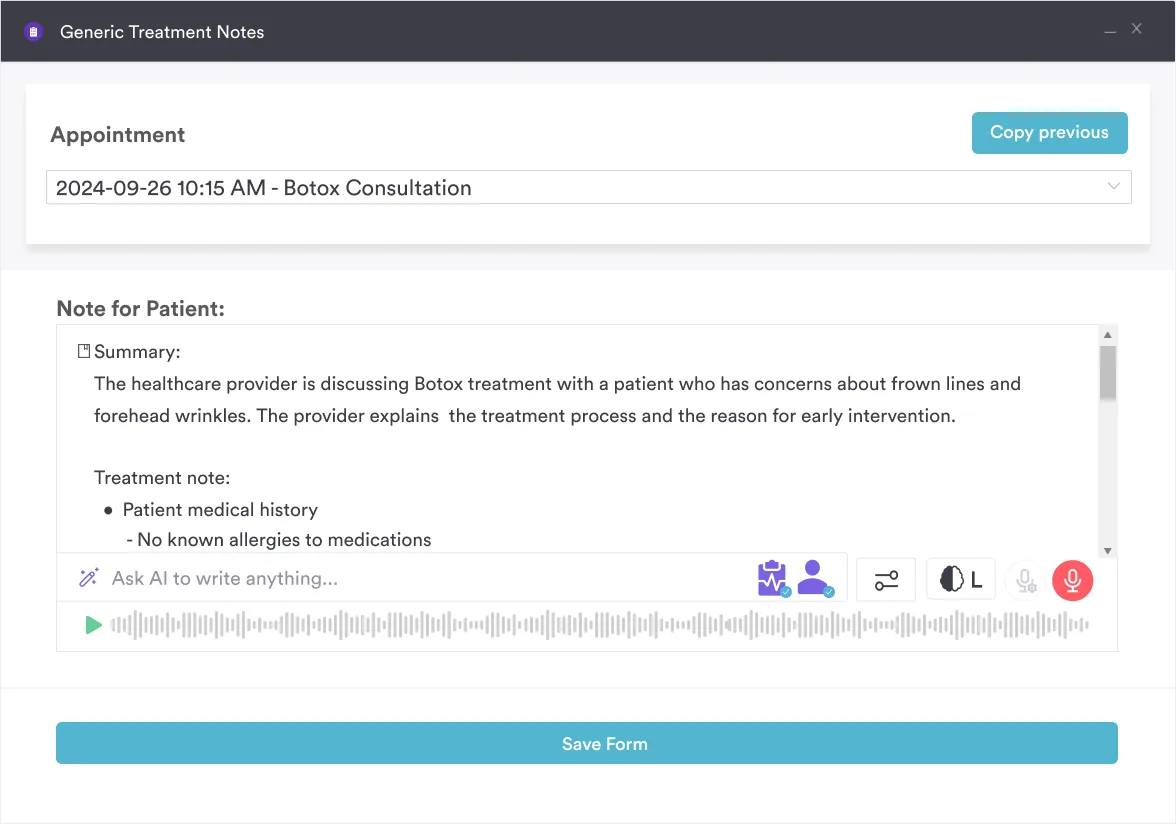

See how Pabau’s digital forms collect consent, medical details and signatures in one place, so your team spends less time chasing paper.

A trip consent form only helps if the adult holding it can act on it. Name that adult, keep the medical authorization to emergency treatment, and collect a signature from every parent with custody before you think about a notary.
For travel abroad, check the destination’s entry rules first, because they decide whether you need a notarized letter. Then have a legal professional check the final wording, since consent rules differ by country and state.
Book a demo to see how Pabau collects signed consent and medical details online, so your team spends less time chasing paper forms.

Need a broader medical release? Medical release form for minor covers authorizing treatment when a parent cannot be reached.
Leaving a child with a caregiver at home? Medical consent form for babysitter sets out what a sitter may decide in an emergency.
Drafting the liability release? Indemnity waiver form walks through what to include, section by section.
Recording a child’s ongoing health needs? Medical needs form template gives you a ready-made format for documenting them.
A minor travel consent form is a signed document that gives permission for a child under the age of majority to travel. It is most useful when the child travels without both parents or with another adult, and it usually includes an emergency contact.
No single law requires one for every trip, but schools, operators and border officials may ask for one, and some destinations may require it. Ask the school, operator or destination which documents they expect before the trip.
A child can often travel with one parent, but a signed letter from the absent parent is a sensible precaution. Some countries and border officers may ask for one, so check destination rules first.
Include known allergies, current medications, relevant medical conditions, insurance details and the limits of emergency treatment authorization. Leave out unnecessary medical history that the travel companion does not need.
Most schools require one before a field trip, so check your district policy. The form usually asks for a parent signature, an emergency contact and medical information.