Prostate medication list: BPH and cancer drug reference
A prostate medication list keeps every BPH and prostate cancer drug in one place...

14
Last Updated: Sep 17, 2026

A male physical exam is a preventive assessment covering vital signs, organ systems, cancer screening, STI testing, and immunization review.
Colorectal screening starts at 45 under USPSTF guidance, while the prostate ages of 40 and 50 come from the American Cancer Society, not the USPSTF.
The USPSTF frames PSA testing as individualized shared decision-making for men aged 55 to 69, which is narrower than the common 50-plus shorthand.
Document the genital and testicular findings, any contraindication to screening, and the conversation behind each screening decision.
Pabau’s digital intake forms, automated recall reminders, and structured records cut documentation time and improve screening follow-up.
A full assessment form for the male annual visit. It has fields for vital signs, every organ system, the genital and testicular exam, lab orders, and immunization status. Prompts cover the prostate and colorectal screening conversations, plus space to record what the patient decided.
Download templateA male physical exam is a preventive assessment that reviews a man’s organ systems, screens for early disease, and sets a baseline for future visits. It covers far more ground than a problem-focused appointment. One encounter combines clinical examination, laboratory testing, age-based cancer screening, and immunization review.
The visit also creates a record of consent. Prostate screening turns on a conversation rather than an age threshold, so the note has to show what was discussed and what the patient chose. The same holds for colorectal and lung screening once a patient reaches the relevant age.
The template below gives every clinician in the practice the same sequence, the same fields, and the same prompts. Practices running these visits at volume keep the completed form inside primary care practice software. The findings then sit against the patient record rather than in a filing cabinet.
The form follows a five-step sequence that matches the order of the encounter, from intake through to counseling:
Each section carries checkbox fields, a free-text area for findings, and a prompt for the shared decision-making conversation. The form is built to be completed in the room, not after hours.
Screening obligations change every decade. The table maps the exam, the cancer screening, and the vaccines that apply to each age band. It pairs with our broader annual physical exam checklist for the items that are not sex-specific.
The ages in that table do not come from one authority, and the difference matters the moment you write a screening decision into the note. Three bodies set the thresholds most men’s exams rely on, and they do not line up.
The USPSTF recommends colorectal screening from 45 to 75, and lung cancer CT from 50 to 80 for patients with a 20 pack-year smoking history. It also recommends HIV screening at least once between 15 and 65.
For PSA testing it recommends individualized shared decision-making for men aged 55 to 69, and advises against routine screening from 70.
The American Cancer Society starts the prostate conversation earlier. It puts the discussion at 50 for average-risk men and 45 for men at high risk. It drops to 40 for men with more than one affected first-degree relative. The AUA sets its core PSA screening window at 55 to 69, in step with the USPSTF.
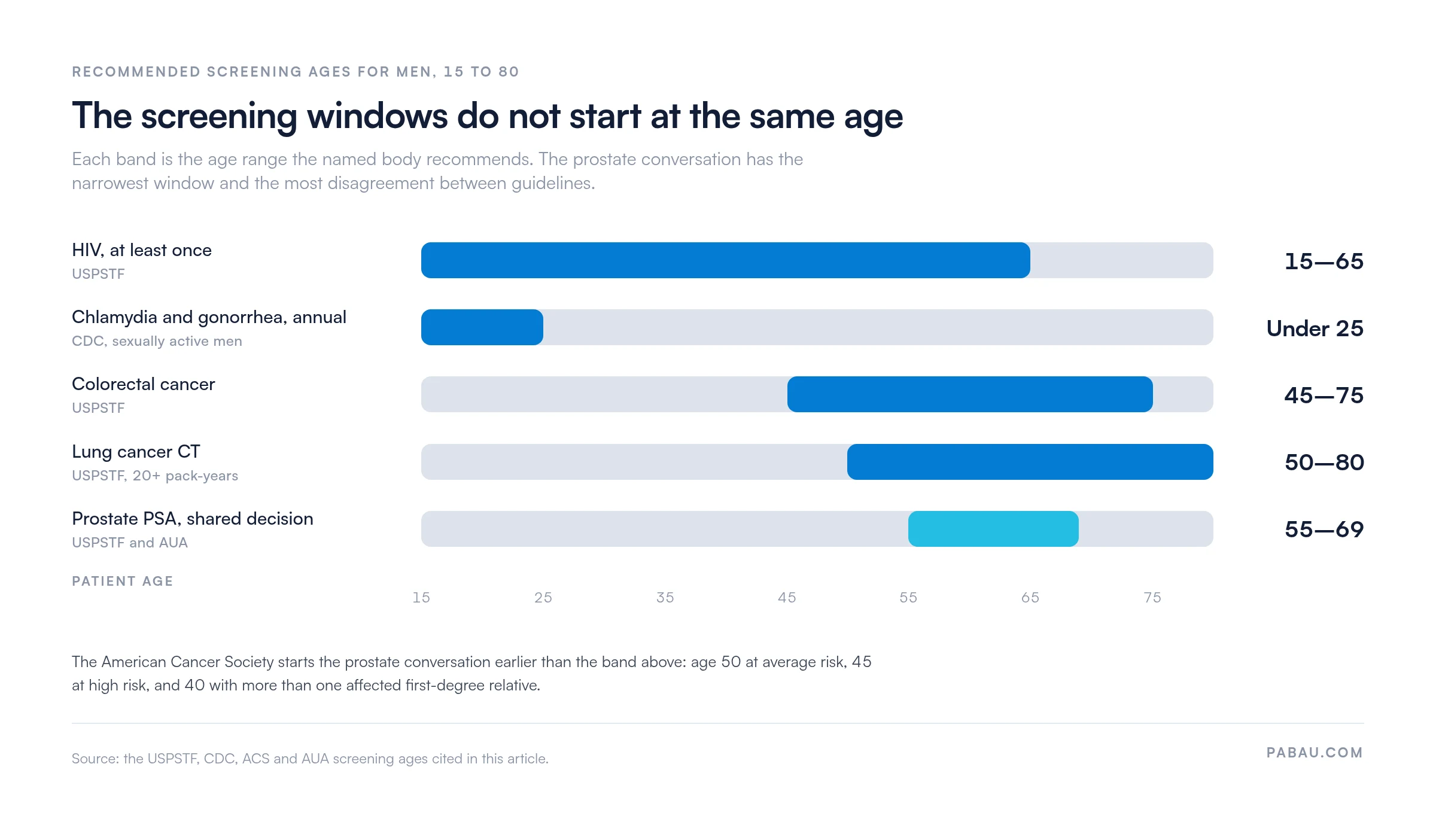
So a chart entry reading “prostate screening discussed per USPSTF” at age 50 contradicts itself. Name the guideline you actually followed and the patient’s risk category, and the record answers the question a year later without anyone reconstructing the visit.
Record the shared decision-making conversation in the patient’s own terms. A line such as ‘Discussed PSA screening per ACS at average risk’ names the guideline and the risk category. Add the patient’s decision and the date, and the note is complete.
The sequence below follows standard practice, so every system gets evaluated in a predictable order. It also tells you how much time to book, since the counseling and the screening conversation take longer than the examination itself:
The standard male annual visit includes a baseline laboratory panel. These tests establish a reference point, catch silent disease, and inform the next round of screening decisions:
STI screening gets skipped in routine male visits more often than any other item on the form, despite CDC recommendations for risk-based testing. The template carries dedicated fields for the discussion and the orders:
Document the discussion, the tests ordered, the results once available, and the prevention counseling. Treating it as a standing item on the form is what stops it being dropped when the visit runs long.
The male annual visit is recommended for all men aged 18 and above as part of preventive care. The settings that run it most often are:
Consistent documentation: Every clinician in the practice evaluates male patients the same way, which takes the variation out of exam quality and completeness.
Lower liability: A documented shared decision-making conversation, especially around prostate and colorectal screening, evidences informed consent. That is the record that answers a later claim of screening harm.
Better screening follow-up: A checklist organized by age leaves fewer screenings missed. Documented recommendations also let practice management software like Pabau send recall reminders without anyone building a list by hand.
Time saved: A structured form cuts note-writing time, so the clinician finishes the exam faster and spends the difference on counseling.
Auditable data: Consistent fields across every male exam let you audit screening rates, find the under-screened patient groups, and compare the practice against clinical guidelines.
Run this exam on paper and the screening decision ends up buried in free text. The form gets scanned into the file. Six months later nobody can say which patients are due a colorectal test, or who declined a PSA.
Pabau replaces that with a structured record. Digital intake forms go out before the appointment, so the history and the sexual health questions arrive already answered. The exam fields, the lab orders, and the shared decision-making note all save against the same patient record.
Recall reminders then run off those fields. When a patient’s colorectal screening or annual visit falls due, the reminder goes out on its own. Pabau Scribe, our AI scribe, can draft the note from the consultation, so the clinician spends less of the evening writing it up.

Pabau keeps the intake form, the exam findings, the lab orders, and the screening conversation in one patient record. Automated recall reminders bring men back before their next screening falls overdue.

The demanding part of the male annual exam is not the examination. It is proving, a year later, which guideline you followed and what the patient decided.
A standardized form settles that by turning the attribution into a field instead of a memory. Name the body behind each age threshold, record the patient’s risk category, and the note answers the question before anyone asks it.
Download the form and run it across the next ten male patients you see. Book a demo to see how Pabau holds those records and the recall reminders in the same place.

Need a faster systems review? 14-point review of systems template gives you a structured ROS you can finish in the room.
Tracking hypertension between visits? Blood pressure log lets patients record readings at home before the next appointment.
Ordering the baseline panel? Blood test consent form documents the patient’s agreement before the draw.
Worried about the record itself? HIPAA compliance checklist for primary care walks through what a compliant patient record has to hold.
A male physical exam covers vital signs, medical history, and a head-to-toe examination. It adds the genital and testicular assessment, the prostate screening discussion, laboratory testing, immunization review, and lifestyle counseling. The full visit usually takes 30 to 45 minutes.
Annual exams are recommended for all men aged 18 and above as part of preventive care. Men with chronic conditions or several risk factors may need more frequent visits, as clinically indicated.
Blood pressure, a lipid panel, glucose or HbA1c, colorectal cancer screening from age 45, and the prostate cancer discussion. Lung cancer CT applies from 50 to 80 with a 20 pack-year smoking history. Skin cancer assessment and STI testing follow the patient’s own risk factors.
Yes. Clinical testicular palpation belongs in every male physical exam. The USPSTF gives routine testicular cancer screening a Grade D recommendation for asymptomatic men. The clinical exam during the annual visit remains the standard.
The American Cancer Society puts the discussion at 50 for average-risk men and 45 at high risk. It drops to 40 for men with more than one affected first-degree relative. The USPSTF frames PSA testing as individualized shared decision-making for men aged 55 to 69. Either way, document the conversation and the patient’s choice.