Maja Popovska

Best TRT clinic software: 8 platforms scored on labs, recalls & prescribing
Eight software platforms are compared for testosterone replacement therapy (TRT)...

Last Updated: Nov 17, 2026
Free PDF 6 pages, print-ready Clinician-reviewed
A TRT consent form records the FDA-labeled risks discussed, the hematocrit, PSA and testosterone checks agreed, fertility and Schedule III acknowledgments, and both signatures. This free template is print-ready and written for men’s TRT. Have your medical director and legal counsel review it before first use.
The form is built around the signed monitoring schedule. The prescriber fills in dated hematocrit, PSA and testosterone checks at the intervals the product label and the Endocrine Society guideline set. The patient initials each acknowledgment and signs up to those dates before the first dose.
The PDF runs to six pages, with a cover page for the practice and five pages for the patient. What follows covers the label-sourced monitoring schedule, route addenda and telehealth rules for a Schedule III drug.
A nine-section men’s TRT consent form with patient and treatment details, FDA-labeled risks to initial, and a contraindication screen. The form also holds hematocrit, PSA and fertility acknowledgments, the signed monitoring schedule, a Schedule III and telehealth statement, and signature lines.
Start from scratch, or upload this PDF or any form you already use, and Pabau's AI Form rebuilds it with tick boxes, text fields and a signature. Attach it to the treatment once, and every patient gets it on time.
AI Form rebuilds the consent, history and aftercare forms you already use. You review each one, then publish.
Patients complete forms on their phone before they arrive, so the front desk stops retyping paper.
Every signed form is versioned and attached to the treatment record, ready when you need it.
Set how long a consent stays valid. Returning patients skip forms they have already signed.
Supports HIPAA and GDPR compliance AES-256 encryption 4.8 on G2 4.7 on Capterra Trusted by 4,000+ practices worldwide

A TRT consent form covers the labeled indication, FDA-label risks, a contraindication screen, monitoring, Schedule III status and two signatures.
The signed monitoring schedule puts dated checks on the form, starting with hematocrit before treatment, at 3 to 6 months and then annually.
No FDA testosterone label sets a numeric hematocrit cutoff, so the form says treatment may pause if hematocrit rises.
The AndroGel 1.62% and Xyosted labels say the impact on fertility may be irreversible, so the form records a sperm-banking discussion.
Testosterone is a Schedule III controlled substance, and the DEA telemedicine flexibility for prescribing it currently runs through December 31, 2026.
A testosterone replacement therapy consent form covers patient and treatment details, the labeled diagnosis, FDA-label risks, contraindications, monitoring, Schedule III status, responsibilities and signatures. Each clinical line comes from the product’s prescribing information. The AndroGel 1.62% prescribing information, revised July 2025, holds the form’s spine.
That label sets hematocrit checks and prostate evaluation before and during treatment, and it warns that fertility effects may be irreversible.
We often see men’s health practices start from a testosterone consent form written for women or for gender-affirming care. Those are the forms that rank, and they leave out PSA, a hematocrit schedule and Schedule III status. The downloadable PDF has nine sections, and each one closes a part of that list.
The contraindication screen also asks for the patient’s current prostate and BPH medicines. A prostate medication list helps staff record those drugs by class.
Most lines in the PDF’s risk table cite the AndroGel 1.62% label, revised July 2025 and checked November 16, 2026. The AndroGel 1.62% label warns of raised hematocrit, blood pressure increases, worsening BPH, prostate cancer risk, blood clots and worse sleep apnea. The label also covers edema, gynecomastia, lipid and liver effects, and abuse and dependence.
The Xyosted label, also revised July 2025, adds a warning on depression and suicidality. Both labels say the impact on fertility may be irreversible, and AndroGel 1.62% carries a boxed warning for secondary exposure. FDA’s February 28, 2025 class-wide labeling change removed boxed warning language on adverse cardiovascular outcomes.
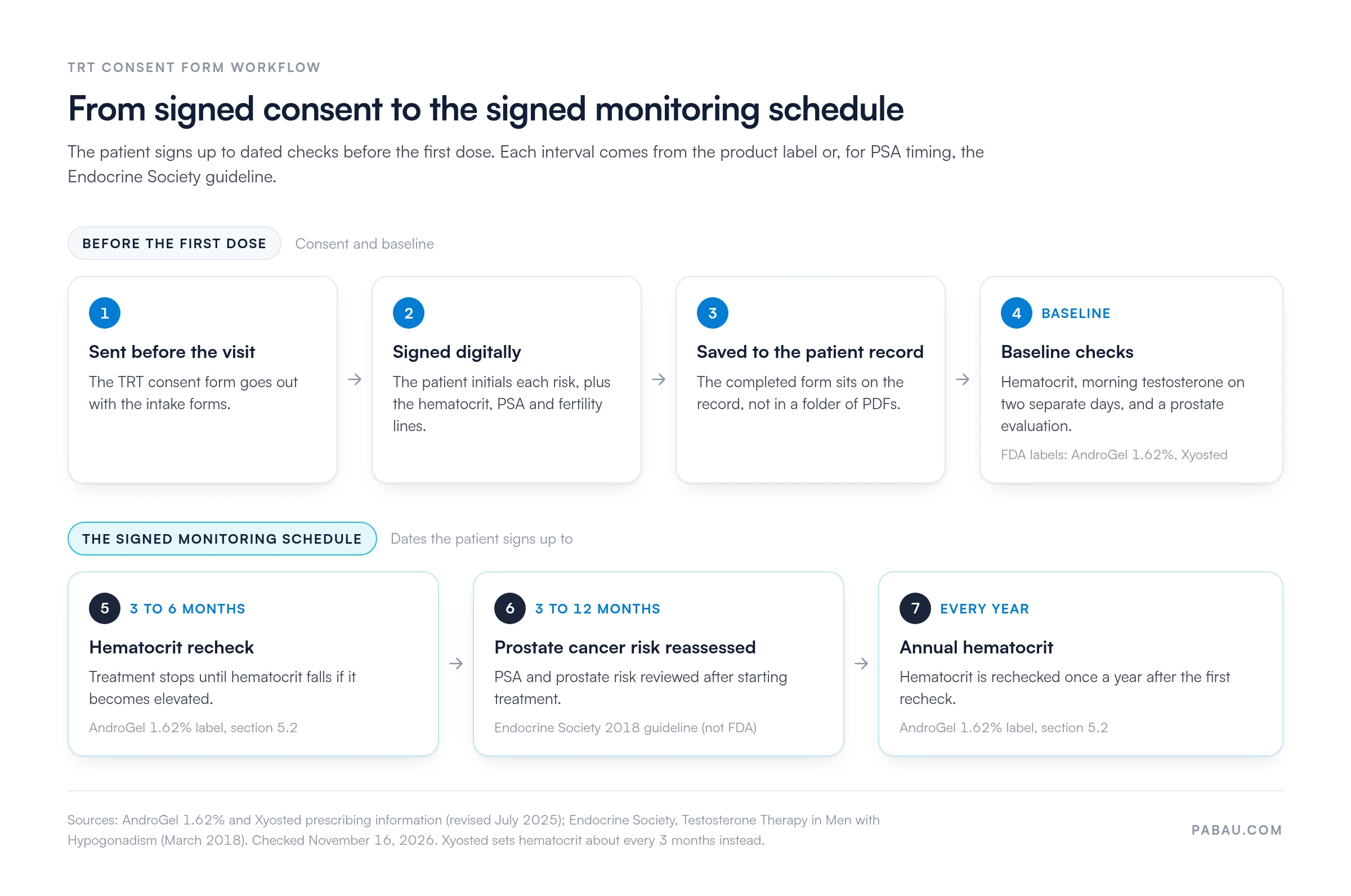
The patient agrees to baseline checks, a hematocrit recheck at 3 to 6 months, a PSA review at 3 to 12 months and annual hematocrit.
In the PDF, the signed monitoring schedule lists each check with its sourced interval, a due date and a done date. The prescriber fills in the due dates on the day of consent, counting from the start date. Where a label says only “periodically”, the form says so and the prescriber sets the date.
Those dates come from the product’s own label, because the labels differ. The AndroGel 1.62% label sets hematocrit 3 to 6 months after starting, then annually. The Xyosted label asks for hematocrit about every 3 months. The Depo-Testosterone label says hemoglobin and hematocrit should be checked periodically.
No FDA label sets a numeric hematocrit cutoff. The AndroGel 1.62% and Xyosted labels say to stop when hematocrit becomes elevated and restart once it falls to an acceptable level. Xyosted adds a permanent stop after a second rise. A form that cites an “FDA 54% limit” quotes a figure the labels do not contain.
PSA timing comes from the Endocrine Society’s 2018 guideline, which is not an FDA requirement. The guideline advises assessing prostate cancer risk before starting and 3 to 12 months after. It also advises urology referral for any of these findings:
A restart after a hematocrit stop is a new decision, so the patient re-signs the schedule with fresh dates. On Xyosted, that signature also records that a second rise ends treatment with the product.
For results between visits, the monthly hormone cycle template is a separate tracking sheet. The consent form records the agreement, and the tracking sheet records the numbers.
Testosterone injection consent needs an addendum when the product label adds route-specific lines, such as Xyosted’s 3-month hematocrit checks, sesame oil allergy and suicidality warning.
One core form covers every route, and each route gets a one-page addendum. Shared risks stay in one place, and the product-specific lines sit next to the product.
Re-consent when any of these happens:
The AndroGel 1.62% label, revised July 2025, and the Depo-Testosterone label, revised October 2025, say safety and efficacy in age-related hypogonadism have not been established.
FDA requested removal of that limitation in June 2026, per its Testosterone Information page, current as of June 23, 2026. A request is not an approval, and the labels checked November 16, 2026 still carry it.
Women and menopause patients need a different form. The BHRT consent form covers bioidentical hormone therapy with its own intake questions.
Informed consent for testosterone therapy by telehealth adds a dated statement of the DEA’s telemedicine rules, because testosterone is a Schedule III controlled substance.
Federal law lists testosterone as item (84) under anabolic steroids in 21 CFR 1308.13(f), checked November 16, 2026. The PDF’s controlled substance statement has the patient agree to use testosterone only as prescribed and never share it.
The fourth temporary extension, published December 31, 2025, lets practitioners prescribe Schedule II to V medicines by telemedicine without a prior in-person evaluation. That extension runs from January 1 through December 31, 2026.
The DEA’s Special Registration rule is still a proposed rule from January 17, 2025. No final rule or fifth extension had been published when we checked on November 16, 2026.
Three points follow for the form:
Pabau, the practice management platform we build, sends the TRT consent form before the visit and saves the signed copy to the patient record. The workflow takes three steps.
The diagram follows one patient from the signed form to the first annual hematocrit.
For a wider launch, our guide on how to start a TRT clinic sets out the other steps in order.
A paper TRT consent form records consent, but it cannot chase signatures, recall patients for labs, pull in results or show trends. Pabau runs booking, charting, consent forms, payments and memberships for practices that offer aesthetics, hormone therapy, weight loss and longevity care in one system. Our ranking of the best TRT clinic software scores eight platforms on labs, recalls and prescribing.
TRT practices run Pabau as men’s health clinic software, so the consent form, the recalls and the lab results share one patient record. Every Pabau plan includes the core features, and add-ons enhance the experience. Pabau is rated 4.7 on G2 and 4.7 on Capterra.

Pabau sends the TRT consent form before the visit and saves it to the patient record. Recall Workflows then bring patients back for the hematocrit and PSA checks they signed up to.

A TRT consent form is only as good as the monitoring that follows it. The signature shows the patient understood the hematocrit, PSA and fertility risks. The protection comes from the rechecks happening on the dates the form set.
So treat the form as the first page of a schedule. Record the date you checked the label, and re-sign after any product change or restart. Review the wording when FDA’s June 2026 request reaches the labels, and again before the DEA flexibility ends on December 31, 2026.
Book a demo to see how Pabau sends the consent form before the visit and brings each TRT patient back for their signed checks.

Setting up a new TRT service? How to start a TRT clinic walks through launching a testosterone practice step by step.
Need to log hormone results between visits? Male monthly hormone cycle template is a tracking sheet kept apart from the consent form.
Treating menopause or BHRT patients too? BHRT consent form pairs a hormone therapy consent with an intake form.
Tracking estradiol alongside testosterone? Male estrogen levels template records estrogen results for male patients.
Offering pellets as well? Hormone pellet insertion covers the procedure a pellet consent describes.
Yes. Federal law lists testosterone as a Schedule III anabolic steroid in 21 CFR 1308.13(f), checked November 16, 2026. A testosterone consent form should state that status, and the patient agrees to use it only as prescribed and never share it.
A TRT patient re-signs when the product or route changes, when treatment restarts after a hematocrit stop, and when the label changes. A switch from gel to injection needs the testosterone injection consent addendum signed first. Your medical director can also set an annual re-sign date in practice policy.
No. The AndroGel 1.62%, Xyosted and Depo-Testosterone labels give no numeric hematocrit cutoff. The AndroGel 1.62% and Xyosted labels say to stop when hematocrit becomes elevated and restart once it falls to an acceptable level. Xyosted adds a permanent stop after a second rise.
One core form can cover injections and gels, with a short addendum for each route. The gel addendum carries the secondary exposure boxed warning, and the Xyosted addendum adds the sesame oil allergy question. Pellets need their own consent, because insertion is a procedure.
Not under current labeling. The AndroGel 1.62% and Depo-Testosterone labels say safety and efficacy in age-related hypogonadism have not been established. FDA requested removal of that limitation in June 2026, but the labels checked November 16, 2026 still carry it.